



Abstract
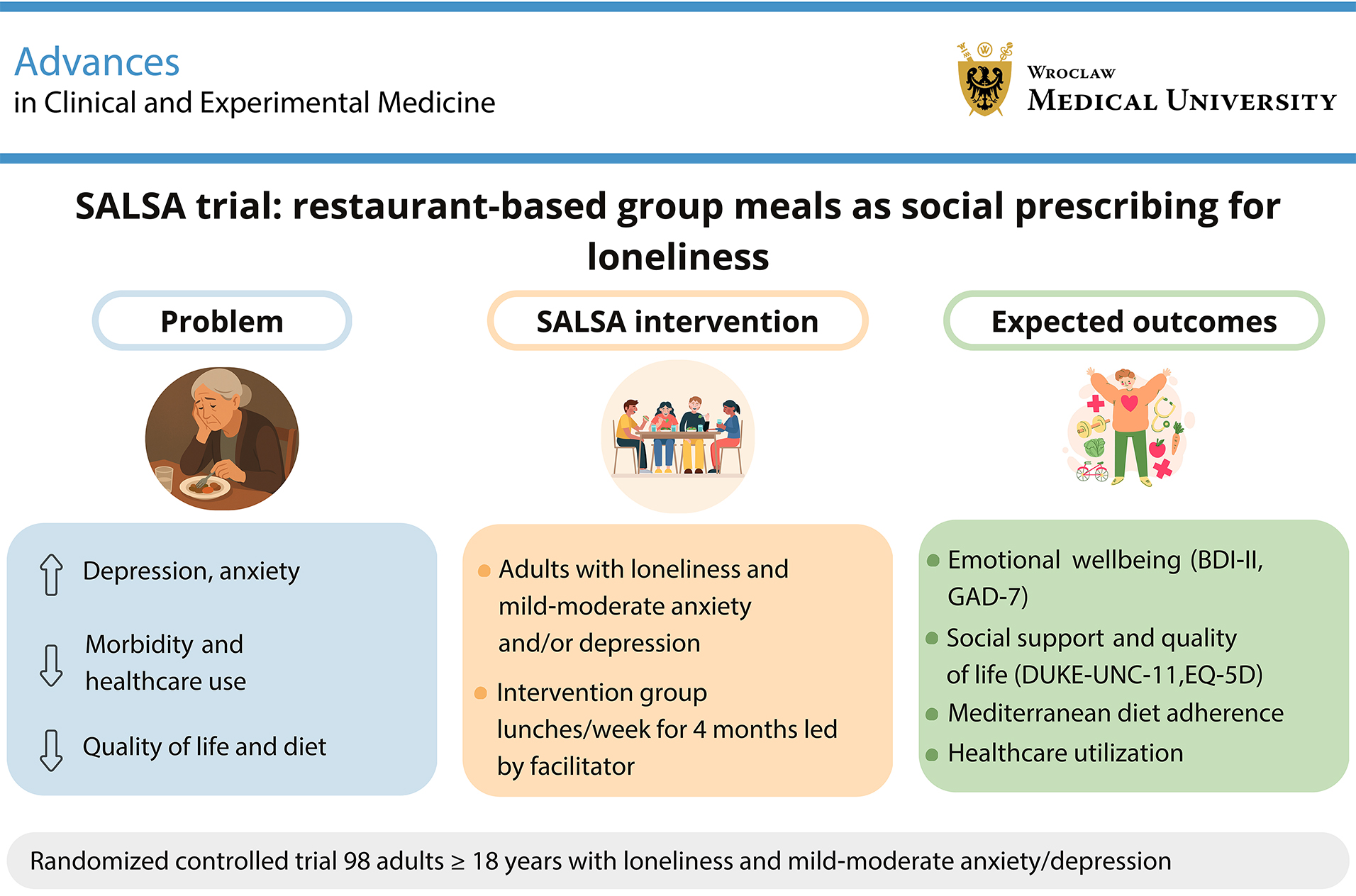
Loneliness is a highly relevant social determinant of health associated with depression, anxiety, reduced quality of life, malnutrition, cognitive decline, and increased morbidity and mortality. Social prescribing initiatives that connect individuals with community-based activities show potential to improve emotional and social wellbeing, although evidence, particularly regarding shared-meal programs, remains limited and inconsistent. This study aims to evaluate a community-based intervention consisting of group meals in restaurants, complemented by monthly healthy eating workshops, to improve emotional, nutritional, and social outcomes among adults experiencing loneliness and symptoms of anxiety and/or depression. We hypothesize that participation in restaurant-based group meals will significantly enhance emotional wellbeing, social support, and diet quality compared with usual care. A randomized controlled trial will be conducted with 2 groups, intervention and control, and a total of 98 participants aged ≥18 years who report loneliness and mild-to-moderate anxiety and/or depression. The intervention group will attend group lunches twice weekly for 4 months in local restaurants, accompanied by a facilitator and supported by monthly healthy eating workshops. The control group will receive usual care. Data collected will include sociodemographic, clinical, and emotional variables (BDI-II, GAD-7), social support (DUKE-UNC-11), quality of life (EQ-5D), adherence to the Mediterranean diet, and healthcare resource use. Analyses will compare pre–post and between-group changes, with logistic regression used to identify predictors of clinical remission.
This innovative intervention leverages existing community infrastructure, namely restaurants, as spaces for social and nutritional support, strengthening local networks while promoting equity and sustainability. It may enhance emotional wellbeing, diet quality, and social connectedness and potentially reduce healthcare utilization. Implementation challenges include adherence, restaurant adaptation, financial sustainability, and interinstitutional coordination. The SALSA (Health, Nutrition and Sociability) trial will provide rigorous evidence on the effectiveness of a social prescribing model based on shared meals. Its results could inform scalable and sustainable strategies to reduce loneliness, improve wellbeing, and promote healthier, more connected communities.
Key words: depression, malnutrition, anxiety, older adults, loneliness
Introduction
Social relationships are a key determinant of health and wellbeing. Their absence has been identified as a risk factor for physical and mental health outcomes comparable to factors such as smoking, physical inactivity, and obesity.1, 2, 3 In this context, loneliness is understood as the perceived discrepancy between existing and desired social relationships.4 In addition, it has been associated with a wide range of health problems, including depression,5, 6, 7 anxiety,5 poorer quality of life,8 risk of malnutrition,9, 10 cognitive impairment and dementia,11 increased morbidity and premature mortality,12, 13 and greater use of health services.14
Systematic reviews and meta-analyses15, 16 conclude that loneliness affects a considerable proportion of the population, especially older adults, with prevalence estimated at around 1 in 4 in high-income countries. However, its prevalence varies greatly by region, being lowest in northern Europe and highest in southern and eastern Europe. Loneliness has been recognized as an emerging public health problem with a clear impact on mental and physical health.17, 18
Faced with this reality, addressing loneliness has become a political imperative in several countries. A prominent example is the UK, which implemented a pioneering national strategy in 2018: A Connected Society: A Strategy for Tackling Loneliness.19 This line of action represents a turning point in public policy, as it was the first national strategy in the world explicitly aimed at combating chronic loneliness as a health and social cohesion problem. Among its areas of intervention is social prescribing, through which healthcare professionals can refer patients to community activities such as urban gardening, reading groups, arts activities, or shared meals. The British strategy is based on a preventive, community-oriented approach involving locally based solutions and promotes coordinated responses across the political, social, and health sectors. Thus, it is presented as an international reference model that is flexible and replicable elsewhere.
Social prescribing programs are a viable way to link primary care with nonmedical community resources in order to improve users’ wellbeing.20, 21 This intervention strategy is especially important for older people, who often have unmet social needs that affect their health, resulting in loneliness and social isolation. The systematic review and meta-analysis by Paquet et al.,22 which included 24 studies with 10,739 participants, concluded that social prescribing interventions may have a modest beneficial effect on reducing loneliness in older adults. However, the wide methodological heterogeneity and limited quality of the studies make it difficult to draw firm conclusions.
Furthermore, Middleton et al.23 reviewed 36 studies of community shared-meal programs and concluded that these programs have the potential to generate significant benefits for the physical, emotional, and social health of older people living in the community. In addition to improving nutrition and reducing the risk of malnutrition, they promote social inclusion and psychological wellbeing. However, the review identified a lack of longitudinal research and robust evaluations to confirm the causal relationship between participation in these programs and the observed outcomes. It also highlighted the need for more studies addressing cultural and socioeconomic diversity, as well as gender differences and equity in geographic access.
Despite the promising potential of social prescribing and shared-meal interventions, several operational challenges must be acknowledged from the outset. Maintaining participant adherence can be particularly difficult among individuals experiencing anxiety, depression, or limited social support, who may struggle to attend regularly despite the anticipated benefits. In addition, restaurants may need to adjust schedules, menus, and physical spaces to accommodate participants’ needs, requiring flexibility and, in some cases, specific training. Ensuring financial sustainability and establishing effective coordination among social services, healthcare providers, community organizations, and restaurant owners are also essential considerations for successful implementation and long-term scalability.
Given this context, we propose a clinical trial to evaluate the effectiveness of a social prescribing program aimed at people who experience loneliness, have limited social support, or present with symptoms of anxiety and/or depression. The intervention consists of participation in group meals in a restaurant 2 days a week for 4 months, with the aim of promoting social interaction and improving emotional wellbeing, quality of life, and social support.
Ethics approval and consent to participate
This study complies with the principles of Good Clinical Practice, the Declaration of Helsinki of the World Medical Association, as amended at the 75th General Assembly in Helsinki, Finland, in October 2024, and current legislation on data protection and research involving human participants. The study has been evaluated and approved by the Ethics Committee of the Jordi Gol i Gurina University Institute for Primary Care Research Foundation (Manresa, Spain; IDIAPJGol), under registration No. 23/285-P. Participants will receive verbal and written information about the study. If they agree to participate, they will be asked to sign an informed consent form voluntarily.
Data confidentiality is guaranteed in accordance with Regulation (EU) 2016/679 (GDPR) and Organic Law 3/2018 on the protection of personal data and the guarantee of digital rights. Personal data will be coded and accessible only to the lead investigator and authorized personnel. No data will be transferred to third parties or internationally, and the data will be retained for 5 years for verification and scientific dissemination purposes.
The Catalan Health Institute (ICS) acts as the data controller and guarantees the security and confidentiality of the stored data. Paper questionnaires and informed consent forms will be stored in locked cabinets at the Research Support Unit (USR) of the ICS in Central Catalonia.
Monitoring
No independent Data Monitoring Committee (DMC) is planned, given the minimal-risk nature of the intervention. Trial conduct, recruitment, adherence, and adverse events will be reviewed monthly by the principal investigator and the research team. No interim efficacy analyses are planned.
Protocol amendments and post-trial care
Substantial protocol amendments will be communicated to the IDIAPJGol Ethics Committee and the funder and will be updated on ClinicalTrials.gov within 30 days. Participants will continue to receive routine healthcare after study completion. If any harm related to participation occurs, compensation will be provided in accordance with institutional policies and national legislation.
Open science and dissemination
The full protocol and statistical analysis plan will be made publicly available on ClinicalTrials.gov (NCT06800027) and in the institutional repository of IDIAPJGol once recruitment begins. De-identified participant data and statistical code will be available upon reasonable request. After publication of the main results, anonymized data and a data dictionary will be deposited in an open-access repository in accordance with FAIR (findable, accessible, interoperable, and reusable) principles. Study results will be communicated to participants, professionals, and the public through plain-language summaries, community presentations, and open-access publications. Results will be reported in the ClinicalTrials.gov results section within 12 months of study completion.
Objectives
Main aim: To evaluate whether attending group lunches in a restaurant 2 days a week, accompanied by a facilitator and combined with participation in healthy eating workshops, improves the emotional wellbeing, nutritional status, social support, and quality of life of people who experience loneliness, have limited social support, or present with symptoms of anxiety and/or depression. Secondary aims: To analyze the impact of the intervention on healthcare resource use by evaluating possible changes in the frequency of medical visits and the prescription of psychotropic drugs.
Materials and methods
Design
Randomized clinical trial with 2 groups (control and intervention).
Context of the study
Study population: Adults aged >18 years assigned to the basic health area (ABS) of Sant Joan de Vilatorrada (12,721 assigned individuals), a semi-urban area in Central Catalonia, Spain.
Inclusion criteria: Independent individuals with problems related to living alone or feeling lonely, defined by code Z60 according to the International Classification of Diseases, 10th Revision (ICD-10), including older people, migrants, people with functional diversity, and individuals at risk of malnutrition and/or emotional disorders. Additional inclusion criteria are a score ≥14 and <28 on the Beck Depression Inventory-II (BDI-II), or a score ≥10 on the Generalized Anxiety Disorder-7 scale (GAD-7), or a score <32 on the DUKE-UNC-11 Social Support Scale; the possibility of follow-up for 12 months; the ability to read and write in Spanish or Catalan; and the ability to attend the restaurant 2 days a week.
Exclusion criteria: A diagnosis of dementia or moderate cognitive impairment; a diagnosis of major depression, defined as a BDI-II score ≥28; problematic consumption or abuse of alcohol or other psychoactive substances; physical or mental impairment preventing attendance at the restaurant 2 days a week; participation in other social-service food support programs; not being responsible for managing one’s own food, including institutionalized people or people in comprehensive assisted living; and not signing the informed consent form.
Intervention
The intervention group will attend lunch at a restaurant, selected in advance and with previously trained staff, 2 days a week for 4 months. A facilitator will accompany participants to the restaurant and supervise them. Once a month, a workshop on healthy habits and meal management will be held at the town’s senior citizens’ center. Participants will not be required to pay anything, either for attending lunch at the restaurant or for participating in the workshops; all costs will be covered by the funding obtained to carry out the study. The control group will receive usual care at their primary care center.
Criteria for discontinuation or modification: Participants may discontinue attendance at their own request or on the basis of the investigator’s judgement for safety or health reasons.
Adherence strategies: The facilitator will maintain weekly contact and follow up on missed sessions by phone; adherence is defined as attendance at ≥75% of scheduled sessions.
Concomitant care: All standard medical and psychosocial care is permitted without restriction.
Harms: Adverse events related to participation, such as emotional distress, conflict, or physical incidents at the restaurant, will be recorded and reviewed by the research team.
Intervention design
In the initial phase of the project, restaurants will be identified and evaluated according to predefined criteria to ensure feasibility, nutritional suitability, and accessibility. Candidate establishments will be required to: 1) offer menus aligned with the Mediterranean dietary pattern; 2) have sufficient capacity to host groups of more than 25 participants; 3) ensure physical accessibility for individuals with reduced mobility; and 4) provide a complete menu at a maximum cost of EUR 12 per person.
Once a restaurant has been selected, a structured training program will be implemented to ensure that it can provide meals suited to the needs and characteristics of the participants. This training will be delivered by professionals from the Alícia Foundation, a research center specializing in food, nutrition, and culinary innovation and a leading institution in culinary medicine. The training sessions will aim to ensure balanced, complete meals and appropriate adaptation to prevalent comorbidities, such as diabetes, hypertension, obesity, dyslipidemia, and chewing or swallowing difficulties. The training will consist of a 2-h theoretical session on the principles of a balanced diet and key dietary and culinary considerations for individuals with the above conditions. This will be followed by a practical session focused on planning the weekly menus to be offered to participants. Using the restaurant’s usual daily menu as a starting point, staff will be guided on how to select, modify, and adapt dishes to ensure that meals remain nutritionally appropriate, varied, sufficient, and adaptable to comorbidity-related needs. During the first weeks of the intervention, the menus will be reviewed before being served to ensure that the training is being implemented correctly.
Regarding long-term financial sustainability, the current study is fully funded for the implementation period. The results of the trial will inform the development of future models that may include mixed funding schemes, such as public funding, municipal council support, and potential partnerships.
Sample size calculation
The sample size was determined assuming a comparison between independent groups at the end of the intervention, with the ability to detect:
– a minimum difference of 4.5 points in the mean BDI-II score, with an estimated standard deviation (SD) of 7 points24;
– a difference of 2.7 points in the mean GAD-7 score, with an SD of 4.5 points25;
– and a 7-point difference in the DUKE-UNC-11 social support questionnaire score, with an SD of 10.6 points.26
A 1 : 1 allocation ratio, with 1 participant in the control group for each participant in the intervention group, a statistical power of 80%, and a 2-sided significance level of 5% (α = 0.05) were assumed. Taking into account an expected loss to follow-up or dropout rate of 10%, the required sample size was estimated at 49 participants per group, i.e., 98 participants in total. The calculation was performed using GRANMO software v. 7.12 (Hospital Del Mar Research Institute, Barcelona, Spain).
Recruitment
The selection screening process will begin with the identification of the target population through official and clinical sources available in the study area. The researchers will request from the technical department of Primary Care Management and the Community of Central Catalonia a list of patients assigned to the ABS of Sant Joan de Vilatorrada with diagnostic codes (ICD-10) compatible with the initial criteria: problems related to living alone or feeling lonely (Z60), anxiety (F41), and/or depression (F32).
Once the list has been obtained, it will be reviewed by health and social care professionals from the ABS, who will verify which patients meet the inclusion criteria established in the protocol. Community representatives and municipal social services contributed to the recruitment design and restaurant selection.
The ABS administrative staff, under the direction of the responsible professionals, will contact the selected individuals by telephone to invite them to participate in the study. Those who agree to participate will be invited to a face-to-face visit, during which the study will be explained, study information will be provided, and informed consent will be obtained. They will also undergo a basic physical examination, a blood sample will be taken, and validated questionnaires will be administered. Individuals who meet at least 1 of the following criteria: BDI-II ≥ 14, GAD-7 ≥ 10, or DUKE-UNC-11 < 32, will be included in the final sample and will move on to the next phase of the study.
Group assignment
Participants will be assigned to the study groups, control and intervention, using a computerized randomization procedure conducted by the research group’s statistician in R v. 4.2.1 (R Foundation for Statistical Computing, Vienna, Austria).
Participants who meet the inclusion criteria and present with symptoms of anxiety and/or depression and/or low social support will be allocated equally to the control and intervention groups. To increase external validity and ensure better comparability between groups, stratified randomization will be performed according to age and sex. This allocation design aims to minimize the risk of bias in group composition and ensure balanced representativeness, thereby facilitating the generalizability of the results.
Variables and measurement methods
Independent variables
Sociodemographic variables: gender (male, female, non-binary), age, marital status (single, married, separated, widowed), and educational level (no education, primary education, secondary education, higher education).
Dependent variables
Clinical remission of depression or response to the intervention will be assessed after completion of the intervention and at 12 months post-intervention. Clinical remission is defined as a score <14 points on the BDI-II, and response to the intervention is defined as a reduction from the initial score.24
Remission of clinical anxiety or response to the intervention will be assessed after completion of the intervention and at 12 months post-intervention. Clinical remission is defined as a score <10 points on the GAD-7 scale, and response to the intervention is defined as a reduction from the baseline score.25
Improvement in social support will be assessed after completion of the intervention and at 12 months post-intervention. Response to the intervention is defined as a decrease in the score on the DUKE-UNC-11 Social Support Questionnaire, and a score >32 points is considered to indicate good social support.26
Improvement in health-related quality of life (HRQoL) will be assessed after the intervention and at 12 months post-intervention. An improvement in HRQoL after the intervention is defined as a decrease in the score on the EuroQol questionnaire (EQ-5D) compared with baseline.27, 28
Clinical variables: weight, height, body mass index (BMI), blood pressure, complete blood count with differential, glycated hemoglobin, total cholesterol, high-density lipoprotein cholesterol (HDL-C), low-density lipoprotein cholesterol (LDL-C), triglycerides, albumin, iron, ferritin, vitamin B12, and folate.
Adherence to the Mediterranean diet will be assessed using the validated PREDIMED questionnaire (Prevention with Mediterranean Diet study).29
Satisfaction with the intervention: At the end of the intervention, a satisfaction survey using a 5-point Likert scale will be conducted.
Adherence to the intervention: Attendance at the restaurant and healthy eating workshops will be recorded. Adherence will be calculated for the intervention variable, defined as attendance at ≥75% of the scheduled days.
Number of visits to the primary care center: pre-intervention period (4 months), intervention period (4 months), and post-intervention period (4 months). Number of visits to accident and emergency services: pre-intervention period (4 months), intervention period (4 months), and post-intervention period (4 months). Number of referrals to hospital: pre-intervention period (4 months), intervention period (4 months), and post-intervention period (4 months). Variables that may act as confounding factors or effect modifiers will be taken into account.
Pharmacological treatment: The defined daily dose (DDD), as defined by the World Health Organization (WHO), will be calculated for each active ingredient, taking into account the number of days, the dose dispensed, and the route of administration of the medication. The active ingredients recorded will be those classified as psychotropic drugs, namely antidepressants and anxiolytics.
Data collection and information sources
Participant retention will be supported by reminder calls and flexible scheduling.
Pre- and post-intervention data will be obtained through:
– the questionnaires specified above;
– clinical variables collected through physical examination and blood testing. The clinical variables collected in the study are those commonly requested during routine check-ups of primary care patients;
– data such as the number of visits during a specified period and prescribed medications, obtained through data extraction by the technical department of the Territorial Management of Central Catalonia;
– participant feedback on their experience.
Data analysis
Blinding: This is an open-label trial due to the nature of the intervention. Outcome assessors and statisticians will remain blinded to group allocation during data analysis. Unblinding will occur only if necessary for participant safety.
Before the intervention begins, the baseline scores of the selected scales will be compared after randomization to assess initial equivalence between groups. These comparisons will serve to rule out statistically significant differences before the intervention.
First, the sociodemographic characteristics and other variables of participants in each group, intervention and control, will be described. Qualitative variables will be presented as absolute frequencies and percentages, while quantitative variables will be summarized as means and SDs or, in the case of non-normal distributions, as medians, ranges, and 25th and 75th percentiles. To evaluate the effect of the intervention, the mean scores of the different scales and variables will be compared within each group to assess pre–post intervention changes and between the 2 groups to assess differences before and after the intervention. Student’s t-test for independent and paired samples will be used when the data are normally distributed; otherwise, the Mann–Whitney U test or Wilcoxon signed-rank test will be used, as appropriate. A secondary analysis will be performed using multiple logistic regression, including sociodemographic and confounding variables, for the clinical remission of depression variable, yes/no (yes: BDI-II < 14), the clinical remission of anxiety variable, yes/no (yes: GAD-7 < 10), and the social support variable, yes/no (yes: DUKE-UNC-11 > 32).
To address potential missing data, we will first examine the pattern and mechanism of missingness. When data are judged to be missing at random, multiple imputation using chained equations will be applied to the relevant variables. Sensitivity analyses will compare complete-case results with those obtained from the imputed datasets to evaluate the impact of missing data and protocol deviations on the study conclusions.
Results showing differences with p < 0.05 will be considered statistically significant, and 95% confidence intervals (95% CIs) will be reported. R v. 4.2.1 will be used for the statistical analysis.
Discussion
Loneliness is a social determinant of health with proven adverse effects on people’s emotional, functional, and nutritional status, especially among older adults. Despite the existence of institutional schemes, such as home-delivered meals or soup kitchens, designed to meet basic needs in situations of severe vulnerability, many people remain excluded from this structured provision. This includes a significant proportion of the population experiencing unwanted loneliness, often linked to physical dependence, mobility difficulties, or lack of financial means. This group, who are not institutionalized or part of conventional care systems, may experience feelings of disconnection and isolation, as well as nutritional risk, with negative medium- and long-term health consequences.
The intervention presented in this study proposes an innovative approach based on the use of existing community infrastructure, such as neighborhood or local restaurants, as spaces for food, interaction, socialization, and community support. Instead of creating new facilities, this initiative recognizes the value of traditional restaurants, which are often at risk of disappearing, and transforms them into partners within the local social and health network. This reinforces the sustainability and efficiency of the model while encouraging the economic revitalization of the local community and promoting the creation of healthy environments, as recommended by community-oriented health promotion policies.
One of the strengths of this study lies in its innovative and community-based nature, which leverages local infrastructure and promotes intersectoral collaboration. In addition, the project aligns with the principles of equal opportunities in health throughout life, addressing structural inequalities associated with age, gender, location, origin, and educational or socioeconomic level. The intervention design also incorporates monthly workshops on healthy eating and practical cooking, conceived as tools for nutritional empowerment and adherence to the Mediterranean diet. This is especially useful for groups that do not usually undertake the tasks of planning or preparing meals, such as older men, overworked caregivers, or people with limited food literacy.
Beyond the expected improvements in emotional and nutritional indicators, the intervention may have an indirect effect on reducing the frequency of health service use as a result of improved perceived wellbeing, reduced isolation, and better monitoring of some chronic health conditions. This approach may translate into reduced healthcare costs and contribute to the sustainability of the system.
Limitations of the study
Despite these strengths, several limitations and operational challenges associated with its implementation must be considered. A major limitation of the present study is its open-label design, which may introduce bias related to participants’ expectations or the assessment of subjective outcomes. However, given the nature of the intervention, namely shared meals in a restaurant setting accompanied by a facilitator, blinding of participants and the professionals involved in delivering the intervention is not feasible.
To mitigate this potential bias, several strategies have been incorporated. First, outcome assessors and the biostatistics team will remain blinded to group allocation throughout the analysis. Second, the use of validated and widely accepted instruments, BDI-II, GAD-7, DUKE-UNC-11, and EQ-5D, helps reduce the risk of bias when measuring emotional, social, and quality-of-life outcomes. Additionally, clinical variables, including anthropometric and laboratory parameters, will be collected according to standardized procedures by staff not involved in delivering the intervention. To further support this approach, objective secondary outcomes, such as healthcare use, will be obtained from electronic medical records, thereby minimizing the influence of participants’ perceptions. Finally, stratified randomization by age and sex will ensure a balanced distribution between groups and reduce the risk of selection bias.
The implementation of the intervention involves several operational challenges, for which specific mitigation strategies have been established.
Adherence: Participant adherence may be challenging given the profile of the target population, who often experience symptoms of anxiety or depression and limited social support. To address this, the intervention incorporates the active role of a facilitator, who will provide personalized support through regular weekly contact and telephone follow-up when participants miss a lunch session. This ongoing support is intended to strengthen engagement and ensure continuity throughout the program.
Adaptation of restaurant establishments: Adjusting schedules, menus, and physical spaces to the needs of the group may create logistical demands. To facilitate implementation, structured collaboration mechanisms have been established with participating restaurants. The Alícia Foundation will maintain direct communication with these establishments, offering continuous guidance and training to ensure balanced and complete menus and adapt them to prevalent comorbidities, such as obesity, diabetes, hypertension, and chewing or swallowing difficulties.
Financial sustainability: The intervention is fully funded for the current implementation period. Looking ahead, long-term sustainability will require the development of mixed funding models combining public co-funding, municipal support, private-sector involvement, and potential access to grants. The trial results will guide the design of these future sustainability strategies.
Interinstitutional coordination: Effective collaboration among social services, healthcare providers, restaurants, community organizations, and the Alícia Foundation is essential for successful implementation. The lead investigator, who has dedicated protected time to conduct the study, will oversee coordination across all involved institutions, ensuring smooth communication, shared operational protocols, and regular feedback mechanisms.
Conclusions
This proposal constitutes a social prescribing strategy that is especially important in the context of demographic and social change. Its rigorous evaluation will allow its effectiveness to be determined, identify areas for improvement, and establish the basis for its structural implementation in other community settings, thereby contributing to reducing loneliness, improving emotional wellbeing, social support, and quality of life, and reducing healthcare expenditure.
Use of AI and AI-assisted technologies
Not applicable.