



Abstract
Background. Hair and scalp disorders substantially impair health-related quality of life (HRQoL), yet no validated Polish-language disease-specific instrument is currently available to assess this burden.
Objectives. This study aimed to translate, cross-culturally adapt, and assess the structural validity and internal consistency of the Polish version of the Hairdex questionnaire (Hairdex-PL).
Materials and methods. The original 48-item German Hairdex questionnaire was translated and culturally adapted according to the Beaton guidelines. Psychometric evaluation was performed in 245 adults with hair loss or scalp disorders recruited through an online survey. Structural validity was assessed using confirmatory factor analysis (CFA), followed by exploratory factor analysis (EFA) when the predefined model demonstrated inadequate fit. Internal consistency was assessed using Cronbach’s α and McDonald’s ω.
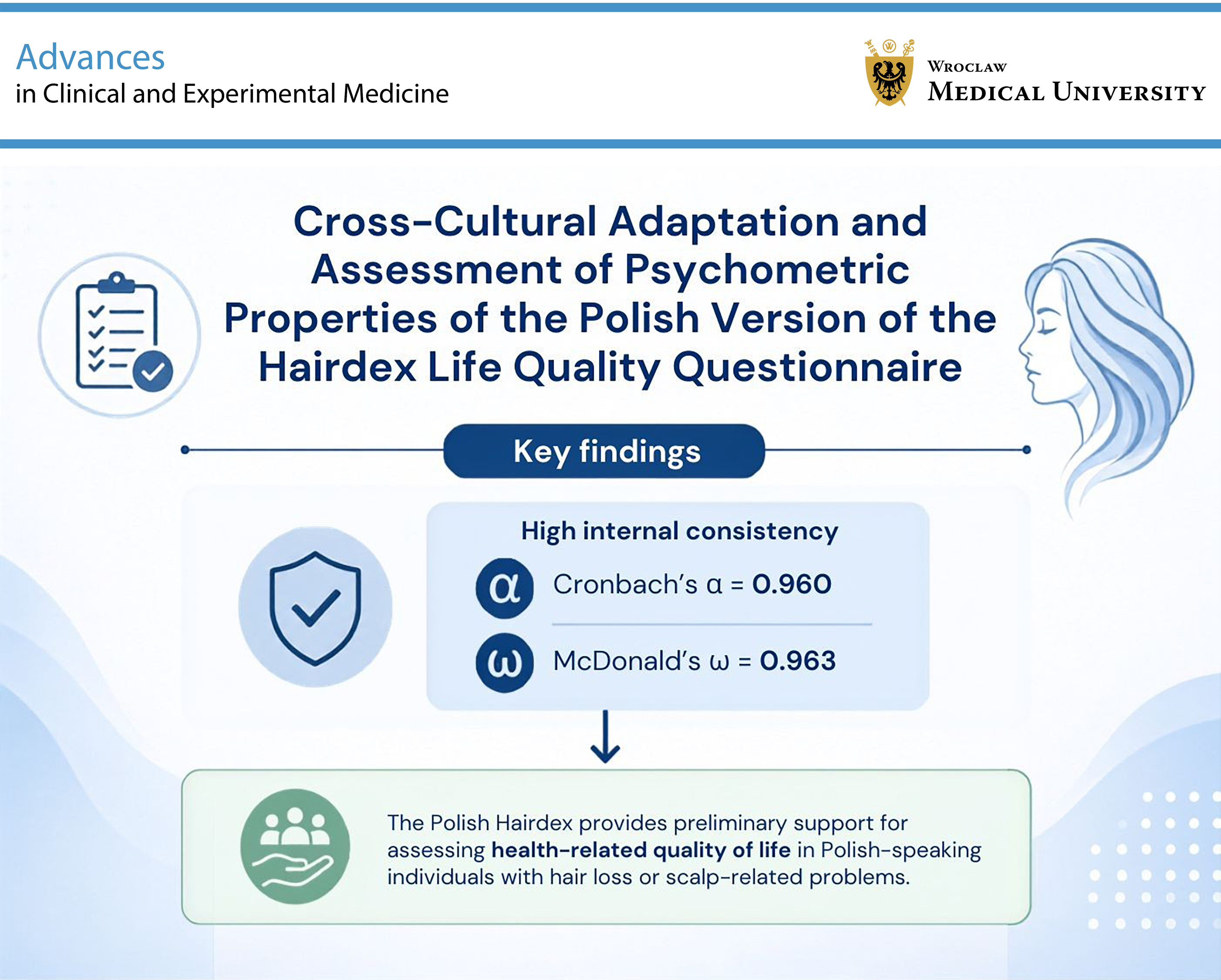
Results. A total of 245 participants (55.9% women; 44.1% men; mean age 35.8 ±9.7 years) were included in the final analysis. Confirmatory factor analysis did not confirm the original 5-factor structure (root mean square error of approximation (RMSEA) = 0.234; comparative fit index (CFI) = 0.744; Tucker–Lewis index (TLI) = 0.749; standardized root mean square residual (SRMR) = 0.192). Exploratory factor analysis retained a single factor explaining 38.2% of the total variance. The greatest impairment in HRQoL was observed in the Self-confidence and Emotions domains, corresponding to the greatest impairment in the same items in the original Hairdex, whereas Functioning and Symptoms were the least affected. Stigmatization had an intermediate mean score. Internal consistency was high (Cronbach’s α = 0.960; McDonald’s ω = 0.963).
Conclusions. Hairdex-PL showed high internal consistency and provided preliminary psychometric evidence supporting its use to assess disease-specific HRQoL in Polish-speaking individuals with hair and scalp disorders. Although confirmatory factor analysis did not support the original 5-factor structure, exploratory factor analysis identified a single factor in the present sample; this exploratory finding requires confirmation in an independent population. This study provides new evidence regarding its underlying measurement structure and supports further evaluation of the instrument in clinical and research settings.
Key words: quality of life, psychometric properties, cross-cultural adaptation, alopecia, patient-reported outcome measures
Background
Hair loss and scalp disorders are among the most common conditions encountered in dermatological practice, and their impact on affected patients’ quality of life can be immense.1, 2, 3, 4 Androgenetic alopecia, the most prevalent form of hair loss, affects up to 70–80% of men and 40–50% of women of European ancestry by the age of 70 years, with prevalence rising progressively with age.2, 5, 6 Alopecia areata, the 2nd most common form, carries an estimated lifetime risk of approx. 2.1%, typically presenting between the ages of 25 and 35 years.7 Although these conditions are rarely life-threatening, their high prevalence and substantial psychosocial burden make them an important public health issue.3, 4, 5
Despite the availability of effective pharmacological and supportive treatments, the psychosocial burden of alopecia areata is increasingly recognized.8, 9 Because of their visible and aesthetic nature, these conditions markedly impair health-related quality of life (HRQoL), frequently leading to reduced self-esteem, social anxiety, social withdrawal, and self-criticism.9 Among patients with alopecia areata, the lifetime prevalence of psychiatric disorders reaches 66–74%, with depression and generalized anxiety disorder affecting approx. 38–39% and 39–62% of patients, respectively.7 Consequently, these disorders often impair occupational and daily functioning.9
Clinicians have traditionally assessed the severity of hair and scalp disorders using scales such as the Norwood–Hamilton and Ludwig classifications and the Psoriasis Area and Severity Index (PASI).10, 11, 12 However, these instruments assess primarily the objective extent of disease and do not adequately reflect the patient’s subjective experience, as clinical severity correlates poorly with patient-perceived HRQoL.13 Similarly, widely used dermatology-specific questionnaires, such as the Dermatology Life Quality Index (DLQI) and Skindex-29, provide standardized measures of HRQoL in skin disease but do not address concerns specific to hair and scalp disorders.14, 15 Consequently, there is growing emphasis on patient-reported outcome measures (PROMs), which provide a standardized assessment of HRQoL from the patient’s perspective and better capture the lived experience of these conditions.16, 17
The Hairdex is a German disease-specific 48-item questionnaire derived from and validated against the Skindex18, 19 and developed to assess the impact of hair and scalp disorders on patients’ HRQoL.3 However, no Polish-language version of this instrument is currently available, limiting the use of a standardized disease-specific measure in both clinical practice and research in Poland. Therefore, the aim of this study was to perform the cross-cultural adaptation and assess selected psychometric properties, including structural validity and internal consistency, of the Polish version of the Hairdex (Hairdex-PL) questionnaire in patients with hair and scalp disorders.
Materials and methods
Study population
Data were collected between August 2025 and January 2026 using an anonymous online survey distributed via social media platforms, internet forums, and Facebook groups dedicated to individuals experiencing hair loss and scalp disorders. Participants were recruited using a non-probability convenience sampling strategy. As recommendations for psychometric validation studies suggest recruiting 5–10 participants per questionnaire item,20 and as the Hairdex3 questionnaire consists of 48 items, we aimed to reach a sample size range of 240–480 participants. Eligibility criteria included age ≥18 years, self-reported hair loss or scalp-related problems, and provision of informed consent. Before accessing the questionnaire, all participants confirmed that they were at least 18 years of age, experienced hair loss, and voluntarily agreed to participate in the study. Information regarding physician-confirmed diagnosis and the type of hair loss was collected separately as part of the demographic questionnaire. A total of 294 individuals participated in the study. Forty-nine respondents completed the sociodemographic section but did not proceed to the Hairdex-PL questionnaire and were therefore excluded from further psychometric analyses. Consequently, the final analytical sample comprised 245 participants. The survey consisted of 2 sections. The 1st section collected demographic and clinical information, including age, sex, place of residence, education, socioeconomic status, duration of hair loss, concomitant diseases, physician-confirmed diagnosis, and the type of hair loss. The 2nd section comprised the Hairdex-PL questionnaire. To ensure data quality, the Webankieta platform automatically prevented multiple questionnaire submissions using IP-based filtering. Researchers had no access to participants’ IP addresses, preserving anonymity and protecting personal data throughout the study.
According to the opinion of the Bioethics Committee at Wroclaw Medical University (opinion No. 296/2025, 03.07.2025), this study was not classified as a medical experiment under Polish regulations and, therefore, did not require approval by the Bioethics Committee.
Hairdex questionnaire
The Hairdex questionnaire is a 48-item disease-specific PROM developed by Fischer et al. to assess HRQoL in patients with hair and scalp disorders.3 The instrument was originally derived from the Skindex questionnaire and subsequently modified to address concerns specific to individuals affected by hair loss and scalp diseases.18, 19 The final version of Hairdex comprises 48 items organized into 5 domains: Symptoms, Functioning, Emotions, Self-confidence, and Stigmatization. Each item is rated on a 5-point Likert scale ranging from 0 (“never”) to 4 (“always”). Responses are treated as ordinal variables in psychometric analyses.3 In the original validation study involving female patients with diffuse alopecia and androgenetic alopecia across 3 hair-loss visibility levels, exploratory factor analysis supported the proposed 5-domain structure, explaining approx. 69% of the total variance. Internal consistency ranged from 0.55 to 0.82 across domains, with the highest reliability in the Self-confidence domain and the lowest in the Symptoms domain.3
Instrument translation and cultural and language adaptation
Permission to translate and culturally adapt the Hairdex questionnaire into Polish was obtained from the copyright holder of the original instrument before commencing the study. The translation and cross-cultural adaptation process followed the internationally accepted recommendations proposed by Beaton et al.21 First, 2 bilingual translators whose native language was Polish independently translated the original German version of the Hairdex questionnaire into Polish (forward translation). The 2 forward translations were subsequently compared and synthesized into a single preliminary Polish version through discussion and consensus. Two bilingual translators who were native German speakers then independently back-translated the synthesized Polish version into German and were blinded to the original questionnaire (back-translation). The purpose of the back-translation was to verify conceptual equivalence and identify potential discrepancies between the translated and original versions. A 10-member expert committee subsequently reviewed all translated versions, including the original questionnaire, the forward translations, the synthesized Polish version, and the back-translations. The committee consisted of a health promotion specialist, 3 nurses, a paramedic, a dermatologist, a methodologist, a cosmetologist, a trichologist, and a patient with physician-confirmed androgenetic alopecia. The expert panel evaluated the semantic, idiomatic, experiential, and conceptual equivalence of all questionnaire items and reached consensus on the final pre-final Polish version. The pre-final version was subsequently pilot-tested among 35 adults experiencing hair loss to evaluate the clarity, comprehensibility, and cultural relevance of the translated questionnaire. Participants reported no difficulties in understanding the Hairdex-PL items. Minor linguistic refinements concerned only the wording of selected sociodemographic questions, primarily to improve clarity and inclusiveness, and did not affect the content or conceptual meaning of the Hairdex-PL items. The Hairdex-PL is provided in the Supplementary Material (https://doi.org/10.5281/zenodo.22108376).
Statistical analyses
Statistical analyses were performed using R v. 4.5.2 (R Foundation for Statistical Computing, Vienna, Austria) together with RStudio and the lavaan, psych, psy, and diagram packages.22, 23, 24, 25 No data were missing, as participants were required to complete all questionnaire items before submitting the survey. Descriptive statistics are presented as means with standard deviations (SDs), medians with interquartile ranges (IQRs), ranges, and frequencies with percentages, as appropriate. Structural validity was initially assessed using confirmatory factor analysis (CFA) to evaluate the fit of the original 5-factor structure of the Hairdex questionnaire. Because the questionnaire items were measured using ordinal Likert-scale responses, the robust weighted least squares estimator with mean and variance adjustment (WLSMV) was applied. Model fit was evaluated using the standardized root mean square residual (SRMR), root mean square error of approximation (RMSEA), comparative fit index (CFI), and Tucker–Lewis index (TLI). Following the recommendation of Hu and Bentler, acceptable model fit was defined as SRMR < 0.09 together with at least one of the following criteria: CFI > 0.96, TLI > 0.96, or RMSEA < 0.06.26 As the predefined 5-factor model demonstrated inadequate fit, exploratory factor analysis (EFA) was subsequently performed to identify the underlying factor structure. The suitability of the data for factor analysis was assessed using the Kaiser–Meyer–Olkin (KMO) measure of sampling adequacy and Bartlett’s test of sphericity. We performed EFA using a Pearson correlation matrix, Principal Axis Factoring (PAF) as the extraction method, and oblimin rotation. Principal Axis Factoring was selected to identify latent factors based on the common variance shared among items, while oblimin rotation was used because potential HRQoL dimensions were expected to be correlated. The number of retained factors was determined using the prespecified Kaiser criterion (eigenvalue >1) as the factor-retention rule for this exploratory analysis. Factor loadings of ≥0.30 were considered meaningful. Internal consistency was assessed using Cronbach’s alpha (α) and McDonald’s omega (ω) coefficients. Corrected item–total correlations and Cronbach’s α if item deleted were additionally calculated to evaluate the contribution of individual items to the internal consistency of the questionnaire. Cronbach’s α values were interpreted as follows: α ≥ 0.90 – excellent; 0.80–0.89 – good; 0.70–0.79 – acceptable; 0.60–0.69 – questionable; 0.50–0.59 – poor; and α < 0.50 – unacceptable. Floor and ceiling effects were evaluated for each questionnaire item. A floor effect was defined as the percentage of participants selecting the lowest possible response category, whereas a ceiling effect was defined as the percentage selecting the highest possible response category. Proportions exceeding 15% were considered indicative of substantial floor or ceiling effects. Statistical significance was set at p < 0.05.
Results
Participant characteristics
A total of 294 individuals entered the survey. Of these, 49 did not complete the Hairdex-PL questionnaire and were excluded from the psychometric analyses, resulting in a final analytical sample of 245 participants. The mean age was 35.84 ±9.71 years; 55.92% of participants were women and 44.08% were men. Most respondents had higher education (73.06%), lived in cities with more than 100,000 inhabitants (56.73%), and reported good socioeconomic status (64.90%). Table 1 presents the detailed demographic and clinical characteristics of the study population.
Hairdex-PL scores
No normative values have been established for the Hairdex-PL questionnaire; therefore, the obtained scores should be interpreted descriptively. Hairdex-PL total and subscale scores range from 0 to 100, with higher scores indicating poorer HRQoL. The mean total Hairdex-PL score was 28.71 ±14.85. Among the 5 subscales, Self-confidence (43.04 ±15.60) had the highest mean score, followed by Emotions (35.91 ±21.79) and Stigmatization (25.29 ±16.21), indicating the greatest impairment in the first 2 domains. In contrast, Functioning (17.83 ±18.39) and Symptoms (22.40 ±15.75) had the lowest mean scores, suggesting a lower impact on HRQoL in these areas. Table 2 presents descriptive statistics for the total Hairdex-PL score and individual subscales.
Analysis of individual questionnaire items
Analysis of floor and ceiling effects is presented in Table 3. Substantial floor effects were identified for several items, particularly those assessing physical symptoms, with several items exceeding the predefined 15% threshold. The pronounced floor effects observed for several symptom-related items likely reflect the clinical characteristics of the study sample, which predominantly comprised patients with hair disorders not typically associated with scalp symptoms such as pain, burning, or pruritus. In contrast, ceiling effects were generally negligible; however, moderate ceiling effects were observed for items 31 (19.6%) and 43 (23.3%).
Confirmatory and exploratory factor analysis
The CFA of the predefined 5-factor model demonstrated inadequate fit to the data (RMSEA = 0.234, CFI = 0.744, TLI = 0.749, SRMR = 0.192). Therefore, EFA was performed to further investigate the latent structure of the Hairdex-PL questionnaire. The data were suitable for factor analysis, as indicated by a KMO measure of sampling adequacy of 0.948 and a statistically significant Bartlett’s test of sphericity (p < 0.001), suggesting the correlation matrix was appropriate for factor analysis. Only 1 factor had an eigenvalue greater than 1 and was therefore retained according to the prespecified Kaiser criterion, explaining 38.19% of the total variance. Forty of the 48 items demonstrated factor loadings of ≥0.30 on the retained factor. The 8 items with loadings below 0.30 were items 1, 7, 10, 19, 27, 31, 40, and 48, most of which also demonstrated pronounced floor effects. Because only 1 factor met the retention criterion, and most questionnaire items had meaningful loadings, the 1-factor solution was the most parsimonious exploratory representation of the data in this sample. Table 4 presents factor loadings for all Hairdex-PL items.
The Hairdex-PL questionnaire showed excellent internal consistency, with a Cronbach’s α of 0.960 and a McDonald’s ω of 0.963. Corrected item–total correlations were positive for all items, ranging from 0.148 to 0.813, indicating that each item contributed positively to the overall scale. Cronbach’s α values after deleting individual items ranged from 0.958 to 0.961, suggesting that removing any single item would not meaningfully improve the questionnaire’s internal consistency. Table 5 presents detailed item-level reliability statistics.
Discussion
This study presents the first cross-cultural adaptation and psychometric evaluation of the Hairdex-PL questionnaire for use in the Polish population. The Polish version demonstrated high internal consistency and overall satisfactory psychometric performance. Although confirmatory factor analysis did not support the originally proposed 5-factor structure, exploratory factor analysis identified a dominant general factor in the present sample. Taken together, these findings indicate that the pattern of domain scores was broadly consistent with previous studies, while providing new evidence on the underlying measurement structure of the Polish adaptation.
The domain-level pattern observed here closely mirrors that of the original German instrument and the Swedish adaptation, in which Self-confidence and Emotions consistently showed the greatest impairment and Symptoms the least.3, 27 A more detailed comparison with the original German Hairdex showed that the Self-confidence and Emotions scores were 29.98 and 37.01, respectively, whereas the Symptoms and Functioning scores were higher than in the Polish version.3 In the Swedish validation, Self-confidence (45.0) and Emotions (36.5) produced the highest scores, almost identical to our values, supporting the cross-cultural stability of the construct that Hairdex captures.27 The instrument has also been applied, without formal psychometric validation, in Turkish and Chinese populations, where it likewise detected the greatest burden in the emotional and self-perception domains and discriminated HRQoL across clinical and sociodemographic subgroups.16, 28 This consistency across linguistically and culturally diverse settings reinforces the view that hair and scalp disorders affect patients principally through emotional and self-image pathways rather than physical symptoms.29, 30, 31, 32
Regarding factor structure, our confirmatory analysis indicated inadequate fit for the 5-factor model (RMSEA = 0.234; CFI = 0.744; TLI = 0.749; SRMR = 0.192), and exploratory analysis retained a single factor explaining 38.19% of the variance. At first glance, this appears to diverge from the original study, in which a 5-factor solution accounted for approx. 69% of the variance.3 However, these variance estimates are not directly comparable across studies because different analytical approaches were used; notably, the Swedish principal component analysis (PCA) was performed on domain-level scores rather than on all 48 individual items.3, 27 This apparent discrepancy likely reflects both methodological differences between PCA and exploratory factor analysis and differences in study populations; PCA tends to yield higher explained variance, and neither previous study subjected the 5-domain model to a confirmatory test. To our knowledge, this study is the first to evaluate the structural validity of the Hairdex using CFA, which is a principal methodological contribution of this work. The CFA findings indicate that the original 5-factor model was not supported in the present Polish sample. The subsequent EFA identified a dominant general factor. The 1-factor solution was considered the most parsimonious exploratory interpretation because only 1 factor met the prespecified Kaiser criterion and 40 of the 48 items demonstrated meaningful loadings on the retained factor. However, this finding should be interpreted as exploratory and sample-specific rather than as definitive evidence of unidimensionality. This caution is particularly warranted because the retained factor explained 38.19% of the total variance and several items demonstrated relatively low factor loadings. Future studies should assess the reproducibility of this structure in independent samples, ideally by testing a prespecified 1-factor model using CFA and comparing it with theoretically plausible multidimensional models.
The strong internal consistency of the Hairdex-PL aligns with both previous validations and reinforces this interpretation. The Swedish Hairdex-S reported a total Cronbach’s α of 0.92,27 and the original German instrument reported domain-level values of 0.55–0.82, with the lowest reliability for the Symptoms subscale.3 Our total α of 0.960 and ω of 0.963 exceed these figures and indicate excellent reliability. Corrected item–total correlations were positive but heterogeneous (0.148–0.813), indicating that some items were only weakly associated with the total score. The high overall α and ω can coexist with low item–total correlations for individual items because these coefficients summarize reliability across all 48 items and reflect scale length and the covariance pattern of the full item set. Removal of any single item changed α only marginally (0.958–0.961); therefore, item deletion was not considered justified on the basis of internal consistency alone.
The items with the lowest factor loadings and item–total correlations were predominantly symptom-related (e.g., items 1, 7, 10, and 27) and corresponded to the items showing the most pronounced floor effects, several of which exceeded the conventional 15% threshold for an acceptable floor effect.33 One possible explanation for this pattern is the clinical composition of our sample; however, the present data cannot determine whether the low loadings reflect sample-specific response distributions, limitations in item performance, or both. Our participants were recruited online and included a substantial proportion of individuals with androgenetic alopecia or hair loss without physician-confirmed diagnosis. This sample composition may have contributed to the low prevalence of scalp symptoms such as pain, burning, or pruritus and, consequently, to the pronounced floor effects. By contrast, the Swedish cohort was recruited from a hospital dermatology register and included a substantial proportion of patients with alopecia totalis or universalis,27 representing more severe disease in which a greater symptom burden would attenuate such floor effects. This interpretation is consistent with the original German work, in which the Symptoms subscale was the weakest performer yet was deliberately retained to preserve comparability with other dermatological instruments,3 and with broader evidence that floor and ceiling effects frequently arise from a mismatch between the severity range of an instrument and the characteristics of the population in which it is applied.33 It also accords with the well-documented observation that clinical severity and patient-perceived HRQoL are only weakly correlated in hair loss.3, 14, 34, 35
In the Polish clinical and research context, the availability of a cross-culturally adapted, hair- and scalp-specific HRQoL instrument addresses a clear gap. Dermatology-specific instruments such as the DLQI and Skindex-29, including their Polish adaptations, do not capture concerns specific to hair loss, and clinical severity scales correlate poorly with the patient’s subjective experience.13, 14, 15 The psychosocial burden of hair loss is increasingly recognized as a substantial component of disease impact, affecting self-esteem, social functioning, and mental health,8, 29 and disease-specific instruments are considered essential for capturing this dimension in both clinical and research settings.36 Our findings, showing that the greatest burden lies in Self-confidence and Emotions, suggest that psychosocial aspects may represent an important component of the HRQoL burden associated with hair and scalp disorders.3 After confirming its factorial structure, temporal reliability, and responsiveness, the Hairdex-PL may support routine monitoring of patient-reported burden and assessment of treatment-related changes. Taken together, these exploratory findings indicate that the total score may provide a useful summary measure of hair- and scalp-related HRQoL. However, the relative validity of the total and domain-level scores requires further evaluation in independent samples before making definitive scoring recommendations.
Limitations of the study
This study has several limitations that should be considered when interpreting the findings. First, although the sample size met current recommendations for studies evaluating psychometric properties, the study population included patients with various hair and scalp disorders rather than a single diagnostic entity. This clinical heterogeneity may have influenced participants’ responses and contributed to the observed factor structure. Future studies involving diagnostically homogeneous patient groups are warranted to further evaluate the structural properties of the Hairdex-PL questionnaire. Second, participants were recruited using a convenience sampling strategy through an anonymous online survey distributed via social media platforms and internet forums. Consequently, individuals without internet access or those not engaged in online communities may have been underrepresented, which may limit the generalizability of the findings to the broader population of patients with hair and scalp disorders. Furthermore, 133 participants (54.29%) reported that a physician had not diagnosed their hair loss. This category indicates a lack of diagnostic confirmation rather than a confirmed absence of disease; nevertheless, it may have increased sample heterogeneity and limited the generalizability of the findings to populations with physician-confirmed diagnoses. Finally, the present study did not evaluate test–retest reliability. Therefore, future studies should examine the temporal stability of the Hairdex-PL questionnaire by administering the instrument at 2 time points in clinically stable patients.
Conclusions
The Hairdex-PL demonstrated high internal consistency and provided preliminary psychometric evidence supporting its use to assess disease-specific health-related quality of life in Polish-speaking individuals with hair and scalp disorders. Although the original 5-factor structure was not supported in the present sample, the domain score pattern was broadly consistent with that reported in previous international studies. Future studies should evaluate additional psychometric properties, particularly test–retest reliability, and examine the reproducibility of the exploratory factor structure and determine the most appropriate scoring model in independent samples.
Supplementary data
Supplementary materials are available at https://doi.org/
10.5281/zenodo.22108376. The package contains the following files:
The Polish version of the Hairdex Life Quality Questionnaire (Hairdex-PL): the final Polish-language version of the 48-item Hairdex questionnaire developed through translation and cross-cultural adaptation.
Data Availability Statement
The datasets generated and/or analyzed during the current study are available in Zenodo at https://doi.org/10.
5281/zenodo.22108332.
Consent for publication of personal information
Not applicable.
Use of AI and AI-assisted technologies
OpenAI’s ChatGPT was used for language editing and proofreading to ensure the final manuscript’s clarity, coherence, and linguistic accuracy.