



Abstract
Background. Pseudomonas aeruginosa (PA) is a major opportunistic pathogen responsible for nosocomial infections, particularly those affecting the lower respiratory tract. The emergence of carbapenem-resistant PA (CRPA) poses a significant global therapeutic challenge, as increasing resistance rates complicate clinical management.
Objectives. To investigate the clinical characteristics and antimicrobial resistance profiles of CRPA infections, identify associated risk factors among patients at The Affiliated Hospital of North Sichuan Medical College, and provide evidence for the development of effective prevention and control strategies.
Materials and methods. A retrospective case-control study was conducted involving 94 patients with CRPA infection (study group) and 50 patients with CSPA infection (control group) between January 2021 and December 2022. Clinical characteristics and risk factors were analyzed using univariate analyses and multivariable logistic regression. Variable selection for the primary model was performed using best-subset selection based on the Bayesian information criterion (BIC).
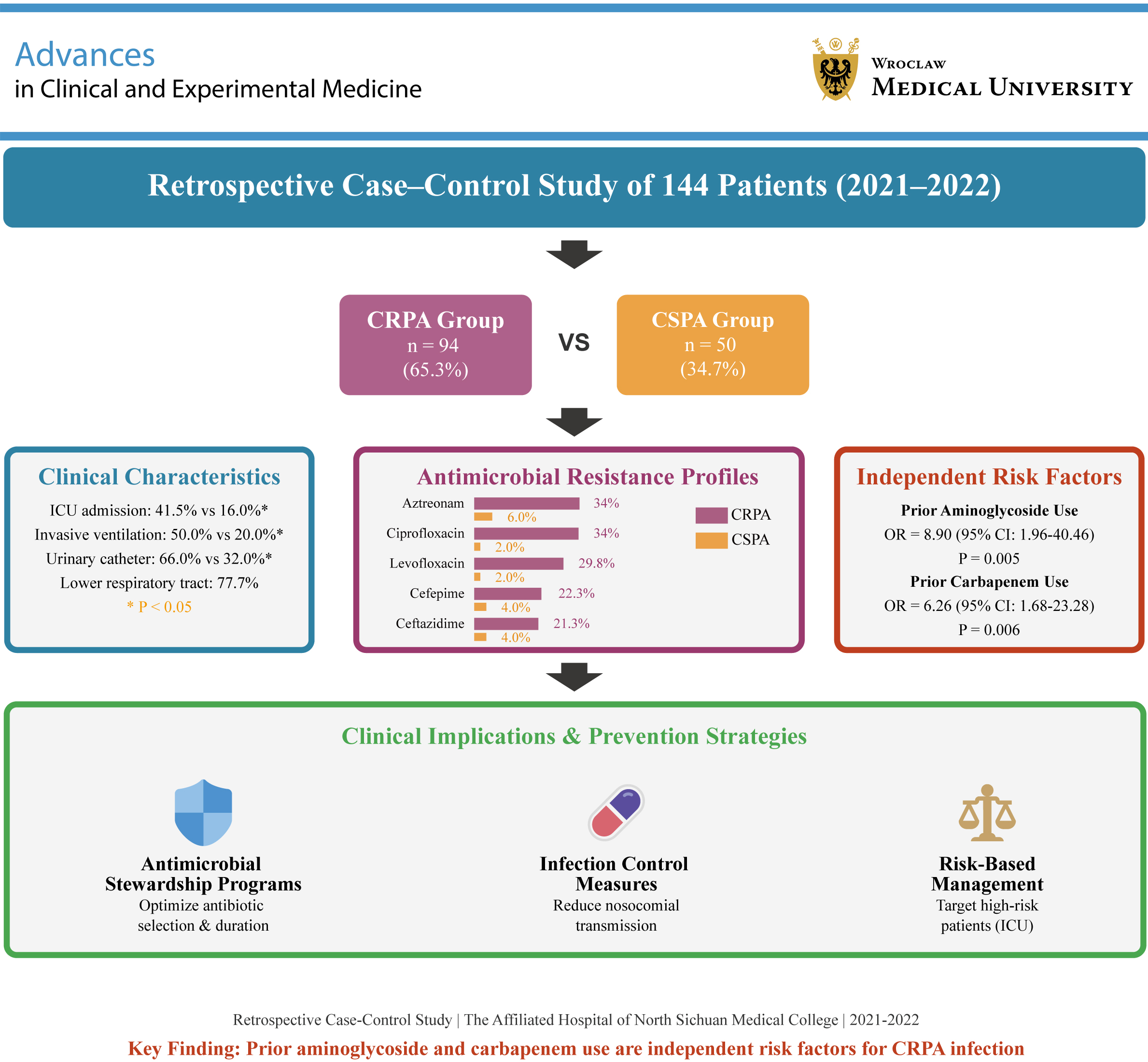
Results. Carbapenem-resistant PA isolates were primarily recovered from lower respiratory tract secretions (77.66%) and were most frequently identified in the intensive care unit (ICU) (41.49%). Compared with CSPA strains, CRPA exhibited significantly higher resistance rates to aztreonam, ciprofloxacin, levofloxacin, and cephalosporins (p < 0.05). Multivariable logistic regression using best-subset selection identified prior exposure to carbapenems (adjusted odds ratio (aOR) = 6.914, 95% confidence interval (95% CI): 2.765–17.290, p < 0.001) and aminoglycosides (aOR = 6.209, 95% CI: 1.701–22.668, p = 0.006) as independent risk factors for CRPA infection.
Conclusions. Carbapenem-resistant PA infection imposes a considerable burden in our hospital, particularly among ICU patients. Prior exposure to carbapenems and aminoglycosides significantly increases the risk of CRPA infection. The BIC-selected model identified the same main risk factors as the fully adjusted sensitivity analysis, supporting the consistency of the findings. Strengthening antimicrobial stewardship and tailoring empirical therapy according to local antimicrobial susceptibility patterns are essential to curb resistance and improve clinical outcomes.
Key words: risk factors, clinical features, respiratory infection, resistance characteristics, carbapenem-resistant Pseudomonas aeruginosa
Background
Pseudomonas aeruginosa (PA) is an opportunistic pathogen widely distributed in nature. Although the isolation rate of PA has steadily decreased in recent years, it remains a major pathogen causing lower respiratory tract infections in healthcare institutions. Carbapenems are broad-spectrum antibiotics with potent antibacterial activity and are characterized by stability against β-lactamases and low toxicity. They are among the most important antibacterial agents used in the clinical treatment of serious bacterial infections. With the increasing misuse of antibiotics, the prevalence of carbapenem-resistant PA, multidrug-resistant PA (MDRPA), and even extensively drug-resistant PA (XDRPA) has gradually increased. According to the China Antibacterial Monitoring Network (CHINET; 2022 Annual Bacterial Resistance Monitoring Report),1 the resistance rates of PA to meropenem and imipenem in 2022 were 22.1% and 17.6%, reference. The high morbidity, mortality, and substantial resistance rates associated with these infections pose major challenges to clinical prevention and control.2, 3, 4 The resistance mechanisms of PA are complex and multifactorial, including the production of β-lactamases (such as carbapenemases), overexpression of efflux pumps that actively expel antibiotics, modification of antibiotic target sites, and reduced outer membrane permeability, all of which limit antibiotic penetration and efficacy. The spread of such resistant strains poses a significant threat to public health, resulting in limited treatment options, prolonged hospital stays, increased healthcare costs, and higher patient mortality.5, 6 Despite numerous studies investigating the epidemiology of PA, the incidence of CRPA remains high, and effective management strategies are still lacking.
Objectives
The primary objective of this study was to analyze and compare the clinical characteristics and antimicrobial resistance profiles of CRPA and carbapenem-susceptible PA (CSPA) infections among patients treated at the Affiliated Hospital of North Sichuan Medical College (Nanchong, China). Furthermore, this study aimed to identify specific risk factors associated with CRPA infection. The findings are intended to provide an evidence base for optimizing clinical management, guiding antimicrobial stewardship, and developing effective strategies for the prevention and control of CRPA.
Materials and methods
Definitions
Multidrug resistance refers to acquired non-susceptibility to at least one agent in 3 or more antimicrobial categories.7 Extensively drug-resistant infection is a more severe form of resistance, defined as non-susceptibility to at least one agent in all but 2 or fewer antimicrobial categories. The latter often develops from multidrug resistance and implies resistance not only to conventional antibiotics but also to certain “last-line” antibiotics. “Last-line antibiotics” are reserve agents used when first- and second-line therapies have failed and typically include drugs such as colistin, polymyxin B, and newer combination agents, including ceftazidime-avibactam, which are critical for the treatment of severe infections caused by resistant pathogens.8
Study design and population
A retrospective case-control study was conducted at The Affiliated Hospital of North Sichuan Medical College, a major tertiary-care referral center with more than 2,000 beds. The hospital serves a diverse patient population from both urban and rural areas, which may influence the epidemiological and antimicrobial resistance characteristics observed in this study. The study population included patients with culture-confirmed PA infections identified between January 2021 and December 2022. The case group comprised 94 patients with CRPA infections. The control group consisted of 50 patients with CSPA infections, selected from the same period and matched to the cases according to admission to the same ward and similar age to ensure comparability.
Ethical approval
This study was approved by the Institutional Review Board and Ethics Committee of The Affiliated Hospital of North Sichuan Medical College (approval No. 2023ER346-1, issued on January 3, 2023). The requirement for individual informed consent was waived by the committee due to the retrospective and anonymized nature of the data analysis.
Inclusion and exclusion criteria
Inclusion criteria: 1. Patients aged ≥18 years who were admitted to our hospital for treatment; 2. Patients with a first-time isolation of CRPA or CSPA and corresponding clinical evidence of infection. Duplicate isolates were excluded. Exclusion criteria: 1. Cases in which CRPA or CSPA was isolated without signs of infection; 2. Patients with incomplete clinical data, incomplete medical records, or age <18 years.
Bacterial isolation and drug susceptibility testing
Data on the isolation, culture, and identification of pathogenic bacteria were retrieved from the hospital laboratory information system. These procedures were originally performed in accordance with the National Operating Procedures for Clinical Examination.9 Pseudomonas aeruginosa was identified using the VITEK® 2 Compact automated system (bioMérieux, Marcy-l’Étoile, France). Antimicrobial susceptibility testing was performed according to the guidelines of the Clinical and Laboratory Standards Institute (CLSI).10 An isolate was classified as CRPA if it demonstrated resistance to one or more carbapenem agents (e.g., imipenem or meropenem). For analytical purposes, isolates with intermediate susceptibility were categorized as resistant. Molecular analysis of specific carbapenemase genes was not performed as part of this study.
Methods
A retrospective case-control design was used to collect relevant variables from the 2 study groups, including: 1) Basic data: age, sex, presence of comorbidities (such as chronic obstructive pulmonary disease (COPD), diabetes, hypertension, and coronary heart disease), surgery, ICU admission, and specimen type; 2) Antibacterial therapy: use of restricted antibiotics, use of antifungal drugs, and combination antibiotic therapy; 3) Invasive procedures: use of invasive mechanical ventilation (tracheotomy or endotracheal intubation), urinary catheterization, placement of a central venous catheter, placement of a gastric tube, and other related procedures. The data from the 2 groups of patients were compiled, and a logistic regression model was constructed. Risk factors for CRPA infection were identified by comparing the variables collected from both groups.
Statistical analyses
This retrospective case–control study was analyzed using logistic regression and evaluated for model adequacy. This design was chosen because it directly tests whether prior exposures are associated with CRPA infection while controlling for potential confounding factors.
Best-subset selection based on the Bayesian information criterion (BIC) was applied to identify the most parsimonious primary model, whereas a fully adjusted model including all candidate covariates was evaluated as a sensitivity analysis to confirm robustness.
Analyses were conducted using SPSS v. 26.0 (IBM Corp., Armonk, USA) and R v. 4.3.3 (R Foundation for Statistical Computing, Vienna, Austria). Categorical variables were summarized as n (%) and compared using Pearson’s χ2 test or Fisher’s exact test, as appropriate. Continuous variables were summarized as the median (interquartile range (IQR)) and compared using the Mann–Whitney U test. For multiple comparisons of antibiotic susceptibility, Benjamini–Hochberg false discovery rate control was applied to the p-values obtained from the overall tests.
To identify risk factors for CRPA, a multivariable logistic regression model was fitted for the binary outcome (coded as 1 for CRPA and 0 for CSPA). Best-subset selection based on the BIC was used for variable reduction to obtain the primary model, and a fully adjusted model including all candidate covariates was additionally analyzed as a sensitivity analysis to confirm robustness. Linearity of the logit for age was assessed using the Box–Tidwell test (p = 0.889). Influence diagnostics included Cook’s distance (threshold >4/n), leverage and studentized residuals. The model was refitted after removing the 1–3 observations with the greatest influence. Student’s t-test was not used.
Results
Strain department distribution and specimen type
Among the 94 CRPA strains collected in this study, isolates were primarily recovered from the respiratory department, ICUs, and surgical departments. The ICU group (including the ICU, emergency intensive care unit (EICU), and other intensive care units) accounted for 41.49% of isolates, the respiratory department for 14.89%, and the surgical departments for 11.70%. Specimens were primarily obtained from lower respiratory tract secretions, midstream urine, wound secretions, whole blood, drainage fluid, tissues, and other clinical samples. In both the CRPA and CSPA groups, lower respiratory tract secretions were the predominant specimen type, accounting for 77.66% and 76.00% of isolates, respectively.
Comparison of drug resistance rate
IBM SPSS v. 26.0 software was used to compare and analyze the resistance and susceptibility profiles of the 2 groups of strains to commonly used antimicrobial agents. As shown in Table 1, resistance rates to aztreonam, piperacillin/tazobactam, cefepime, ceftazidime, levofloxacin, and ciprofloxacin were significantly higher in the CRPA group than in the CSPA group (p < 0.05), whereas resistance rates to amikacin and gentamicin did not differ significantly between the 2 groups (p > 0.05). In the comparison of susceptible strains, susceptibility rates to aztreonam, piperacillin/tazobactam, cefepime, ceftazidime, levofloxacin, and ciprofloxacin were significantly higher in the CSPA group than in the CRPA group (p < 0.05), whereas susceptibility to amikacin and gentamicin did not differ significantly between the 2 groups (p > 0.05).
CRPA univariate analysis
A total of 144 patients were enrolled in this study, including 50 patients in the CSPA group and 94 patients in the CRPA group. As detailed in Table 2, comparisons between the groups showed that the use of invasive mechanical ventilation, urinary catheters, and other invasive procedures differed significantly between the 2 groups (p < 0.05). In addition, significant differences were observed between the 2 groups regarding the use of aminoglycosides, fluoroquinolones, carbapenems, tetracyclines, restricted antibiotics (including vancomycin, linezolid, and tigecycline), antifungal drugs, and combination antimicrobial therapy (p < 0.05). The rate of ICU admission in the CRPA group was also significantly higher than that in the CSPA group (p = 0.002).
Multivariate logistic regression analysis of CRPA infection risk factors
For robustness, we also fitted a fully adjusted model. Using best-subset selection based on the BIC, the final multivariable logistic regression model retained carbapenem and aminoglycoside exposure as predictors. Both exposures were associated with higher odds of CRPA infection: carbapenems (adjusted odds ratio (aOR) = 6.914; 95% confidence interval (95% CI): 2.765–17.290; p < 0.001) and aminoglycosides (aOR = 6.209; 95% CI: 1.701–22.668; p = 0.006). Linearity of age in the logit was confirmed (Box–Tidwell test: p = 0.889). Influence diagnostics identified a small number of high-influence observations (Cook’s distance >4/n ≈ 0.028); refitting the model after removing the top 1–3 observations produced no material changes in the estimates.
As a sensitivity analysis to confirm the robustness of our findings, a fully adjusted model including all candidate covariates was also fitted, and the results are summarized in Table 3. In this model, after adjustment for potential confounders, prior exposure to aminoglycosides (adjusted odds ratio (aOR) = 8.90, 95% CI: 1.96–40.46, p = 0.005) and carbapenems (aOR = 6.26, 95% CI: 1.68–23.28, p = 0.006) remained independent risk factors significantly associated with CRPA infection.
Discussion
Pseudomonas aeruginosa is a significant cause of nosocomial (hospital-acquired) infections, particularly among patients with compromised immune function. In addition, it is one of the leading causes of ventilator-associated pneumonia (VAP).11 Carbapenem antibiotics, such as imipenem, meropenem, and doripenem, have historically played an important role in the treatment of infections caused by PA, especially in cases in which the bacterium exhibits resistance to other classes of antibiotics. However, the overuse and misuse of carbapenems in both healthcare and agricultural settings have led to the emergence and spread of CRPA. Multidrug-resistant PA (MDRPA) and extensively drug-resistant PA aeruginosa (XDRPA) strains have become increasingly common in healthcare settings worldwide.12 These strains are resistant not only to carbapenems but also to multiple other classes of antibiotics, making them difficult to treat and posing a significant threat to patients, particularly those who are immunocompromised or critically ill. The problem of antibiotic resistance has become a global crisis. Despite the introduction of several new antibiotics in recent years, including ceftolozane-tazobactam, ceftazidime-avibactam, and imipenem-relebactam, which are recommended by international guidelines for the treatment of severe difficult-to-treat resistant PA (DTRPA) infections,8 antimicrobial resistance to these agents has also begun to emerge. This study identified risk factors associated with CRPA infection through multivariable logistic regression analysis, with the aim of providing evidence to support CRPA intervention and control strategies.
Our analysis of antibiotic susceptibility patterns revealed a concerning trend of co-resistance among CRPA isolates. These strains demonstrated markedly higher resistance rates to aztreonam, cephalosporins, and fluoroquinolones than their carbapenem-susceptible counterparts, thereby exhibiting a multidrug-resistant profile that substantially limits therapeutic options and complicates clinical management. In contrast, the relatively low resistance rates observed for aminoglycosides, including amikacin and gentamicin, suggest that these agents may retain some clinical value against CRPA in our setting. Nevertheless, given their identification as risk factors for CRPA, their use should be approached with caution. A previous study demonstrated that PA is highly susceptible to lipopeptides and aminoglycosides but highly resistant to cephalosporins, fluoroquinolones, and aztreonam.13 These findings indicate that CRPA isolates exhibit high levels of resistance to multiple antibiotics, and the presence of such resistance may increase the difficulty of treatment, particularly when agents such as aztreonam, ciprofloxacin, and levofloxacin are required. For piperacillin/tazobactam, CRPA exhibited significantly higher resistance than CSPA, whereas differences for amikacin and gentamicin were not statistically significant, which has important implications for the development of treatment protocols and preventive measures. Our findings are consistent with national surveillance data, which have reported persistently high resistance rates of CRPA to fluoroquinolones and resistance to aztreonam, reflecting a similar antimicrobial resistance profile across multiple tertiary hospitals in China.1 International studies have likewise identified prior exposure to carbapenems and aminoglycosides as important risk factors for CRPA infection, lending further support to our findings.13 Interestingly, the aminoglycoside resistance rate observed in our study (3.19%) was notably lower than those reported in both national and international datasets, possibly reflecting differences in local antibiotic stewardship strategies, prescribing practices, and infection control measures. In clinical practice, physicians should select appropriate antimicrobial agents based on these data and closely monitor patients’ responses to treatment to ensure optimal therapeutic outcomes.
The BIC-selected model identified prior exposure to carbapenems (aOR = 6.914) and aminoglycosides (aOR = 6.209) as independent risk factors; the fully adjusted sensitivity model produced estimates in the same direction (Table 3). In univariate analyses, invasive mechanical ventilation, invasive procedures and ICU admission were also associated with CRPA infection, but these variables were not retained as independent predictors after adjustment. Prior exposure to carbapenems emerged as the most statistically significant predictor (aOR = 6.914, 95% CI: 2.765–17.290, p < 0.001), which is consistent with the well-established principle of antibiotic selection pressure. This finding strongly reinforces the need for stringent carbapenem stewardship. In addition, prior exposure to aminoglycosides was also confirmed as a significant risk factor (aOR = 6.209, 95% CI: 1.701–22.668, p = 0.006). The wide confidence intervals indicate that the magnitude of these associations should be confirmed in larger multicenter studies.
The predictably higher resistance rates of CRPA strains to multiple antibiotics compared with CSPA strains, as shown in Table 1, are consistent with the definition of carbapenem resistance, which often co-occurs with resistance to other antimicrobial classes. A comparison with national surveillance data from CHINET highlights the severity of resistance in this subgroup. The 2022 CHINET report indicated that the overall resistance rate of PA to ciprofloxacin was 15.3%.1 This contrasts sharply with the 34.0% ciprofloxacin resistance rate observed among the CRPA isolates in our study. This substantial difference underscores that CRPA strains are not only resistant to carbapenems but also exhibit markedly higher rates of co-resistance to other critical antibiotics, such as fluoroquinolones, compared with the general PA population. Furthermore, this study was conducted between 2021 and 2022, during the COVID-19 pandemic. This period was characterized by a global increase in the use of broad-spectrum antibiotics, including carbapenems, to treat or prevent secondary bacterial infections in critically ill patients with COVID-19. This intensified antibiotic pressure likely accelerated the selection and spread of resistant pathogens such as CRPA, which may have influenced the incidence and resistance patterns observed in our cohort. However, our institutional COVID-19 treatment protocol did not routinely include carbapenems as first-line therapy, which may have mitigated this effect. Although this retrospective study could not formally compare antibiotic consumption before and during the pandemic, the potential increase in antibiotic pressure during this global health crisis remains an important consideration when interpreting our findings and represents a notable limitation of the study.
A meta-analysis by Raman et al.14 summarized the risk factors associated with the acquisition of MDRPA, XDRPA, and other DRPA strains. Compared with patients infected with drug-susceptible or less-resistant PA strains, hospitalized patients and those admitted to the ICU exhibited higher rates of CRPA, and the duration of ICU stay was significantly associated with the acquisition of MDRPA or XDRPA, suggesting that ICU stay is a risk factor for CRPA infection.
In a 6-month prospective study conducted in 1997,15 CRPA isolates in the medical ICU accounted for 22.1% of all isolates, compared with 13.7% in the surgical ICU. These findings suggest that CRPA is more prevalent in medical ICUs. Consistent with these observations, the incidence of CRPA in medical wards was higher than that in surgical wards in our study, which may be attributable to higher rates of antibiotic prescribing in medical departments.
Teelucksingh et al.16 underscored the importance of invasive procedures, such as central venous catheter insertion and mechanical ventilation, in increasing the risk of PA infection and influencing patient outcomes. In many previous case-control studies,17, 18, 19 carbapenems, including imipenem and meropenem, have frequently been identified as risk factors for the development of antibiotic resistance in various pathogens, including PA.
Given the established association between carbapenem use and the development of resistance, antimicrobial stewardship programs advocate the prudent use of these antibiotics to preserve their effectiveness and minimize the emergence of resistant strains. This includes appropriate antibiotic prescribing practices, infection control measures, and surveillance of antibiotic-resistant pathogens to guide treatment decisions and mitigate the spread of resistance.
Previous patient-level case-control analyses have reported that prior use of fluoroquinolones20 or amikacin21 is associated with the isolation of imipenem-resistant PA. While these observational findings suggest a link between prior antibiotic exposure and the development of resistance, causality cannot be directly inferred. Consistent with these reports, our multivariable analysis confirmed that prior aminoglycoside exposure is an independent risk factor for CRPA infection. However, further research is needed to establish direct causality and elucidate the underlying mechanisms.
In addition, factors such as antimicrobial stewardship, infection control practices, and bacterial resistance mechanisms should be considered when interpreting these findings and implementing interventions aimed at mitigating the spread of antibiotic-resistant pathogens such as CRPA.
Indeed, retrospective observational studies often have inherent limitations. To reduce their impact, we used a multivariable logistic regression model to adjust for baseline patient characteristics. Second, the relatively small sample size and the single-center nature of the study may have resulted in insufficient matching between cases and controls, potentially affecting the accuracy and reliability of the findings and limiting their generalizability to other settings. Finally, the study may not have included all relevant factors influencing CRPA infection, which may have affected a comprehensive understanding of the infection. Despite these limitations, the study has important clinical implications. By improving our understanding of the resistance patterns and risk factors associated with CRPA, appropriate measures can be implemented to prevent its spread, and more rational antimicrobial stewardship strategies can be developed to improve treatment outcomes. This is important for preventing hospital outbreaks and reducing the occurrence of MDR and pandrug-resistant (PDR) infections. Overall, despite its limitations, this study provides valuable information, offers guidance for the prevention and treatment of CRPA infections, and highlights the importance of effective management of these infections.
A strength of this study is the use of model diagnostics and sensitivity analyses. The final multivariable model was developed using best-subset selection based on the BIC, which helps to avoid overfitting. Furthermore, rigorous model diagnostics were performed, confirming the linearity assumption for continuous variables (Box–Tidwell test, p = 0.889) and including influence diagnostics. Sensitivity analysis demonstrated that the removal of high-influence observations did not materially alter the risk estimates, supporting the consistency of the findings.
Limitations of the study
However, several limitations must be acknowledged. First, the retrospective single-center design is susceptible to selection and information bias and limits the generalizability of our findings. Second, the relatively small sample size may have limited the statistical power to detect additional potential risk factors and contributed to the wide CIs observed for the primary findings. A post hoc power analysis was not conducted.
Third, our analysis did not account for the potential clustering of patients within specific wards (e.g., the ICU), which could influence the risk factor estimates; future studies may benefit from the use of multilevel modeling to address this issue. Fourth, there is a risk of omitted-variable bias, as we were unable to account for all potential confounders, such as measures of underlying disease severity.
In addition, although the primary model was selected using the BIC and a fully adjusted model was fitted as a sensitivity analysis, model development may still be affected by the moderate sample size and the limited number of events. Some clinically relevant confounders may therefore have been excluded, and residual model-selection bias cannot be ruled out. Post hoc diagnostics showed acceptable multicollinearity(all variance inflation factor (VIF) values <10) and adequate model fit according to the Hosmer–Lemeshow test. Nevertheless, the potential for selection bias inherent to this approach remains a limitation of the study. Finally, the study period coincided with the COVID-19 pandemic, which may have altered antibiotic prescribing practices and infection control measures, thereby potentially influencing the results. The absence of molecular typing of CRPA strains also precludes further insight into the genetic mechanisms underlying resistance.
Conclusions
This study demonstrates that CRPA infections are particularly prevalent in ICU settings and that prior exposure to carbapenems and aminoglycosides is an independent risk factor. These findings provide important guidance for antimicrobial stewardship programs (ASPs). First, ASPs should incorporate prospective audits with real-time feedback to clinicians regarding the appropriateness of carbapenem and aminoglycoside prescriptions, thereby reducing unnecessary exposure. Second, formulary restrictions or pre-authorization policies for last-line agents should be enforced to preserve their efficacy. Third, cumulative local antibiogram data should be routinely analyzed to develop and update institutional empirical therapy guidelines, thereby supporting more rational initial antibiotic selection and timely de-escalation once susceptibility results become available. Finally, minimizing avoidable invasive procedures and reinforcing infection control bundles are essential strategies for reducing the overall risk of CRPA infection. Collectively, these measures can optimize antibiotic use, limit the development of resistance, and improve patient outcomes.
Data Availability Statement
Data sharing is not applicable to this article, as all data are already included in the manuscript.
Supplementary data
The supplementary materials are available at https://doi.org/10.5281/zenodo.17698555. The package contains the following files:
Supplementary Table 1. Comparison of commonly used antibiotics in CSPA and CRPA (unadjusted p-value).
Supplementary Table 2. Post hoc tests and p-value adjustment.
Supplementary Table 3. Shapiro–Wilk normality test.
Supplementary Table 4. Multicollinearity diagnostics for variables included in the multivariate model.
Supplementary Table 5. Hosmer–Lemeshow goodness-of-fit test for binary logistic model.
Supplementary Fig. 1. Q–Q plot of age distribution in the CSPA group. This Q–Q plot evaluates whether age in the CSPA group follows a normal distribution. The observed values (x-axis) were plotted against expected normal quantiles (y-axis). Data points align closely with the reference line, indicating no major deviation from normality.
Supplementary Fig. 2. Q–Q plot of age distribution in the CRPA group. This Q–Q plot assesses the normality of age distribution in the CRPA group. Although slight deviations are observed at the lower and upper tails, most points lie close to the diagonal reference line, suggesting acceptable normality for subsequent statistical modeling.
Use of AI and AI-assisted technologies
Not applicable.