



Abstract
Only recently has there been a push for increased funding in women’s health, an area that has historically been neglected and underfunded. In this editorial, we argue that the higher risk of poor brain health faced by women can be usefully understood from a biopsychosocial perspective. In addition to biological differences, psychosocial stressors contribute to poorer health outcomes over time. Therefore, we advocate for a broad biopsychosocial approach to health, encompassing biological, psychological, and social factors, to better understand and promote women’s brain health and to inform ambitious public health policy and research in this area.
Key words: social determinants of health, health equity, dementia risk, women’s brain health, biopsychosocial approach
Introduction: The growing interest in women’s brain health
Brain health is gaining momentum as a research and policy priority worldwide. The goal of the World Health Organization (WHO) Intersectoral Global Action Plan on Epilepsy and Other Neurological Disorders 2022–2031 (IGAP), applicable in all 194 Member States, is to elevate brain health to the status of a public health priority.1 Several countries now have national brain health plans2, 3 and dementia prevention plans,4 which have previously been analyzed from public health5 and ethical6 perspectives.
Here, we focus on women’s brain health. Women are at higher risk of poor brain health than men. A striking statistic supporting this claim is that 2 out of 3 cases of dementia worldwide occur in women; although women live longer than men, greater longevity does not fully explain their higher risk.7, 8, 9 Yet, women’s health has historically been under-researched and underfunded, although there is now growing interest in women’s brain health across science and society.10 We focus on cisgender women; for an analysis of the brain health of sex and gender minorities, see Huo et al.11 We argue for greater action and awareness regarding women’s brain health. First, we define brain health from a biopsychosocial, rights-based perspective, before discussing the research and policy priorities that emerge from this position.
Defining a biopsychosocial, rights-based approach to women’s brain health
There is a clear need to define concepts carefully and use precise language when addressing women’s brain health. It is often unclear what the term “brain health” refers to. Several definitions have been proposed in recent decades, but no consensus has been reached.12 The concept of women’s brain health is frequently used to refer interchangeably to the risk of developing diseases such as dementia and to mental health conditions.
The concept of menopause and its treatment provides a cautionary example. Calvo and Einstein13 highlight the problem of “poor evidence” that results when neither the type of menopause nor the type of hormone therapy is specified. This lack of clarity has practical consequences. In November 2025, the U.S. Food and Drug Administration (FDA) reversed a black box warning for estrogen treatments for menopause that had been in place for more than 20 years.14 Widespread misunderstanding of the types of menopause and their treatment has significant consequences, not only for the management of menopausal symptoms but also for brain health and dementia prevention.
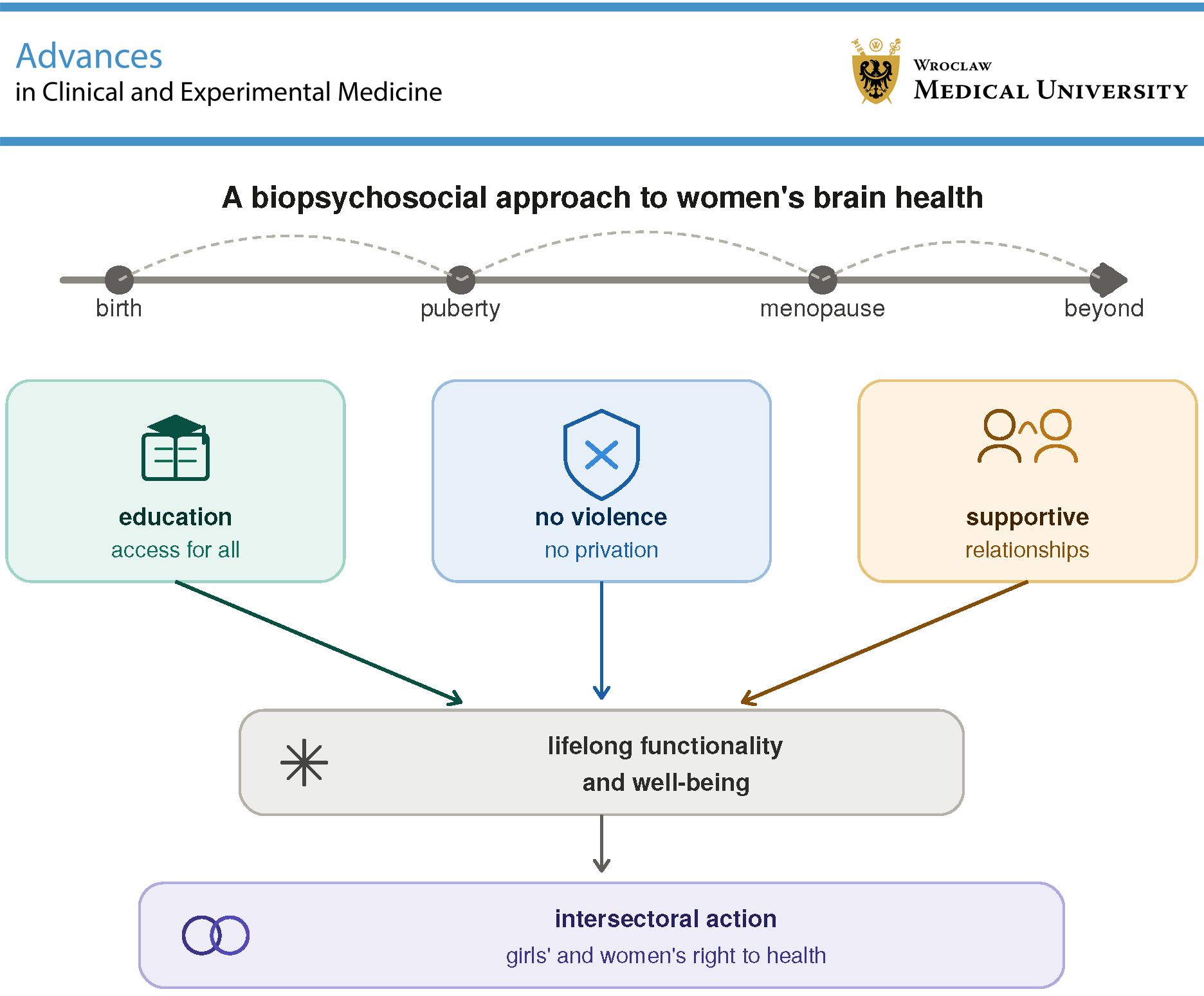
Here, we approach women’s brain health from a biopsychosocial, rights-based perspective15 across the life course, from birth through menopause and into older age. Given the wide range of factors that contribute to poorer brain health among women over time, we define women’s brain health using a biopsychosocial approach; that is, we understand it as embedded in biological, psychological, and broader social factors. The central idea behind our definition of women’s brain health is the need to expand our understanding of the factors that determine health, allowing us to critically examine the influence of psychosocial factors and social determinants of health.16 We position this definition within a life-course perspective,17 in which good brain health is understood as being sustained by social conditions, including access to adequate education, freedom from violence and deprivation, and supportive, high-quality relationship.
The biopsychosocial model was first introduced by the psychiatrist Engel in 1977,18 who argued that the biomedical model was overly reductionist and could not account for the psychosocial and behavioral factors that affect the experience of health and disease. Because the way we define health affects how we promote it,19 we resist the narrow biomedicalization of women’s brain health by adopting a biopsychosocial definition as a starting point. The practical purpose of our biopsychosocial definition of women’s brain health is to support equitable brain health promotion at the policy level. In this paper, we discuss the determinants of brain health in women as a “multi-tiered system,” that is, from “molecule to network to society.”20
We consider mental health and brain health to overlap fundamentally.21 To help clarify this position, we draw on a recent example that shows the essential relationship between girls’ and women’s rights, mental health, and brain health. The United Nations Children’s Fund (UNICEF) report Girl Goals: What Has Changed for Girls? Adolescent Girls’ Rights over 30 Years22 includes an extensive focus on mental health, providing a lens through which to understand certain patterns of gender inequality. For example, the report found that almost 4 out of 10 adolescent girls worldwide do not complete upper secondary school, particularly those in poor, rural, and marginalized populations. This schooling gap can be understood in light of gender-based violence and socialization, particularly as they occur during puberty, a critical window for longer-term health.
Psychosocial stressors, such as gender-based violence and expectations linked to gender norms, including those related to physical appearance, contribute to poorer mental health, reduced access to education and healthcare, and poorer mental and physical health, creating a vicious cycle. Depression is the leading cause of disability among girls aged 15–19 years worldwide, and other common responses to psychosocial stressors include eating disorders and a disease-agnostic reduction in wellbeing. Meta-analyses from the Lancet Commission on Dementia have consistently identified low educational attainment as the most robust modifiable risk factor for dementia.23
Moreover, the Global Burden of Disease Study suggests that the regions in which dementia cases are expected to increase the most this century (the Middle East and sub-Saharan Africa) overlap with those where girls’ right to education is least respected, creating conditions that may further undermine women’s brain health in these regions.24, 25
These structural challenges facing girls early in life can help us understand brain health later in life.26 The high exposure of girls to psychosocial stressors poses 2 problems: first, these stressors undermine the universal right to health15; second, they lead to downstream losses for broader society because of their impact on girls’ flourishing as full participants in society.10 Although women may indeed be more predisposed to dementia because of hormonal changes, neurobiological mechanisms, and genetic factors,27, 28 we argue that biopsychosocial mechanisms, such as structural barriers to education early in life, are also likely to be important contributors. Moreover, exposure to psychosocial stressors persists across the life course, through the many roles and multiple responsibilities that women are expected to perform,29 including childbearing, caregiving, additional professional duties,30 and domestic responsibilities.31 Women’s sleep is often more disrupted because of caregiving duties,32, 33 and this chronic sleep disturbance contributes to increased stress and poorer brain health outcomes.34, 35, 36 Although women may learn to cope with and manage these multiple roles,37 these demands take a toll on physical and mental health across the lifespan.38, 39, 40
In summary, a rights-based approach to women’s brain health first entails certain duties, including those of governments, to respect girls’ inalienable rights to education and health. Second, it entails further duties to reduce the impact of structural factors that increase psychosocial stress among girls and women across the life course. Third, it means that women are entitled to participate in, shape, and benefit from prevention strategies and programs that affect them,41, 42, 43 to have their lived experiences inform priorities, and to make autonomous, informed decisions about interventions that may affect their cognitive futures.44, 45
The consequences of a biopsychosocial approach: broad policy inputs
There are many different biopsychosocial mechanisms through which brain health inequalities arise and are reinforced worldwide, and these mechanisms do not act in isolation. Broadly speaking, health policy must address inequality if it is to be both ethical and effective.46, 47 Here, we focus on 3 important mechanisms: 1) structural inequalities that shape women’s exposure to risk and access to care; 2) stress-related and physiological pathways, such as chronic sleep disruption and hormonal transitions; and 3) behavioral mediators that protect brain health.
Structural inequalities
Responsibility for maintaining brain health cannot be placed solely on individuals. Adequate health-promotion policy should address the health-related burdens faced by girls and women.48 Thus, adopting a biopsychosocial approach to women’s brain health requires changing modifiable unhealthy environments while supporting girls and women within their existing daily environments49 through actions that span social, psychological, and biological domains. Inequalities in brain health mirror broader patterns of health inequality.
In the UK, life expectancy among women living in the most deprived 10% of areas fell between 2010–2012 and 2016–2018.50 This suggests that brain health among the most deprived populations may also be declining. However, the downward trend extends beyond people living in deprived neighborhoods. An April 2026 report from the Health Foundation in the UK51 found that, over the decade from 2012–2014 to 2022–2024, healthy life expectancy across the UK fell by approx. 2 years, to 60.7 years for men and 60.9 years for women, with a more rapid decline among women. The authors of the report stress that these reductions are not inevitable. They reflect policy choices that have increased health inequalities52 and reinforce the need for a life-course approach to understanding how health inequalities contribute to poorer brain health.53
These policy considerations also apply to individual-level preventive and therapeutic interventions. In this context, it is necessary to consider not only biological risk factors but also the support that people need to maintain brain health,54 as well as the timing and manner in which interventions are implemented.
Stress-related and physiological pathways
A central pathway linking these inequalities to brain health is chronic stress, particularly the burden of caregiving and the sleep disruption it produces. Improving sleep should be prioritized because it is vital for cognition and brain health.55, 56 Women may experience chronic sleep disturbances for extended periods because of caregiving responsibilities, which creates an under-discussed health burden.32, 33, 34, 35, 36 Establishing supportive systems is essential for maintaining women’s health and wellbeing.
In research, another important consideration is the recognition of sex differences.57, 58, 59, 60, 61, 62 These include biological differences as well as psychosocial factors. Hormonal fluctuations, including those that occur during menopause, pregnancy, and the postpartum period,63 can significantly affect brain health.64 Women should be informed about these changes early, and interventions should proactively address their impact.
The adage “it takes a village” is particularly relevant for women raising children: It is important to consider how a woman can maintain her own health when she lacks support or bears the full burden of caregiving. This is particularly important for mothers with preexistingmental65 and/or physical health concerns.66
Behavioral mediators
Primary care physicians and general practitioners are well positioned to have supportive conversations with new mothers and new parents about expectations and possible interventions for sleep disturbances that may increase mothers’ risk of postpartum mental health challenges.58, 59, 60 For instance, if a woman has childcare responsibilities, an intervention should be feasible within her working life, allowing her to balance motherhood, career, and personal identity.61 This is, however, no small task.
For example, when women earn less than men, they often have fewer resources to invest in mental and physical activities that promote brain health. A recent study suggests that women’s brain health suffers as a result of pay gaps; therefore, closing pay gaps should be a priority action for brain health promotion and preventive care.62 Furthermore, societal expectations and caregiving responsibilities exacerbate the barriers women face in obtaining adequate care. Interventions must address these disparities if they are to be fair and far-reaching.
At present, women continue to be underrepresented in research and clinical trials,67, 68, 69 and this is not limited to Alzheimer’s disease69; it is particularly pronounced among ethnic minority populations.70, 71, 72 Women are still underrepresented in Alzheimer’s disease clinical trials relative to the overall proportion of women diagnosed with Alzheimer’s disease.73, 74 New antibodies for Alzheimer’s disease appear to be less effective in women,75, 76 which makes it increasingly urgent to investigate the mechanisms underlying this difference, as well as other factors that may hinder women’s access to clinical trials and reduce the effectiveness of available therapies.77
It is essential that researchers do not reinforce the erroneous notion that individuals should bear responsibility for maintaining their own brain health.54 Effective interventions to support women’s brain health and cognitive function must be responsive to these challenges and to the distinct characteristics of different life stages.57 It is also important to ensure that public health and community-based approaches are not only available but also accessible to women, and that they are integrated into existing programs or policies to make them more affordable and effective within established care pathways.
Conclusion: Tackling health inequalities is a policy priority for women’s brain health
Promoting and safeguarding women’s brain health across the life course requires society-wide action to support well-being and neurological function (see Table 113, 22, 25, 73, 78, 79, 80, 81, 82, 83, 84, 85, 86, 87, 88, 89, 90, 91, 92, 93, 94, 95, 96, 97, 98, 99, 100, 101, 102, 103). A biopsychosocial approach emphasizes the importance of factors beyond the narrow biomedical boundaries of medicine and the need for public policy to pursue brain health equity ambitiously.47, 104 We also need to consider the economic benefits of optimizing women’s brain health. Supporting women’s brain health can drive economic growth,10 especially as women now make up around 42% of the global workforce.105 Retaining talented women for as long as they choose to work, and for as long as their health allows, is essential.
By supporting women throughout the reproductive life course106 and beyond, ensuring access to education for women and girls, and reducing structural burdens on women across the life course, we can maximize women’s brain health as both an intrinsic and an instrumental good,15 while making a significant positive impact on the global economy.10, 107 Further research could focus on the brain health of subpopulations, including sex and gender minorities. 11, 108
Use of AI and AI-assisted technologies
Not applicable.