



Abstract
Background. Resistance of Klebsiella pneumoniae to carbapenems is complex and involves the production of carbapenemases. Infections caused by carbapenemase-producing K. pneumoniae represent a significant public health concern due to the limited treatment options available.
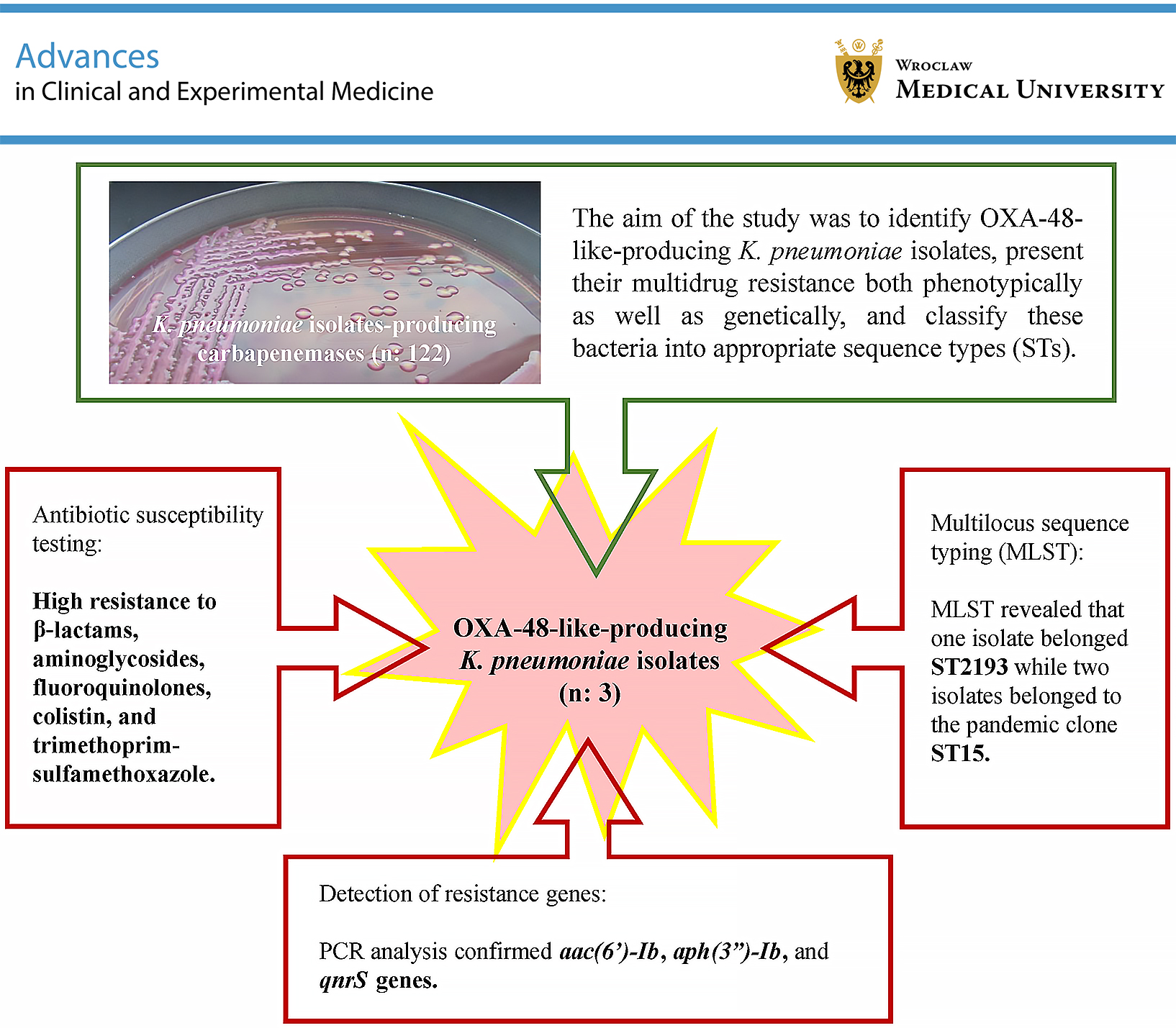
Objectives. The aim of the study was to identify OXA-48-like-producing K. pneumoniae isolates, characterize their multidrug resistance phenotypically and genetically, and classify them into appropriate sequence types (STs).
Materials and methods. The study was conducted on 3 K. pneumoniae isolates producing OXA-48 carbapenemase obtained from patients hospitalized at the University Hospital of Bialystok, Poland. Identification and antimicrobial susceptibility testing were performed using the automated VITEK 2 system and the broth microdilution method for colistin. Screening for OXA-48 production was performed using a disc containing 30 µg of temocillin. Carbapenemase production was confirmed using the Carba NP test. The presence of the blaOXA-48 gene and genes encoding resistance to quinolones (qnrA, qnrB, qnrD, qnrS) and aminoglycosides (aac(3)-Ia, aac(6’)-Ib, ant(4’)-IIa, ant(2”)-Ia, and aph(3”)-Ib) was detected using polymerase chain reaction (PCR). The ST of the isolates was determined based on sequence analysis of conserved housekeeping genes (rpoB, gapA, mdh, pgi, phoE, infB, tonB).
Results. Analysis of antimicrobial susceptibility revealed that the tested strains were resistant to all tested β-lactam antibiotics and exhibited resistance to amikacin, gentamicin, ciprofloxacin, colistin, and trimethoprim–sulfamethoxazole. Polymerase chain reaction analysis revealed the presence of the aac(6’)-Ib and aph(3”)-Ib genes encoding aminoglycoside-modifying enzymes in all OXA-48-positive strains. Among the genes encoding quinolone resistance, qnrS was detected in all tested isolates. Multilocus sequence typing (MLST) revealed that 2 OXA-48-positive strains belonged to ST15, whereas 1 isolate belonged to ST2193.
Conclusions. Two sequence types of K. pneumoniae, ST15 and ST2193, producing OXA-48 carbapenemase and exhibiting resistance to aminoglycosides and fluoroquinolones associated with the aac(6’)-Ib, aph(3”)-Ib, and qnrS genes, respectively, were identified.
Key words: Klebsiella pneumoniae, OXA-48 beta-lactamase, antimicrobial resistance, multilocus sequence typing, Poland
Background
Carbapenems are an important group of antibiotics widely used for the treatment of severe bacterial infections.1 The prevalence of carbapenem resistance among Gram-negative rods is increasing and has become a serious problem worldwide.2 Gram-negative bacteria of the species Klebsiella pneumoniae are among the most important producers of carbapenem resistance mechanisms.3 Carbapenem-resistant K. pneumoniae very often exhibits multidrug resistance to antibiotics from different groups simultaneously.4 It is well known that carbapenem-resistant K. pneumoniae usually carries resistance determinants for at least 3 groups of antibiotics: β-lactams, aminoglycosides, and fluoroquinolones. This considerably limits therapeutic options.5 Inappropriate antimicrobial treatment is associated with higher patient mortality rates.6 Infections caused by carbapenem-resistant K. pneumoniae represent a major public health challenge due to limitations in selecting appropriate treatment.7
Antibiotic resistance in K. pneumoniae strains is mediated by several mechanisms. The 1st mechanism involves the synthesis of enzymes that hydrolyze β-lactam antibiotics, known as β-lactamases, or aminoglycoside-modifying enzymes. The 2nd mechanism results from efflux pump overexpression. The 3rd mechanism, referred to as porin-mediated resistance, results from decreased cellular permeability due to the loss of outer membrane proteins (Omps). The last mechanism involves modification of the antimicrobial target site.8
The phenomenon of carbapenem resistance in K. pneumoniae is complex and may involve the production of extended-spectrum β-lactamases (ESBLs), overexpression of AmpC β-lactamase combined with the loss of porin channels, or the hydrolytic activity of carbapenemases.9
All β-lactamases constitute a large group of enzymes with considerable molecular and functional diversity. Molecular classification, based on amino acid structure, distinguishes 4 classes of these enzymes: A, B, C, and D. Carbapenemases are classified into 3 groups, including class A serine carbapenemases (Klebsiella pneumoniae carbapenemases (KPC)), class B metallo-β-lactamases (MBLs) (imipenemase (IMP), Verona integron-encoded metallo-β-lactamase (VIM), and New Delhi metallo-β-lactamase (NDM)), and class D β-lactamases (OXA-48).10
Carbapenem resistance mediated by carbapenemases in K. pneumoniae has been reported worldwide. Enzymes classified as KPC and NDM are the most frequently reported.11 In Poland, the first case of KPC was identified in 2008 among K. pneumoniae isolates obtained from a patient with a urinary tract infection.12 As of 2021, 741 cases of KPC-positive isolates had been reported, with K. pneumoniae being the major producer.13 The first case of an NDM-positive isolate was reported in 2012 in a patient with a history of international travel.14 In 2021, 3,036 cases of NDM-positive strains were detected in clinical samples obtained from different sites of infection.13 The first reported NDM-positive isolate belonged to Escherichia coli; however, K. pneumoniae was the main producer of NDM enzymes.13
Enzymes from the OXA-48 oxacillinase family are less common in Poland compared to KPC and NDM. The number of strains producing OXA-48 enzymes in 2021 was 285.13 The first OXA-48-family enzymes were isolated in 2012 from Enterobacter cloacae; however, their main producers were K. pneumoniae and E. coli.15 The least common carbapenemases are MBLs from the VIM group, with 110 positive isolates reported in 2021, and Enterobacter hormaechei, K. pneumoniae, and Klebsiella oxytoca as the main producers.13
Here, we report and describe K. pneumoniae strains carrying a rare mechanism of carbapenem resistance mediated by the class D oxacillinase OXA-48.
Objectives
The main aim of this study was to identify the presence of the blaOXA-48 gene among K. pneumoniae isolates obtained from clinical samples. Moreover, we aimed to define the antibiotic resistance profiles of OXA-48-like-producing K. pneumoniae and determine the prevalence of genes encoding other carbapenemases (blaKPC, blaIMP, blaVIM, blaNDM), as well as plasmid-mediated quinolone resistance genes (qnrA, qnrB, qnrD, qnrS). Additionally, we aimed to screen for aminoglycoside resistance genes, including aac(3)-Ia, aac(6’)-Ib, ant(4’)-IIa, ant(2”)-Ia, and aph(3”)-Ib. Finally, we aimed to determine the sequence type (ST) of the tested OXA-48-positive isolates.
Materials and methods
The study was conducted between January 1, 2015, and September 15, 2016. In 2015, 5 carbapenemase-producing K. pneumoniae isolates were identified, whereas in the first 9 months of 2016, 117 carbapenemase-producing K. pneumoniae isolates were detected. Among these isolates, only 3 were identified as OXA-48 producers.
The tested isolates were collected and processed at the Department of Microbiological Diagnostics and Infectious Immunology, Medical University of Bialystok (Białystok, Poland). The 1st strain (K. pneumoniae 1) was responsible for a bloodstream infection and was isolated from a blood sample obtained from a hematology patient in 2015. The remaining isolates were associated with gastrointestinal tract colonization. The 2nd strain was isolated from a stool sample obtained from a patient hospitalized in the hematology department in 2016, and the 3rd strain (K. pneumoniae 3) was isolated from a rectal swab collected from a patient in the intensive care unit (ICU), also in 2016. All patients were hospitalized at the University Hospital of Bialystok.
The VITEK 2 automated system (bioMérieux, Marcy-l’Étoile, France) was used for identification and antimicrobial susceptibility testing. Colistin minimum inhibitory concentration (MIC) determination was performed using Microlatest MIC Colistin tests (Erba Lachema, Brno, Czech Republic) according to the manufacturer’s protocol. The results of antibiotic susceptibility testing were interpreted according to the criteria of the European Committee on Antimicrobial Susceptibility Testing (EUCAST, 2016).16
Screening tests for carbapenemase production were performed using ethylenediaminetetraacetic acid (EDTA) for MBL detection, boric acid for KPC detection, and a disc containing 30 µg of temocillin for OXA-48 detection according to EUCAST (Version 2.0, July 2017).17 In addition, the biochemical Nordmann–Poirel carbapenemase (Carba NP) test was performed.18
Plasmid DNA was isolated from K. pneumoniae isolates after overnight cultivation at 37°C in Trypticase Soy Broth (TSB; Emapol, Warsaw, Poland) using a Plasmid Mini Kit according to the manufacturer’s instructions (A&A Biotechnology, Gdynia, Poland). Detection of blaKPC, blaIMP, blaVIM, blaNDM, and blaOXA-48 genes was performed using polymerase chain reaction (PCR) with specific primers.19 Moreover, to determine the mechanism of quinolone resistance, we amplified qnrA, qnrB, qnrD, and qnrS genes associated with plasmid-mediated quinolone resistance (PMQR).20 Additionally, we screened for aminoglycoside resistance genes, including aac(3)-Ia, aac(6’)-Ib, ant(4’)-IIa, ant(2”)-Ia, and aph(3”)-Ib.21 All PCR reactions, as well as visualization of the PCR products, were performed according to previously described protocols.19, 20
Furthermore, multilocus sequence typing (MLST) was conducted to classify K. pneumoniae strains harboring OXA-48 carbapenemase genes (blaOXA-48) based on analysis of housekeeping gene sequences (rpoB, gapA, mdh, pgi, phoE, infB, tonB) and typing profiles obtained from the MLST database.22
Results
Isolates K. pneumoniae 1 and 2 were negative in the double-disc synergy test (DDST) for extended-spectrum β-lactamases (ESBLs), whereas isolate K. pneumoniae 3 was positive in this test. All tested isolates were negative in the DDST for MBLs and in the disc-diffusion test with boronic acid for KPC detection. Moreover, all 3 tested strains were positive in phenotypic tests using a disc containing 30 µg of temocillin. Additionally, all tested strains were positive in the biochemical Carba NP test used for carbapenemase detection.
Analysis of antimicrobial susceptibility revealed that all tested strains were resistant to β-lactam antibiotics, including amoxicillin–clavulanic acid, cefepime, cefotaxime, ceftazidime, cefuroxime, and piperacillin–tazobactam. Two isolates (K. pneumoniae 1 and 2) were non-susceptible to imipenem and meropenem, with MICs > 16 µg/mL. One isolate (K. pneumoniae 3) was susceptible to imipenem and meropenem, with MICs of 2 µg/mL and 1 µg/mL, respectively. Additionally, all tested isolates were resistant to amikacin, gentamicin, ciprofloxacin, colistin, and trimethoprim–sulfamethoxazole (Table 1).
Polymerase chain reaction analysis revealed the presence of the blaOXA-48 gene in all tested K. pneumoniae strains. The aac(6’)-Ib and aph(3”)-Ib genes encoding aminoglycoside-modifying enzymes were also detected in all tested strains. Among the tested genes encoding Qnr-like proteins, only qnrS was detected in all tested K. pneumoniae strains. The identified antibiotic resistance genes of the tested K. pneumoniae strains are shown in Table 2.
MLST analysis revealed that 2 OXA-48-positive strains (K. pneumoniae 1 and K. pneumoniae 3) belonged to the pandemic clone ST15, whereas 1 strain (K. pneumoniae 2) belonged to ST2193.
Discussion
Carbapenem resistance in K. pneumoniae may result from several mechanisms, including β-lactamase activity combined with the loss of porin channels or the production of carbapenemases.23 Class D is the most diverse group of β-lactamases and is referred to as oxacillinases due to their preferential hydrolysis of isoxazolyl penicillins. Among them, carbapenemases are defined as carbapenem-hydrolyzing class D β-lactamases (CHDLs).24 CHDL enzymes have been detected mainly in bacteria of the genus Acinetobacter. Among the order Enterobacterales, the most important are oxacillinases of the OXA-48-like type. These enzymes have been identified in bacteria of various species, including K. pneumoniae, E. coli, and the Enterobacter cloacae complex.25
The first case of OXA-48-producing K. pneumoniae was detected and described in Turkey in 2001.26 To date, strains producing OXA-48 have been detected in Europe (e.g., Poland, Germany, Denmark, and France), North Africa, and the Middle East.27 We identified a rare mechanism of carbapenem resistance resulting from the production of OXA-48 oxacillinases among clinical K. pneumoniae isolates obtained from patients hospitalized at the University Hospital of Bialystok in northeastern Poland.
A positive result in the phenotypic test using a temocillin-containing disc for OXA-48 detection was genetically confirmed by demonstrating the presence of the corresponding blaOXA-48 gene. Additional analysis of the blaKPC, blaIMP, blaVIM, and blaNDM genes, which encode KPC, IMP, VIM, and NDM carbapenemases, respectively, did not reveal their presence.
The resistance profile of K. pneumoniae 1 and K. pneumoniae 2, as confirmed genetically with PCR, was consistent with their phenotypic resistance to imipenem and meropenem. In contrast, K. pneumoniae 3 showed a discrepancy, as it was phenotypically susceptible to imipenem and meropenem despite being positive for the blaOXA-48 gene. One explanation for this phenomenon may be the low carbapenem-hydrolyzing efficiency of OXA-48-type oxacillinases.28 On the other hand, defects in porin channels or rearrangements of blaOXA-48 gene promoters may be responsible for increased resistance to carbapenems. All of these factors contribute to the substantial phenotypic diversity in carbapenem resistance observed among OXA-48-producing Enterobacterales.
The additional hydrolytic activity of OXA-48-type oxacillinases includes penicillins and first-generation cephalosporins.29 Cases of strains resistant to penicillins and their combinations with β-lactamase inhibitors, while exhibiting only reduced susceptibility to carbapenems, have been reported. Susceptibility to carbapenems among Enterobacterales producing OXA-48 was also observed by Bonnin et al., who reported susceptibility rates of 75.5% for imipenem and 63.5% for meropenem.30 Moreover, our study showed that the tested isolates were resistant to other β-lactam antibiotics, including amoxicillin–clavulanic acid, cefepime, cefotaxime, ceftazidime, cefuroxime, and piperacillin–tazobactam.
Moreover, in our study, we evaluated the antibiotic susceptibility of OXA-48-producing K. pneumoniae isolates to other groups of antibiotics, including aminoglycosides, fluoroquinolones, colistin, and trimethoprim–sulfamethoxazole. We observed resistance of the tested isolates to amikacin, gentamicin, ciprofloxacin, colistin, and trimethoprim–sulfamethoxazole. The demonstrated resistance of the tested strains to multiple groups of antibiotics allows us to conclude that OXA-48 producers are multidrug-resistant strains.
Multidrug resistance among OXA-48-producing Enterobacterales was also observed by Lee et al., who reported this phenomenon among isolates obtained from patients with both nosocomial and community-acquired infections.31 Klebsiella pneumoniae isolates carrying it should be: blaOXA-48 genes and resistant to 3 or more classes of antibiotics were also reported by Kamel et al. According to their study, all isolates were resistant to amikacin and gentamicin.32 Multidrug-resistant K. pneumoniae strains exhibiting resistance to both amikacin and ciprofloxacin were also described by Takei et al.33
The results of our antimicrobial susceptibility testing correlated with the findings of the molecular analyses of antimicrobial resistance genes. Our molecular studies revealed the presence of the aac(6’)-Ib, aph(3”)-Ib, and qnrS genes, which confer resistance to aminoglycosides and fluoroquinolones in the studied isolates. Resistance to aminoglycosides and fluoroquinolones in clinical K. pneumoniae strains was also reported by Swedan et al. According to their study, ant(3″)-I and aac(6′)-Ib were the most common genes encoding aminoglycoside-modifying enzymes. Moreover, qnrS was among the most prevalent plasmid-mediated quinolone resistance
genes.34
Analyses of antimicrobial resistance genes in OXA-48-producing K. pneumoniae performed by Meng et al. revealed that aph genes (100%) were the predominant aminoglycoside resistance genes. Furthermore, qnr genes (53.4%), particularly qnrB1 and qnrS1, were the major fluoroquinolone resistance genes.35 Additionally, we classified K. pneumoniae strains harboring OXA-48 carbapenemase genes based on the results of allelic profile analysis, including the rpoB, gapA, mdh, pgi, phoE, infB, and tonB genes. MLST analysis revealed that 1 OXA-48-positive strain belonged to sequence type 2193 (ST2193) (K. pneumoniae 2), whereas 2 strains belonged to sequence type 15 (ST15) (K. pneumoniae 1 and K. pneumoniae 3).
Klebsiella pneumoniae ST2193 was reported in China by Yang et al. following a study of carbapenem-non-susceptible and hypervirulent isolates.36 However, clone ST15 is more common and, according to Peirano et al., belongs to the high-risk multidrug-resistant clones of K. pneumoniae, together with clones ST14, ST147, and ST307.37 According to Shankar et al., these clones play important roles in the global dissemination of OXA-48 enzymes.38
Limitations of the study
The main limitation of our study was the small number of isolates analyzed. Our work describes the outcomes of a preliminary study; therefore, the number of tested isolates was limited. Since carbapenem resistance caused by the production of OXA-48 enzymes is relatively rare among K. pneumoniae isolates, extending the study period could increase the number of isolates available for analysis. Moreover, this study focused only on the most frequently observed plasmid-mediated mechanisms of fluoroquinolone and aminoglycoside resistance. Further studies are needed to improve our understanding of these resistance mechanisms.
Conclusions
We present OXA-48-like-producing K. pneumoniae isolates belonging to ST15 and ST2193, exhibiting resistance to aminoglycosides and fluoroquinolones mediated by the aac(6’)-Ib, aph(3”)-Ib, and qnrS genes, respectively.
Data Availability Statement
Data sharing does not apply to this article, as all data are already included in the manuscript.
Consent for publication of personal information
Not applicable.
Use of AI and AI-assisted technologies
Not applicable.