Advances in Clinical and Experimental Medicine

Title abbreviation: Adv Clin Exp Med
Journal Impact Factor (JIF 2025) – 2.5
Journal Citation Indicator (JCI 2025) – 0.40
Scopus CiteScore (2025) – 4.2
Index Copernicus Value (ICV 2025) – 162.75
MNiSW – 70 pts
ISSN 1899–5276 (print), ISSN 2451-2680 (online)
Periodicity – monthly

Download original text (EN)

Advances in Clinical and Experimental Medicine

Ahead of print

doi: 10.17219/acem/241963

Publication type: review

Thematic category: Periodontology; cardiology; heart and cardiovascular system

Language: English

License: Creative Commons Attribution 3.0 Unported (CC BY 3.0)

Download citation:

  • BIBTEX (JabRef, Mendeley)
  • RIS (Papers, Reference Manager, RefWorks, Zotero)

Cite as:


Derwich M, Seweryn P, Martynowicz H, Trzepietowski W, Więckiewicz M. The emerging oral–heart failure axis: Mechanistic plausibility, bidirectionality, and the limits of causal evidence. A state-of-the-art review [published online as ahead of print on November 10, 2026]. Adv Clin Exp Med. 2026. doi:10.17219/acem/241963

The emerging oral–heart failure axis: Mechanistic plausibility, bidirectionality, and the limits of causal evidence. A state-of-the-art review

Marcin Derwich1,A,B,C,D,F, Piotr Seweryn1,B,C,D,F, Helena Martynowicz2,C,E,F, Wiktor Trzepietowski1,D,F, Mieszko Więckiewicz1,A,C,E,F

1 Department of Experimental Dentistry, Wroclaw Medical University, Poland

2 Department and Clinic of Diabetology, Hypertension and Internal Diseases, Institute of Internal Diseases, Wroclaw Medical University, Poland

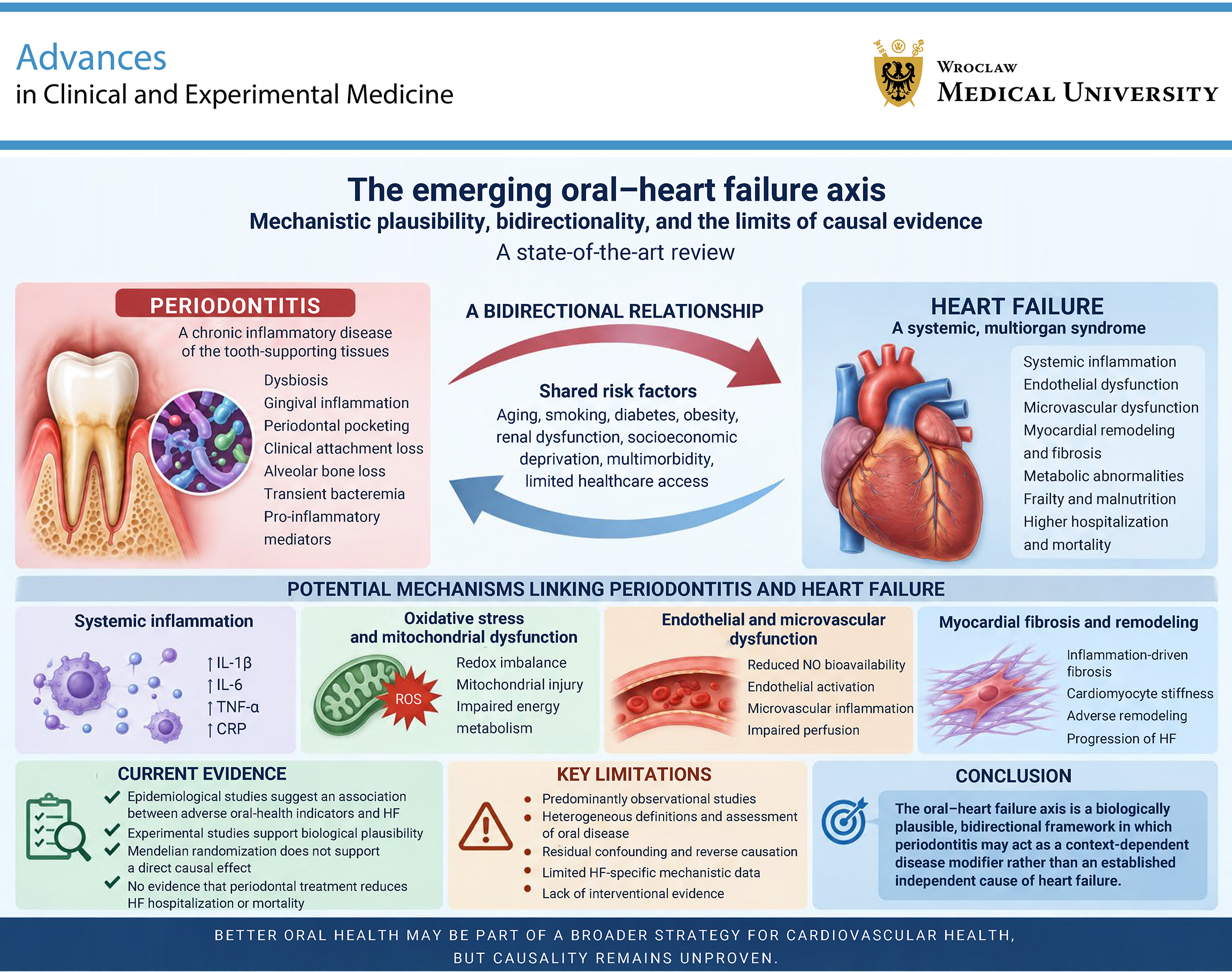
Graphical abstract


Graphical abstracts

Highlights


• Evidence supports a biologically plausible, bidirectional oral–heart failure axis, but does not establish periodontitis as an independent cause of heart failure.
• Tooth loss and edentulism show the most consistent epidemiological associations with incident heart failure, whereas findings for periodontitis remain less consistent.
• Inflammation, oxidative stress, endothelial dysfunction, coronary microvascular dysfunction, and myocardial fibrosis provide plausible mechanisms, but direct human evidence remains limited.
• Mendelian randomization does not support a direct causal effect of periodontitis on heart failure, and no completed heart failure-specific trial has established reductions in hospitalization or mortality after periodontal treatment.
• Periodontal assessment and appropriate treatment may form part of comprehensive care in patients with heart failure, but periodontal therapy cannot currently be considered heart failure-modifying treatment.

Abstract

Heart failure (HF) is a systemic, multiorgan syndrome in which inflammation, oxidative stress, endothelial dysfunction, metabolic abnormalities, and frailty contribute to disease progression. Periodontitis may represent an additional extracardiac source of inflammatory and microbial exposure, whereas HF itself may promote deterioration of oral health through frailty, malnutrition, impaired self-care, and reduced access to dental treatment. This state-of-the-art review evaluates the emerging oral–HF axis, focusing on systemic inflammation, oxidative stress and mitochondrial dysfunction, endothelial and coronary microvascular dysfunction (CMD), and myocardial fibrosis and remodeling. Epidemiological studies support associations between adverse oral-health indicators and HF, particularly tooth loss and edentulism, but findings for periodontitis are less consistent and remain vulnerable to residual confounding, reverse causation, and heterogeneous exposure definitions. Experimental studies provide biological plausibility for inflammatory, oxidative, endothelial, and fibrotic pathways, yet direct human evidence linking periodontal inflammatory burden to CMD, myocardial remodeling, or HF progression remains limited. Mendelian randomization does not currently support a direct causal effect of periodontitis on HF, and periodontal treatment has not been shown to reduce HF hospitalization or mortality. The oral–HF axis should therefore be regarded as a biologically plausible, bidirectional framework in which periodontitis may act as a disease modifier rather than an established independent cause of HF.

Key words: periodontitis, inflammation, oxidative stress, endothelial dysfunction, heart failure

Introduction

Heart failure (HF) remains a major clinical problem, affecting more than 64 million people worldwide and contributing substantially to hospitalization, disability, and premature mortality.1 Despite major progress in pharmacological and device-based treatment, its clinical course is strongly influenced by age, comorbidities, nutritional status, frailty, and dysfunction of organs outside the cardiovascular system.2, 3 This has broadened the view of HF beyond cardiac pump failure and increased interest in extracardiac factors that may contribute to disease susceptibility and progression.

One potential source of systemic inflammatory exposure is the oral cavity.4, 5, 6 It contains a complex microbial community that continuously interacts with the host immune system. Disruption of periodontal homeostasis may promote local inflammation and provide a source of microbial products, inflammatory mediators, and transient bacteremia.7, 8 Periodontitis is a dysbiosis-associated chronic inflammatory disease characterized by progressive destruction of the tooth-supporting tissues, with clinical attachment loss, alveolar bone loss, periodontal pocketing, and gingival bleeding.9 It should not be treated as equivalent to tooth loss, which is a cumulative endpoint with several possible causes, or to impaired mastication, swallowing dysfunction, and the broader construct of oral frailty. Marked tooth loss remains common among older adults despite improvements in population-level tooth retention and is associated with age, sex, education, and place of residence.10

Periodontal disease has been associated with systemic immune activation, endothelial dysfunction, altered redox regulation, and changes in host inflammatory signaling.7, 8, 11 These mechanisms are well established in the wider periodontal–cardiovascular literature and provide biological grounds for considering an oral–HF axis. Their relevance to HF, however, is less certain. Most available evidence is observational, and mechanistic plausibility does not demonstrate that periodontal inflammation independently contributes to HF development or progression.12

The question may be particularly relevant in heart failure with preserved ejection fraction (HFpEF), where aging, multimorbidity, vascular dysfunction, and systemic inflammatory activation have a prominent role in disease biology.2, 13, 14, 15 Periodontitis could represent an additional inflammatory exposure in this setting, but this possibility remains hypothetical. The available literature does not establish an independent periodontal contribution to HFpEF, and mechanisms demonstrated in atherosclerotic cardiovascular disease (CVD) cannot be directly transferred to HF.

Shared risk factors further complicate interpretation. Aging, diabetes mellitus, obesity, chronic kidney disease, smoking, socioeconomic disadvantage, and access to healthcare are associated with both poor oral health and CVD.16, 17, 18 Oral disorders may therefore act as markers of accumulated comorbidity and social vulnerability rather than direct determinants of HF. At the same time, the relationship may operate in the opposite direction. Heart failure can adversely affect oral health through impaired tissue perfusion, nutritional deterioration, frailty, cognitive impairment, polypharmacy, and reduced capacity for self-care, which may facilitate periodontal deterioration and functional oral decline.12, 19, 20, 21, 22

Several uncertainties remain. Heart failure-specific studies are limited by observational designs, heterogeneous definitions of oral disease, inconsistent periodontal assessment, and incomplete adjustment for confounding factors.8, 9, 12, 16, 17, 23 Prospective studies combining standardized oral phenotyping with detailed HF characterization, coronary microvascular assessment, and biomarker profiling are scarce. Convincing evidence that periodontal treatment improves clinically relevant HF outcomes is also lacking.

In this state-of-the-art review, we examine the proposed oral–HF axis by integrating evidence from periodontology, cardiovascular biology, immunology, and HF research. We focus on inflammation, oxidative stress, endothelial dysfunction, and coronary microvascular dysfunction (CMD) as candidate mechanisms connecting oral disorders with HF. We pay particular attention to the distinction between HF-specific observations and mechanisms extrapolated from the broader cardiovascular literature, as well as to methodological limitations that should guide future mechanistic and interventional studies.

Objectives

To critically evaluate the emerging oral–HF axis by integrating epidemiological, mechanistic, experimental, and interventional evidence, with particular emphasis on bidirectionality, biological plausibility, causal inference, and potential clinical implications.

Materials and methods

Search strategy and evidence classification

This state-of-the-art review was based on a targeted literature search focused primarily on publications from 2022 to 2026. The search was last updated on September 8, 2026. An initial core set of relevant studies was expanded through searches of MEDLINE via PubMed and the reference lists of key publications. The core search combined terms related to HF: heart failure (HF), heart failure with preserved ejection fraction (HFpEF), heart failure with reduced ejection fraction (HFrEF), heart failure with mildly reduced ejection fraction (HFmrEF), with oral and periodontal concepts (periodontitis, periodontal disease, oral health, oral microbiome, tooth loss). Additional targeted searches incorporated mechanistic terms including inflammation, oxidative stress, mitochondrial dysfunction, endothelial dysfunction, CMD, fibrosis, remodeling, frailty, and periodontal treatment. We included earlier landmark or mechanistically important studies when necessary. Studies were identified and selected iteratively as individual themes of the review were developed; predefined systematic screening criteria were not applied.

The selection of publications was guided by thematic relevance, study design, and their contributions to the epidemiology, mechanistic plausibility, bidirectionality, causal interpretation, or interventional implications of the oral–HF axis. Human studies directly examining oral or periodontal disease in relation to HF were prioritized. Broader cardiovascular evidence was used only to inform intermediate biological mechanisms when direct HF-specific evidence was limited, without equating these data with proof of an oral contribution to HF. Observational human, experimental, genetic, and interventional evidence were considered separately. The narrative synthesis considered exposure definitions, consistency, potential residual confounding and reverse causation, and relevance to HF. This targeted search was neither systematic nor exhaustive; no formal study-level risk-of-bias assessment or de novo quantitative synthesis was performed.

Results

Heart failure as a systemic multiorgan syndrome

Heart failure is increasingly understood as a systemic, multiorgan syndrome rather than an isolated disorder of cardiac pump function. Hemodynamic abnormalities, congestion, and neurohormonal activation interact with inflammation, oxidative stress, endothelial dysfunction, and metabolic disturbances, allowing cardiac and extracardiac abnormalities to reinforce one another.14, 24 Aging adds another layer through cellular senescence, mitochondrial dysfunction, impaired tissue repair, and vascular stiffening.14 Sleep fragmentation may further contribute through autonomic, hemodynamic, and metabolic stress.25

Inflammatory activation is a frequent component of HF, although it is not uniform across phenotypes or patients. Interleukin-6 (IL-6) was more consistently associated with cardiovascular mortality in HFpEF than in HFrEF, in line with a stronger contribution of comorbidity-related inflammatory activation in HFpEF.24, 26 Simple blood-derived indices also reflect this systemic component. Neutrophil-to-lymphocyte and lymphocyte-to-C-reactive protein (CRP) indices have been associated with congestion, nutritional status, physical performance, and mortality, while other complete blood count-derived indices have been proposed as accessible measures of systemic immune activity.27, 28, 29, 30 These markers remain nonspecific and should not be interpreted as evidence of a particular inflammatory source.

The comorbidity-driven model of HFpEF provides a framework for how systemic inflammation may affect myocardial function. In the Paulus–Tschöpe paradigm, obesity, diabetes, renal dysfunction, and other comorbidities promote systemic inflammation, coronary microvascular endothelial activation, oxidative stress, reduced nitric oxide (NO) bioavailability, and impaired NO–cyclic guanosine monophosphate (cGMP)–protein kinase G (PKG) signaling.13 These abnormalities may increase cardiomyocyte stiffness and contribute to remodeling. The model is biologically coherent but remains an integrative rather than fully demonstrated causal pathway. Coronary microvascular dysfunction is common in HFpEF and is associated with diastolic abnormalities and adverse outcomes, although prevalence and effect estimates depend on the diagnostic method.15

The cardiorenal axis is a key example of organ interdependence in HF. Renal dysfunction occurs across the ejection-fraction spectrum and is associated with worse symptoms, impaired health status, and poorer prognosis.14, 31 Venous congestion and neurohormonal activation may further impair renal function. In HFpEF, albuminuria, tubular-injury markers, urinary oxidative-stress products, and proteomic signatures suggest systemic vascular, inflammatory, and fibrotic involvement beyond reduced glomerular filtration3. Thus, ejection fraction and conventional cardiac biomarkers capture only part of the biological burden of HF.3, 14

Metabolic organs and adipose tissue also contribute to HF pathophysiology. Epicardial adiposity may promote local inflammatory signaling, ventricular interaction, and pericardial constraint, whereas body mass index (BMI) does not adequately capture risk related to fat distribution.32, 33 In non-diabetic patients with acute HF, a higher triglyceride–glucose index was associated with in-hospital mortality.18 Experimental metabolomic studies further link altered substrate utilization and impaired mitochondrial ATP production with adverse ventricular remodeling, although their relevance to human HF remains uncertain.34

Skeletal-muscle deterioration, malnutrition, and frailty are important components of the systemic HF phenotype. Sarcopenia, impaired muscle quality, and reduced strength are associated with poorer physical performance and prognosis.35, 36 Malnutrition and inadequate protein intake frequently coexist with inflammation and are linked to mortality, readmission, and functional dependence, although these associations vary with the method of nutritional assessment and may partly reflect reverse causation.21, 37 Frailty extends beyond physical impairment to nutritional, cognitive, and psychosocial deficits and is associated with greater hospitalization burden and reduced quality of life.19, 38, 39

The brain is also involved in this multiorgan network. Cerebral hypoperfusion, vascular injury, and inflammatory processes may contribute to cognitive dysfunction, while prospective observations indicate changes in depressive symptoms, cognitive function, and self-care behavior in patients with HF.22, 40 These abnormalities are clinically relevant because they affect patients’ ability to follow treatment recommendations, maintain adequate nutrition, and perform daily self-care.22, 40, 41 Oral hygiene and access to dental care may be affected for the same reasons.

Heart failure can therefore be viewed as a disorder in which cardiovascular dysfunction interacts with renal, metabolic, muscular, nutritional, inflammatory, and neurocognitive abnormalities. This systemic background is important when considering oral disease. Chronic periodontal inflammation may add to an already increased inflammatory and oxidative burden, whereas HF-related frailty, malnutrition, cognitive impairment, and reduced self-care may simultaneously worsen oral health. The oral–HF axis should therefore be examined within this wider multiorgan network rather than as an isolated interaction between periodontal tissues and the myocardium.12, 14, 24

Oral inflammatory and functional disorders

Oral abnormalities relevant to HF include distinct inflammatory, structural, and functional phenotypes that should not be combined under a single concept of poor oral health. Active gingival inflammation, established periodontitis, tooth loss, and impaired oral function represent different disease features or consequences and require standardized clinical assessment.9, 23, 42, 43 This distinction is particularly relevant when oral findings are interpreted as possible markers of systemic inflammatory exposure.

Periodontal inflammatory activity can be characterized beyond the diagnosis of periodontitis itself. Bleeding on probing (BOP) and periodontal inflamed surface area (PISA) reflect the extent of clinically active inflammatory tissue, whereas attachment loss and radiographic bone loss mainly describe cumulative structural damage.23 Biological studies also indicate an inflammatory and redox component of active oral disease. Salivary IL-18 decreased, and IL-35 increased after non-surgical periodontal therapy.44 Stage III periodontitis was associated with higher serum CRP and mannose-binding lectin and lower SIRT-1, although short-term treatment did not significantly change CRP or SIRT-1.45 Acute odontogenic infection was accompanied by higher salivary IL-6, macrophage inflammatory protein (MIP)-1α, and tumor necrosis factor alpha (TNF-α) and altered antioxidant enzyme activity,46 while changes in oxidative and nitrosative markers were reported during treatment of gingivitis in obese young adults.47 These observations support active local and systemic inflammatory or redox alterations in oral disease, but they do not establish cardiac involvement.

Heart failure-specific observations are more limited. Left ventricular assist device (LVAD) recipients had more missing teeth and more severe periodontitis than controls, together with limited use of interdental hygiene measures.48 In a subsequent cohort including patients with severe HF, LVAD support, or previous heart transplantation, nearly 90% of dentate participants had stage III–IV periodontitis. Higher BOP was associated with cardiac/driveline and extracardiac bacterial infections, whereas higher PISA was associated with extracardiac infection and sepsis. Neither oral variable, however, independently predicted cardiac/driveline infection or survival after multivariable analysis.17 Periodontal inflammation may therefore identify patients with advanced HF and greater clinical vulnerability, but the available data do not demonstrate an independent causal role. Broader cardiovascular evidence supports mechanistic plausibility, while periodontal intervention studies have mainly demonstrated changes in surrogate rather than clinical cardiovascular outcomes.49, 50

Oral functional deterioration represents a different, less-investigated component of this relationship. Periodontitis is associated with poorer oral-health-related quality of life and functional limitation, and advanced disease can be accompanied by tooth loss and impaired mastication.9, 51 Edentulism and absence of functional dentition remain common in older populations.10 Xerostomia, plaque accumulation, and impaired oral care are also frequent during critical illness.42, 52 Such abnormalities could contribute to nutritional vulnerability, although studies of oral nutritional supplementation in HF have focused on anorexia and malnutrition rather than dental or masticatory causes of reduced intake.53 Prospective HF studies combining standardized assessment of periodontal inflammatory burden with oral function, nutritional status and frailty are still missing.

Epidemiological evidence for the oral–heart failure association

Heart failure-specific epidemiological evidence remains less extensive than that available for atherosclerotic CVD. Most studies are observational and have assessed periodontitis, tooth loss, edentulism, dental attendance, or oral-hygiene behaviors, while studies testing whether oral interventions influence HF outcomes are virtually absent.54

In the Atherosclerosis Risk in Communities (ARIC) cohort, periodontal disease was associated with incident HFrEF, whereas the association with HFpEF was weaker and statistically inconclusive. Edentulism showed stronger associations with both HF phenotypes, with approximately twofold higher risks after adjustment for cardiovascular risk factors and biomarkers.55 These findings suggest that cumulative oral-health deterioration may be more strongly associated with HF than periodontitis considered as a single exposure.

Large South Korean cohorts provide further observational evidence. In a cohort of 161,286 adults without HF at baseline, toothbrushing at least 3 times a day was associated with modestly lower HF incidence in a fully adjusted model (hazard ratio (HR) = 0.88, 95% confidence interval (95% CI): 0.83–0.94), whereas professional dental cleaning was not statistically significant after adjustment for all oral-health variables (HR = 0.94, 95% CI: 0.89–1.01). At least 22 missing teeth were associated with greater HF incidence (HR = 1.31, 95% CI: 1.11–1.55).16 Among adults with type 2 diabetes, extensive tooth loss was associated with incident HF, with modest associations reported for oral-hygiene behaviors.56 A separate nationwide cohort of 4,440,970 adults reported a graded association of tooth loss with incident HF (adjusted HR = 1.016, 95% CI: 1.013–1.019, per additional missing tooth).57 These behavioral and structural oral-health indicators are nonspecific and do not demonstrate periodontal causality.

The interpretation of this association is less straightforward. Tooth loss is not specific to periodontitis and may result from periodontal disease, dental caries, or both. It also accumulates with aging and is associated with smoking, diabetes, socioeconomic disadvantage, access to dental care, and long-term health behaviors.10 Edentulism and extensive tooth loss may therefore reflect cumulative oral and systemic vulnerability rather than ongoing periodontal inflammatory activity.

Data from patients with established HF are fewer. In stable HFrEF, moderate or severe periodontitis was common, and greater periodontal severity was associated with higher N-terminal prohormone of brain natriuretic peptide (NT-proBNP) concentrations in a subgroup of younger patients.58 Among older adults hospitalized with acute HF, oral-health problems coexisted with malnutrition, cognitive impairment, and reduced physical function. Poorer oral status also predicted deterioration in activities of daily living during hospitalization.59 These observations indicate that oral abnormalities are frequent in clinically vulnerable HF populations, but they do not establish whether oral disease contributes to HF severity or mainly accompanies advanced systemic disease.

Residual confounding remains difficult to exclude. Several determinants of poor oral health also increase HF risk, and this problem is particularly relevant when oral exposures are based on self-report, dental claims, or administrative records rather than standardized clinical examination. Reverse causation is equally plausible, because frailty, malnutrition, cognitive impairment, and functional dependence may reduce oral hygiene, dental attendance, and access to treatment in patients with HF.20, 60

Comparison between studies is further complicated by differences in periodontal assessment. Periodontitis has been defined using full-mouth examination, partial recording protocols, probing depth, clinical attachment loss, self-report, or insurance diagnoses.61 These approaches do not measure the same phenotype and may partly explain differences in reported associations.

Current epidemiological evidence therefore supports an association between adverse oral-health indicators and HF, with the most reproducible findings concerning tooth loss and edentulism. Evidence for periodontitis as an independent HF risk factor is less consistent. Associations observed for oral-hygiene behaviors are also difficult to separate from socioeconomic status, healthcare use, and other health-related behaviors. At present, epidemiological data do not establish causality. Table 116, 54, 55, 56, 57, 58, 59 summarizes the main HF-specific epidemiological evidence linking periodontal and oral health with HF, along with its key limitations and implications for the oral–HF axis.

Biological pathways linking oral disease with heart failure

Oral dysbiosis, microbial translocation, and functional alterations of the oral microbiome

A mechanistic interpretation of the oral–HF association starts at the periodontal biofilm, where dysbiosis reflects community-level interactions rather than the action of a single pathogen.62, 63 This ecological perspective is increasingly incorporated into cardiovascular models of the oral microbiome.64, 65 Antimicrobial adjuncts support a microbial contribution to periodontal disease but do not identify a systemic route,66 while treatment-related cytokine and serum biomarker changes do not demonstrate microbial translocation.44, 45

Interpretation of microbiome studies requires caution because microbial profiles depend on sampling and analytical methods; moreover, different oral niches are not interchangeable measures of exposure, and taxonomic composition does not necessarily reflect microbial activity.65

Direct characterization of the oral microbiome in HF has only recently begun. In a case–control study of 63 patients with HF and 31 controls, HF status and New York Heart Association (NYHA) class were associated with differences in supragingival bacterial and fungal community structure.67 Rather than a generalized loss of microbial diversity, HF was characterized by specific bacterial and fungal signatures and altered bacterial–fungal co-abundance relationships, some of which were associated with more advanced NYHA class.67 Functional differences were inferred rather than directly measured, and the cross-sectional design precluded determination of directionality.

A further HF-specific study found differences in oral microbial profiles associated with emotional disorders and systemic inflammatory indices.68 Together, these small cross-sectional studies indicate variation of the oral ecosystem across HF populations but do not establish a general HF-specific microbial signature or directionality.67, 68

Systemic exposure becomes more plausible when periodontal barrier integrity is compromised. Pocket formation increases epithelial permeability, while PISA estimates the extent of inflamed pocket epithelium exposed to the subgingival biofilm.69, 70 Porphyromonas gingivalis lipopolysaccharide (LPS) and gingipain are biologically relevant bacterial components,71, 72 but experimental reconstruction of these components does not demonstrate their passage through the human periodontal barrier. Transient bacteremia after periodontal procedures or tooth brushing provides direct human evidence that the periodontal barrier can be crossed.73, 74 Procedure-related bacteremia is considered in dental recommendations for patients with vascular prostheses, but does not imply persistent bloodstream infection.75 Detection of periodontal bacterial DNA in blood provides additional evidence of systemic exposure, but bacterial DNA does not indicate viable bacterial dissemination.76 Human studies have also associated periodontitis and periodontal inflammatory burden with circulating LPS/endotoxemia, although systemic endotoxin is not specific to an oral source.77, 78, 79 Overall, bacteremia and circulating microbial products remain plausible oral–cardiovascular routes, but evidence is substantially stronger for CVD in general than for HF specifically.8, 64, 65

Altered oral microbial function may provide a complementary mechanism that does not require dissemination. The enterosalivary nitrate–nitrite–NO pathway partly depends on oral nitrate-reducing bacteria and may contribute to vascular homeostasis.80 Dysbiosis may therefore involve not only acquiring pro-inflammatory properties but also losing beneficial microbial functions. In 9 older patients with HFrEF and nine age-matched controls, oral nitrate-reducing capacity and salivary nitrite concentrations were lower in HFrEF.81 Across the combined cohort, nitrate-reducing capacity correlated with measures of aerobic capacity, although these associations were not significant when groups were analyzed separately.81 The study did not sequence the microbiome, demonstrate differences in circulating nitrite, or assess endothelial or coronary microvascular function. It therefore supports impaired oral nitrate-reducing function in HFrEF, but not a proven pathway to systemic NO deficiency or vascular dysfunction.

For HF, these observations do not yet form a demonstrated causal chain. Severe periodontitis was associated cross-sectionally with HF with reduced or mildly reduced ejection fraction, but not with HFpEF or HF overall.82 Gut-microbiome studies show that microbe-derived signals can reach the circulation and participate in HF-related immune pathways,83, 84 but cannot establish an oral source, while human evidence remains mixed on whether inflammation is a causal driver of HF rather than a marker or response to disease.85 Recent HF-specific studies suggest altered oral bacterial and fungal community structure and preliminary evidence of impaired nitrate-reducing function.67, 68, 81 A useful working model may therefore distinguish a potential pathogenic gain of function, involving barrier disruption and intermittent microbial exposure, from a potential homeostatic loss of function, involving impairment of physiological activities such as nitrate reduction. Whether these processes modify HF, result from HF, or operate bidirectionally remains unresolved; their most immediate mechanistic implication is possible convergence on systemic immune-inflammatory pathways.

Systemic inflammation and immune activation

One potential consequence of periodontal barrier disruption is amplification of systemic immune-inflammatory activity. Cumulative periodontal inflammatory burden, quantified by periodontal inflamed surface area, has been associated with circulating CRP.86 Similarly, in a multicentre study of systemically healthy individuals, periodontal treatment reduced serum IL-6 and high-sensitivity CRP (hsCRP), with changes in periodontal inflamed surface area particularly related to changes in IL-6.87 These findings link the extent of active periodontal inflammation with systemic inflammatory activity, although reductions in nonspecific biomarkers after treatment do not establish periodontitis as an independent causal source of systemic inflammation.

A more direct oral–cardiac route may coexist with this systemic pathway. Experimental evidence indicates that translocation of P. gingivalis to atrial tissue can be accompanied by increased IL-6, galectin-3, and transforming growth factor (TGF)-β1 signaling and greater fibrosis, while human observations have associated atrial P. gingivalis burden with atrial fibrosis.88 However, these findings come from an odontogenic infection model and patients with atrial fibrillation (AF) rather than HF, so they support biological plausibility without demonstrating an oral microbial contribution to HF remodeling.

Periodontal-derived inflammatory or microbial stimuli could also converge on innate immune pathways already implicated in HF.7, 24, 89 Pattern-recognition signaling can activate NF-κB (nuclear factor kappa-light-chain-enhancer of activated B cells) and the NLRP3 (NLR family pyrin domain containing 3) inflammasome, promoting caspase-1-dependent maturation of IL-1β and IL-18 and downstream IL-6-mediated acute-phase responses.24, 90 Experimental studies support a functional role of this pathway in cardiac injury: in a mouse model of structural cardiomyopathy, genetic deletion of Nlrp3 reduced caspase-1 activation and circulating IL-1β and improved systolic function, while IL-1 receptor blockade attenuated myocardial inflammation and dysfunction.91 These findings demonstrate that inflammasome-dependent signaling can contribute to cardiac dysfunction, but they do not identify periodontal inflammation as the initiating stimulus.

In HFpEF, inflammation may arise from aging, obesity, diabetes, and renal dysfunction,14, 92, 93 while circulating mediators and immune-cell abnormalities cannot identify its source.26, 85, 94 Interventional evidence confirms the biological relevance of inflammatory signaling.95 In CANTOS, IL-1β inhibition with canakinumab was associated with a dose-dependent trend toward fewer HF hospitalizations among patients with previous myocardial infarction (MI) and residual inflammatory risk.96 However, the HF analysis was exploratory; the population was not selected for established HF, and the findings provide no evidence that the inflammatory activity being modified originated from periodontal disease.

A more appropriate interpretation may therefore be an additive inflammatory-burden model. Periodontal inflammation need not initiate HF to be biologically relevant; persistent exposure to inflammatory mediators, microbial components, or intermittent bacteremia could hypothetically add to inflammation generated by HF-related comorbidities. Such convergence may be particularly plausible in HFpEF, where multiple extracardiac stressors are thought to promote systemic inflammation and vascular dysfunction.

Collectively, the available evidence supports a biologically coherent framework in which active periodontal inflammation may contribute to systemic immune-inflammatory activity, while microbial dissemination provides an additional potential route of oral–cardiac communication.86, 87, 88 Separately, experimental and clinical data show that innate immune pathways, particularly NLRP3–IL-1 signaling, can contribute to myocardial dysfunction and HF-related outcomes.85, 91, 96 The critical missing link is prospective evidence connecting quantified periodontal inflammation or microbial exposure with systemic immune activation and subsequent HF development or progression. The inflammatory component of the oral–HF axis should therefore be regarded as mechanistically plausible, but not as an established causal pathway.

Oxidative stress and mitochondrial dysfunction

Oxidative stress is increasingly recognized as a component of periodontal tissue injury, reflecting excessive reactive oxygen species (ROS) generation relative to antioxidant and repair capacity. In periodontitis, neutrophil activation, inflammatory signaling, and NADPH oxidases contribute to ROS production, while antioxidant systems including SOD1, GPX1, and thioredoxin-related pathways may be impaired.97, 98, 99, 100 This redox imbalance is detectable beyond periodontal tissues. Patients with periodontitis show higher circulating oxidative stress indices and lower antioxidant capacity, and periodontal inflamed surface area is independently associated with systemic oxidative stress.101 Serum and salivary malondialdehyde (MDA) and 8-oxo-2’-deoxyguanosine (8-OHdG) may decrease after periodontal therapy, although changes in antioxidant enzymes are inconsistent across populations and disease grades.102, 103 Meta-analytic data therefore support a systemic oxidative signature of periodontitis but also substantial biomarker heterogeneity and limited source specificity.98, 104

Mitochondria may amplify periodontal redox injury. Experimental and human periodontal data indicate mitochondrial Ca2+ overload, increased signaling involving voltage-dependent anion channel 1 (VDAC1) and the mitochondrial calcium uniporter (MCU), mitochondrial DNA (mtDNA) leakage, impaired oxidative phosphorylation, defective PTEN-induced kinase 1 (PINK1)-dependent mitophagy, and increased mitochondrial reactive oxygen species (mtROS).105, 106, 107, 108 Porphyromonas gingivalis can also promote dynamin-related protein 1 (Drp1)-dependent mitochondrial fission, loss of membrane potential, and adenosine triphosphate (ATP) depletion in vascular cells, providing a plausible cardiovascular bridge without demonstrating myocardial injury.109

Cardiac effects remain predominantly preclinical. Experimental periodontitis has been associated with cardiac lipid peroxidation, increased 8-OHdG, oxidative stress, and mitochondrial DNA damage,110, 111 while antioxidant interventions attenuated cardiac redox abnormalities.11, 112 Complementary experiments using P. gingivalis LPS demonstrated cardiac oxidative stress associated with toll-like receptor 4 (TLR4)–NADPH oxidase 4 (NOX4) signaling and increased xanthine oxidase expression, accompanied by cardiomyocyte apoptosis, myocardial fibrosis, and systolic dysfunction. These changes were attenuated by pharmacological inhibition of TLR4 or treatment with allopurinol.113, 114 These models support biological plausibility but do not reproduce chronic human periodontitis.

More disease-proximal evidence comes from experimental HFpEF, where P. gingivalis-associated periodontitis aggravated diastolic dysfunction and myocardial injury, although mitochondrial function was not directly assessed.115 Mitochondrial dysfunction is, however, well established in HF. Human advanced HF myocardium shows impaired oxidative capacity associated with inflammation,116 while experimental HFrEF and HFpEF models demonstrate impaired respiration, ATP production, increased mtROS, and defective mitophagy.34, 117 Human HFpEF proteomics further supports disruption of mitochondrial organization and oxidative phosphorylation.118 Altered redox regulation and immunometabolic signaling provide additional mechanistic context.119, 120, 121, 122, 123

Collectively, periodontitis is associated with local and systemic redox imbalance and increasingly with mitochondrial dysfunction, while experimental oral inflammatory exposures can induce cardiac oxidative injury. Nevertheless, direct human evidence that periodontitis causes myocardial mitochondrial dysfunction and thereby accelerates HF remains lacking.

Endothelial and microvascular dysfunction

Endothelial dysfunction may represent a vascular interface between periodontal inflammation and HF. Periodontitis is associated with impaired peripheral endothelial function, and periodontal therapy may improve flow-mediated dilation (FMD) despite heterogeneity.124, 125, 126, 127 However, FMD reflects conduit-artery responsiveness rather than coronary microvascular function, and periodontal intervention studies have not assessed coronary flow reserve, myocardial blood flow, invasive microvascular resistance, or HF outcomes.124, 125, 126, 127

Experimental data provide a mechanistic bridge. Porphyromonas gingivalis can impair endothelial redox and NO signaling and promote endothelial activation and mitochondrial dysfunction.109, 128, 129 These findings support biological plausibility but remain predominantly preclinical.

This mechanism may be relevant to HFpEF, where comorbidity-driven systemic inflammation has been proposed to induce coronary microvascular endothelial activation, oxidative stress, reduced NO bioavailability, and impaired NO–cGMP–PKG signaling, thereby increasing cardiomyocyte stiffness and remodeling.13 Human myocardial studies support key elements of this paradigm, demonstrating increased endothelial E-selectin and intercellular adhesion molecule 1 (ICAM-1) expression, NADPH oxidase 2 (NOX2)-related oxidative stress, endothelial nitric oxide synthase (eNOS) uncoupling, and reduced myocardial cGMP–PKG activity.130 Systemic endothelial dysfunction has also been associated with subsequent HF development,131 while impaired endogenous NO production occurs in HFrEF as well,132 indicating that endothelial injury is not specific to HFpEF. Contemporary data further show immuno-hemostatic abnormalities in HFpEF, but circulating endothelial markers are not uniformly elevated.133

Coronary microvascular dysfunction is nevertheless common in HFpEF. PROMIS-HFpEF reported impaired coronary flow reserve in 75% of patients and linked it with systemic endothelial dysfunction, albuminuria, NT-proBNP, and HF severity.134 Positron emission tomography (PET) studies associated impaired coronary flow reserve with worse diastolic function and future HFpEF hospitalization,135 and follow-up data linked CMD with HF-related events.136 A meta-analysis estimated CMD in approx. 58% of HFpEF patients and associated it with more severe diastolic dysfunction and higher risk of death or HF hospitalization.15 Importantly, CMD includes both endothelium-dependent and endothelium-independent abnormalities.137 Human tissue studies also demonstrate coronary microvascular rarefaction associated with myocardial fibrosis.138

Direct oral–HFpEF evidence remains preclinical. In mice, P. gingivalis-associated periodontitis reduced NO bioavailability, worsened diastolic dysfunction, decreased coronary microvascular density, and increased inflammation and fibrosis.115 Human studies of peripheral endothelial function in periodontitis and studies of CMD in HFpEF arise from distinct populations and assess different vascular outcomes. Brachial flow-mediated dilation does not directly measure coronary microvascular function. No human study identified in this review establishes that clinically quantified periodontal inflammatory burden causes CMD in HFpEF or that periodontal therapy improves coronary microvascular function or HF outcomes.115, 124, 125, 126, 127

Cardiac fibrosis and remodeling

The inflammatory, oxidative, mitochondrial, and microvascular abnormalities discussed above may ultimately converge on structural cardiac remodeling. This process includes cardiomyocyte hypertrophy, cardiac fibroblast activation, altered extracellular matrix (ECM) turnover, and interstitial fibrosis, which increase myocardial stiffness and may impair ventricular function.139 Systemic inflammation, immune-cell activation, aging, inflammasome signaling, and mitochondrial dysfunction can contribute to these changes,14, 24, 85, 116, 140, 141, 142 while fibroadipogenic progenitor cells may represent an additional cellular component of profibrotic remodeling in failing human myocardium.143 In HFpEF, inflammation, endothelial dysfunction, congestion, and fibrosis frequently coexist and may reduce ventricular compliance and functional reserve.3, 144 AMPK-, PI3K–AKT-, and Nrf2-related pathways further link hypertrophic, metabolic, and redox responses, although their clinical relevance to HFpEF remains uncertain.120, 145, 146

Periodontitis could add to this profibrotic environment by increasing systemic inflammatory and oxidative burden. Periodontal studies have demonstrated alterations in CRP, SIRT-1, antioxidant defense, and paraoxonase-1 activity, with smoking modifying some treatment-related biomarker responses.45, 97, 147 Human cardiac data remain limited. In patients with controlled hypertension, greater periodontal inflammatory burden, as quantified by PISA, was associated with mild alterations in global longitudinal strain, although the clinical significance remains uncertain.148 In Multi-Ethnic Study of Atherosclerosis (MESA), self-reported periodontal disease was associated with a small increase in myocardial extracellular volume fraction in men, but not in women, and was not associated with myocardial scar.149 A large population-based study subsequently found small differences in left ventricular (LV) volumes, mass, and function across periodontal measures and disease stages.150 These associations remain susceptible to residual confounding and reverse causality.

Experimental evidence is more consistent. Persistent periodontitis intensified post-MI fibrosis in mice through expansion of collagen-producing SiglecF+ neutrophils and activation of cardiac fibroblasts.151 In a murine HFpEF model, periodontitis increased myocardial inflammation, interstitial and pericapillary fibrosis, coronary microvascular rarefaction, and diastolic dysfunction.115 Together, these findings support a disease-modifying model in which periodontal inflammation may amplify remodeling when the myocardium is already exposed to pathological stress, rather than initiating fibrosis independently.

Cardiac remodeling can partially regress during contemporary HF treatment, and sustained reverse remodeling occurs in a subset of patients with HFrEF.139, 152, 153 Serial CMR with T1 mapping and extracellular volume assessment provides a noninvasive approach to quantify diffuse myocardial fibrosis over time.154 Periodontitis should therefore be regarded as a potential additional contributor to the inflammatory-fibrotic burden, not as a proven cause of myocardial fibrosis. Future studies should combine standardized periodontal phenotyping with CMR, myocardial strain imaging, circulating fibrosis markers, and repeated HF characterization.

Phenotype-specific and bidirectional nature of the oral–HF axis

The oral–HF axis is unlikely to be uniform across HF phenotypes or disease stages. HFpEF is characterized by aging, multimorbidity, systemic inflammation, and CMD, providing a plausible setting in which periodontal inflammation could act as an additional extracardiac stressor.13, 15, 26, 155 Human data, however, do not consistently support greater periodontal susceptibility in HFpEF. Periodontitis was more clearly associated with HFrEF than HFpEF in ARIC, while severe periodontitis was associated with prevalent HFrEF/HFmrEF but not HFpEF in another population study; periodontal severity has also been linked to NT-proBNP in stable HFrEF.55, 58, 82 Experimental periodontitis worsens HFpEF through inflammatory, microvascular, and fibrotic pathways, whereas reduced oral nitrate-reducing capacity in HFrEF suggests that HF phenotype may also influence oral microbial function.81, 115

The relationship may also operate in the opposite direction. Advanced HF and LVAD populations frequently show substantial periodontal disease and impaired oral-health behavior.17, 48 More recently, HF was associated with greater oral-health burden in UK Biobank, while pressure-overload HF induced gingival inflammation and impaired periodontal remodeling in mice.12 Broader dental cohorts suggest that systemic disease burden may accompany poorer periodontal status, although findings are inconsistent.156, 157 Xerostomia may represent another reverse pathway: in 371 patients with chronic HF, 64.8% reported xerostomia, with fluid restriction, thirst, edema, and treated diabetes associated with greater symptom intensity.158 Diabetes-related xerostomia is independently associated with poorer oral-health-related quality of life.159 Cognitive impairment and declining self-care may further compromise oral maintenance.22, 40, 160

Frailty and nutritional deterioration may amplify this bidirectional interaction. Sarcopenia, malnutrition, reduced protein intake, and functional dependence are common in HF and are associated with prognosis.19, 20, 21, 39 Contemporary data further support nutritional impairment and substantial hospitalization burden in HF populations.161, 162 In older adults, tooth loss, unmet prosthetic needs, and oral symptoms may accompany functional vulnerability and reduce oral-health-related quality of life.163, 164 Nevertheless, these studies do not establish that oral functional deterioration independently accelerates HF progression. Heart failure-specific longitudinal studies that combine standardized periodontal assessment with oral function, nutrition, frailty, and clinical outcomes are still needed.

Overall, the oral–HF axis is better viewed as a dynamic, phenotype- and stage-dependent bidirectional interaction. Oral inflammation may increase systemic stress, whereas established HF may progressively worsen periodontal and oral function. Prospective studies with repeated oral and cardiac phenotyping are required to determine the temporal sequence and relative contribution of both directions.

Periodontal treatment and clinical implications in heart failure

The potential systemic relevance of periodontal therapy should be distinguished from its established local efficacy. Non-surgical treatment consistently reduces probing depth and bleeding on probing, including in patients with systemic comorbidities.165 Adjunctive approaches such as melatonin or local drug delivery may further improve selected periodontal endpoints, but their effects remain treatment-specific.166, 167 Changes in inflammatory biomarkers after non-surgical therapy also confirm that periodontal inflammation is biologically modifiable.44, 45 Local treatment success, however, does not itself demonstrate cardiovascular or HF benefit.

The strongest systemic intervention signal concerns CRP and IL-6. Meta-analyses of randomized trials support reductions in CRP and, less consistently, IL-6 after periodontal treatment,168, 169 while multicenter data relate reduced periodontal inflammatory burden to changes in IL-6 and hsCRP.87 Responses are heterogeneous and time-dependent, varying with sampling interval and patient phenotype.170 A recent meta-analysis found the apparent CRP effect more convincing in uncontrolled pre–post comparisons than in limited controlled evidence,171 while a randomized type 2 diabetes mellitus (T2DM) study showed numerical but nonsignificant between-group reductions in hsCRP and IL-6 despite substantial periodontal improvement.172 Treatment protocols may also influence biomarker trajectories.173 Thus, periodontal therapy can modify selected systemic inflammatory markers, but these changes should not be equated with reduced HF risk.

Redox effects remain uncertain: periodontal therapy can modify selected oxidative-stress markers,45, 47, 174, 175, 176 but antioxidant responses are inconsistent,177 and no study demonstrates reduced myocardial oxidative stress in HF.

Vascular outcomes remain surrogate. Periodontal therapy may improve FMD and arterial stiffness,124, 125, 126, 127 but findings are inconsistent,178 and clinical cardiovascular benefit remains unproven.179 Flow-mediated dilation should not be interpreted as evidence of improved coronary microvascular function or HF prognosis.

Heart failure-related biomarkers and cardiac functional measures remain sparse. In patients without established HF, periodontal treatment reduced NT-proBNP,180 while a randomized study in T2DM showed a modest improvement in E/e’ without changes in LV mass index; reductions in NT-proBNP, hsCRP, and IL-6 were not significant between groups.172 These findings indicate biomarker or functional modulation rather than HF treatment. Direct HF evidence is limited to a small uncontrolled pilot in patients with congestive HF and periodontitis, in which NT-proBNP and TNF-α changed after treatment181; concomitant HF therapy precluded causal attribution. Cross-sectional associations between periodontitis and NT-proBNP provide context only.58 Current data therefore do not demonstrate modification of the HF phenotype.

Evidence remains insufficient to establish whether periodontal therapy modifies clinical HF outcomes. Periodontal treatment has not demonstrated reductions in major cardiovascular events or mortality in interventional or observational studies,182, 183 while favorable findings for AF recurrence remain non-randomized and disease-specific.184 No completed trial has shown that periodontal therapy reduces HF hospitalization or mortality.185, 186 Importantly, this absence of demonstrated benefit should not be interpreted as evidence that periodontal treatment has no effect on these outcomes. Rather, adequately powered HF-specific trials with sufficient follow-up and clinical endpoints have not yet been completed.

This lack of HF-modifying evidence does not make oral care clinically irrelevant. Heart failure-specific observations associate oral-hygiene-related characteristics with HF status,187 while dental cohorts demonstrate a high prevalence of systemic comorbidity and support structured medical-history assessment.156, 188 Clinical examination remains necessary even when self-reported periodontal symptoms are informative,157 and advanced HF or critical illness may further complicate oral care.48, 52 Treatment should remain proportionate: systemic antibiotics did not improve uncomplicated early healing after regenerative periodontal surgery,189, 190 local adjuncts mainly affect periodontal endpoints,167 and oral surgery may itself provoke a transient systemic inflammatory response.191, 192 The high healthcare burden of HF supports coordinated management of relevant extracardiac disease,162 while systemic and nutritional determinants of periodontal status caution against attributing biomarker changes solely to dental intervention.193 Contemporary cardiovascular guidance also does not recognize periodontal treatment as a proven strategy to reduce cardiovascular events.186 A dedicated randomized trial, Periodontitis Treatment and Heart Failure (NCT07036289), is currently evaluating whether periodontal therapy can influence NT-proBNP in patients with HFrEF/HFmrEF.194 Although this study will not establish effects on hospitalization or mortality, it represents an important step toward testing the oral–HF hypothesis in a disease-specific interventional setting. Periodontal therapy in HF should therefore be regarded as appropriate treatment of oral inflammatory disease, while its role as an HF-modifying intervention remains investigational.

Table 287, 127, 168, 169, 172, 178, 180, 181, 182, 183, 184, 194 summarizes selected periodontal intervention studies and their relevance to HF.

Discussion

From association to causation: Current evidence, limitations, and future directions

The epidemiological association between periodontal disease and HF is increasingly reproducible, but reproducibility does not establish causality. Prospective studies report associations with incident or prevalent HF.54, 55, 82 Leelaviwat et al. reported a pooled odds ratio (OR) of 1.58 (95% CI: 1.15–2.18) across 3 cohort studies including 17,807 participants, with substantial heterogeneity (I2 = 78.4%).195 A subsequent meta-analysis of 7 cohorts comprising more than 370,000 participants reported a similar crude pooled association, risk ratio (RR) of 1.58 (95% CI: 1.20–2.07), but with very high heterogeneity (I2 = 93.8%).196 Adjusted estimates were not pooled because individual studies differed substantially in covariate selection and model specification.196 Pooled OR and crude RR should not be treated as interchangeable, and neither estimate alone establishes an independent causal effect. The included studies also varied in periodontal and HF definitions and in whether HF was incident or prevalent. These findings support a reproducible epidemiological signal, but its magnitude is sensitive to study design, periodontal definition, population characteristics, and analytical approach.

A major problem is the inconsistent definition of periodontal exposure. Studies use full-mouth examination, partial recording, administrative diagnoses, self-reported symptoms, tooth loss, edentulism, toothbrushing, or dental attendance, although these measures are not biologically equivalent. Self-reported measures have limited sensitivity for clinically defined periodontitis,197 questionnaire performance varies across populations,198 and partial-mouth protocols can alter prevalence and risk associations.199 Contemporary staging and grading also show incomplete agreement,200 supporting the need for standardized phenotyping.201 Tooth loss may show stronger associations with HF than clinically defined periodontitis,55 but also reflects aging, caries, smoking, diabetes, socioeconomic factors, and dental history; thus, stronger associations with edentulism do not imply greater effects of active periodontal inflammation.

Confounding further limits interpretation. Periodontitis and HF share aging, smoking, diabetes, obesity, renal dysfunction, socioeconomic deprivation, multimorbidity, and limited healthcare access.8, 14, 202 Periodontal disease predicted later CVD and vice versa despite extensive adjustment,203 while PAROKRANK showed a modest adjusted association with cardiovascular events.204 Residual confounding may persist because adherence, nutrition, lifetime smoking exposure, and healthcare-seeking behavior are measured imperfectly,203 with healthy-user effects particularly relevant to preventive dental behaviors.205 Causal diagrams may help distinguish confounders, mediators, and colliders,206 while negative controls may detect residual behavioral bias.207

Directionality is also uncertain. Heart failure may worsen oral health through frailty, medication burden, impaired self-care, nutritional decline, and reduced access to dental treatment. Longitudinal evidence supports reverse directionality, with CVD predicting later periodontal disease,203 and HF associated with gingival inflammation and impaired periodontal remodeling.12 Observed associations may therefore reflect an oral contribution to HF, a consequence of HF, shared vulnerability, or combinations of these processes.

Mendelian randomization (MR) offers a complementary approach to causal inference but depends on valid genetic instruments and an accurate representation of the exposure. Chen et al. reported no statistically significant MR association between genetically proxied acute or chronic periodontitis and HF.54 The exposure datasets included 367 acute and 3,046 chronic periodontitis cases, with 10 and 16 genetic instruments, respectively, selected using a relaxed association threshold (p < 5 × 10–6); reported F-statistics exceeded 10. Inverse-variance weighting (IVW) was supplemented by MR-Egger, weighted median, mode-based, heterogeneity, pleiotropy, and leave-one-out analyses. However, nonsignificant sensitivity tests do not establish that all instrumental-variable assumptions hold.54 Similar null findings have been reported for coronary atherosclerosis,208 and a recent systematic review found limited evidence for direct causal effects across systemic outcomes.209 These results weaken a simple model in which periodontitis independently causes HF, but do not exclude clinically relevant effects. Genetically proxied periodontal diagnoses do not match clinically quantified inflammatory burden, such as bleeding on probing or periodontal inflamed surface area. Limited case numbers, exposure misclassification, possible horizontal pleiotropy, ancestry restrictions, and limited power to detect modest effects constrain interpretation. The null MR findings weaken a simple independent causal account but do not exclude context-dependent modification of HF in patients with active periodontal inflammation. Better genetically instrumented periodontal phenotypes and triangulation with prospective and interventional studies are needed.210, 211, 212, 213, 214

Periodontal genome-wide association studies (GWAS) often rely on self-reported painful gums, bleeding gums, or loose teeth rather than standardized inflammatory phenotypes,210 so instrument strength does not ensure biological fidelity. Pleiotropy, ancestry, sample overlap, and phenotype definition remain important,211, 212 and shared genetic loci may coexist with a null direct MR estimate.213 Hypertension provides a useful comparator, where MR and periodontal intervention have been combined within a stronger triangulation framework214; comparable evidence is not yet available for HF.

Mechanistic plausibility should be distinguished from causal completion. Periodontitis is associated with systemic inflammation; periodontal treatment can modify selected inflammatory markers,86, 87 and inflammatory pathways contribute to HF biology.85, 96 These observations are compatible but do not demonstrate mediation. Periodontal oxidative imbalance and oxidative injury in HF do not establish an oral origin of myocardial oxidative stress; likewise, peripheral endothelial dysfunction in periodontitis and CMD in HFpEF do not establish a periodontal cause of CMD. Formal mediation requires temporality and appropriate causal analysis,215 while biological plausibility should not convert parallel observations into causality.216

Experimental HFpEF and cardiac remodeling models provide the strongest mechanistic signal, although their translational relevance to human HF remains limited. Periodontitis and P. gingivalis LPS can induce cardiac functional, inflammatory, oxidative, and fibrotic changes,217, 218, 219 but these models do not reproduce chronic polymicrobial human disease. In experimental HFpEF, periodontitis worsened an established cardiometabolic phenotype rather than initiating HF,115 supporting disease modification over disease initiation.

Human evidence is weakest at the myocardial and coronary microvascular steps. Small observational signals exist for strain, extracellular volume, and ventricular geometry,148, 149, 150 while large imaging datasets show statistically detectable but quantitatively small CMR differences associated with periodontal disease.220 No direct human study identified in this review has linked clinically quantified periodontal inflammatory burden with myocardial blood flow, myocardial flow reserve, invasive coronary flow reserve, or index of microvascular resistance. These are central measures of CMD,221 and peripheral FMD cannot fill this gap.

Table 315, 54, 55, 62, 63, 64, 65, 67, 68, 69, 70, 74, 76, 77, 78, 79, 81, 82, 86, 87, 88, 97, 98, 101, 102, 103, 104, 109, 110, 111, 112, 113, 114, 115, 124, 125, 126, 127, 128, 129, 134, 135, 136, 137, 138, 148, 149, 150, 151, 195, 196, 217, 218, 219 presents the triangulation of evidence across the proposed oral–HF pathway.

Current evidence supports 3 overlapping interpretations: a direct causal model, a disease-modifier model, and a shared-vulnerability model. The latter 2 are better supported than a simple independent causal pathway. Future studies should combine repeated full-mouth periodontal assessment with adjudicated HF outcomes and detailed cardiac phenotyping. Direct CMD assessment should use PET or invasive coronary physiology, while serial CMR, strain, multiomics, and formal mediation analyses could test remodeling and pathway transmission. Better genetic instruments based on clinically defined periodontitis are needed. Observational treatment studies may benefit from target trial emulation.222, 223 Given the prognostic relevance of nutritional status in HF, future oral–HF studies should also include standardized assessment of malnutrition and dietary intake.224 Ultimately, HF-specific randomized trials must evaluate functional status, quality of life, hospitalization, and mortality, not biomarkers alone.

Limitations of the study

This review integrates observational, experimental, genetic, and intervention evidence while distinguishing biological plausibility from causality, HF phenotypes, and bidirectionality. The literature search was targeted, iterative, and relevance-based, rather than systematic or exhaustive; relevant studies may therefore have been omitted and selection bias cannot be excluded. No formal study-level risk-of-bias assessment or de novo meta-analysis was undertaken. The small number of studies in the available HF-specific meta-analyses limits reliable evaluation of publication bias, and statistical heterogeneity should not be confused with biological heterogeneity. Several pathways rely on preclinical data or extrapolation from broader cardiovascular research rather than directly paired periodontal and HF measurements in humans.

Conclusions

Current observational evidence supports associations between adverse oral-health indicators and HF, whereas associations specifically involving clinically defined periodontitis remain heterogeneous. Systemic inflammation, oxidative stress, altered NO signaling, endothelial dysfunction, and myocardial remodeling are plausible intermediate mechanisms, but their connection to periodontal exposures in human HF remains largely indirect. Interpretation is constrained by shared risk factors, non-equivalent oral exposure definitions, confounding, reverse causation, and the absence of supportive MR evidence for a simple direct causal effect.

The oral–HF axis should therefore be viewed as a working biological framework rather than an established causal pathway. Periodontitis may act as a context-dependent disease modifier, while HF itself may adversely affect oral health. Periodontal assessment and treatment remain appropriate as part of comprehensive care, but periodontal therapy cannot currently be considered HF-modifying treatment. Future studies should combine standardized periodontal phenotyping with detailed HF characterization, direct coronary microvascular assessment, serial cardiac imaging, and clinically meaningful outcomes. The oral–HF axis is a compelling research framework, but its causal significance remains unproven.

Use of AI and AI-assisted technologies

Not applicable.

Tables


Table 1. Heart failure-specific epidemiological evidence linking periodontal and oral health with heart failure

Study

Population and design

Oral exposure

HF endpoint

Main finding

Key limitations

Interpretation for the oral-HF axis

Chang et al.16

Nationwide South Korean population cohort; >160,000 adults without HF at baseline

Missing teeth, toothbrushing frequency, professional dental cleaning

Incident HF

Fully adjusted HF associations: toothbrushing ≥3 times/day: HR = 0.88 (95% CI: 0.83–0.94); professional dental cleaning: HR = 0.94 (95% CI: 0.89–1.01), not statistically significant; ≥22 missing teeth: HR = 1.31 (95% CI: 1.11–1.55).

Administrative exposure measures; healthy user bias; socioeconomic and healthcare-use confounding.

Suggests an oral-health signal, but behavioral associations are not evidence of periodontal causality.

Chen et al.54

Meta-analysis plus Mendelian randomization

Periodontitis

HF overall, HFrEF, and HFpEF

Observational synthesis supported a positive association, whereas Mendelian randomization did not identify a significant causal effect of acute or chronic periodontitis on HF.

Genetic instrument validity depends on periodontal phenotype definition; observational studies remain heterogeneous.

Key discordance between conventional epidemiology and genetic causal inference.

Molinsky et al.55

ARIC prospective cohort

Clinically assessed periodontal status and edentulism

Incident HFrEF and HFpEF

Clinically assessed periodontal disease was associated with incident HFrEF (HR = 1.69, 95% CI: 1.18–2.43), but its association with HFpEF was inconclusive (HR = 1.35, 95% CI: 0.98–1.86); edentulism was associated with both phenotypes.

Observational design; residual confounding; edentulism is a cumulative and nonspecific oral endpoint.

Supports an association, but does not isolate active periodontal inflammation as the causal exposure.

Huh et al.56

Nationwide cohort of adults with type 2 diabetes

Dental disease, tooth loss, oral-hygiene behaviors

Incident HF

Extensive tooth loss was associated with higher HF risk, while regular toothbrushing and professional cleaning showed small inverse associations.

Diabetes-specific population; claims-based exposure assessment; healthy user bias.

Supports association in a high-risk population, but exposure specificity is limited.

Lee et al.57

Large nationwide population cohort

Number of missing teeth

Incident HF and other cardiovascular outcomes

Each additional missing tooth was associated with higher HF hazard: adjusted HR = 1.016 (95% CI: 1.013–1.019).

Tooth loss does not identify active periodontitis and reflects cumulative oral, behavioral, and systemic factors.

Strong marker of cumulative vulnerability rather than direct evidence of an inflammatory oral-HF pathway.

Sharma et al.58

Cross-sectional study in stable chronic HFrEF

Clinical periodontitis severity

HF status and NT-proBNP

Moderate or severe periodontitis was common; greater periodontal severity was associated with higher NT-proBNP in a younger subgroup.

Cross-sectional design; subgroup finding; no temporal inference.

Shows coexistence of periodontal disease and HF severity markers, not directionality.

Uemura et al.59

Older adults hospitalized with acute HF

Oral-health status

Physical function and in-hospital functional decline

Poorer oral status coexisted with malnutrition, cognitive impairment, and reduced physical function and predicted deterioration in activities of daily living.

Oral exposure not specific to periodontitis; outcome was functional decline rather than HF incidence or progression.

Supports oral health as a marker of vulnerability in HF populations.

Representative HF-specific observational and synthesis evidence evaluating associations of periodontal disease, tooth loss, oral-hygiene behaviors, and oral-health status with prevalent or incident HF. Differences in periodontal exposure definition, HF ascertainment, population characteristics, and adjustment strategy limit direct comparison and causal interpretation. ARIC – atherosclerosis risk in communities; HR – hazard ratio; 95% CI – 95% confidence interval; EF – ejection fraction; HF – heart failure; HFpEF – heart failure with preserved ejection fraction; HFrEF – heart failure with reduced ejection fraction; NT-proBNP – N-terminal pro-B-type natriuretic peptide; OR – odds ratio.
Table 2. Periodontal intervention studies and their relevance to heart failure

Study

Population, n

Intervention and follow-up

Outcome

Main quantitative finding

HF relevance

Key limitation

Matsuda et al.87

Systemically healthy patients with periodontal disease; n = 153 overall; responder analysis n = 145 (72 low, 73 high responders)

Initial periodontal treatment; variable treatment period; median 175.5 days in low responders and 203 days in high responders

Systemic inflammation

On log-transformed analysis, IL-6 decreased (β = −0.12, 95% CI: −0.19 to −0.05; p < 0.001) and hsCRP decreased (β = −0.18, 95% CI: −0.27 to −0.08; p < 0.001). The treatment-response interaction was significant for IL-6 (β = −0.07, 95% CI: −0.14 to −0.002; p = 0.044) but not for hsCRP.

Supports biological modifiability of systemic inflammatory activity after periodontal treatment.

No HF or cardiovascular population; no randomized untreated comparator; nonspecific surrogate biomarkers.

Tonetti et al.127

Severe generalized periodontitis; n = 120 randomized: 61 intensive treatment, 59 community care

Intensive periodontal therapy vs community periodontal care; assessments to 180 days

Peripheral endothelial function

FMD was transiently worse at 24 h, then greater after intensive treatment at 60 days (+0.9%, 95% CI: 0.1–1.7; p = 0.02) and 180 days (+2.0%, 95% CI: 1.2–2.8; p < 0.001).

Demonstrates modulation of a peripheral vascular surrogate after periodontal intervention.

Brachial FMD is not coronary microvascular function; non-HF population; no HF outcomes.

Luthra et al.168

Systematic review / meta-analysis of 26 RCTs; n = 2579

Periodontal treatment vs control; studies with ≥6-month follow-up

CRP

At 6 months, CRP was lower after treatment: MD = –0.69 mg/L (95% CI: −0.97 to −0.40; p < 0.001; I2 = 66%) across 19 studies. No treatment effect was demonstrated in 4 studies with ≥12-month follow-up.

Strong evidence that periodontal therapy can modify a systemic inflammatory surrogate relevant to HF biology.

Not HF-specific; substantial heterogeneity; biomarker rather than cardiac or HF clinical outcome.

Meng et al.169

Meta-analysis of 21 RCTs; aggregate participant number NR as a single total in the source

NSPT vs no treatment, OHI or control periodontal treatment; follow-up varied across trials

CVD-related inflammatory and vascular risk markers

CRP: WMD = −0.63 mg/L (95% CI: −1.02 to −0.24; p < 0.01; I2 = 66%); IL-6: WMD = −0.73 pg/mL (95% CI: −0.89 to −0.57; p < 0.01; I2 = 30%). FMD was not significantly improved: WMD = +1.70% (95% CI: −1.63 to 5.03; p = 0.32).

Supports effects on selected systemic inflammatory markers but does not establish improvement in vascular function or HF outcomes.

Heterogeneous populations and follow-up; surrogate outcomes; not HF-specific.

Wang et al.172

T2DM with stage III/IV-equivalent periodontitis and no major cardiovascular complications; n = 58 randomized (29/29); echocardiographic analysis 28 control / 27 treatment

NSPT vs OHI with delayed periodontal therapy; 6 months

LV diastolic function, LVMI and biomarkers

Adjusted between-group treatment effect on mean E/e’ was -1.66 (95% CI: −2.64 to −0.68; p < 0.01). LVMI was unchanged. NT-proBNP, hsCRP, and IL-6 decreased numerically but without significant between-group effects.

Provides randomized evidence for modulation of an HF-relevant cardiac functional surrogate.

Not an HF trial; preserved LVEF, no major CVD complications; small sample, 6-month follow-up and surrogate echocardiographic endpoint.

Molina et al.178

Stage III/IV periodontitis with established CVD; 36 randomized, 35 assessed at baseline

Nonsurgical periodontal intervention vs control periodontal care; 6 months

Endothelial function

At 6 months, FMD was 10.14% in control vs 9.72% in test group; between-group difference 0.42 percentage points (95% CI: −3.63 to 4.46; p = 0.831).

Shows that favorable peripheral vascular effects are not uniformly reproducible in higher-risk CVD populations.

Small, underpowered pilot; attrition; surrogate vascular outcome; not HF-specific.

Isola et al.180

Stage III periodontitis without established HF; n = 48, 24 FM-SRP vs 24 SOC

Full-mouth scaling and root planing vs minimal standard oral care; 1, 3, and 6 months

NT-proBNP and inflammatory/CVD-related biomarkers

At 6 months, NT-proBNP was 102 vs 127 pg/mL in FM-SRP vs SOC (p = 0.004).

Demonstrates modulation of an HF-relevant biomarker after periodontal treatment.

Participants did not have HF; biomarker reduction does not establish improvement in HF phenotype or clinical outcomes.

Czerniuk et al.181

Patients with congestive HF and periodontitis; n = 39 overall, with small marker-specific test/reference subsets

Periodontal treatment with scaling / root planing; reassessment after 3–9 months (mean: approx. 6 months); concomitant HF treatment continued

NT-proBNP and TNF-α

In the principal test subgroup, NT-proBNP decreased by approx. 29.7% from baseline after periodontal treatment; biomarker changes were reported without a conventional randomized treatment-control architecture.

Directly HF-specific pilot evidence showing biomarker change following periodontal treatment.

Small, nonrandomized pilot; unconventional reference groups; concurrent HF therapy; biomarker rather than clinical endpoint; causal attribution not possible.

Sen et al.182

Stroke/TIA with moderate-to-severe periodontitis; n = 280, 140 intensive vs 140 standard

Intensive vs standard periodontal treatment; 12 months

Death, MI or recurrent stroke

Primary composite occurred in 11/140 (8%) vs 17/140 (12%); HR = 0.65 (95% CI: 0.30–1.38). Intensive treatment was not superior.

Provides randomized clinical-outcome context for cardiovascular prevention.

Population and outcome were not HF-specific; CI was wide and included no effect.

Michalowicz et al.183

Periodontitis with CAD, CBVD and/or T2DM; 9503 unique patients

Periodontal treatment/maintenance vs untreated; mean clinical follow-up 7.5 years CAD, 4.8 years CBVD, and 5.3 years T2DM

Hospitalization, CV outcomes and mortality

Treatment plus maintenance was associated with lower all-cause hospitalization: CAD: OR = 0.71 (95% CI: 0.55–0.92); CBVD: OR = 0.73 (95% CI: 0.56–0.94); T2DM: OR = 0.80 (95% CI: 0.64–0.99). Adjusted cardiovascular events and mortality were not significantly reduced.

Provides long-term healthcare-utilization context but not evidence of HF modification.

Retrospective observational design; nonrandom treatment selection and residual/healthy-user confounding; not HF-specific.

Miyauchi et al.184

Patients undergoing initial AF ablation; n = 288; 97 accepted periodontal treatment

Periodontal treatment during the blanking period; mean follow-up 507 ±256 days

AF recurrence

Periodontal treatment was associated with lower AF recurrence: adjusted HR = 0.393 (95% CI: 0.215–0.719; p = 0.002).

Provides disease-specific evidence that periodontal intervention may have cardiac relevance outside HF.

Prospective but nonrandomized; AF rather than HF; residual selection and confounding cannot be excluded.

NCT07036289194

Periodontitis with HF of intermediate/reduced EF plus non-HF periodontal comparator; actual total enrollment n = 80

Three-arm randomized trial; SRP + OHI vs HF periodontal control with delayed treatment; primary comparison through 6 months

Primary: change in blood NT-proBNP

No results available. Registry status: Active, not recruiting. Primary endpoint is change in NT-proBNP from baseline to 6 months.

Most directly HF-specific randomized interventional test of the oral-HF hypothesis to date.

No efficacy results posted; actual arm-specific analyzed sample sizes unavailable; biomarker primary endpoint, not hospitalization or mortality.

Selected periodontal intervention studies relevant to systemic inflammation, vascular function, cardiac biomarkers, cardiac functional surrogates, and clinical cardiovascular outcomes. Evidence is most consistent for improvement in periodontal status and selected systemic inflammatory markers. Effects on peripheral endothelial function are heterogeneous, while direct evidence for modification of the HF phenotype remains sparse. No completed randomized HF-specific trial included in this review has established reductions in HF hospitalization or mortality. This reflects the current absence of adequately powered HF-specific outcome trials rather than demonstrated absence of benefit. For systematic reviews and meta-analyses, aggregate sample sizes are reported only when explicitly provided by the source publication and were not reconstructed from individual trial reports. AF – atrial fibrillation; CAD – coronary artery disease; CBVD – cerebrovascular disease; 95% CI – 95% confidence interval; CRP – C-reactive protein; CVD – cardiovascular disease; FMD – flow-mediated dilation; FM-SRP – full-mouth scaling and root planing; HF – heart failure; HFmrEF – heart failure with mildly reduced ejection fraction; HFrEF – heart failure with reduced ejection fraction; HR – hazard ratio; hsCRP – high-sensitivity C-reactive protein; IL – interleukin; LV – left ventricular; LVEF – left ventricular ejection fraction; LVMI – left ventricular mass index; MD – mean difference; MI – myocardial infarction; NR – not reported; NSPT – non-surgical periodontal therapy; NT-proBNP – N-terminal pro-B-type natriuretic peptide; OHI – oral-hygiene instructions; OR – odds ratio; PISA – periodontal inflamed surface area; RCT – randomized controlled trial; SOC – standard oral care; SRP – scaling and root planing; T2DM – type 2 diabetes mellitus; TIA – transient ischemic attack; TNF-α – tumor necrosis factor alpha; WMD – weighted mean difference.
Table 3. Triangulation of evidence across the proposed oral–HF pathway

Proposed pathway step

Human oral or periodontal evidence

Human HF evidence (direct oral–HF studies or HF pathophysiology)

Experimental or genetic evidence

Current inference

Critical missing evidence

Oral dysbiosis to periodontal inflammation

Human microbiome and clinical studies support dysbiosis, increased community biomass, and active periodontal inflammation.62, 63, 64, 65

Small HF studies show altered oral bacterial and fungal community structure and preliminary functional differences.67, 68, 81

Mechanistic models support polymicrobial synergy and dysbiosis, but do not establish HF directionality.

Relatively well supported locally; HF directionality uncertain.

Longitudinal HF cohorts with standardized periodontal phenotyping, repeated microbiome sampling and functional assays.

Periodontal barrier disruption to microbial exposure

Pocket epithelial disruption, procedure-related bacteremia and endotoxemia support intermittent systemic exposure.69, 70, 73, 74, 76, 77, 78, 79

No direct demonstration of oral microbial delivery to human failing myocardium or HF-specific vascular tissue.

Experimental evidence supports extraoral dissemination of P. gingivalis, including to atrial tissue.88

Biologically plausible, but source attribution remains incomplete.

Source-specific demonstration of oral microbial products reaching HF-relevant tissues in humans.

Periodontitis to systemic inflammation

PISA is associated with circulating CRP; periodontal treatment can reduce selected inflammatory markers, including IL-6 and hsCRP.86, 87

HF-specific studies do not show that periodontal inflammation is the dominant or initiating source of the inflammatory HF phenotype.

Inflammatory pathways including NLRP3-IL-1 signaling contribute to cardiac dysfunction in experimental models.91

Moderate evidence for systemic inflammatory effects; causal mediation to HF unproven.

Prospective mediation linking quantified periodontal burden to systemic inflammation and subsequent HF outcomes.

Periodontitis to systemic oxidative stress

Human studies and meta-analyses support systemic redox imbalance and associations with periodontal inflammatory burden.97, 98, 101, 102, 103, 104

No direct evidence that periodontal disease is a source of myocardial oxidative stress in human HF.

Animal periodontitis and P. gingivalis LPS models show cardiac oxidative injury and mitochondrial damage.110, 111, 112, 113, 114, 115

Moderate mechanistic plausibility.

Human source attribution and longitudinal assessment linking periodontal exposure to myocardial redox or mitochondrial dysfunction.

Periodontitis to peripheral endothelial dysfunction

Periodontitis is associated with impaired brachial FMD; treatment can improve FMD in some studies.124, 125, 126, 127

Peripheral endothelial measures are relevant to HF risk but are not equivalent to coronary microvascular physiology.

Endothelial cell models support impaired NO signaling, oxidative stress, inflammatory activation, and mitochondrial dysfunction.109, 128, 129

Moderate evidence for peripheral vascular effects.

Direct demonstration that periodontal inflammatory burden alters coronary endothelial or microvascular function.

Periodontitis to CMD

No direct human periodontal study identified using myocardial blood flow, myocardial flow reserve, invasive coronary flow reserve, or microvascular resistance.

CMD is common and prognostically relevant in HFpEF,15, 134, 135, 136, 137, 138 but its oral source has not been demonstrated.

Periodontitis worsened coronary microvascular rarefaction and reduced NO bioavailability in experimental HFpEF.115

Not adequately demonstrated in humans.

Prospective periodontal phenotyping paired with PET myocardial perfusion, stress CMR, or invasive coronary physiology.

Periodontitis to myocardial fibrosis and remodeling

Small human studies report associations with strain, myocardial extracellular volume, and LV geometry.148, 149, 150

No prospective HF study demonstrates periodontal-induced remodeling or fibrosis progression.

Animal studies show greater fibrosis and remodeling after periodontal inflammatory exposure, especially in pre-existing cardiac stress.115, 151

Preliminary human evidence; stronger experimental support.

Serial CMR T1 mapping, extracellular volume, and strain with repeated periodontal assessment and confounder control.

Periodontitis to incident or progressive HF

HF-specific cohorts and meta-analyses show a reproducible but heterogeneous association.54, 55, 82, 195, 196

Human evidence for HF progression is sparse; direct mediation through CMD or remodeling has not been shown.

HF-specific MR found no statistically significant association for genetically proxied periodontal disease,54 while experimental models suggest potential disease modification.115, 217, 218, 219

Association reproducible; causal effect unresolved.

Triangulated prospective studies with clinically defined periodontitis, adjudicated HF outcomes, repeated mediators, and improved genetic instruments.

Periodontal treatment to HF modification

Periodontal therapy improves local disease and can modify selected systemic inflammatory, redox, and vascular surrogate markers.87, 124, 125, 126, 127, 168, 169, 174, 175, 176, 177, 180

Direct HF intervention evidence is limited to small or ongoing studies; no completed trial has shown reduced HF hospitalization or mortality.181, 185, 194

No experimental or genetic evidence can substitute for clinical outcome trials.

HF-modifying benefit unproven.

HF-specific randomized trials assessing symptoms, functional status, hospitalization and mortality in addition to biomarkers.

Evidence is separated across human periodontal studies, HF-specific human observations and experimental or genetic studies to distinguish biological plausibility from demonstrated causal mediation. The qualitative terms in the “Current inference” column are interpretive summaries for this review and do not represent a formal GRADE assessment. The table highlights the discontinuity between relatively well-supported proximal periodontal and systemic processes and the limited direct human evidence linking oral inflammatory burden to CMD, myocardial remodeling, and clinically manifest HF. Human HF evidence includes both studies directly measuring oral or periodontal exposures and studies of HF pathophysiology without oral assessment; these should not be regarded as equivalent evidence for an oral contribution to HF. CMD – coronary microvascular dysfunction; CMR – cardiac magnetic resonance; CRP – C-reactive protein; FMD – flow-mediated dilation; HF – heart failure; HFpEF – heart failure with preserved ejection fraction; hsCRP – high-sensitivity C-reactive protein; LV – left ventricular; NO – nitric oxide; PET – positron emission tomography; PISA – periodontal inflamed surface area.

References (224)

  1. Savarese G, Becher PM, Lund LH, Seferovic P, Rosano GMC, Coats AJS. Global burden of heart failure: A comprehensive and updated review of epidemiology. Cardiovasc Res. 2023;118(17):3272–3287. doi:10.1093/cvr/cvac013
  2. Beghini A, Sammartino AM, Papp Z, et al. 2024 update in heart failure. ESC Heart Fail. 2025;12(1):8–42. doi:10.1002/ehf2.14857
  3. Nasiadka AA, Rydzewska-Rosołowska A, Kakareko K, Głowińska I, Hryszko T. The role of urinary biomarkers in the diagnosis, prognosis and pathophysiology of heart failure with preserved ejection fraction. Adv Clin Exp Med. 2025;34(11):1981–1989. doi:10.17219/acem/200268
  4. Li F, Liang X, Li J, et al. Oral microbiome perturbations link periodontal health to cognitive ageing in a large community cohort. EBioMedicine. 2026;126:106231. doi:10.1016/j.ebiom.2026.106231
  5. Ebihara S, Kamada N. The oral-gut axis: Bidirectional interactions between microbiome and diseases [published online as ahead of print on May 6, 2026]. J Periodont Res. 2026. doi:10.1111/jre.70116
  6. Matys J, Gedrange T, Dominiak M, Grzech-Leśniak K. Analysis of aerosol generation during Er:YAG laser-assisted caries treatment: A randomized clinical trial. Adv Clin Exp Med. 2024;33(10):1087–1095. doi:10.17219/acem/174536
  7. Hajishengallis G, Chavakis T. Local and systemic mechanisms linking periodontal disease and inflammatory comorbidities. Nat Rev Immunol. 2021;21(7):426–440. doi:10.1038/s41577-020-00488-6
  8. Sanz M, Marco Del Castillo A, Jepsen S, et al. Periodontitis and cardiovascular diseases: Consensus report. J Clin Periodontol. 2020;47(3):268–288. doi:10.1111/jcpe.13189
  9. Papapanou PN, Sanz M, Buduneli N, et al. Periodontitis: Consensus report of workgroup 2 of the 2017 World Workshop on the Classification of Periodontal and Peri-Implant Diseases and Conditions. J Periodontol. 2018;89(Suppl 1):S173–S182. doi:10.1002/JPER.17-0721
  10. Dąbrowski W, Jagiełło K, Zdrojewski TR, Mossakowska M, Chudek J, Górska R. Evaluating changes in dental status among Polish older adults over a decade: A comparative analysis of PolSenior (2009) and PolSenior2 (2019) surveys. Dent Med Probl. 2025;62(1):23–30. doi:10.17219/dmp/196535
  11. Kocaman G, Altinoz E, Erdemli M, et al. Crocin attenuates oxidative and inflammatory stress-related periodontitis in cardiac tissues in rats. Adv Clin Exp Med. 2021;30(5):517–524. doi:10.17219/acem/133753
  12. Berger M, Rizk M, Kern JS, et al. Heart failure promotes gingival inflammation and impairs periodontal remodeling. Sci Rep. 2026;16(1):20556. doi:10.1038/s41598-026-58806-2
  13. Paulus WJ, Tschöpe C. A novel paradigm for heart failure with preserved ejection fraction. J Am Coll Cardiol. 2013;62(4):263–271. doi:10.1016/j.jacc.2013.02.092
  14. Fang Z, Raza U, Song J, et al. Systemic aging fuels heart failure: Molecular mechanisms and therapeutic avenues. ESC Heart Fail. 2025;12(2):1059–1080. doi:10.1002/ehf2.14947
  15. D’Amario D, Laborante R, Bianchini E, et al. Impact of coronary microvascular dysfunction in heart failure with preserved ejection fraction: A meta-analysis. ESC Heart Fail. 2024;11(4):2063–2075. doi:10.1002/ehf2.14626
  16. Chang Y, Woo HG, Park J, Lee JS, Song TJ. Improved oral hygiene care is associated with decreased risk of occurrence for atrial fibrillation and heart failure: A nationwide population-based cohort study. Eur J Prev Cardiol. 2020;27(17):1835–1845. doi:10.1177/2047487319886018
  17. Schmalz G, Hennecke A, Haak R, et al. Secondary analysis of potential associations between oral health and infection-related parameters in patients with severe heart failure: Results of a German cohort. BMC Cardiovasc Disord. 2023;23(1):573. doi:10.1186/s12872-023-03612-1
  18. Cheng H, Huang W, Huang X, Miao W, Huang Y, Hu Y. The triglyceride glucose index predicts short-term mortality in non-diabetic patients with acute heart failure. Adv Clin Exp Med. 2024;33(2):103–110. doi:10.17219/acem/166043
  19. Wleklik M, Lee CS, Lewandowski Ł, et al. Frailty determinants in heart failure: Inflammatory markers, cognitive impairment and psychosocial interaction. ESC Heart Fail. 2025;12(3):2010–2022. doi:10.1002/ehf2.15208
  20. Lisiak M, Jędrzejczyk M, Wleklik M, Lomper K, Czapla M, Uchmanowicz I. Nutritional risk, frailty and functional status in elderly heart failure patients. ESC Heart Fail. 2025;12(5):3426–3434. doi:10.1002/ehf2.15351
  21. Prokopidis K, Chen Y, Liu Y, et al. Assessing the link of malnutrition with diabetes and mortality risk in heart failure patients. ESC Heart Fail. 2025;12(4):3103–3113. doi:10.1002/ehf2.15263
  22. Jędrzejczyk M, Lee CS, Vellone E, et al. Analysis of changes in mental health, cognitive function and self-care behaviors in patients with heart failure: A prospective cohort study. Adv Clin Exp Med. 2025;34(11):1969–1979. doi:10.17219/acem/202773
  23. Fernandes GVDO, Mosley G, Cañizares AC, Fernandes JCH, Muller R. Standardizing clinical evaluations of periodontal condition to guide assessments and diagnoses using the Periodontal Assessment Protocol (GF-PAPro). Adv Clin Exp Med. 2025;34(7):1069–1077. doi:10.17219/acem/207502
  24. Wilk MM, Wilk J, Florek K, Zimoch WJ. Smoldering inflammation: The silent flame driving heart failure. Dent Med Probl. 2025;62(5):963–976. doi:10.17219/dmp/210102
  25. Martynowicz H, Wichniak A, Wieckiewicz M. Sleep disorders and cardiovascular risk: Focusing on sleep fragmentation. Dent Med Probl. 2024;61(4):475–477. doi:10.17219/dmp/185395
  26. Berger M, März W, Niessner A, et al. IL-6 and hsCRP predict cardiovascular mortality in patients with heart failure with preserved ejection fraction. ESC Heart Fail. 2024;11(6):3607–3615. doi:10.1002/ehf2.14959
  27. Geller V, Dominiak M. An underrated clinical tool: CBC-derived inflammation indices as a highly sensitive measure of systemic immune response and inflammation. Adv Clin Exp Med. 2025;34(6):851–860. doi:10.17219/acem/205833
  28. Maeda D, Matsue Y, Kagiyama N, et al. Lymphocyte-to-C-reactive protein ratio and score in patients with heart failure: Nutritional status, physical function, and prognosis. ESC Heart Fail. 2024;11(6):3723–3731. doi:10.1002/ehf2.14972
  29. Rezig AOM, Morsy MI, Caiazzo E, et al. Neutrophil-to-lymphocyte ratio: Link to congestion, inflammation, and mortality in outpatients with heart failure. ESC Heart Fail. 2025;12(3):1571–1582. doi:10.1002/ehf2.15240
  30. Ma Y, Geng X. Prognostic value of the systemic inflammation response index on 3-year outcomes of elderly patients with acute coronary syndrome after stent implantation. Adv Clin Exp Med. 2025;34(7):1123–1130. doi:10.17219/acem/190739
  31. Ambrosy AP, Sauer AJ, Patel S, et al. Baseline kidney function and the effects of dapagliflozin on health status in heart failure in DEFINE-HF and PRESERVED-HF. ESC Heart Fail. 2025;12(3):1676–1681. doi:10.1002/ehf2.15184
  32. Crum Y, Hoendermis ES, van Veldhuisen DJ, et al. Epicardial adipose tissue and pericardial constraint in heart failure with preserved ejection fraction. ESC Heart Fail. 2024;11(3):1698–1706. doi:10.1002/ehf2.14739
  33. Kim J, Chun S, Park JK, et al. Poor cardiovascular outcomes of underweight abdominal obesity in the entire population of newly diagnosed heart failure. ESC Heart Fail. 2025;12(6):4242–4254. doi:10.1002/ehf2.15413
  34. Venkateswaran VR, She R, Gardell SJ, et al. Association of plasma metabolites and cardiac mitochondrial function with heart failure progression. ESC Heart Fail. 2025;12(3):2057–2065. doi:10.1002/ehf2.15215
  35. Kawaharata W, Kouzu H, Ogura K, et al. Diagnostic value of computed tomography-based muscle quality and metabolic signatures in heart failure with sarcopenia. ESC Heart Fail. 2025;12(5):3589–3600. doi:10.1002/ehf2.15371
  36. Saito H, Matsue Y, Maeda D, et al. Sarcopenia prognosis using dual-energy X-ray absorptiometry and prediction model in older patients with heart failure. ESC Heart Fail. 2024;11(2):914–922. doi:10.1002/ehf2.14667
  37. Katano S, Yano T, Yamano K, et al. Associations between in-hospital daily protein intake and adverse clinical outcomes in older patients with heart failure. ESC Heart Fail. 2024;11(5):2591–2605. doi:10.1002/ehf2.14812
  38. Prokopidis K, Nortcliffe A, Okoye C, Venturelli M, Lip GYH, Isanejad M. Length of stay and prior heart failure admission in frailty and heart failure: A systematic review and meta-analysis. ESC Heart Fail. 2025;12(4):2417–2426. doi:10.1002/ehf2.15300
  39. Szczepanowski R, Uchmanowicz I, Pasieczna AH, et al. Application of machine learning in predicting frailty syndrome in patients with heart failure. Adv Clin Exp Med. 2024;33(3):309–315. doi:10.17219/acem/184040
  40. Massussi M, Bellicini MG, Adamo M, et al. Connecting the dots: A narrative review of the relationship between heart failure and cognitive impairment. ESC Heart Fail. 2025;12(2):1119–1131. doi:10.1002/ehf2.15144
  41. Iovino P, Uchmanowicz I, Vellone E. Self-care: An effective strategy to manage chronic diseases. Adv Clin Exp Med. 2024;33(8):767–771. doi:10.17219/acem/191102
  42. Chapple ILC, Mealey BL, Van Dyke TE, et al. Periodontal health and gingival diseases and conditions on an intact and a reduced periodontium: Consensus report of workgroup 1 of the 2017 World Workshop on the Classification of Periodontal and Peri-Implant Diseases and Conditions. J Periodontol. 2018;89(Suppl 1):S74–S84. doi:10.1002/JPER.17-0719
  43. Fernandes GVDO, Fernandes JCH. New algorithm/tool used to achieve the periodontal risk assessment, diagnosis and prognosis (GF-PeDRA©): A clinical study with 221 patients. Dent Med Probl. 2025;62(5):801–813. doi:10.17219/dmp/199583
  44. Durgapal S, Shetty DM. Effect of non-surgical periodontal therapy on the salivary levels of IL-18 and IL-35 in patients with periodontitis. Dent Med Probl. 2025;62(1):41–48. doi:10.17219/dmp/169387
  45. Purohit A, Kolte R, Kolte A, Rathi P, Gupta M. Comparative evaluation of the effect of non-surgical periodontal therapy on serum levels of mannose-binding lectin, SIRT-1 and C-reactive protein in non-smokers and smokers with stage III periodontitis: A case–control study. Dent Med Probl. 2025;62(3):461–468. doi:10.17219/dmp/174299
  46. Orzechowska-Wylęgała BE, Wylęgała AA, Zalejska-Fiolka J, Czuba Z, Toborek M. Pro-inflammatory cytokines and antioxidative enzymes as salivary biomarkers of dentofacial infections in children. Dent Med Probl. 2024;61(6):1027–1034. doi:10.17219/dmp/185733
  47. Skrypnyk M, Neporada K, Petrushanko T, et al. Systemic administration of cerium oxide nanoparticles reduces oxidative stress in young patients with generalized gingivitis and obesity. Dent Med Probl. 2025;62(6):1043–1052. doi:10.17219/dmp/186336
  48. Garbade J, Rast J, Schmalz G, et al. Oral health and dental behaviour of patients with left ventricular assist device: A cross-sectional study. ESC Heart Fail. 2020;7(3):1273–1281. doi:10.1002/ehf2.12636
  49. Schulze-Späte U, Wurschi L, van der Vorst EPC, et al. Crosstalk between periodontitis and cardiovascular risk. Front Immunol. 2024;15:1469077. doi:10.3389/fimmu.2024.1469077
  50. Herrera D, Sanz M, Shapira L, et al. Periodontal diseases and cardiovascular diseases, diabetes, and respiratory diseases: Summary of the consensus report by the European Federation of Periodontology and WONCA Europe. Eur J Gen Pract. 2024;30(1):2320120. doi:10.1080/13814788.2024.2320120
  51. Paśnik-Chwalik B, Konopka T. Impact of periodontitis on the Oral Health Impact Profile: A systematic review and meta-analysis. Dent Med Probl. 2020;57(4):423–431. doi:10.17219/dmp/125028
  52. Espitia Espinosa M, Marin Jaramillo RA, Rojas Gualdrón DF. Oral care associated with a stay in an intensive care unit (ICU): A systematic review of clinical practice guidelines and scientific statements. Dent Med Probl. 2025;62(3):547–555. doi:10.17219/dmp/171992
  53. Fujimoto Y, Dotare T, Maekawa E, et al. Oral nutritional supplements in older outpatients with heart failure: Rationale and design of the ALIMENT-HF trial. ESC Heart Fail. 2024;11(4):2379–2386. doi:10.1002/ehf2.14800
  54. Chen Y, Rao R, Wu X, et al. Periodontitis and the risk of heart failure: A meta-analysis and Mendelian randomisation study. Oral Health Prev Dent. 2025;23:149–164. doi:10.3290/j.ohpd.c_1793
  55. Molinsky RL, Yuzefpolskaya M, Norby FL, et al. Periodontal status, C-reactive protein, NT-proBNP, and incident heart failure. JACC Heart Fail. 2022;10(10):731–741. doi:10.1016/j.jchf.2022.05.008
  56. Huh Y, Yoo JE, Park S, et al. Association of dental diseases and oral hygiene care with the risk of heart failure in patients with type 2 diabetes: A nationwide cohort study. J Am Heart Assoc. 2023;12(16):e029207. doi:10.1161/JAHA.122.029207
  57. Lee HJ, Choi EK, Park JB, Han KD, Oh S. Tooth loss predicts myocardial infarction, heart failure, stroke, and death. J Dent Res. 2019;98(2):164–170. doi:10.1177/0022034518814829
  58. Sharma S, Mathur D, Goswami S, et al. Prevalence of periodontitis in chronic heart failure patients and its relationship with NT-ProBNP: A cross-sectional study. Indian Heart J. 2025;77(2):110–113. doi:10.1016/j.ihj.2025.03.004
  59. Uemura Y, Shibata R, Ishikawa S, Takemoto K, Murohara T, Watarai M. The association between oral health status and physical function in elderly patients with acute heart failure. Clin Exp Dent Res. 2024;10(1):e824. doi:10.1002/cre2.824
  60. Lomper K, Jędrzejczyk M, Wleklik M, Uchmanowicz I. Relationship of malnutrition and frailty on prolonged stay at the hospital in heart failure patients. ESC Heart Fail. 2025;12(5):3614–3623. doi:10.1002/ehf2.15390
  61. Fernandes GVDO, Fernandes JCH. Revisiting and rethinking on staging (severity and complexity) periodontitis from the new classification system: A critical review with suggestions for adjustments and a proposal of a new flowchart. Dent Med Probl. 2025;62(2):371–391. doi:10.17219/dmp/192121
  62. Hajishengallis G, Darveau RP, Curtis MA. The keystone-pathogen hypothesis. Nat Rev Microbiol. 2012;10(10):717–725. doi:10.1038/nrmicro2873
  63. Hajishengallis G, Lamont RJ. Beyond the red complex and into more complexity: the polymicrobial synergy and dysbiosis (PSD) model of periodontal disease etiology. Mol Oral Microbiol. 2012;27(6):409–419. doi:10.1111/j.2041-1014.2012.00663.x
  64. Tonelli A, Lumngwena EN, Ntusi NAB. The oral microbiome in the pathophysiology of cardiovascular disease. Nat Rev Cardiol. 2023;20(6):386–403. doi:10.1038/s41569-022-00825-3
  65. Wu YC, Chen BY, Duan SZ. Oral microbiota in cardiovascular health and disease. Front Cell Infect Microbiol. 2026;15:1731845. doi:10.3389/fcimb.2025.1731845
  66. Sun G. The impact of systemic and topical antimicrobial therapy combined with non-surgical periodontal therapy: A meta-analysis. Adv Clin Exp Med. 2025;34(5):681–692. doi:10.17219/acem/188258
  67. Li H, Wu Q, Wang Z, Hu X, Zhang S. Dysbiosis of oral bacteriome and mycobiome associated with the severity of heart failure. BMC Oral Health. 2026;26(1):1846. doi:10.1186/s12903-026-08977-1
  68. Wu Q, Yu Z, Cao J, Li H, Zhang S. Oral microbiome dysbiosis mediates the link between emotional disorders and systemic inflammation in heart failure. Brain Behav Immun Health. 2026;54:101240. doi:10.1016/j.bbih.2026.101240
  69. Bosshardt DD. The periodontal pocket: Pathogenesis, histopathology and consequences. Periodontol 2000. 2018;76(1):43–50. doi:10.1111/prd.12153
  70. Nesse W, Abbas F, van der Ploeg I, Spijkervet FKL, Dijkstra PU, Vissink A. Periodontal inflamed surface area: Quantifying inflammatory burden. J Clin Periodontol. 2008;35(8):668–673. doi:10.1111/j.1600-051X.2008.01249.x
  71. Brzozowska E, Świętnicki W, Sycz J, et al. Reconstruction of outer glycolipid synthesis pathways from Porphyromonas gingivalis in Escherichia coli for production of a vaccine candidate. Adv Clin Exp Med. 2025;34(12):2091–2103. doi:10.17219/acem/200882
  72. Devarajan DLA, Ramamurthy DS, Yadalam DP, et al. Potential inhibition of Porphyromonas gingivalis Lys-gingipain by 4-caffeoylquinic acid of Moringa oleifera extract: In silico docking and dynamic simulation. Dent Med Probl. 2025;62(5):883–889. doi:10.17219/dmp/169141
  73. Forner L, Larsen T, Kilian M, Holmstrup P. Incidence of bacteremia after chewing, tooth brushing and scaling in individuals with periodontal inflammation. J Clin Periodontol. 2006;33(6):401–407. doi:10.1111/j.1600-051X.2006.00924.x
  74. Lockhart PB, Brennan MT, Sasser HC, Fox PC, Paster BJ, Bahrani-Mougeot FK. Bacteremia associated with toothbrushing and dental extraction. Circulation. 2008;117(24):3118-3125. doi:10.1161/CIRCULATIONAHA.107.758524
  75. Łyko-Morawska D, Serafin M, Szkółka Ł, Kazelka M, Levin M, Senderek E. Indications for antibiotic prophylaxis, and algorithms for dental management after open and endovascular surgery in patients with aortic diseases. Dent Med Probl. 2025;62(2):201–207. doi:10.17219/dmp/193485
  76. Britos M, Hernández M, Fernández A, et al. Bacterial translocation signatures and subgingival microbiome in individuals with periodontitis. Clin Oral Invest. 2025;29(6):288. doi:10.1007/s00784-025-06363-9
  77. Dong A, Manzoor M, Leskelä J, et al. Periodontitis and endotoxemia: Clinical and microbiological insights. J Clin Periodontol. 2026;53(8):1344–1354. doi:10.1111/jcpe.70148
  78. Pussinen PJ, Vilkuna-Rautiainen T, Alfthan G, et al. Severe periodontitis enhances macrophage activation via increased serum lipopolysaccharide. Arterioscler Thromb Vasc Biol. 2004;24(11):2174–2180. doi:10.1161/01.ATV.0000145979.82184.9f
  79. Pussinen PJ, Tuomisto K, Jousilahti P, Havulinna AS, Sundvall J, Salomaa V. Endotoxemia, immune response to periodontal pathogens, and systemic inflammation associate with incident cardiovascular disease events. Arterioscler Thromb Vasc Biol. 2007;27(6):1433–1439. doi:10.1161/ATVBAHA.106.138743
  80. Salama RAA, Msalat OF, Fouad MM, Alhammadi M, Elsheikh S, Nasser RA. The oral microbiome–nitrate–nitrite–nitric oxide axis and cardiovascular health: A narrative review. J Clin Med. 2026;15(13):4871. doi:10.3390/jcm15134871
  81. Stahl ME, Grammer EE, Weltman A, et al. Oral nitrate-reducing capacity and aerobic fitness are impaired in older individuals with heart failure with reduced ejection fraction. Am J Physiol Heart Circ Physiol. 2025;329(4):H952–H958. doi:10.1152/ajpheart.00567.2025
  82. Walther C, Wenzel JP, Schnabel RB, et al. Association between periodontitis and heart failure in the general population. ESC Heart Fail. 2022;9(6):4189–4197. doi:10.1002/ehf2.14150
  83. Huang L, Zhao X, Wang J, et al. Gut microbiota and risk of heart failure in European population: A comprehensive Mendelian randomization study. ESC Heart Fail. 2025;12(4):2518–2527. doi:10.1002/ehf2.15267
  84. Roessler J, Zimmermann F, Heidecker B, Landmesser U, Haghikia A. Gut microbiota-related modulation of immune mechanisms in post-infarction remodelling and heart failure. ESC Heart Fail. 2025;12(2):942–954. doi:10.1002/ehf2.14991
  85. Sokolski M, Bromage DI. Targeting inflammation in heart failure: From genetic evidence to therapeutic agents. ESC Heart Fail. 2026;13(1):xvaf030. doi:10.1093/eschf/xvaf030
  86. Yan Y, Sharma P, Suvan J, D’Aiuto F. The association of periodontal inflammation and systemic health indicators: A machine learning approach. J Clin Periodontol. 2025;52(10):1466–1477. doi:10.1111/jcpe.70000
  87. Matsuda S, Shintani T, Miyagawa T, et al. Effect of periodontal treatment on reducing chronic inflammation in systemically healthy patients with periodontal disease. Am J Med. 2024;137(3):273–279.e2. doi:10.1016/j.amjmed.2023.11.001
  88. Miyauchi S, Kawada-Matsuo M, Furusho H, et al. Atrial translocation of Porphyromonas gingivalis exacerbates atrial fibrosis and atrial fibrillation. Circulation. 2025;151(21):1527–1540. doi:10.1161/CIRCULATIONAHA.124.071310
  89. Guo Q, Zhang C, Gao J, Shi W, Liu X. Penehyclidine hydrochloride alleviates LPS-induced inflammatory responses and oxidative stress via ROS/Nrf2/HO-1 activation in RAW264.7 cells. Adv Clin Exp Med. 2025;34(1):101–111. doi:10.17219/acem/183883
  90. Fang L, Zheng M, He F. Antioxidant, anti-inflammatory and antiseptic molecular actions of gedunin against lipopolysaccharide-induced sepsis in experimental rats. Adv Clin Exp Med. 2024;33(7):717–728. doi:10.17219/acem/171537
  91. Bracey NA, Beck PL, Muruve DA, et al. The Nlrp3 inflammasome promotes myocardial dysfunction in structural cardiomyopathy through interleukin-1β. Exp Physiol. 2013;98(2):462–472. doi:10.1113/expphysiol.2012.068338
  92. Skrypnyk M, Petrushanko T, Neporada K, Petrushanko V, Skrypnyk I. Changes in the periodontium against the background of systemic vascular reactions in young individuals with obesity. Dent Med Probl. 2024;61(2):197–207. doi:10.17219/dmp/157294
  93. Arumuga Nainar D, Krishna Naik V, Ramadoss R, Balasundaram A, Victor DJ. Evaluation of CD44 antigen in type 2 diabetic patients with periodontitis: An immunohistochemical study. Dent Med Probl. 2024;61(2):225–231. doi:10.17219/dmp/156225
  94. Hanarz M, Siniarski A, Gołębiowska-Wiatrak R, Nessler J, Malinowski KP, Gajos G. Gender-related and PUFA-related differences in lipoprotein-associated phospholipase A2 levels in patients with type 2 diabetes and atherosclerotic cardiovascular disease. Adv Clin Exp Med. 2024;33(6):593–600. doi:10.17219/acem/171002
  95. Nagasaka R, Kim E, Ambrosy AP, Feinstein MJ. Targeting inflammation in heart failure: Evolving insights and future directions from randomized clinical trials. Heart Fail Rev. 2025;30(6):1177–1190. doi:10.1007/s10741-025-10538-7
  96. Everett BM, Cornel JH, Lainscak M, et al. Anti-inflammatory therapy with canakinumab for the prevention of hospitalization for heart failure. Circulation. 2019;139(10):1289–1299. doi:10.1161/CIRCULATIONAHA.118.038010
  97. Toczewska J, Baczyńska D, Zalewska A, Maciejczyk M, Konopka T. The mRNA expression of genes encoding selected antioxidant enzymes and thioredoxin, and the concentrations of their protein products in gingival crevicular fluid and saliva during periodontitis. Dent Med Probl. 2023;60(2):255–265. doi:10.17219/dmp/150888
  98. Chen W, Ling X, Li W, et al. Systemic and local oxidative stress biomarkers in periodontitis: An updated systematic review and meta-analysis [in press]. BMC Oral Health. doi:10.1186/s12903-026-09434-9
  99. Bullon P, Giampieri F, Bullon B, Battino M. The role of oxidative stress in periodontitis [published online as ahead of print on July 17, 2025]. J Periodont Res. 2025. doi:10.1111/jre.70016
  100. Ping Y, Wang Z, Yang B, et al. NOX2 exacerbates periodontitis via JAK2-STAT3-mediated ferroptosis of gingival epithelial cells. Front Immunol. 2026;17:1744612. doi:10.3389/fimmu.2026.1744612
  101. Sari A, Doğan S, Nibali L. Association between systemic zinc and oxidative stress levels and periodontal inflamed surface area. Turk J Med Sci. 2024;54(5):915–923. doi:10.55730/1300-0144.5868
  102. Gautam A, Mittal N, Mishra SP, Singh TB, Chandra A. Evaluation of the effect of nonsurgical periodontal therapy on malondialdehyde and 8-hydroxy deoxyguanosine levels in chronic periodontitis. Indian J Dent Res. 2022;33(1):41–45. doi:10.4103/ijdr.ijdr_912_21
  103. İyigün S, Görgülü NG, Doğan B. Changes in MMP-9, T-SOD and SIRT-1 levels after non-surgical periodontal treatment. BMC Oral Health. 2025;25(1):262. doi:10.1186/s12903-025-05610-5
  104. Gupta V, Dawar A, Das SK, et al. Cardiovascular biomarkers in periodontitis: A systematic review and meta-analysis. Oral Dis. 2026;32(2):278–287. doi:10.1111/odi.70084
  105. Cheng X, Cai Y, Geng Y, Zang X, Liu J, Luan Q. Mitochondrial calcium overload drives mtDNA-cGAS-STING activation via VDAC1 and MCU upregulation in periodontitis. Int J Mol Sci. 2026;27(10):4317. doi:10.3390/ijms27104317
  106. Gou H, Wang T, Chen Y, Zhou Y, Li J, Xu Y. Role of Pink1 in regulating osteoclast differentiation during periodontitis. J Dent Res. 2025;104(7):753–762. doi:10.1177/00220345251315723
  107. Jang JS, Hong SJ, Mo S, et al. PINK1 restrains periodontitis-induced bone loss by preventing osteoclast mitophagy impairment. Redox Biol. 2024;69:103023. doi:10.1016/j.redox.2023.103023
  108. Jiang W, Wang Y, Cao Z, et al. The role of mitochondrial dysfunction in periodontitis: From mechanisms to therapeutic strategy. J Periodont Res. 2023;58(5):853–863. doi:10.1111/jre.13152
  109. Xu T, Dong Q, Luo Y, et al. Porphyromonas gingivalis infection promotes mitochondrial dysfunction through Drp1-dependent mitochondrial fission in endothelial cells. Int J Oral Sci. 2021;13(1):28. doi:10.1038/s41368-021-00134-4
  110. Tomofuji T, Ekuni D, Irie K, et al. Relationships between periodontal inflammation, lipid peroxide and oxidative damage of multiple organs in rats. Biomed Res. 2011;32(5):343–349. doi:10.2220/biomedres.32.343
  111. Köse O, Arabacı T, Yemenoglu H, et al. Influence of experimental periodontitis on cardiac oxidative stress in rats: A biochemical and histomorphometric study. J Periodont Res. 2017;52(3):603–608. doi:10.1111/jre.12428
  112. Yigit U, Kirzioglu FY, Ozmen Ö, Uguz AC. Protective effects of caffeic acid phenethyl ester on the heart in experimental periodontitis against oxidative stress in rats. Dent Med Probl. 2021;58(3):335–341. doi:10.17219/dmp/132388
  113. Matsuo I, Kawamura N, Ohnuki Y, et al. Role of TLR4 signaling on Porphyromonas gingivalis LPS-induced cardiac dysfunction in mice. PLoS One. 2022;17(6):e0258823. doi:10.1371/journal.pone.0258823
  114. Morii A, Matsuo I, Suita K, et al. Allopurinol attenuates development of Porphyromonas gingivalis LPS-induced cardiomyopathy in mice. PLoS One. 2025;20(4):e0318008. doi:10.1371/journal.pone.0318008
  115. Daana S, Rokach Y, Abedat S, et al. Periodontitis accelerates progression of heart failure with preserved ejection fraction in mice. JACC Basic Transl Sci. 2025;10(8):101270. doi:10.1016/j.jacbts.2025.03.002
  116. Borger J, Zweck E, Moos C, et al. Myocardial inflammation is associated with impaired mitochondrial oxidative capacity in ischaemic cardiomyopathy. ESC Heart Fail. 2025;12(2):1246–1255. doi:10.1002/ehf2.15133
  117. Yoshii A, McMillen TS, Wang Y, et al. Blunted cardiac mitophagy in response to metabolic stress contributes to HFpEF. Circ Res. 2024;135(10):1004–1017. doi:10.1161/CIRCRESAHA.123.324103
  118. Jani VP, Yoo EJ, Binek A, et al. Myocardial proteome in human heart failure with preserved ejection fraction. J Am Heart Assoc. 2025;14(6):e038945. doi:10.1161/JAHA.124.038945
  119. Pepin ME, Konrad PJM, Nazir S, et al. Mitochondrial NNT promotes diastolic dysfunction in cardiometabolic HFpEF. Circ Res. 2025;136(12):1564–1578. doi:10.1161/CIRCRESAHA.125.326154
  120. Fiori E, Davinelli S, Ferrera A, et al. The emerging role of Nrf2 in heart failure: From cardioprotection to therapeutic approaches. ESC Heart Fail. 2025;12(6):4000–4020. doi:10.1002/ehf2.15406
  121. Parker AM, Lees JG, Murray AJ, et al. Precision medicine. JACC Basic Transl Sci. 2025;10(9):101345. doi:10.1016/j.jacbts.2025.101345
  122. Paillard M, Abdellatif M, Andreadou I, et al. Mitochondrial targets in ischaemic heart disease and heart failure, and their potential for a more efficient clinical translation: A scientific statement of the ESC Working Group on Cellular Biology of the Heart and the ESC Working Group on Myocardial Function. Eur J Heart Fail. 2025;27(9):1720–1736. doi:10.1002/ejhf.3674
  123. Fragasso G, Stolfo D, Anker MS, et al. The crosstalk between immune activation and metabolism in heart failure: A scientific statement of the Heart Failure Association of the ESC. Eur J Heart Fail. 2025;27(9):1700–1719. doi:10.1002/ejhf.3703
  124. Ples C, Savencu C, Pah AM, Stoichescu-Hogea G, Mateescu DM, Oancea R. Periodontitis, endothelial dysfunction, and systemic inflammation: A systematic review and meta-analysis of flow-mediated dilation. Biomedicines. 2026;14(5):1106. doi:10.3390/biomedicines14051106
  125. Lyu J, Zhang Y, Zhou R, et al. The effect of periodontal treatments on endothelial function in degrees of periodontitis patients: A systematic review and meta-analysis. PLoS One. 2024;19(9):e0308793. doi:10.1371/journal.pone.0308793
  126. Polizzi A, Nibali L, Tartaglia GM, Isola G. Impact of nonsurgical periodontal treatment on arterial stiffness outcomes related to endothelial dysfunction: A systematic review and meta-analysis. J Periodontol. 2025;96(4):330–345. doi:10.1002/JPER.24-0422
  127. Tonetti MS, D’Aiuto F, Nibali L, et al. Treatment of periodontitis and endothelial function. N Engl J Med. 2007;356(9):911–920. doi:10.1056/NEJMoa063186
  128. Sampath C, Okoro EU, Gipson MJ, Chukkapalli SS, Farmer-Dixon CM, Gangula PR. Porphyromonas gingivalis infection alters Nrf2-phase II enzymes and nitric oxide in primary human aortic endothelial cells. J Periodontol. 2021;92(7):54–65. doi:10.1002/JPER.20-0444
  129. Bugueno IM, Zobairi El-Ghazouani F, Batool F, et al. Porphyromonas gingivalis triggers the shedding of inflammatory endothelial microvesicles that act as autocrine effectors of endothelial dysfunction. Sci Rep. 2020;10(1):1778. doi:10.1038/s41598-020-58374-z
  130. Franssen C, Chen S, Unger A, et al. Myocardial microvascular inflammatory endothelial activation in heart failure with preserved ejection fraction. JACC Heart Fail. 2016;4(4):312–324. doi:10.1016/j.jchf.2015.10.007
  131. Ärnlöv J, Sang Y, Ballew SH, et al. Endothelial dysfunction and the risk of heart failure in a community-based study: The multi-ethnic study of atherosclerosis. ESC Heart Fail. 2020;7(6):4231–4240. doi:10.1002/ehf2.13054
  132. Falls R, Wang BH, Vogrin S, Neil CJ. Decreased endogenous nitric oxide production in acute decompensated heart failure with a reduced ejection fraction. ESC Heart Fail. 2025;12(3):2278–2286. doi:10.1002/ehf2.15253
  133. D’Italia G, Coenen DM, Lemmens TP, et al. Immuno-haemostatic dysregulation in heart failure with preserved ejection fraction. ESC Heart Fail. 2025;12(5):3444–3460. doi:10.1002/ehf2.15361
  134. Shah SJ, Lam CSP, Svedlund S, et al. Prevalence and correlates of coronary microvascular dysfunction in heart failure with preserved ejection fraction: PROMIS-HFpEF. Eur Heart J. 2018;39(37):3439–3450. doi:10.1093/eurheartj/ehy531
  135. Taqueti VR, Solomon SD, Shah AM, et al. Coronary microvascular dysfunction and future risk of heart failure with preserved ejection fraction. Eur Heart J. 2018;39(10):840–849. doi:10.1093/eurheartj/ehx721
  136. Hage C, Svedlund S, Saraste A, et al. Association of coronary microvascular dysfunction with heart failure hospitalizations and mortality in heart failure with preserved ejection fraction: A follow-up in the PROMIS-HFpEF study. J Cardiac Fail. 2020;26(11):1016–1021. doi:10.1016/j.cardfail.2020.08.010
  137. Yang JH, Obokata M, Reddy YNV, Redfield MM, Lerman A, Borlaug BA. Endothelium-dependent and independent coronary microvascular dysfunction in patients with heart failure with preserved ejection fraction. Eur J Heart Fail. 2020;22(3):432–441. doi:10.1002/ejhf.1671
  138. Mohammed SF, Hussain S, Mirzoyev SA, Edwards WD, Maleszewski JJ, Redfield MM. Coronary microvascular rarefaction and myocardial fibrosis in heart failure with preserved ejection fraction. Circulation. 2015;131(6):550–559. doi:10.1161/CIRCULATIONAHA.114.009625
  139. Colombo G, Biering-Sorensen T, Ferreira JP, et al. Cardiac remodelling in the era of the recommended four pillars heart failure medical therapy. ESC Heart Fail. 2025;12(2):1029–1044. doi:10.1002/ehf2.15095
  140. Guo X, Zhang J, Huang M, et al. Systemic inflammation is associated with myocardial fibrosis in patients with obstructive hypertrophic cardiomyopathy. ESC Heart Fail. 2025;12(1):582–591. doi:10.1002/ehf2.15109
  141. Li G, He W, Wang DW. Immune cell dynamics in heart failure: Implicated mechanisms and therapeutic targets. ESC Heart Fail. 2025;12(3):1739–1758. doi:10.1002/ehf2.15238
  142. Nagy D, Onódi Z, Kocsis M, et al. Multiorgan characterization of inflammasome component expression in a rat model of advanced heart failure. ESC Heart Fail. 2025;12(5):3601–3613. doi:10.1002/ehf2.15362
  143. Larsen AH, Lin L, Møller AB, et al. Metformin inhibits proliferation of residing fibroadipogenic progenitor cells from failing human hearts. ESC Heart Fail. 2026;13(1):xvag001. doi:10.1093/eschf/xvag001
  144. Menghoum N, Badii MC, Deltombe M, et al. Carbohydrate antigen 125: A useful marker of congestion, fibrosis, and prognosis in heart failure with preserved ejection fraction. ESC Heart Fail. 2024;11(3):1493–1505. doi:10.1002/ehf2.14699
  145. Zhang X, Qin X. CTRP3/AMPK pathway plays a key role in the anti-hypertrophic effects of cyanidin-3-O-glucoside by inhibiting the inflammatory response. Adv Clin Exp Med. 2024;33(8):831–841. doi:10.17219/acem/172546
  146. Yu S, Wang M, Xie Y, Wang B, Xu Y. Let-7e-5p promotes cardiac hypertrophy by targeting LBH and regulating the IGF–PI3K–AKT signaling pathway. Adv Clin Exp Med. 2026;35(7):1199–1213. doi:10.17219/acem/211410
  147. Ghorbani P, Rezaei Esfahrood Z, Foroughi M. Paraoxonase-1, a novel link between periodontitis and ischemic heart disease: A case–control study. Dent Med Probl. 2023;60(1):55–59. doi:10.17219/dmp/152181
  148. Narendran N, Shenoy S, Kodangala S, Raghavendra Vamsi A, Kamath V. Assessment of myocardial strain in hypertensive patients with periodontitis. Dent Med Probl. 2023;60(1):61–69. doi:10.17219/dmp/152707
  149. Doughan M, Chehab O, de Vasconcellos HD, et al. Periodontal disease associated with interstitial myocardial fibrosis: The multiethnic study of atherosclerosis. J Am Heart Assoc. 2023;12(3):e8146. doi:10.1161/JAHA.122.027974
  150. Trost M, Ittermann T, Holtfreter B, et al. Periodontitis and its association with left ventricular geometry and function: A cross-sectional study [published online as ahead of print on May 22, 2026]. J Periodontol. 2026. doi:10.1002/jper.70131
  151. Wang X, Xu Y, Yu C, et al. Periodontitis-related myocardial fibrosis by expansion of collagen-producing SiglecF+ neutrophils. Eur Heart J. 2025;46(23):2223–2238. doi:10.1093/eurheartj/ehaf049
  152. Savage P, Watson C, Coburn J, et al. Impact of SGLT2 inhibition on markers of reverse cardiac remodelling in heart failure: Systematic review and meta-analysis. ESC Heart Fail. 2024;11(6):3636–3648. doi:10.1002/ehf2.14993
  153. Furquim SR, Bocchi EA, Lira de Sousa MTS, et al. Predictors of sustained reverse remodelling in patients with heart failure with reduced ejection fraction. ESC Heart Fail. 2025;12(3):2190–2199. doi:10.1002/ehf2.15241
  154. Puls M, Zeisberg EM, Placzek M, et al. Effect of anti-fibrotic therapy on regression of myocardial fibrosis after TAVI: Design and rationale of the Reduce-MFA DZHK25 trial. ESC Heart Fail. 2026;13(3):xvag083. doi:10.1093/eschf/xvag083
  155. Zawadzka M, Grabowski M, Kapłon-Cieślicka A. Phenotyping in heart failure with preserved ejection fraction: A key to find effective treatment. Adv Clin Exp Med. 2022;31(10):1163–1172. doi:10.17219/acem/149728
  156. Ozcan Bulut S, Ozturkmen Z. Evaluation of the periodontal status and systemic diseases in dental patients in Turkey. Dent Med Probl. 2025;62(3):469–477. doi:10.17219/dmp/156679
  157. Lopez LZ, Taques Neto L, Arcaro G, et al. Periodontal condition and quality of life in patients with controlled chronic systemic diseases: A cross-sectional study. Dent Med Probl. 2025;62(2):237–245. doi:10.17219/dmp/162016
  158. Wefer F, Krüger L, Kolbe N, et al. Prevalence of thirst and xerostomia and their associated factors in patients with chronic heart failure in Germany: A multicenter cross-sectional study [published online as ahead of print on July 30, 2026]. Z Evid Fortbild Qual Gesundhwes. 2026. doi:10.1016/j.zefq.2026.06.006
  159. Tabesh A, Mahmood M, Sirous S. Oral health-related quality of life and xerostomia in type 2 diabetic patients. Dent Med Probl. 2023;60(2):227–231. doi:10.17219/dmp/147754
  160. Aranda Romo S, Garrocho-Rangel A, Marín González A, et al. Cognitive status and periodontitis: Is there a correlation? A cross-sectional study. Dent Med Probl. 2025;62(4):591–600. doi:10.17219/dmp/177412
  161. Popiołek-Kalisz J, Jarosz I. Phase angle from bioelectrical impedance analysis as a reliable marker for malnutrition detection in patients with heart failure. Adv Clin Exp Med. 2026;35(8):1355–1362. doi:10.17219/acem/211866
  162. Lelonek M, Nessler JM, Bohdan M, et al. Heart failure in Poland: Epidemiology, hospitalizations, and trends from 2014 to 2021. Adv Clin Exp Med. 2026;35(4):611–619. doi:10.17219/acem/208786
  163. Dąbrowski W, Jagiełło K, Suligowska K, Górska R. Trends in unmet denture needs among Polish seniors with partial or complete edentulism: A comparative analysis of the PolSenior (2009) and PolSenior2 (2019) surveys. Dent Med Probl. 2026;63(1):15–24. doi:10.17219/dmp/206044
  164. Wąsacz K, Chomyszyn-Gajewska M, Hukowska D. Oral health-related quality of life (OHRQoL) in Polish adults with periodontal diseases, oral mucosal diseases and dental caries. Dent Med Probl. 2022;59(4):573–581. doi:10.17219/dmp/146195
  165. Joseph P, Prabhakar P, Holtfreter B, et al. Systematic review and meta-analysis of randomized controlled trials evaluating the efficacy of non-surgical periodontal treatment in patients with concurrent systemic conditions. Clin Oral Invest. 2023;28(1):21. doi:10.1007/s00784-023-05392-6
  166. Kasliwal PA, Rathod S, Rathi P, Kolte AP. Effect of melatonin as an adjunct to non-surgical periodontal therapy in the treatment of periodontitis: A systematic review and meta-analysis. Dent Med Probl. 2025;62(4):751–757. doi:10.17219/dmp/177932
  167. Nudrath A, Bodduru RR, Boyapati R, Hassan S, Hari S, Vadla A. Comparative efficacy of a local drug delivery system using Blue®M gel and Gengigel® as an adjunct to scaling and root planing in chronic periodontitis patients. Dent Med Probl. 2026;63(1):43–49. doi:10.17219/dmp/187885
  168. Luthra S, Orlandi M, Hussain SB, et al. Treatment of periodontitis and C-reactive protein: A systematic review and meta-analysis of randomized clinical trials. J Clin Periodontol. 2023;50(1):45–60. doi:10.1111/jcpe.13709
  169. Meng R, Xu J, Fan C, Liao H, Wu Z, Zeng Q. Effect of non-surgical periodontal therapy on risk markers of cardiovascular disease: A systematic review and meta-analysis. BMC Oral Health. 2024;24(1):692. doi:10.1186/s12903-024-04433-0
  170. Cardisciani M, Di Nicolantonio S, Altamura S, Ortu E, Del Pinto R, Pietropaoli D. Temporal dynamics of early inflammatory markers after professional dental cleaning: a meta-analysis and spline-based meta-regression of TNF-α, IL-1β, IL-6, and (hs)CRP. Front Immunol. 2025;16:1634622. doi:10.3389/fimmu.2025.1634622
  171. Montoya-Carralero JM, Ávila-Villasmil R, Romo-García MF, Jornet-García A, Sánchez-Pérez A, Moya-Villaescusa MJ. Changes in serum C-reactive protein following nonsurgical periodontal therapy: A systematic review and meta-analysis. J Clin Med. 2026;15(16):6251. doi:10.3390/jcm15166251
  172. Wang Y, Liu HN, Zhen Z, et al. A randomized controlled trial of the effects of non-surgical periodontal therapy on cardiac function assessed by echocardiography in type 2 diabetic patients. J Clin Periodontol. 2020;47(6):726–736. doi:10.1111/jcpe.13291
  173. Isola G, Pesce P, Polizzi A, Lo Giudice A, Cicciù M, Scannapieco FA. Effects of minimally invasive non-surgical therapy on C-reactive protein, lipoprotein-associated phospholipase A2, and clinical outcomes in periodontitis patients: A 1-year randomized, controlled clinical trial. J Periodontol. 2024;95(10):949–962. doi:10.1002/JPER.23-0518
  174. Isola G, Tartaglia GM, Santonocito S, Chaurasia A, Marya A, Lo Giudice A. Growth differentiation factor-15 and circulating biomarkers as predictors of periodontal treatment effects in patients with periodontitis: A randomized-controlled clinical trial. BMC Oral Health. 2023;23(1):582. doi:10.1186/s12903-023-03237-y
  175. Rapone B, Scarano A, Qorri E, et al. Salivary oxidative-antioxidant profile following adjunctive gaseous ozone administration in non-surgical periodontal treatment: A randomized controlled trial. J Clin Med. 2024;13(17):5272. doi:10.3390/jcm13175272
  176. Harris JJ, Rajasekar A. Efficacy of antimicrobial photodynamic therapy (a-PDT) as an adjunct to scaling and root planing on clinical parameters, oxidative and anti-oxidative profile in the treatment of chronic periodontitis: A randomized controlled clinical trial. Odontology. 2026;114(1):130–137. doi:10.1007/s10266-025-01106-4
  177. Nisha S, Bettahalli Shivamallu A, Prashant A, Shashikumar P, Ganganna A, Das D. Effect of non surgical periodontal therapy and vitamin C supplementation on total antioxidant capacity in patients with chronic generalised periodontitis: A randomised controlled trial. J Oral Biol Craniofac Res. 2023;13(4):511–516. doi:10.1016/j.jobcr.2023.05.003
  178. Molina A, Ambrosio N, Molina M, et al. Effect of periodontal therapy on endothelial function and serum biomarkers in patients with periodontitis and established cardiovascular disease: A pilot study. Front Oral Health. 2025;6:1488941. doi:10.3389/froh.2025.1488941
  179. Kesavalu LN, Lucas AR, Reddy SSP. Increased cardiovascular disease risk in patients with periodontal disease: Insights from studies of periodontal treatment. Am Heart J Plus. 2026;65:100759. doi:10.1016/j.ahjo.2026.100759
  180. Isola G, Tartaglia GM, Santonocito S, Polizzi A, Williams RC, Iorio-Siciliano V. Impact of N-terminal pro-B-type natriuretic peptide and related inflammatory biomarkers on periodontal treatment outcomes in patients with periodontitis: An explorative human randomized-controlled clinical trial. J Periodontol. 2023;94(12):1414–1424. doi:10.1002/JPER.23-0063
  181. Czerniuk MR, Bartoszewicz Z, Filipiak KJ, Dudzik-Niewiadomska I, Pilecki T, Górska R. Plasmatic NT-proBNP concentrations in patients with coexistent periodontal disease and congestive heart failure: Pilot studies. Kardiol Pol. 2017;75(2):135–142. doi:10.5603/KP.a2016.0148
  182. Sen S, Curtis J, Hicklin D, et al. Periodontal disease treatment after stroke or transient ischemic attack: The PREMIERS study, a randomized clinical trial. Stroke. 2023;54(9):2214–2222. doi:10.1161/STROKEAHA.122.042047
  183. Michalowicz BS, Anderson JP, Kottke TE, et al. Periodontal treatment and subsequent clinical outcomes and medical care costs: A retrospective cohort study. PLoS One. 2023;18(8):e0290028. doi:10.1371/journal.pone.0290028
  184. Miyauchi S, Ouhara K, Shintani T, et al. Periodontal treatment during the blanking period improves the outcome of atrial fibrillation ablation. J Am Heart Assoc. 2024;13(8):e033740. doi:10.1161/JAHA.123.033740
  185. Zhang X, An X. Association between periodontitis and heart failure: Mechanisms and clinical implications (Review). Mol Med Rep. 2026;34(4):263. doi:10.3892/mmr.2026.13974
  186. Tran AH, Zaidi AH, Bolger AF, et al; American Heart Association Cardiovascular Disease Prevention Committee of the Council on Lifelong Congenital Heart Disease and Heart Health in the Young; Council on Clinical Cardiology; Stroke Council; Council on Basic Cardiovascular Sciences; and Council on Cardiovascular and Stroke Nursing. Periodontal disease and atherosclerotic cardiovascular disease: A scientific statement from the American Heart Association. Circulation. 2026;153(6):e73–e88. doi:10.1161/CIR.0000000000001390
  187. VanWormer JJ, Shimpi N, Schroeder K, VanWormer A, Jain G, Dart RA. Oral hygiene, quality of life, and risk of heart failure. Front Oral Health. 2025;6:1438026. doi:10.3389/froh.2025.1438026
  188. Aranda Romo S, Amaya-Larios IY, López Macías K, et al. Prevalence of systemic diseases in 82,363 patients at a dental school in San Luis Potosí, Mexico: A cross-sectional study. Dent Med Probl. 2025;62(1):31–39. doi:10.17219/dmp/185608
  189. Dolińska E, Pietruska M, Milewski R, Sculean A. Early healing after regenerative periodontal surgery with or without antibiotics. Dent Med Probl. 2025;62(4):601–608. doi:10.17219/dmp/175893
  190. Zúñiga-Loor D, Parise-Vasco JM, Montesinos-Guevara C. Mechanical debridement combined with amoxicillin and metronidazole compared with mechanical debridement alone for the treatment of chronic periodontitis: An overview of systematic reviews. Dent Med Probl. 2024;61(3):439–446. doi:10.17219/dmp/158925
  191. Atzmon M, Tagger-Green N, Kolerman R, Chaushu L. Systemic inflammatory acute-phase response following palatal graft harvesting in rats. Dent Med Probl. 2026;63(3):667–675. doi:10.17219/dmp/194529
  192. Antonowicz B, Borys J, Zalewska A, et al. Circulating biomarkers of nitrosative stress, protein glycoxidation and inflammation in maxillofacial surgery patients treated with titanium implants. Dent Med Probl. 2025;62(2):225–236. doi:10.17219/dmp/188863
  193. Özkal Eminoğlu D, Laloglu E, Kasali K, et al. Iodine deficiency and its association with periodontitis: A randomized controlled triple-blinded clinical study. Adv Clin Exp Med. 2025;34(6):885–893. doi:10.17219/acem/190352
  194. Cortelli JR. Periodontitis treatment and heart failure. ClinicalTrials.gov. NCT07036289; 2026. https://clinicaltrials.gov/study/NCT07036289. Accessed September 8, 2026.
  195. Leelaviwat N, Kewcharoen J, Trongtorsak A, et al. Association between periodontal disease and heart failure: A systematic review and meta-analysis. Acta Cardiol. 2024;79(3):405–409. doi:10.1080/00015385.2023.2259192
  196. Valenzuela-Rodríguez G, Diaz-Arocutipa C, Mayta-Tovalino F, Hernandez AV. Periodontal disease and risk of heart failure: A systematic review and meta-analysis. Int J Dent. 2026;2026(1):3288710. doi:10.1155/ijod/3288710
  197. Bond JC, Casey SM, McDonough R, McLone SG, Velez M, Heaton B. Validity of individual self-report oral health measures in assessing periodontitis for causal research applications. J Periodontol. 2024;95(9):892–906. doi:10.1002/JPER.23-0551
  198. Bi M, Xie Y, Yu X, Li H, Li Y, Tonetti MS. Diagnostic accuracy of self-reported questionnaires for detecting periodontitis across multiple cultures and geographic locations: A systematic review and meta-analysis. J Clin Periodontol. 2025;52(11):1510–1528. doi:10.1111/jcpe.70002
  199. Alawaji YN, Alshammari A, Aleksejuniene J. Accuracy of estimating periodontitis and its risk association using partial-mouth recordings for surveillance studies: A systematic review and meta-analysis. Int J Dent. 2022;2022(1):7961199. doi:10.1155/2022/7961199
  200. Marini L, Tonetti MS, Nibali L, et al. The staging and grading system in defining periodontitis cases: Consistency and accuracy amongst periodontal experts, general dentists and undergraduate students. J Clin Periodontol. 2021;48(2):205–215. doi:10.1111/jcpe.13406
  201. Herrera D, Tonetti MS, Chapple I, et al. Consensus Report of the 20th European Workshop on Periodontology: Contemporary and Emerging Technologies in Periodontal Diagnosis. J Clin Periodontol. 2025;52(Suppl 29):4–33. doi:10.1111/jcpe.14152
  202. Zięba S, Zalewska A, Żukowski P, Maciejczyk M. Can smoking alter salivary homeostasis? A systematic review on the effects of traditional and electronic cigarettes on qualitative and quantitative saliva parameters. Dent Med Probl. 2024;61(1):129–144. doi:10.17219/dmp/172084
  203. Nabila S, Choi J, Kim JE, et al. Bidirectional associations between periodontal disease and systemic diseases: A nationwide population-based study in Korea. Sci Rep. 2023;13(1):14078. doi:10.1038/s41598-023-41009-4
  204. Norhammar A, Näsman P, Buhlin K, et al; PAROKRANK Study Group. Does periodontitis increase the risk for future cardiovascular events? Long-term follow-up of the PAROKRANK study. J Clin Periodontol. 2025;52(1):16–23. doi:10.1111/jcpe.14064
  205. Rusyan E, Panczyk M, Jończyk Z, Budnik F, Zalisz K, Mielczarek A. Assessment of oral hygiene knowledge and health-promoting behaviors among adults in the Masovian Voivodeship, Poland: A cross-sectional survey study. Dent Med Probl. 2025;62(4):569–578. doi:10.17219/dmp/194167
  206. Dekkers OM, Laugesen K, Groenwold RHH. Directed acyclic graphs in clinical research. Eur J Endocrinol. 2024;190(4):E5–E7. doi:10.1093/ejendo/lvae032
  207. Yang Q, Yang Z, Cai X, Zhao H, Jia J, Sun F. Advances in methodologies of negative controls: A scoping review. J Clin Epidemiol. 2024;166:111228. doi:10.1016/j.jclinepi.2023.111228
  208. Li Z, Wang Q, Huang X, et al. A Mendelian randomisation analysis reveals no relationship between periodontitis and coronary atherosclerosis. Int Dent J. 2024;74(4):705–712. doi:10.1016/j.identj.2024.01.027
  209. Zhao Y, Zhang C, Chang X, et al. Causal association between periodontitis and systemic diseases: A systematic review and meta-analysis of mendelian randomization studies. BMC Oral Health. 2026;26(1):383. doi:10.1186/s12903-026-07725-9
  210. Gao C, Iles MM, Bishop DT, et al. Genetic risk factors for periodontitis: A genome-wide association study using UK Biobank data. Clin Oral Invest. 2025;29(2):129. doi:10.1007/s00784-025-06205-8
  211. Lovegrove CE, Howles SA, Furniss D, Holmes MV. Causal inference in health and disease: A review of the principles and applications of Mendelian randomization. J Bone Miner Res. 2024;39(11):1539–1552. doi:10.1093/jbmr/zjae136
  212. Burgess S, Woolf B, Mason AM, Ala-Korpela M, Gill D. Addressing the credibility crisis in Mendelian randomization. BMC Med. 2024;22(1):374. doi:10.1186/s12916-024-03607-5
  213. Jin T, Lin J, Zhang P, Lu Y, Chen S, Lin H. Exploring the shared genetic architecture between periodontitis and cardiovascular disease. BDJ Open. 2026;12(1):28. doi:10.1038/s41405-026-00421-4
  214. Czesnikiewicz-Guzik M, Osmenda G, Siedlinski M, et al. Causal association between periodontitis and hypertension: Evidence from Mendelian randomization and a randomized controlled trial of non-surgical periodontal therapy. Eur Heart J. 2019;40(42):3459–3470. doi:10.1093/eurheartj/ehz646
  215. Schuler MS, Coffman DL, Stuart EA, Nguyen TQ, Vegetabile B, McCaffrey DF. Practical challenges in mediation analysis: A guide for applied researchers. Health Serv Outcomes Res Methodol. 2025;25(1):57–84. doi:10.1007/s10742-024-00327-4
  216. Lesko CR, Fox MP. An evolved interpretation of Austin Bradford Hill’s causal viewpoints and their influence on epidemiologic methods. Am J Epidemiol. 2025;194(6):1476–1481. doi:10.1093/aje/kwae367
  217. Elhaieg A, Farag A, Elfadadny A, et al. Effect of experimental periodontitis on cardiac functions: A comprehensive study using echocardiography, hemodynamic analysis, and histopathological evaluation in a rat model. Front Vet Sci. 2023;10:1327484. doi:10.3389/fvets.2023.1327484
  218. Nigiz M, Özden FO, Tunçel ÖK, Önger ME, Çakmak E, Yılmaz F. Periodontitis-induced cardiovascular changes and the mitigating effects of non-surgical periodontal treatment in a rat model. BMC Oral Health. 2026;26(1):1126. doi:10.1186/s12903-026-08965-5
  219. Matsuo I, Suita K, Ohnuki Y, et al. Role of β-adrenergic signaling in the development of Porphyromonas gingivalis lipopolysaccharide-induced cardiac dysfunction in mice. Sci Rep. 2026;16(1):28792. doi:10.1038/s41598-026-57762-1
  220. Sanghvi MM, Ramírez J, Chadalavada S, et al. The association between periodontal disease and cardiovascular disease. JACC Adv. 2024;3(10):101241. doi:10.1016/j.jacadv.2024.101241
  221. Schindler TH, Fearon WF, Pelletier-Galarneau M, et al. Myocardial perfusion PET for the detection and reporting of coronary microvascular dysfunction. JACC Cardiovasc Imaging. 2023;16(4):536–548. doi:10.1016/j.jcmg.2022.12.015
  222. Hubbard RA, Gatsonis CA, Hogan JW, Hunter DJ, Normand SLT, Troxel AB. “Target trial emulation” for observational studies: Potential and pitfalls. N Engl J Med. 2024;391(21):1975–1977. doi:10.1056/NEJMp2407586
  223. Simon-Tillaux N, Martin GL, Hajage D, et al. Conducting observational analyses with the target trial emulation approach: A methodological systematic review. BMJ Open. 2024;14(11):e086595. doi:10.1136/bmjopen-2024-086595
  224. Czapla M, Kwaśny A, Popiołek-Kalisz J, et al. Diet and nutrition in chronic heart failure: A scientific statement of the Polish Society of Dietetics [published online as ahead of print on October 2, 2026]. Adv Clin Exp Med. 2026. doi:10.17219/acem/225017