Abstract
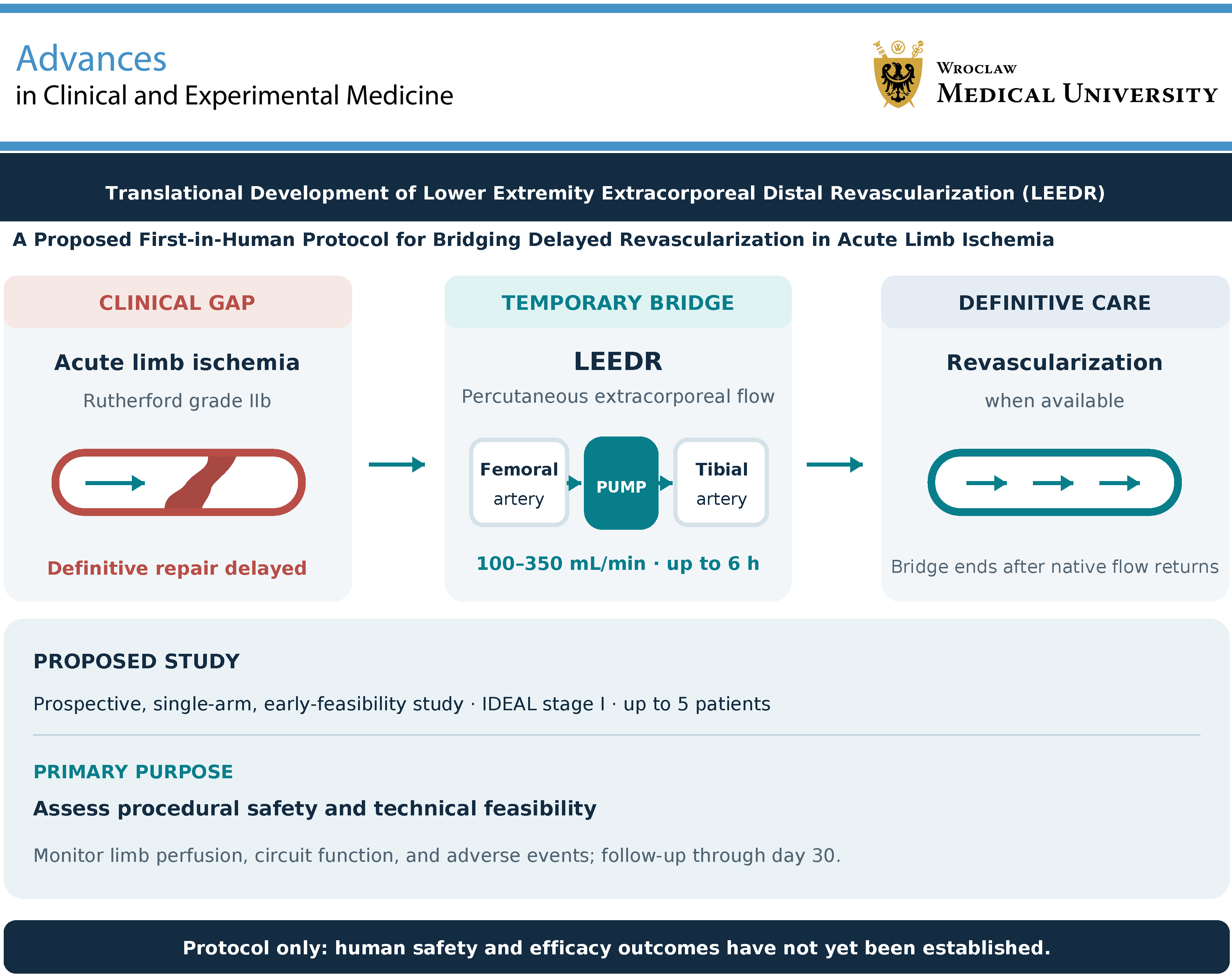
Introduction. Acute limb ischemia (ALI) is a time-critical vascular emergency in which delayed revascularization markedly increases the risk of limb loss and mortality. Lower extremity extracorporeal distal revascularization (LEEDR) is a percutaneous technique designed to restore distal limb perfusion when definitive repair is delayed due to system-level or clinical constraints. After successful preclinical testing, clinical translation requires a structured, ethically grounded framework such as the IDEAL (Idea, Development, Exploration, Assessment and Long-term study) guidelines for surgical innovation.
Methodology. This single-arm, early feasibility study (IDEAL Stage 1) will evaluate the safety and technical feasibility of LEEDR in patients with Rutherford grade IIb ALI who are unable to undergo immediate revascularization. The extracorporeal circuit delivers oxygenated blood from the contralateral femoral artery to the ischemic limb via a distal tibial cannula, with adjustable flow rates between 100 and 350 mL/min under systemic anticoagulation. Continuous physiologic monitoring and serial laboratory assessments will be used to evaluate circuit performance, distal perfusion, and safety.
Discussion. LEEDR may provide a temporary bridge to definitive revascularization when timely vascular care is unavailable. This initial clinical evaluation will focus on procedural safety, technical reproducibility, and practical challenges, particularly distal cannulation. Its single-arm design will inform procedural refinements and subsequent controlled studies rather than establish comparative efficacy.
Conclusions. This first-in-human protocol advances LEEDR from preclinical evaluation (IDEAL Stage 0) toward clinical feasibility assessment (IDEAL Stage 1). Following institutional approval and informed consent, the study will generate preliminary safety and feasibility data to guide further evaluation of LEEDR as a bridge to definitive revascularization in ALI.
Key words: acute limb ischemia, extracorporeal circulation, limb salvage, percutaneous revascularization, LEEDR technique
Introduction
Acute limb ischemia (ALI) remains a vascular emergency characterized by sudden limb hypoperfusion that threatens tissue viability.1 Although timely revascularization is the definitive therapy, real-world delays due to interhospital transfer, limited specialist availability, and resource constraints often extend ischemic time beyond the threshold for limb viability.2 Recent European Society for Vascular Surgery (ESVS) trauma guidelines recommend reperfusion within 1 h of admission.3 Transferred patients experience approximately twice the risk of amputation and mortality compared with those treated during the index admission, highlighting the potential influence of system-level factors on outcomes.4
To address this gap, a novel technique called lower extremity extracorporeal distal revascularization (LEEDR) has been developed.5, 6 It uses percutaneous extracorporeal circulation to restore distal perfusion in ischemic limbs when immediate revascularization is not feasible. The system draws arterial blood from a proximal inflow artery, typically the contralateral femoral artery, and delivers it retrogradely into a distal tibial artery of the affected limb through a portable pump circuit. This configuration enables controlled, bedside initiation of limb perfusion as a bridge to definitive repair.
The feasibility of LEEDR has been demonstrated in a swine model of 6 h of hindlimb ischemia. This program has been extended to a 9-h ischemia model, in which swine survived for 48 h after completion of the protocol. LEEDR improved survival, preserved gait function, and mitigated systemic ischemia/reperfusion (I/R) injury compared with untreated controls.5, 6 A complementary technical guide further defined the procedural workflow, flow targets, and safety parameters for bedside implementation.7 Collectively, these studies established the physiologic foundation and technical feasibility required for clinical translation.
Building upon this preclinical evidence, the current methods paper uses the IDEAL framework for surgical innovation to present a clinical study that transitions LEEDR from Stage 0 (preclinical development and proof of concept) to Stage 1 (first-in-human).8 It outlines the protocol for a first-in-human feasibility trial of LEEDR in patients with Rutherford grade IIb ALI9 who cannot undergo immediate revascularization, with the aim of evaluating procedural safety. Secondary aims include assessment of bedside feasibility, adequacy of distal limb perfusion, circuit performance and stability, successful transition to definitive revascularization, and limb viability at hospital discharge.
Methodology
Study design and objectives
This single-arm, prospective clinical study will evaluate the safety and technical feasibility of LEEDR in human subjects with ALI. The study will be conducted under an Investigational Device Exemption (IDE) in alignment with U.S. Food and Drug Administration (FDA) guidance for early feasibility studies of novel circulatory support systems. Consistent with the IDEAL framework for surgical innovation, this study represents Stage 1 (first-in-human), following successful Stage 0 preclinical proof-of-concept work. Participant enrolment will begin once approval is granted, and each participant will provide written informed consent before inclusion. Primary objective: To assess procedural safety, defined as the absence of major adverse limb or systemic events related to LEEDR within 24 h of deployment. Secondary objectives: To evaluate:
1. Bedside procedural feasibility;
2. Adequacy of distal limb perfusion;
3. Circuit performance and stability;
4. Successful transition to definitive revascularization;
5. Limb viability at hospital discharge.
To align with IDEAL Stage 1 recommendations, the study will enroll up to 5 participants to establish technical feasibility and procedural safety and to identify potential refinements before broader evaluation. Exploratory analyses will assess biochemical markers of I/R injury, technical reproducibility, and operator learning curves.
Study population
Adults (≥18 years) with Rutherford grade IIb acute limb ischemia due to thrombotic, embolic, or traumatic causes are eligible when definitive revascularization is not expected to occur within 60 min of the initial surgical assessment. Total warm ischemia time from symptom onset to LEEDR initiation must not exceed 6 h. Patients with ischemia lasting more than 6 h will not be eligible for this first-in-human feasibility study.
Exclusion criteria include Rutherford grade III ischemia, a nonviable limb, active hemorrhage, uncontrolled hemodynamic instability requiring ongoing resuscitation or escalating vasopressor support, severe coagulopathy, known hypercoagulable disorders, ipsilateral deep or superficial venous thrombosis, concomitant major venous injury requiring repair, a contraindication to systemic heparinization, pregnancy, or inability to provide informed consent.
Timing and duration of LEEDR support
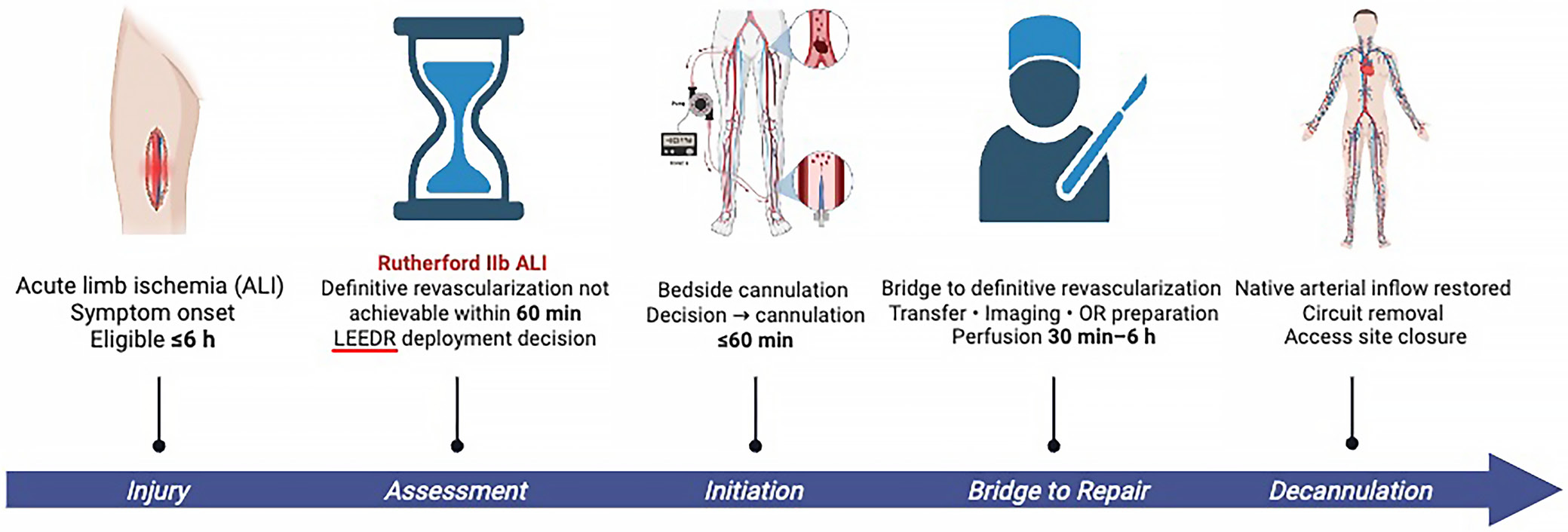
LEEDR deployment is intended as a temporizing intervention, initiated as soon as possible after recognizing that definitive revascularization will be delayed. The target time from the surgical decision to cannulation is ≤60 min.
Extracorporeal perfusion may continue for a minimum of 30 min and a max of 6 h, or until native revascularization is established, whichever occurs first.
Decannulation will occur:
– immediately after definitive open or endovascular repair; or
– earlier if clinical deterioration or a device-related complication occurs, or if restoration of native arterial inflow is confirmed (Figure 1).
The circuit may remain active during angiography or operative preparation to minimize additional ischemic time.
LEEDR procedure
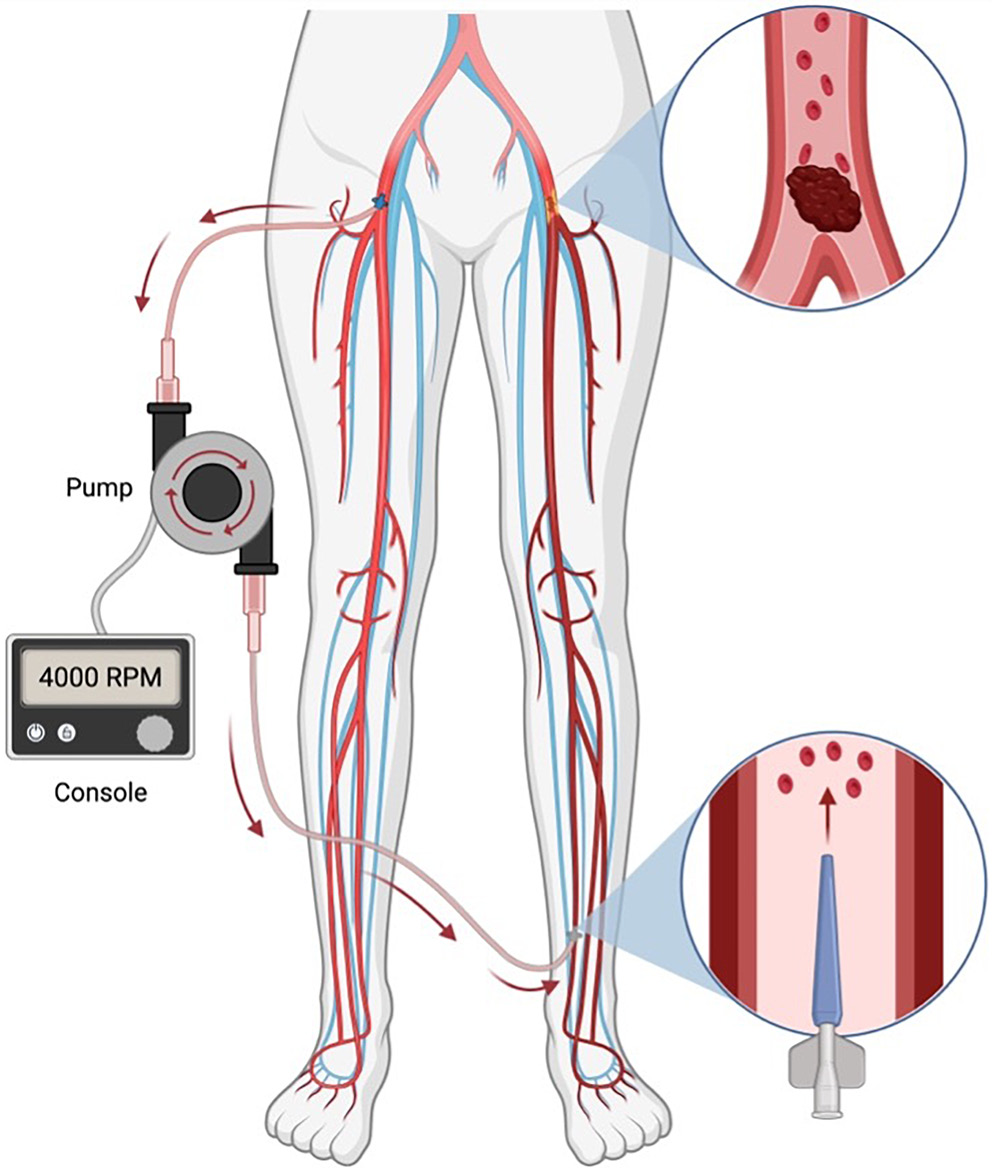
LEEDR will be initiated at the bedside using percutaneous vascular access obtained under ultrasound guidance. The inflow cannula will typically be inserted into the contralateral common femoral artery, and the outflow cannula into a distal runoff artery (posterior tibial or dorsalis pedis) of the ischemic limb. Both access sites will use 5–7 Fr sheaths inserted using a sterile technique (Figure 2).
The extracorporeal circuit will consist of heparin-bonded tubing and a centrifugal pump capable of generating adjustable flow rates between 100 and 350 mL/min.7 The circuit will be primed with isotonic saline and de-aired prior to connection. Systemic anticoagulation will be achieved with intravenous unfractionated heparin, targeting an activated clotting time (ACT) of 180–220 s.
Flow initiation will follow a controlled ramp protocol, starting at 100 mL/min and increasing incrementally to the target flow range while monitoring hemodynamics and distal perfusion. Limb viability will be assessed clinically, including evaluation of limb sensation, active and passive range of motion, capillary refill, temperature, tissue oximetry, and Doppler signals. Perfusion may continue for up to 6 h or until native perfusion is restored, whichever is sooner. The LEEDR circuit can remain active during diagnostic angiography or operative preparation to maintain continuous perfusion.
Monitoring and safety management
Continuous monitoring will include systemic arterial pressure, electrocardiography, temperature, and oxygen saturation. Laboratory assessments will include serial measurements of ACT, serum potassium, lactate, free hemoglobin, haptoglobin, and creatine kinase. Anticipated adverse events include vascular access complications, bleeding, thrombosis, or device malfunction. Criteria for emergent discontinuation include hemodynamic instability, distal malperfusion, or signs of hemolysis (Table 1). Following completion, the circuit will be disconnected, anticoagulation reversed as clinically appropriate, and vascular access sites closed percutaneously or by surgical repair.
All adverse events will be prospectively recorded and adjudicated by an independent Data and Safety Monitoring Board (DSMB). Recommendations, which may include study discontinuation, will be made to the institutional review board (IRB). Patient follow-up evaluations will occur at 24 h, hospital discharge, and 30 days to assess wound healing, limb viability, and functional status.
Data collection and analysis
Study data will be collected using a secure electronic case report form (eCRF). Baseline demographics, comorbidities, procedural details, and postoperative outcomes will be documented. Quantitative variables will be reported as means ± standard deviation (SD) for normally distributed data or medians with interquartile ranges (Q1–Q3) for non-normally distributed data. Categorical variables will be presented as counts and percentages. This early feasibility study will use descriptive statistics without inferential hypothesis testing. Safety events will be classified according to the Society for Vascular Surgery (SVS) reporting standards.10
Ethical and regulatory considerations
This article presents the methodological concept and design of a future first-in-human feasibility study. At the time of manuscript submission, the ethics application had not yet been submitted to the Mayo Clinic Institutional Review Board. Ethical approval will be obtained before study initiation, and written informed consent will be obtained from all participants before any study procedure. The study will be conducted in accordance with the Declaration of Helsinki, Good Clinical Practice guidelines, and institutional policies for human research. All patient data will be de-identified, and confidentiality will be maintained in accordance with applicable federal and institutional regulations.
Discussion and Conclusions
This protocol represents the translational advancement of LEEDR from preclinical research to first-in-human evaluation. Previous animal studies showed that LEEDR maintains perfusion during prolonged ischemia and mitigates local and systemic complications of reperfusion.6 These findings informed the flow parameters, sheath selection, and anticoagulation targets used in this clinical study design.
Hospital transfer analyses reveal persistent gaps in timely vascular care, with delayed revascularization directly contributing to higher rates of limb loss and mortality.4 LEEDR aims to address this need through a percutaneous, portable perfusion strategy deployable in emergency or critical care settings.
This protocol uses the IDEAL framework to guide translation and follows completion of Stage 0 preclinical evaluation. This first-in-human phase is designed to establish procedural safety and technical reproducibility and to identify refinements, particularly regarding distal cannulation, a key determinant of success and a potential source of risk.
The data from this proposed study will inform the design of subsequent multicenter, controlled evaluations assessing LEEDR as a bridge to definitive revascularization. Following the IDEAL guidelines will ensure a structured and ethical translational process that minimizes patient risk while enabling innovation.
Use of AI and AI-assisted technologies
During the preparation of this manuscript, the authors used ChatGPT (OpenAI, San Francisco, USA) for language editing and formatting assistance. After using this tool, the authors reviewed and edited the content as needed and take full responsibility for the integrity and accuracy of the final manuscript.