



Abstract
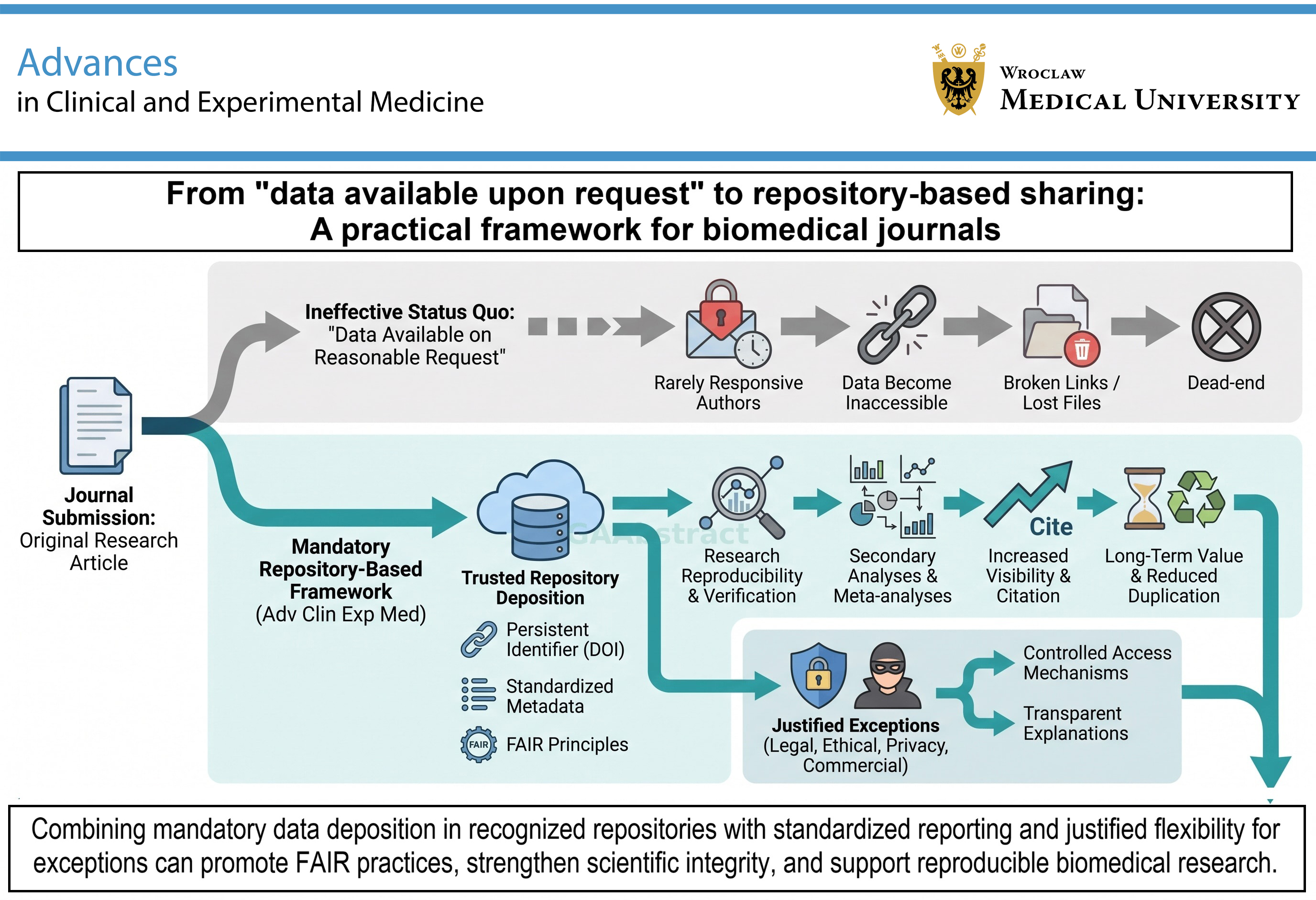
Data sharing has become a cornerstone of open science, promoting transparency, reproducibility, and the efficient reuse of research data. Although many biomedical journals encourage data sharing, policies remain inconsistent and often require data to be available only upon reasonable request, a practice shown to be largely ineffective. This editorial discusses the rationale, principles, and practical implementation of mandatory repository-based data sharing in biomedical journals, using the experience of Advances in Clinical and Experimental Medicine as an implementation case. It outlines the policy’s key components, current recommendations, and the editorial team’s implementation experience. Exceptions based on legal, ethical, or commercial constraints are also described. Repository-based data sharing is intended to strengthen research transparency, reproducibility, and long-term accessibility while reducing reliance on ineffective ‘data available upon request’ models. A practical framework combining clear requirements, persistent data deposition, standardized data-availability statements, justified exemptions, and active editorial support may facilitate wider adoption of FAIR (Findable, Accessible, Interoperable, Reusable) data practices across biomedical journals.
Key words: publishing, data sharing, biomedical research, open science, reproducibility of results
Introduction
Nullius in verba – “take nobody’s word for it” – is the motto chosen by the founding members of the Royal Society in 1660. It is “an expression of the determination of Fellows to withstand the domination of authority and to verify all statements by an appeal to facts determined by experiment.”1 Concisely, one of the cornerstones of modern science is thus expressed – scientific claims must be supported by evidence and hypotheses must be tested. This very idea is the main motivation for a policy that is becoming increasingly widespread in scientific journals, including in the biomedical field – the requirement to share the data on which the findings presented in submitted manuscripts are based. Drawing on implementation experience from Advances in Clinical and Experimental Medicine (Adv Clin Exp Med), complemented by examples from Dental and Medical Problems (Dent Med Probl), this editorial discusses practical principles for implementing repository-based data-sharing policies in biomedical journals.
What is data sharing?
Data sharing is not mandatory in many journals; frequently, instructions for authors state only that authors are encouraged (but not required) to release the data, or that they must declare that data will be made available to individual researchers upon reasonable request. The picture of general trends regarding data sharing policies in biomedical journals is not clear, although relatively broad studies in this regard were published by Danchev et al.,2 Liu et al.,3 Chen et al.,4 and Zhang et al.5 (all for clinical trials), Hamilton et al.6 (for cancer research), and recently by Archer et al.7 The largest-scale studies were conducted by Johnson et al.8 (a scoping review of clinical trial data-sharing policies among journals, funding agencies, foundations, and other professional organizations) and Tan et al.9 (a cross-sectional analysis of the data-sharing policies of the largest health research funders, all national ethics committees, all clinical trial registries, the highest-impact medical journals, and all medical research data repositories). Zhao et al.10 released a protocol for a cross-sectional study of journal data-sharing policies and their impact on publications.
Data sharing fosters scientific progress by enabling validation, reproducibility and verification, reanalysis, new analyses, reinterpretation of data, and inclusion in meta-analyses. There are 7 main reasons for implementing it in scientific publishing:
1) It makes preparing secondary analyses (meta-analyses and different types of reviews, among others) easier and allows for conducting more in-depth analyses; this advantage of data sharing was outlined by Bauchner and Fontanarosa in chapter 39 of Principles of Scientific Writing and Biomedical Publication,11 as well as by Yoong et al.12;
2) It enables reproducibility of research – as pointed out by Miyakawa,13 lack of underlying research data necessary to reproduce the reported analyses or data fabrication is another possible cause of the reproducibility crisis since, with no access to these data, many studies cannot be reproduced or verified;
3) It allows for verification of methodology and reporting standards – although the scientific community is to a large extent based on mutual trust between researchers and other stakeholders, refusal to share the data (even on request) may sometimes be a way to avoid the detection of misconduct (data fabrication, p-hacking, etc.). This is why in Adv Clin Exp Med, authors are required to share the required data already during submission and not only after the manuscript is accepted for publication; the peer reviewers also need to be able to verify these data (there are no broad studies on re-using shared data and in light of the general reproducibility crisis, post-publication verification may not be widespread enough to be counted on);
4) It fosters data archiving, thus increasing the value of the investment made in funding scientific research – funding is used more efficiently since data amassed during one project can be re-used and financing another study on a similar subject may not be necessary;
5) It reduces the burden on authors in preserving and finding old data, and managing data access requests (this issue is discussed below);
6) It stimulates citation and linking of research data and their associated articles, enhancing visibility and ensuring recognition for authors, data producers, and curators; citations and linking may be an important incentive for data sharing, as discussed by Toga et al.14;
7) In clinical trials, data sharing is also important from the viewpoint of study participants since their contribution to science becomes more pronounced (data can be utilized in more than one research project) and may reduce the need to expose additional participants to research-related risks (each clinical trial entails some degree of risk, even if very small). This issue has also been discussed in the context of research conducted in low- and middle-income countries (LMICs), e.g., by Waithira et al.15
Data sharing is considered central to open science – which is why many researchers, editors, and other stakeholders see it as more than a purely procedural issue. Barbui et al.16 wrote about data sharing culture, Zhang et al.17 about a “data ecosystem”, while Bauchner et al.18 called data sharing “an ethical and scientific imperative”. More advantages of data sharing than listed above were described by Johnson.19
Several authors (e.g., Waithira et al.20 and Meyer21) emphasized the role of clear guidelines that should simultaneously encourage authors to share data, stipulate it in certain contexts (particularly in clinical trials), and inform researchers about the importance of making data available, as well as potential related pitfalls. Guidelines regarding sharing underlying research data necessary to reproduce the reported analyses are much more prevalent than those dealing with supplementary data – most of the most renowned publishing entities have more or less detailed policies in this area: the BMJ Group,22 Springer Nature,23, 24 Science,25 American Society of Clinical Oncology (ASCO),26, 27 Taylor & Francis,28 Wiley,29 and Dove Medical Press.30 A detailed policy on sharing data from clinical trials and other research funded by public funds in the USA has been established (and has already been amended several times) by the National Institutes of Health (NIH).31 Recommendations for the Conduct, Reporting, Editing, and Publication of Scholarly Work in Medical Journals, published by the International Committee of Medical Journal Editors (ICMJE) and last updated in January 2026,32, 33, 34 also include detailed guidance concerning data sharing in published clinical trials. The EQUATOR network also released an executive position statement,35 and Loder et al. published an editorial discussing policies implemented in BMJ.36 An exhaustive book – Sharing Clinical Trial Data: Maximizing Benefits, Minimizing Risk – devoted entirely to various aspects of data sharing was released by the U.S. Institute of Medicine (IOM).37
Why “data available upon request” is insufficient
Since August 15, 2024, Adv Clin Exp Med has required the authors of all original papers and research letters to make all data necessary to reproduce and verify the analyses reported in the study publicly available upon submission to the journal, unless a justified legal, ethical, privacy, contractual, or commercial restriction applies. It should be emphasized once more that the data must be shared at the time of submission, not only after the manuscript is accepted for publication; peer reviewers need to be able to access the dataset via the DOI (or a stable accession number for established discipline-specific repositories) provided in the text.
Until this date, it was sufficient to state that the data supporting the study findings were available from the corresponding author upon reasonable request. However, some recent studies have noted that fulfilling such a declaration and actually providing relevant data to the requesting researchers occur alarmingly rarely. In 2019, Gabelica et al.38 tested the reliability of this declaration among authors who published papers in high-ranking anesthesiology journals. Only 14% of authors responded to their data-sharing query, and only 4% provided the requested data. A similar query was conducted 3 years later among authors from 333 open-access journals published by BioMed Central.39 Of 3,556 analyzed articles, 3,416 contained the Data Availability Statement (DAS). The most frequent DAS category (42%) indicated that datasets are available upon reasonable request. Among 1,792 manuscripts in which the DAS indicated that authors were willing to share their data, 1,669 (93%) authors either did not respond or declined to share their data with them. Only 254 (14%) authors responded to the data-sharing query, and only 123 (6.8%) provided the requested data. Tedersoo et al.40 reported similar results, though they varied by discipline. This issue was also discussed in an editorial by Watson.41 The crucial issue here is not peculiar responses from isolated individual authors (Gabelica et al.39 mentioned a corresponding author who expected reimbursement before sharing the data), but the fact that the majority of contacted researchers did not respond at all, and in multiple cases the e-mails bounced back because the accounts had become inactive since article publication. Personal experience of the editors of Adv Clin Exp Med also confirms that relying on e-mail contact with authors is an ineffective strategy for making the data available – a given author may change affiliation, retire, die – or simply change the e-mail address; in consequence, the data “available on request” become effectively unavailable. Datasets shared in a repository are accessible even if no one from the original research team can be reached.
Requirements of Adv Clin Exp Med
In Adv Clin Exp Med, data-sharing requirements apply exclusively to original papers, including research letters, and do not extend to reviews, meta-analyses, study protocols, or research-in-progress papers. Authors conducting secondary analyses (i.e., review and meta-analyses) may choose to share data they have collected, either as shared data or as supplementary material; however, this is not obligatory, as such data are not classified as those required to be shared.
Authors should deposit the underlying research data necessary to reproduce and verify the analyses reported in the study. Depending on discipline-specific standards and the nature of the analysis, this may include raw, cleaned, processed, or analysis-ready data, together with sufficient metadata and documentation. Authors are not required to deposit variables or data that were not used in the reported analyses. Where discipline-specific standards favor processed or analysis-ready data rather than raw data, authors should follow those standards, provided that the deposited material and accompanying metadata are sufficient to reproduce and verify all findings reported in the article.
Where custom analytical code is essential to reproduce the reported findings, code sharing is required where feasible. This is particularly important for papers reporting complex statistical analyses (including Mendelian randomization (MR), machine learning (ML), and bioinformatics) and for other studies in which custom code or scripts are necessary to reproduce the reported analyses.
If field-specific standards for data deposition exist, Adv Clin Exp Med editors require authors to comply with them. If no standards currently exist in the field, authors should maximize data accessibility and reusability by selecting a file format that allows efficient extraction.
Data should be shared via deposition in a repository – either subject-specific (for specific data types, e.g., GenBank, the European Nucleotide Archive (ENA), or DNA Data Bank of Japan (DDBJ) for nucleotide sequence data) or cross-disciplinary (for multiple data types). However, the chosen repository should assign a persistent identifier, preferably a DOI or, for established discipline-specific repositories, a stable accession number, as they are persistent identifiers and more stable than simple uniform resource locators (URLs). Therefore, Adv Clin Exp Med requires data to be shared in a repository, not on a simple website. Data repositories improve discoverability and accessibility, ensure long-term preservation, and attract increased attention to the research. Where authors can select the license, an open license that permits appropriate reuse, such as CC BY or CC0, should be preferred, subject to applicable legal, ethical, and repository-specific requirements.
Sharing data using ordinary websites or cloud services is not accepted. Repositories – especially those with an established reputation – ensure continuous access to stored data using the assigned DOI or stable accession number, even years after article publication. Conversely, many websites are short-lived, while URLs to data stored on cloud servers become inactive when an account is discontinued. Third parties manage repositories, and authors are responsible only for the dataset’s contents after depositing it, not for access. If any problems arise with depositing data, editors of Adv Clin Exp Med offer to store the data in a general repository (Zenodo), provided that the relevant files are supplied via e-mail or other means. Neither Adv Clin Exp Med nor the publisher of this journal (Wroclaw Medical University) is in any way associated with the Zenodo repository – neither financially nor organizationally; we simply recommend this entity as a reliable, cost-free third-party data storage option.
An extensive, although non-exhaustive, list of available repositories was compiled by Meyer.21
Data Availability Statement
Authors are required to provide a DAS describing compliance with the journal’s data policy. If the data can be shared, the statement should include the following information:
The datasets supporting the findings of the current study are openly available in [repository name] at [DOI or stable accession number].
Listing the individual files that constitute the dataset is not necessary, although some authors may elect to provide such information. The DAS always appears in the same place in every original paper published in Adv Clin Exp Med: at the end of the main body of the article, in the Declarations section, directly following the Conclusions section.
Making underlying research data necessary to reproduce the reported analyses available through a repository is the most common option among authors of original papers published in Adv Clin Exp Med. An example of model data sharing can be found in Rogowski et al.42 In Dent Med Probl, Samulak et al.43 chose this option. Kidoikhammouan et al.44 retrieved transcriptomic datasets for stable 5-fluorouracil (5-FU)-resistant cancer cell lines and Thai cholangiocarcinoma (CCA) patient tissues from the Gene Expression Omnibus (GEO) database, but then made them available in Figshare.
In our editorial experience, Zenodo and Figshare have been the most commonly selected repositories; only 1 research team (Li et al.45) deposited the datasets generated and analyzed during the study in the National Center for Biotechnology Information (NCBI) repository.
Exceptions to public data sharing
References to “data not shown” are not permitted in Adv Clin Exp Med. All publicly available resources must be cited in the reference list or referenced in the main text with an appropriate URL. Authors are required to share all data covered by the journal’s policy, either in the manuscript or through an appropriate repository or other permitted mechanism, unless one of the exceptions listed below applies. Manuscripts in which data are withheld solely because of author preference or plans for future publications will not be considered for peer review. Patent-related or other legitimate commercial restrictions should be handled through the embargo provisions described below.
Acceptable restrictions on public data sharing are:
1) If there are commercial restrictions on sharing data, the DAS should be as follows:
The datasets supporting the findings of the current study will be available in [repository name] at [DOI or stable accession number], subject to a [time period] embargo from the date of publication to allow for the commercialization of the research findings.
2) For studies involving third-party data, Adv Clin Exp Med encourages authors to share any data specific to the analyses that they can legally distribute. However, if there are any third-party restrictions on data availability, the DAS should be as follows:
The datasets supporting the findings of the current study were used under license and are available with permission from [name of the third party and contact information].
Data may sometimes be entirely unavailable due to third-party restrictions. In such cases, authors must specify the precise legal restrictions applicable in the given context. Citing only broadly defined “institutional policies” is inadequate. For example, an editor of Adv Clin Exp Med reported a case where authors claimed that all data generated during research in a military hospital are, by definition, subject to military secrecy.
An example of using this clause is the article by Lalika et al.46
3) If no new data were created while conducting the research, the DAS should be as follows:
Data sharing does not apply to this article, as no new data were generated during the current study.
This was the case in Chen et al.47
4) If no new data were created, but any already available data were used, the DAS should be as follows:
The datasets supporting the findings of the current study were already openly available when the research project commenced, and can be accessed at [reference or DOI or stable accession number].
This situation is most commonly encountered in studies that use data from human genome databases such as GEO, Kyoto Encyclopedia of Genes and Genomes (KEGG), and various genome-wide association study (GWAS) databases. Examples of implementing this clause in practice include papers by Zhang et al.48 (who analyzed data from the Curated Breast Imaging Subset of Digital Database for Screening Mammography (CBIS-DDSM)) and Wu et al.49 (in which thyroid function datasets were taken from a GWAS public database (ThyroidOmics Consortium), and data on human cerebral cortex were downloaded from the ENIGMA Consortium website). In Dent Med Probl, Riad and Attia50 used data from public sources.
Some authors employed a mixed approach – Chen et al.51 analyzed publicly available GWAS summary statistics used as both the exposure and the outcome, accessed from FinnGen R10 and GWAS. In addition, all raw and processed data were uploaded to the Zenodo repository. In a paper by Feng et al.,52 gut microbiota GWAS data were obtained from the MiBioGen consortium, metabolite GWAS data from the TwinsUK and KORA studies annotated via the Human Metabolome Database, and diffuse large B-cell lymphoma (DLBCL) summary statistics from the FinnGen consortium. Because this was a MR study, the authors made the MR analysis code available in Zenodo.
5) If all data are already included in the manuscript (its main body, tables, and figures), the declaration should be as follows:
Data sharing does not apply to this article, as all data are already included in the manuscript.
This was the case, e.g., in Paczwa et al.53 In Dent Med Probl, Fernandes and Fernandes54 and Saberian et al.55 provided such a declaration.
6) If all data are included in the manuscript and its supplementary files, the DAS should read:
Data sharing does not apply to this article, as all data are already included in the manuscript and its supplementary files.
This option is applicable only when supplementary files have been deposited in a public repository prior to manuscript submission, and the corresponding DOI or stable accession number is included in the manuscript. Supplementary data and shared data must be regarded as distinct datasets. Supplementary data refer to materials other than shared research data that cannot be published within the main text but are essential for reviewers and readers to fully understand the manuscript. A submission may include both shared and supplementary data, only shared data, or only supplementary data.
Data available on request under legal or ethical restrictions
The journal’s data policy is subordinate to local legal or ethical frameworks. When these frameworks prevent or restrict data release, authors must specify these limitations in the DAS at the time of submission. Authors must also provide contact information for an ethics committee or relevant institutional body that can verify these restrictions. In these circumstances, the DAS should be formatted as follows:
The datasets supporting the findings of the current study are available from the corresponding author on reasonable request. The data are not publicly available due to legal/ethical reasons [an explanation of the specific reasons for this decision].
This is the only situation in which Adv Clin Exp Med permits a DAS stating that data are available from the corresponding author on reasonable request. Authors should make this assessment in accordance with applicable ethical and legal requirements, preferably in consultation with the relevant ethics committee or institutional body.
Data not available due to legal or ethical restrictions
If participant consent and the applicable ethical or legal framework do not permit public sharing of the research data, the DAS should be as follows:
The participants in this study did not provide written consent for their data to be shared publicly; therefore, due to the sensitive nature of the research, the supporting data are not available.
If data can be shared following anonymization, authors are expected to take appropriate steps to make the data openly available. For studies involving human research participant data or other sensitive information, authors should share de-identified or anonymized datasets where this is ethically and legally permissible. Before sharing human research participant data, authors must consult an ethics committee to ensure that data sharing aligns with participant consent and complies with all relevant local regulations. Data sharing must not compromise participant privacy. Public sharing of personally identifiable information about human research participants is not permitted.
There are 3 main reasons for refraining from data sharing in papers published in Adv Clin Exp Med:
1) Full protection of patients’/respondents’ identities, particularly in qualitative studies involving racial or sexual identity issues (assessing whether such protection can be obtained only by withholding the data is at the authors’ discretion, but in accordance with applicable ethical and legal requirements as well as the relevant ethics committee’s opinion);
2) Participants consented to participate in the study, but not to sharing any data collected during the course of the study (problems related to participant consent and data sharing were discussed in detail by Meyer,21 Pellen et al.,56 Ramstrand et al.,57 and Lewis et al.58);
3) Legal regulations regarding data protection, either national or international (e.g., issued by the EU or the USA). In the last instance, the DAS is adequately modified and refers to specific legal acts.
An example of this exception appears in the paper by Martinez-Sabater et al.59 and in Dent Med Probl – in Kunjumon et al.60 An outstanding example of transparency in Adv Clin Exp Med was the paper by Lu et al.61 – the authors provided detailed clarifications on the strict legal definition of anonymization, the scope of patient consent, and controlled-access data sharing.
FAIR data are not necessarily open data
Authors should adhere to the FAIR (Findable, Accessible, Interoperable, Reusable) principles, which provide a structured framework to improve data management and make it easier for humans and machines to locate, access, and use data effectively. The 4 tenets are understood as follows:
Findability: Data and metadata must be easy for both humans and machines to locate. This requires assigning globally unique, persistent identifiers, providing comprehensive metadata, and registering or indexing data in searchable repositories.
Accessibility: Upon discovery, data must be retrievable through standardized communication protocols. Additionally, metadata should remain accessible even if the underlying data are no longer available.
Interoperability: Data must be compatible with other datasets and analytical tools. Achieving this requires standardized vocabularies and formats to enable seamless integration with external data sources.
Reusability: Data must be thoroughly described and documented to support verification, reproducibility, and subsequent reuse. This includes explicit licensing, comprehensive provenance information, and compliance with established community standards.
However, it should be noted here that the FAIR principles themselves do not mean that access must always be completely open and unrestricted – they may also include access that requires authorization. Following the FAIR concept means primarily that the data are appropriately accessible to both humans and machines, not that they are openly available. The framework discussed here combines FAIR data stewardship with openness as the default: data should be findable and appropriately accessible, and should be openly available whenever no justified legal, ethical, privacy, contractual, or commercial restriction applies.
A practical framework for journal implementation
Experience with implementing mandatory data sharing suggests that an effective journal policy should combine clear requirements with practical support for authors. A workable framework can be organized around 5 elements. First, the journal should define a clear and transparent data-sharing policy, specifying which article types and data are covered, when data must be made available, and what minimum information is required to enable verification and reuse. Second, authors should deposit data in a trusted repository that provides a persistent identifier, such as a DOI or, where appropriate, a stable accession number, thereby ensuring long-term accessibility independent of individual authors or institutions. Third, every relevant article should include a standardized DAS describing where the supporting data can be accessed and under what conditions. Fourth, the policy should allow clearly justified exceptions when ethical, legal, privacy, contractual, or legitimate commercial constraints prevent unrestricted public sharing; such restrictions should be described specifically rather than invoked in general terms. Finally, active editorial guidance should support implementation. Authors may be willing to share their data but unfamiliar with repository selection, metadata preparation, licensing, anonymization, or appropriate DAS wording. Editorial assistance can therefore turn a formal requirement into a feasible component of routine publishing practice.
Taken together, these elements create a model in which data sharing is not treated as an additional administrative obligation imposed at publication, but as an integral part of transparent and reproducible research. Importantly, such a framework combines a strong presumption in favor of repository-based sharing with sufficient flexibility to accommodate legitimate restrictions. This balance may make mandatory data-sharing policies more practicable for biomedical journals while supporting the broader transition toward FAIR and reproducible research practices.
Conclusions
Any shared data would be usable by other researchers only if their format, quality, organization, and other features really let them be used in further investigations; sharing data “just for the sake of it” or solely to fulfill the journal’s requirements, will not advance science or make it more open. Authors should adhere to the FAIR principles; however, data sharing policies of Adv Clin Exp Med go further and require open access wherever there are no legal, ethical, privacy, contractual, or commercial restrictions. Data openness is the default unless justified restrictions apply.
Low-quality datasets can lead to low-quality reuse, often described as “garbage in, garbage out”.57, 62, 63 Instructions for authors in Adv Clin Exp Med not only require data sharing for original papers, but also explain why it matters and why the journal’s editorial board made it mandatory, even though it is not a universal practice in biomedical periodicals.
Several authors, including Johnson,19 Bauchner and Fontanarosa,11 and Kaiser,64 pointed out important concerns expressed by authors regarding potential negative consequences of releasing data along with paper publication; these include a danger of being scooped by other researchers during further investigations on the same topic, misuse of shared data by researchers who – inadvertently or on purpose – can misinterpret them out of context or even use them maliciously to discredit results inconvenient from a non-scientific point of view (e.g., in politically or ideologically sensitive research fields). Lack of time is an often underestimated but also important factor – data, to be useful (as stated above), in many cases must be meticulously prepared for sharing, which may include providing data dictionaries, indexes, etc. Consequently, many authors may perceive making data available as an unnecessary burden with little or no payoff. As editors of Adv Clin Exp Med, we recognize these concerns and challenges, and we are open to discussing additional data-sharing exceptions and new forms of support for authors who wish to share their data but face barriers in the process.
As Naudet et al.65 stated in 2019, the time is ripe for improving data sharing, especially in clinical trials. They called on ICMJE to adopt a stronger data-sharing policy that all ICMJE members and affiliated journals rigorously enforce; in concurrence, Adams and Clauw66 proposed unifying existing principles into practical guidance for trial data documentation. It is clear that the movement is towards expecting more openness – in our opinion, an ideal data-sharing policy should stipulate data sharing whenever it can be done, while offering exceptions and exemptions for authors in situations when possible harm from making the datasets public outweighs its benefits or when data sharing is impossible because of legal issues. However, in each situation the reasons should be clearly specified by authors – first to the editors and then to the readers.
It is too early to provide any – if only preliminary – summary of experiences with the new data-sharing policy in Adv Clin Exp Med. However, one trend is encouraging: many authors do not initially provide the required data at submission, but when asked for them during initial manuscript verification or peer review, either make them available themselves or send them via e-mail or using cloud services (and the editors can deposit them in a repository themselves). This remains an informal editorial observation rather than the result of a systematic evaluation. Nevertheless, this experience suggests that active editorial enforcement and support can facilitate compliance with data-sharing requirements. We suggest that wider adoption of repository-based data sharing may be facilitated when 3 conditions are met concurrently: 1) data sharing is required rather than merely suggested; 2) data are deposited in repositories rather than made available only on request; and 3) authors receive practical guidance and support in meeting data-sharing requirements.
Use of AI and AI-assisted technologies
Not applicable.