Abstract
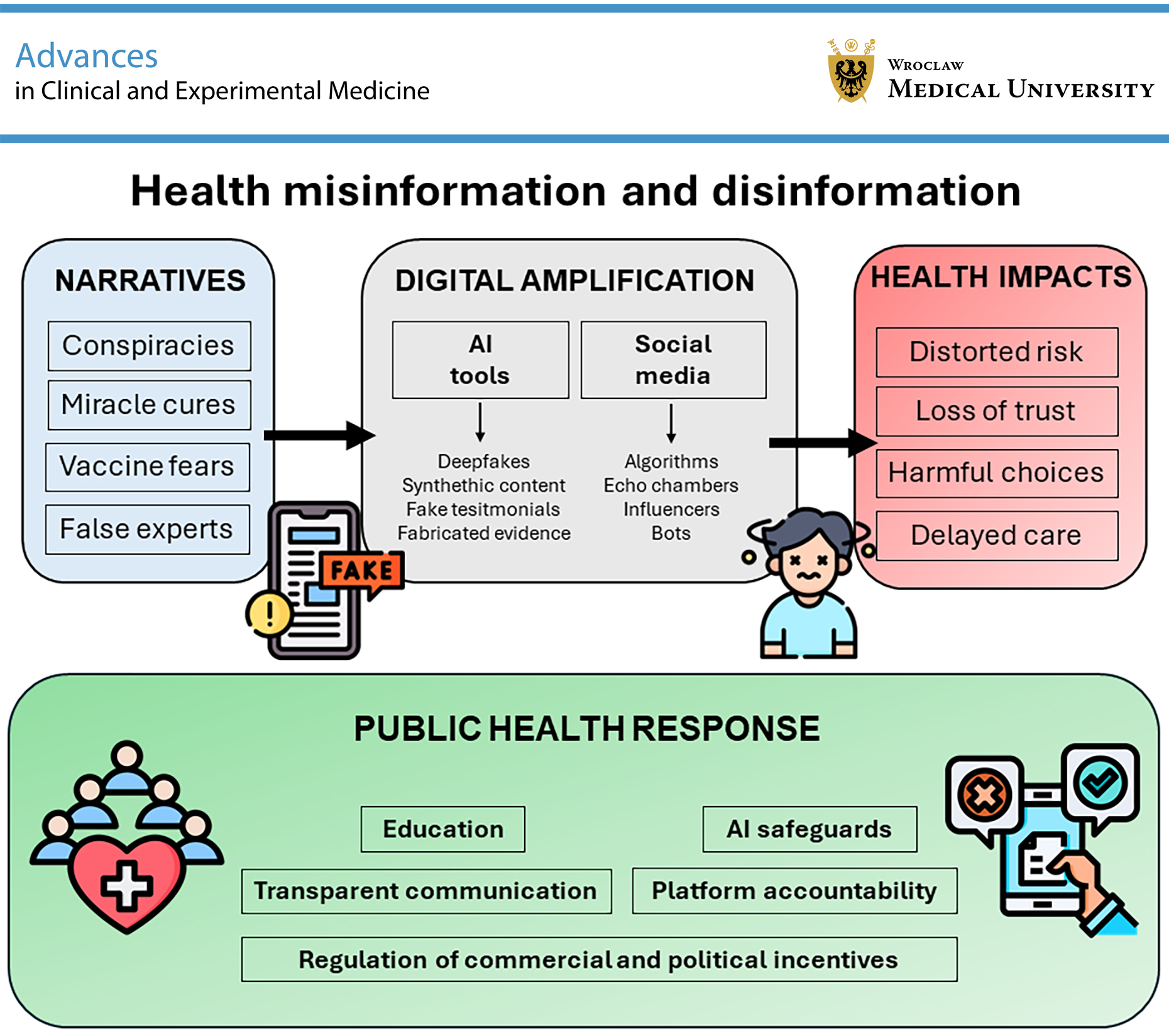
This editorial discusses how health misinformation and disinformation combine long-established narratives with new technologies that substantially increase the speed, reach, personalization, and apparent credibility of misleading content. The novelty of the contemporary information environment lies less in entirely new false narratives than in digital infrastructures that allow misleading content to be created, tailored, disseminated, and monetized at unprecedented scale. Online social media platforms and generative artificial intelligence (AI) have transformed these conditions, enabling misleading health information to be created and disseminated at previously impossible scale and speed. Health misinformation and disinformation can influence behavior, undermine trust in scientific and public health institutions, delay appropriate care, promote ineffective or harmful interventions, and weaken responses to disease outbreaks. Their effects may be particularly pronounced among populations with limited access to reliable information, healthcare, and trusted institutions. This editorial also examines how engagement-driven platform design, commercial and political incentives, synthetic media, and inconsistent safeguards amplify the problem. It argues that fact-checking and individual media literacy, while necessary, are insufficient on their own. A more effective response requires timely, transparent public health communication; institutional support for healthcare professionals; greater platform accountability; systematic safety evaluation of generative AI; independent access to relevant data; and policies that address the incentives sustaining the production and circulation of false and misleading health information.
Key words: public health, vaccine hesitancy, disinformation, health misinformation
Introduction
Misinformation generally refers to false or misleading information shared without the intention to deceive, whereas disinformation involves the deliberate creation or dissemination of false or misleading content intended to manipulate or deceive. In the context of health, neither is a new phenomenon. Long before social media emerged, misleading claims about disease, prevention, and treatment circulated through pamphlets, newspapers, informal networks, commercial advertising, and interpersonal communication. Miracle cures, vaccine scares, conspiracy narratives, and allegations directed at medical institutions have repeatedly accompanied periods of uncertainty and social change.1, 2, 3, 4, 5, 6, 7, 8, 9, 10, 11 Table 1 summarizes selected historical episodes illustrating the circumstances, recurring themes, driving forces, and public health consequences of medical misinformation and disinformation. What distinguishes the contemporary information environment is less the emergence of entirely new misinformation narratives than the technological systems that enable their production, personalization, amplification, and monetization. Established narratives now circulate across platforms designed for rapid communication and sustained user engagement, while generative artificial intelligence (AI) can substantially increase the scale, speed, and efficiency of creating persuasive false or misleading content.
This convergence makes the spread of health misinformation and disinformation a structural public health concern, not merely a problem of inaccurate communication. A substantial body of evidence indicates that false and misleading health information can undermine trust, distort risk perceptions, delay appropriate care, encourage harmful treatment choices, and weaken adherence to evidence-based recommendations.8, 12, 13, 14 These consequences are especially visible during infectious disease outbreaks, when uncertainty is high, scientific knowledge evolves rapidly, and public cooperation is essential. However, the problem extends far beyond public health emergencies and affects vaccination, cancer treatment, chronic disease management, nutrition, tobacco use, vaping, and the promotion of unproven health products.
Old narratives remain influential
The persistence of health misinformation and disinformation partly reflects the fact that they rarely depend on entirely original ideas. Their recurring narratives are familiar: authorities conceal the truth, scientists are influenced by commercial or political interests, natural remedies are suppressed, a simple cure exists but is withheld for profit, vaccines are more dangerous than the diseases they prevent, and personal testimony is more trustworthy than population-level evidence. Such claims may be persuasive because they offer simple explanations for complex events, identify clear causes or responsible actors, and provide a sense of control in uncertain situations.
These narratives frequently exploit pre-existing mistrust. Personal experience, social identity, scientific and health literacy, institutional performance, political context, and perceived exclusion from decision-making shape responses to health information. Susceptibility to health misinformation has been associated with lower literacy, conspiracy thinking, and greater reliance on social media rather than professional sources of health information.15, 16 In communities that have experienced discrimination, inadequate access to care, or institutional neglect, distrust may have an understandable historical basis, even when it is subsequently redirected towards unsupported or false explanations. Therefore, addressing misinformation and disinformation requires more than repeatedly instructing the public to trust scientific or governmental authorities. Trust must be developed and maintained through institutional competence, transparency, accountability, and equitable access to healthcare and reliable information.17
Despite the conceptual distinction between misinformation and disinformation, the boundary between them can become difficult to identify once content begins to circulate. A strategically crafted narrative may be sincerely repeated by individuals who believe it to be true. Consequently, the same claim may originate as disinformation but subsequently spread predominantly as misinformation. Public health responses must consider both the possible origin of false content and the social and technological mechanisms that sustain its circulation.
From inaccurate beliefs to adverse health outcomes
Health misinformation and disinformation warrant attention because they can influence behavior, not only beliefs. Evidence links exposure to false or misleading health claims with vaccine hesitancy, rejection of public health recommendations, delayed use of standard care, and interest in ineffective or potentially toxic interventions.12, 14, 18 Vaccination remains one of the most widely discussed examples, as misinformation and disinformation surrounding it have been linked to increased hesitancy, reduced uptake of immunization and other protective measures, and the persistence or recurrence of vaccine-preventable diseases.19 The introduction of COVID-19 vaccines showed how public uncertainty about newly introduced vaccine technologies, such as mRNA and adenoviral vector vaccines, can facilitate the spread of misinformation and highlighted the need for proactive, evidence-based communication led by scientific and medical experts.20
The effects of health misinformation and disinformation are not restricted to individual decision-making. Both can also burden health systems by requiring clinicians, public health professionals, and institutions to devote considerable time to correcting false claims, responding to avoidable concerns, and managing the consequences of delayed or inappropriate care. During public health emergencies, misleading information may divert resources, complicate risk communication, interfere with access to services, and increase hostility towards healthcare professionals. In conflict-affected settings, disinformation may interact with propaganda, insecurity, and attacks on healthcare workers or facilities, thereby further weakening already vulnerable systems.12, 17
Exposure to and the consequences of health misinformation and disinformation may also reflect existing social inequalities. Populations with limited access to trusted clinicians, high-quality education, reliable digital infrastructure, or stable institutions may be more exposed to misleading content and less able to assess its credibility. Conflict-affected and socioeconomically disadvantaged groups may experience both greater informational vulnerability and more severe consequences when misleading claims affect healthcare-seeking behavior.17, 21 Therefore, framing the problem exclusively as a deficit in individual critical thinking may obscure the broader conditions that determine who has access to reliable information and who bears the greatest risk of harm.
Social media and the architecture of amplification
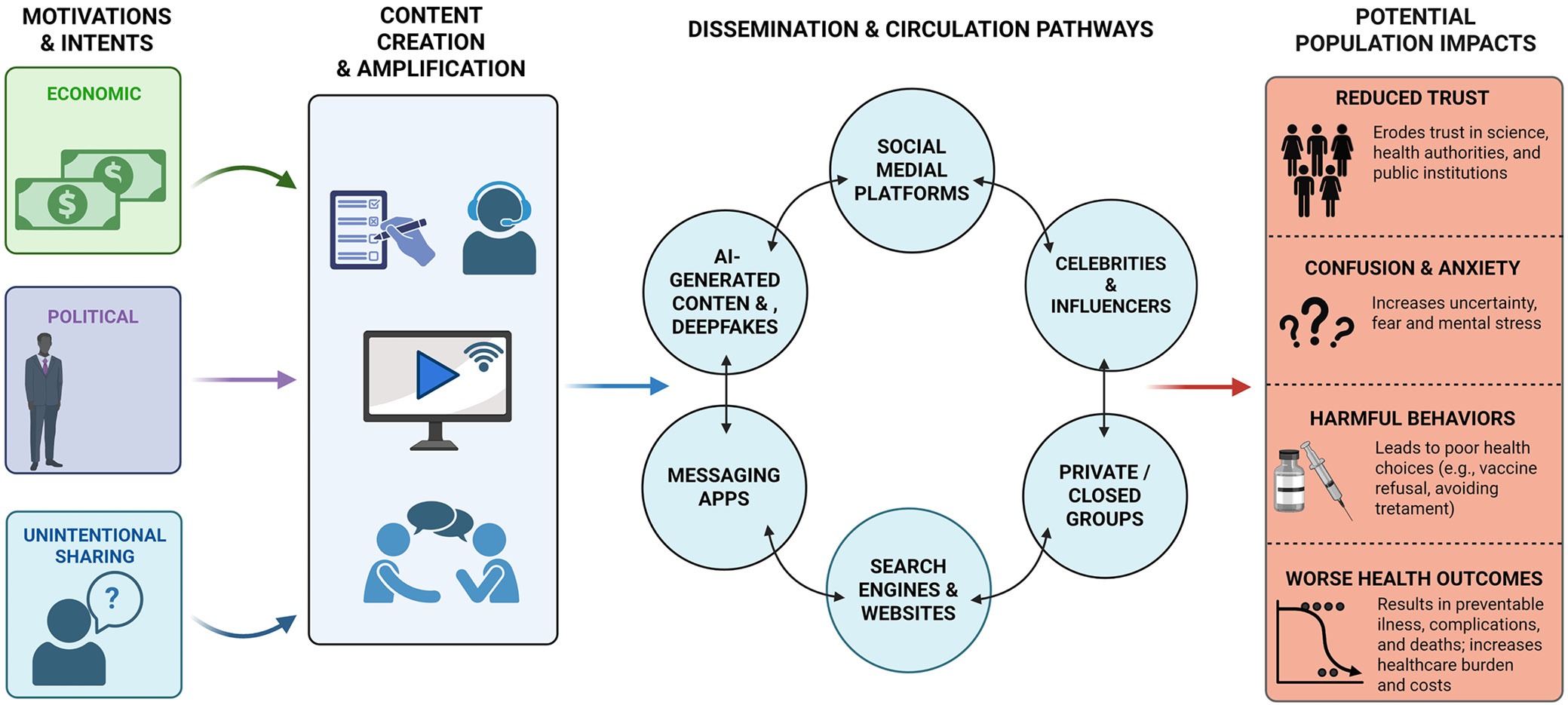
Modern online social media did not create health misinformation or disinformation, but transformed their reach, velocity, and visibility (Figure 1). False or misleading claims can now be produced and disseminated effectively by non-experts, self-described experts, influencers, commercial actors, ordinary users, and coordinated networks, often with little editorial gatekeeping.14, 22, 23 Systematic reviews consistently identify major social media platforms as key channels for health misinformation and disinformation, particularly around vaccination, infectious disease outbreaks, cancer, and other topics marked by uncertainty or strong emotional responses.8, 24, 25, 26 The problem extends beyond the mere presence of inaccurate material online. Many platforms are primarily optimized for user engagement, and content associated with novelty, fear, anger, certainty, or personal relevance may attract disproportionate attention. Personalized recommendation systems curate information based on past behavior, while social networks may cluster users around shared identities, values, and beliefs. Repeated exposure can increase perceived familiarity and, under some conditions, a claim’s apparent credibility. Echo chambers and selective exposure may consequently reinforce the perception that misleading information is widely accepted or socially validated.27, 28, 29
These mechanisms may produce an asymmetry between evidence-based communication and misleading content. Reliable health communication is often cautious, conditional, and subject to revision because scientific evidence is probabilistic and evolves over time. Misleading claims can instead be presented with certainty, emotional force, and narrative simplicity. For example, reviews of cancer misinformation indicate that inaccurate posts may receive considerable views and engagement, including when they promote unsupported or potentially harmful interventions.26 Bots, trolls, and coordinated actors may further amplify such material and create an artificial impression of popularity, agreement, or controversy.24, 30
Commercial incentives are also relevant. Misleading claims concerning wellness products, supplements, unproven therapies, and conspiratorial media may generate revenue for influencers, advertisers, vendors, and platforms. Therefore, the circulation of false and misleading health information should not always be viewed as an accidental consequence of poor information quality. In some contexts, political, commercial, or reputational incentives strongly support it by rewarding attention and making misleading content profitable.14, 31
Generative artificial intelligence and increasing scale
Generative AI introduces an additional dimension to this problem. It does not create the underlying motivations for deception, but it can substantially reduce the resources required to produce misleading content (Figure 1). Language and image-generation systems can create polished text, synthetic testimonials, apparently professional visual material, and fabricated scientific references within a short period of time. Such content can also be adapted to different languages, cultural contexts, demographic groups, or political identities at relatively low cost.
Studies have shown that publicly accessible AI models can effectively generate targeted disinformation about vaccines, cancer, and vaping, including persuasive personal narratives, false references, and realistic images.32, 33 These capabilities create a credibility challenge that extends beyond obviously implausible material. Users may interpret linguistic fluency, professional presentation, visual realism, or apparently scientific citations as indicators of reliability, even when the underlying information is inaccurate or fabricated.
Generative AI may also make it increasingly difficult to distinguish authentic materials from synthetic or manipulated content. Deepfake audio or video may falsely attribute statements to clinicians, researchers, or public officials. Synthetic patient narratives can imitate spontaneous personal testimony, while automated accounts can create the appearance of widespread agreement. The combination of generative systems with platform amplification may therefore increase both the volume and apparent social credibility of false health claims.
Current safeguards appear feasible but inconsistent. Comparative evaluations have found that some AI models refuse requests to produce health disinformation, whereas others generate such content with limited resistance. Mechanisms for reporting safety vulnerabilities have also varied in accessibility and responsiveness.11, 33 These findings suggest that voluntary safeguards alone may be insufficient, particularly if even a minority of widely available systems can be used to generate misleading material on a large scale.
Correction is necessary but insufficient
Correcting inaccurate claims remains an essential component of the response to misinformation and disinformation. Nevertheless, available evidence indicates that corrective interventions have moderate and variable effects depending on their source, timing, format, and audience. A meta-analysis found that attempts to correct health misinformation on social media were effective overall, but not uniformly so, and that expert corrections were more effective than those by non-experts.34 Corrections may also reach users only after a false claim has achieved substantial exposure, and repeatedly restating the original claim can unintentionally increase its familiarity.
An effective strategy should therefore extend beyond reactive fact-checking and recognize education as a central pillar of long-term resilience to health misinformation and disinformation. Prebunking approaches may help users identify common techniques such as false experts, conspiratorial framing, fabricated consensus, emotional manipulation, or misleading presentations of scientific evidence. However, these interventions should form part of a broader educational effort encompassing health, scientific, media, and digital literacy. Education should equip individuals not only to assess the credibility of information sources but also to understand how scientific evidence is generated, reviewed, and revised; why expert conclusions may change as new data emerge; and how uncertainty, probability, and disagreement should be interpreted. Such competencies should be developed through formal education, professional training, and accessible lifelong learning, rather than being expected to emerge only during public health crises. Nevertheless, individual vigilance, even when supported by strong educational foundations, cannot fully compensate for structural features that amplify emotionally engaging or misleading content.
Public health institutions must therefore complement educational measures by improving the quality, accessibility, and timing of communication. Delayed, fragmented, or insufficient communication during periods of uncertainty can create informational gaps that alternative, including misleading, explanations readily fill. Communication should clearly distinguish established knowledge from remaining uncertainties and explain why recommendations may change as evidence develops. It should also support public understanding rather than merely transmit instructions, helping audiences interpret evidence and place evolving guidance in context. Messages should be adapted to different communities, delivered through trusted intermediaries, and responsive to legitimate concerns rather than dismissive of them. In this way, effective communication can reinforce the educational foundations required for informed decision-making and strengthen public resilience to future waves of health misinformation and disinformation.
The spread of health misinformation and disinformation should increasingly be approached as a problem of information ecosystem governance. First, public health institutions require the capacity to identify emerging narratives, assess their potential health consequences, and distinguish widespread confusion from coordinated manipulation. Such activities should focus on publicly circulating information and avoid stigmatizing private beliefs or legitimate disagreement.
Second, social media platforms should provide greater transparency about recommendation systems, advertising practices, coordinated inauthentic behavior, and the reach of harmful health content. Independent researchers require secure and appropriately governed access to platform data to evaluate the scale of the problem and the effectiveness of potential interventions. Removing individual posts without addressing the systems that repeatedly promote similar material is unlikely to provide a sufficient response.
Third, developers of generative AI should be expected to undertake systematic red-teaming focused specifically on health disinformation, publish meaningful safety evaluations, and establish effective channels for reporting vulnerabilities. Provenance systems, watermarking, and content credentials may help users and institutions identify synthetic media, although none should be considered a complete solution. Safeguards must also be evaluated across languages and cultural settings, rather than predominantly in English, because moderation and fact-checking resources are often weakest in populations that may already face significant informational and health inequalities.11, 32
Fourth, healthcare professionals require institutional support. Individual clinicians cannot be expected to counter a rapidly evolving information environment within already constrained consultation time. Training in risk communication, access to rapidly updated explanatory materials, and referral pathways to credible resources should form part of routine public health preparedness. This emphasis on institutional support is consistent with recent arguments that translating evidence into practice requires deliberate structures, education, and shared accountability.35
Finally, policy responses should address the political and commercial incentives that support the production and dissemination of misleading health claims. Where disinformation generates profit, influence, or reputational benefits, corrective communication alone is unlikely to be sufficient. Advertising regulation, consumer protection, platform accountability, and enforcement against fraudulent health claims should therefore be regarded as relevant public health instruments.31
Conclusions
Health misinformation and disinformation can no longer be treated as a series of isolated false claims to be corrected after they spread. They are persistent features of the contemporary information environment, reinforced by technologies and incentives that reward speed, certainty, emotion, and engagement over accuracy. Three priorities should guide the public health response: strengthening population resilience through health, scientific, media, and digital literacy; ensuring timely, transparent, and trustworthy communication supported by institutional preparedness; and establishing meaningful accountability for platforms, AI developers, and commercial actors that facilitate the amplification or monetization of harmful content. Old narratives have acquired new power; public health must now develop responses equal to the systems that amplify them.
Use of AI and AI-assisted technologies
Not applicable.