Abstract
Background. Allogeneic hematopoietic stem cell transplantation (alloHSCT) is a current treatment option for patients with refractory/relapsed Hodgkin lymphoma (R/R HL), including those whose disease has failed to respond to checkpoint inhibitor (CPI) treatment.
Objectives. To evaluate the outcomes of alloHSCT after CPI therapy in R/R HL.
Materials and methods. We performed a retrospective single-center analysis of 8 patients (median age: 30.9 years (range: 21.6–50.1 years); 62.5% male) with R/R HL who had undergone alloHSCT after CPI therapy in Poland.
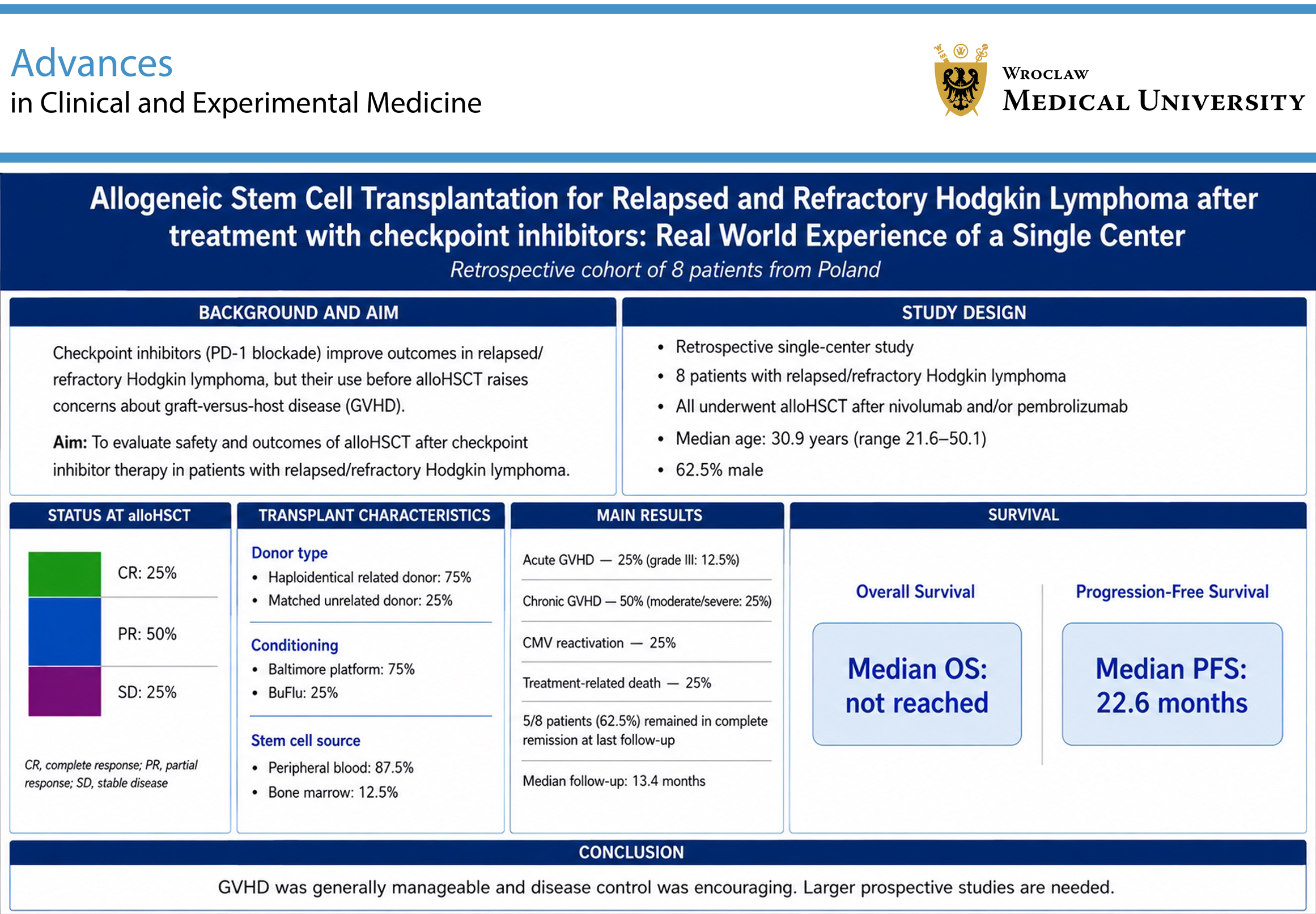
Results. At the time of alloHSCT, 2 patients (25%) were in complete remission (CR), 4 (50%) were in partial remission (PR), and 2 (25%) had stable disease. Haploidentical related donors were used in 6 patients (75%) and matched unrelated donors in 2 patients (25%). Reduced-intensity conditioning based on the Baltimore platform was applied in 6 patients (75%), and busulfan/fludarabine conditioning was used in 2 patients (25%). Acute graft-versus-host disease (GVHD) occurred in 2 patients (25%), including 1 case of grade III disease (12.5%), while chronic GVHD developed in 4 patients (50%), with moderate-to-severe disease in 2 patients (25%). Two patients (25%) died from transplant-related causes. At a median follow-up of 13.4 months, 5 patients (62.5%) remained in CR. Median progression-free survival was 22.6 months, and median overall survival (OS) was not reached.
Conclusions. To our knowledge, this is the largest Polish single-center analysis published to date. In our cohort, alloHSCT after CPI therapy was feasible with acceptable safety. However, because of the small sample size, retrospective design, and relatively short follow-up, no definitive conclusions regarding long-term efficacy or safety can be drawn. Additional prospective studies are needed for further clarification.
Key words: Hodgkin lymphoma, allogeneic stem cell transplantation, nivolumab, pembrolizumab, checkpoint inhibitor
Background
Hodgkin lymphoma (HL) is an uncommon B-cell lymphoproliferative disorder characterized by a bimodal age distribution, with incidence peaks occurring in young adults and patients older than 55 years.1 In Europe, approx. 2–3 new HL cases are diagnosed annually per 100,000 people.2 In Poland, 835 new cases of HL were registered in 2023, accounting for 16.5% of all lymphoma diagnoses.3 Patients most frequently present with supradiaphragmatic lymphadenopathy, often described as painless enlargement of lymph nodes in the neck or armpits, commonly accompanied by systemic “B symptoms.” These symptoms include unexplained fever above 38°C, profuse night sweats, and unintentional weight loss exceeding 10% of body weight during the preceding 6 months. Other possible manifestations include pruritus, dyspnea, abdominal discomfort, and persistent fatigue.4
The exact etiology of HL remains unclear; however, it is believed to arise through interactions among genetic, environmental, and immunological factors. Some viral infections, including those caused by Epstein–Barr virus (EBV) and human immunodeficiency virus (HIV), play an important role in the pathogenesis of some cases.5 Contemporary management of HL primarily involves chemotherapy, frequently combined with radiotherapy and, more recently, targeted immunotherapeutic approaches.1, 4
Although modern frontline treatment strategies have enabled a cure in most patients with HL, nearly 20%, particularly those with advanced-stage disease, experience relapsed or refractory (R/R) disease following initial therapy.6, 7 Patients with primary refractory HL generally require salvage treatment and tend to have less favorable outcomes.8 Treatment options for these patients include high-dose chemotherapy, immunotherapy, and autologous and/or allogeneic hematopoietic stem cell transplantation (HSCT). Immunotherapeutic approaches have become increasingly important in managing R/R HL and include monoclonal antibodies, immune checkpoint inhibitors (CPIs), and other targeted and cellular therapies.9, 10 Among these, the PD-1 inhibitors nivolumab and pembrolizumab, together with the anti-CD30 antibody–drug conjugate brentuximab vedotin (BV), have demonstrated the most encouraging clinical results.11 The combination of BV and PD-1 blockade has significantly improved outcomes in R/R HL and is progressively being incorporated into earlier treatment settings.
PD-1 inhibitors act by disrupting the interaction between the PD-1 receptor on activated T lymphocytes and its ligand, PD-L1. By blocking PD-1 signaling, these agents prevent inhibitory signals that suppress T-cell proliferation and effector activity. Hodgkin lymphoma is characterized by extensive recruitment of immune cells into the tumor microenvironment and frequent PD-L1 overexpression by HL cells. Immune checkpoint inhibitors restore antitumor T-cell activity, which provides the biological rationale for their clinical effectiveness.12
Despite the effectiveness of autologous HSCT (autoHSCT), approx. 40% of patients eventually develop R/R disease due to adverse prognostic factors. Consequently, allogeneic HSCT (alloHSCT) remains a potentially curative therapeutic option for patients with high-risk HL.13, 14 Beyond conditioning therapy, disease control after alloHSCT relies on the graft-versus-lymphoma effect, in which donor immune cells target residual malignant cells. Several donor sources are available, including matched sibling donors, matched unrelated donors, and haploidentical related donors. The transplantation process involves pretransplant evaluation of organ function, administration of conditioning therapy, and infusion of donor stem cells.15, 16 Following transplantation, patients require close monitoring to confirm successful engraftment and to identify complications such as graft-versus-host disease (GVHD) and infectious events. Some retrospective studies have suggested that prior exposure to PD-1 blockade may be associated with an increased risk of GVHD. These observations have raised concerns regarding the optimal timing of alloHSCT after checkpoint inhibitor therapy and the most appropriate strategy for GVHD prophylaxis.17
Objectives
This study aimed to assess the safety and effectiveness of alloHSCT in patients with R/R HL who had previously received checkpoint inhibitor therapy.
Materials and methods
Study population
This retrospective single-center study included 8 patients diagnosed with R/R HL who underwent alloHSCT at the Department of Hematology, Copernicus Memorial Hospital in Lodz, Poland, between January 2018 and September 2025. Histopathological diagnoses were established according to the 4th edition of the World Health Organization (WHO) classification. The study was conducted in accordance with institutional ethical standards. All data were fully anonymized prior to analysis. Because of the retrospective design and the use of anonymized patient data, the Ethical Committee of the Medical University of Lodz waived the requirement for ethical approval and informed consent.
Study design
All enrolled patients underwent alloHSCT after receiving checkpoint inhibitor therapy with nivolumab and/or pembrolizumab. Pembrolizumab was administered after disease progression during nivolumab treatment. Nivolumab was introduced under a reimbursement program, whereas pembrolizumab was financed through a procedure called “Emergency Access to Drug Technologies” (RDTL). Treatment response was assessed in all patients according to the Deauville criteria using 18F-FDG PET-CT (fluorine-18 fluorodeoxyglucose positron emission tomography–computed tomography) performed on various scanners. Based on routine clinical interpretation of the available examinations, no cases were reported as suggestive of pseudoprogression or atypical immune-related patterns of FDG uptake following PD-1 inhibitor therapy. Acute GVHD was graded according to the Mount Sinai Acute GVHD International Consortium (MAGIC) criteria,18 while chronic GVHD severity was evaluated using the National Institutes of Health (NIH) consensus criteria.19
Statistical analyses
Categorical variables were summarized as frequencies and percentages. Continuous variables were reported as medians with ranges. Overall survival (OS) and progression-free survival (PFS) were estimated using the Kaplan–Meier method and reported as medians with 95% confidence intervals (95% CIs). Median follow-up was calculated using the reverse Kaplan–Meier approach. Statistical analyses were performed using Python v. 3.12.12 (https://www.python.org/downloads/release/python-31212).
Results
Patient characteristics
Eight patients underwent alloHSCT for relapsed or refractory HL. The median age at transplantation was 30.9 years (range: 21.6–50.1 years), and 5 patients (62.5%) were male. According to the Ann Arbor classification at diagnosis, 4 patients (50%) had stage IIB disease, 2 (25%) had stage IIIA disease, 1 (12.5%) had stage IVA disease, and 1 (12.5%) had stage IVB disease.
Regarding International Prognostic Score (IPS), 2 patients (25%) scored 1 point, 2 (25%) scored 2 points, 1 (12.5%) scored 3 points, and 3 (37.5%) scored 4 points. All patients had an ECOG performance status of 0 at baseline. Primary refractory disease was present in 5 patients (62.5%). First-line treatment consisted exclusively of ABVD chemotherapy in all cases. Second-line consisted of DHAP (n = 4, 50%), ICE (n = 2, 25%) and BEACOPP (n = 2, 25%). Two individuals (25%) also received adjuvant radiotherapy.
All alloHSCT procedures were performed following disease relapse after autoHSCT. Median PFS after autoHSCT was 8.4 months, and the median interval between initial diagnosis and alloHSCT was 4.28 years. Individual patient characteristics are presented in Table 1.
Treatment following autoHSCT
Five patients (62.5%) received brentuximab vedotin maintenance therapy after autologous transplantation. All patients experienced disease progression after autoHSCT. The median time between autoHSCT and alloHSCT was 36.7 months. All patients received checkpoint inhibitors as salvage therapy. Five individuals (62.5%) received nivolumab without subsequent pembrolizumab, with a median of 12 treatment cycles (range: 5–46), while 3 patients (37.5%) received nivolumab followed by pembrolizumab, with a median of 8 pembrolizumab cycles (range: 3–8). Additionally, 4 patients (50%) received conventional chemotherapy combined with checkpoint inhibitors. In total, patients received a median of 6.5 lines of therapy before alloHSCT (range: 4–8). Nivolumab was combined with IGEV (ifosfamide, gemcitabine, prednisolone, and vinorelbine) (n = 1), COPP (cyclophosphamide, vincristine, procarbazine, and prednisone) (n = 1), or bendamustine (n = 1). Pembrolizumab was combined with bendamustine, gemcitabine, and dexamethasone (BGD) in 1 patient. The median washout period from the last dose of anti-PD-1 therapy to alloHSCT was 84 days (range: 58–141 days).
Transplantation and post-transplant outcomes
At the time of alloHSCT, 2 patients (25%) were in complete remission (CR), 4 (50%) were in partial remission (PR), and 2 (25%) had stable disease. Of the 2 patients in CR, 1 achieved CR with nivolumab monotherapy and 1 with nivolumab and bendamustine combination therapy. Most transplantations were performed using haploidentical related donors (75%), while matched unrelated donors were used in the remaining cases. Peripheral blood stem cells served as the graft source in 7 patients (87.5%), whereas 1 patient (12.5%) received bone marrow-derived stem cells.
Reduced-intensity conditioning based on the Baltimore platform was administered to 6 patients (75%), while 2 patients (25%) received a busulfan/fludarabine (BuFlu) conditioning regimen. Graft-versus-host disease prophylaxis consisted of tacrolimus, mycophenolate mofetil, and posttransplant cyclophosphamide in 6 patients, whereas 2 patients received cyclosporine A, methotrexate, and antithymocyte globulin. No acute GVHD developed in 5 patients (62.5%). Grade I acute GVHD occurred in 1 patient (12.5%), and grade III acute GVHD occurred in 1 patient (12.5%). No cases of grade II or grade IV acute GVHD were observed. Grade I acute GVHD involved the gastrointestinal tract and required only supportive care with a proton pump inhibitor. Grade III acute GVHD involved the liver and gastrointestinal tract and required temporary treatment with systemic steroids and tacrolimus.
Chronic GVHD was absent in 3 patients (37.5%). Mild chronic GVHD occurred in 2 patients (25%), moderate chronic GVHD in 1 patient (12.5%), and severe chronic GVHD in 1 patient (12.5%). The median time to cGVHD onset was 11 months (range: 6–24 months). Mild cGVHD consisted of cutaneous GVHD, which required only topical treatment, and gastrointestinal tract GVHD, treated with a proton pump inhibitor. Moderate GVHD involved the gastrointestinal tract and required temporary treatment with tacrolimus. Severe cGVHD was primarily mucocutaneous but required chronic immunosuppressive treatment and was fatal. One patient could not be evaluated for either aGVHD or cGVHD because of early posttransplant mortality due to infectious complications. Transplant characteristics are summarized in Table 2.
Survival outcomes
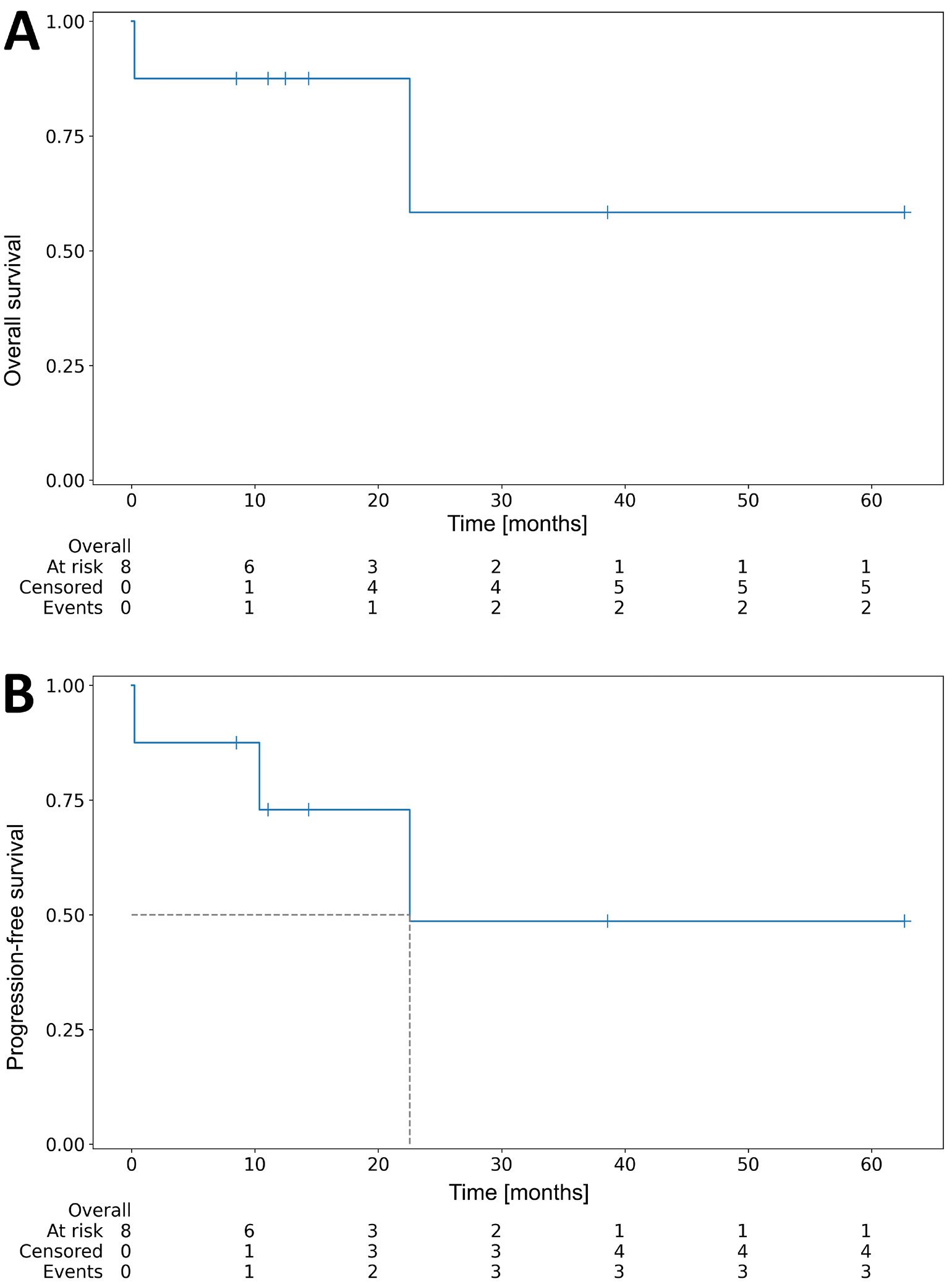
The median follow-up was 13.4 months (interquartile range (IQR): 10.4–34.6 months). At the final follow-up assessment, 5 patients (62.5%) remained in CR. One patient experienced disease progression. One patient died from septic shock due to Gram-negative pneumonia related to the alloHSCT procedure. Another patient developed severe steroid-refractory mucocutaneous chronic GVHD with prominent ocular involvement. Treatment included systemic corticosteroids, cyclosporine, and extracorporeal photopheresis. Despite intensive immunosuppressive therapy, the patient died from complications associated with chronic GVHD and its treatment. Median progression-free survival was 22.57 months (95% CI: 0.23–22.57 months), whereas median OS had not yet been reached. Survival curves are shown in Figure 1.
Discussion
The therapeutic landscape of R/R HL has evolved considerably over the last decade with the introduction of checkpoint inhibitors. PD-1-targeting agents such as nivolumab and pembrolizumab have produced high response rates, likely because the highly inflammatory tumor microenvironment characteristic of HL can be reactivated through immune checkpoint blockade.20, 21 These benefits also extend to patients whose disease has relapsed following autoHSCT. Despite these advances, most patients eventually experience disease progression, making subsequent management particularly challenging. In this setting, alloHSCT continues to represent a potentially curative treatment approach, although concerns regarding toxicity, GVHD, and nonrelapse mortality have limited its broader application.22, 23
In this retrospective single-center analysis, outcomes were assessed in 8 patients with R/R HL who underwent alloHSCT after prior checkpoint inhibitor exposure. The findings indicate that alloHSCT following CPI therapy may provide durable disease control while maintaining an acceptable safety profile. At the time of the last follow-up, 5 of 8 patients remained in CR despite adverse baseline characteristics, including primary refractory disease, multiple previous lines of treatment, and relapse following autoHSCT. Furthermore, transplantation was performed across varying disease states, with half of the patients transplanted in PR and 25% with stable disease. Although some patients achieved disease control without prior CR, the sample size is insufficient to determine the prognostic importance of pretransplant remission status.
These results align with previously published retrospective and registry-based studies. Large-scale analyses conducted by the Center for International Blood and Marrow Transplant Research (CIBMTR) and the European Society for Blood and Marrow Transplantation (EBMT) demonstrated improved progression-free survival among patients receiving checkpoint inhibitors before alloHSCT.17 The observed benefit was largely attributable to a reduced risk of relapse, although a corresponding improvement in OS was not clearly demonstrated. In a recent joint CIBMTR–EBMT analysis of 2,186 patients with HL, prior checkpoint inhibitor exposure was associated with an increased risk of grade II–IV and grade III–IV acute GVHD, but not chronic GVHD.17 Kaphan et al. reported an increased incidence of grade ≥II acute GVHD when transplantation was performed within 60 days of the last anti-PD-1 infusion and a particularly high incidence of severe acute GVHD when this interval was shorter than 30 days.24 Emerging evidence suggests that posttransplant cyclophosphamide (PTCy)-based GVHD prophylaxis may reduce the risk of CPI-associated GVHD and improve outcomes, although further research is needed to confirm these observations.25 In our cohort, the median interval between the last anti-PD-1 dose and alloHSCT was 84 days (range: 58–141). Six out of 8 patients (75%) received PTCy-based GVHD prophylaxis. Thus, although most GVHD manifestations in our cohort were clinically manageable, the fatal case demonstrates that severe immune-mediated toxicity may still occur despite a relatively long anti-PD-1 washout interval and the frequent use of PTCy. Nevertheless, the small sample size and absence of a CPI-naïve control group preclude conclusions regarding a causal association between prior anti-PD-1 exposure and GVHD incidence or severity.
Although follow-up was relatively short, the high CR rate after alloHSCT is encouraging. In our cohort, prior checkpoint inhibitor exposure does not appear to compromise transplant feasibility or success. Conversely, checkpoint inhibitors may enhance posttransplant disease control by modulating donor immune responses, albeit at the cost of increased immune-mediated toxicity.
Limitations of the study
Several limitations should be acknowledged. The retrospective design, small sample size (n = 8), short follow-up, and single-center nature of the study limit the generalizability of the findings. Furthermore, patients received heterogeneous salvage treatments between ABVD therapy and autologous transplantation. Variability in both the duration of checkpoint inhibitor exposure and the interval between CPI treatment and alloHSCT may also have affected clinical outcomes.
Despite these limitations, the study contributes valuable real-world data from a narrowly defined and clinically challenging patient population, supporting the feasibility of alloHSCT following checkpoint inhibitor failure in R/R HL.
Conclusions
In our retrospective single-center descriptive case series, allogeneic hematopoietic stem cell transplantation was a feasible and potentially curative treatment strategy for selected patients with R/R HL who either relapsed after or failed to respond to checkpoint inhibitor therapy. Particular attention should be devoted to the prevention, early recognition, and effective treatment of GVHD, especially among patients previously exposed to checkpoint inhibitors. Our study has several limitations, including the small sample size and relatively short follow-up, so larger prospective studies are needed to establish the optimal timing of transplantation, define the most appropriate conditioning regimens, and determine the most effective GVHD prophylaxis strategies in contemporary clinical practice.
Data Availability Statement
The participants in this study did not provide written consent for their data to be shared publicly; therefore, due to the sensitive nature of the research, the supporting data are not available.
Consent for publication of personal information
Not applicable.
Use of AI and AI-assisted technologies
Not applicable.