


Abstract
Recognizing that a child is seriously unwell before a full examination is completed remains one of the most valued yet least explicitly taught competencies in pediatrics. In practice, experienced clinicians often form an early judgment from a child’s appearance, breathing, movement, interaction, muscle tone, and the overall tempo of illness. Yet traditional teaching tends to compress these dynamic observations into brief written labels, while student exposure to informative cases remains uneven and largely dependent on chance. This editorial argues that the pediatric clinical eye is teachable and that digital educational tools may help make this tacit expertise more explicit, structured, and accessible to learners earlier in training. Recent literature supports the educational value of video-based learning, simulation-based training, and digital practice environments in health professions education. Against this background, this paper presents a digital educational application developed as part of a doctoral implementation project as an illustrative educational initiative rather than a completed diagnostic tool. The project centers on a structured audiovisual repository of real pediatric cases linked to clinical context and follow-up, which can be used to support repeated observation, feedback, and clinical reasoning. Digital tools are not proposed as a replacement for pediatric judgment. Their purpose is narrower: to help learners recognize clinically important cues and refine their judgments through repeated feedback. With appropriate governance and close integration with bedside teaching, such tools may help make expert observation more explicit and support the development of better-calibrated clinical reasoning.
Key words: medical education, pediatrics, clinical reasoning, video-based learning, child assessment
Introduction
An experienced pediatrician standing in the doorway of an examination room may form an initial impression of whether the child requires immediate attention within seconds. Before vital signs are measured, a pattern has already been registered: the effort behind each breath, the child’s spontaneous movement, and the way the child does or does not track and respond to the examiner and surroundings.1, 2 A toddler who shows unusually little resistance to being undressed may provide an important clinical cue that is difficult to capture in a single measurement. Experienced clinicians often act on such impressions but may find them difficult to explain. In written curricula, this complex pattern is frequently compressed into a few adjectives: “lethargic,” “irritable,” or “toxic-appearing.” These terms carry meaning for clinicians who have encountered the corresponding presentations but offer learners limited guidance on what to observe. Whether a student encounters such children during a pediatric rotation depends heavily on local case mix, timing, and chance.
In this editorial, the pediatric clinical eye refers to the rapid, experience-based integration of observable cues into an initial judgment of illness severity. It complements rather than replaces vital signs, structured triage, and formal clinical assessment. In practice, it reflects pattern recognition built through repeated exposure to how children look, move, breathe, and respond during illness.2 In young children, especially infants and toddlers, this skill matters greatly because symptoms are often nonspecific and verbal self-report is limited or absent.1, 3 Early appraisal therefore shapes what follows: observation or escalation, the choice of tests, and decisions about antibiotics or hospital admission.1, 2
Teaching this skill directly is difficult. Terms such as “ill-appearing” or “apathetic” are familiar to clinicians, but they give learners little sense of what to notice. Text can describe reduced reactivity or increased work of breathing; it cannot reproduce how these findings unfold over time. Bedside teaching remains essential, yet clinical workload and chance exposure mean that learners do not encounter the same cases.
Clinicians with limited pediatric experience may still need to make important decisions after only a brief encounter with a young child with a nonspecific presentation.1, 3 Unless expert pediatric observation becomes an explicit learning objective, this important competence may remain part of the hidden curriculum and be acquired unevenly.4
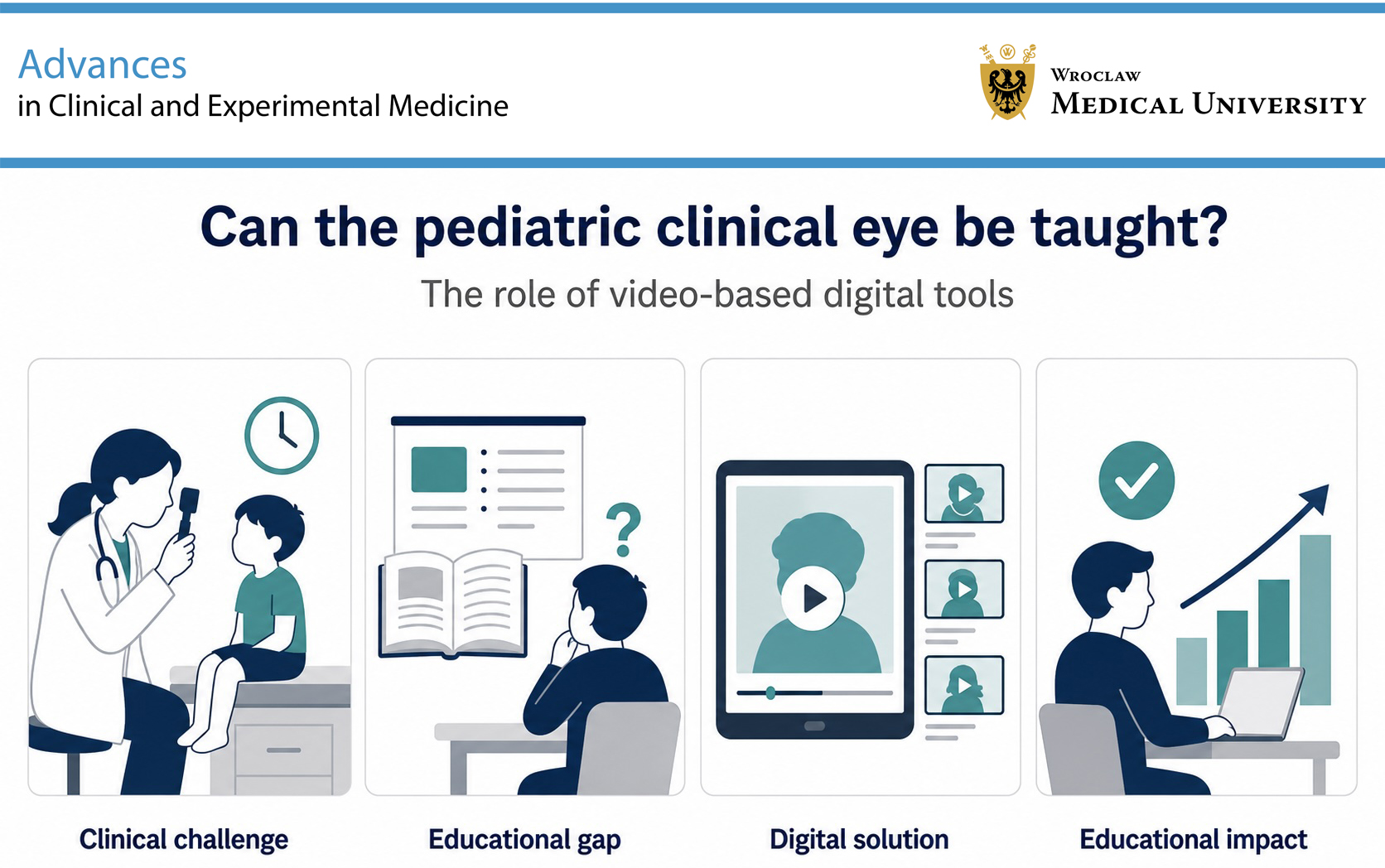
This editorial examines how digital tools may give the pediatric clinical eye a clearer educational structure. In this article, an audiovisual case repository refers to a secure collection of recorded cases, a video-based case library is its curated educational subset, and the digital application is the interface through which learners review cases and receive feedback. A doctoral implementation project in pediatric urgent care illustrates this model. The project remains in development and is presented as an educational initiative rather than a validated diagnostic technology. No claims about its clinical effectiveness are made.
In the proposed application, learners would review short recordings of children presenting to urgent care, record an initial judgment of the child’s general condition, identify the cues informing that judgment, and consider an initial management pathway. Structured clinical information, expert interpretation, and follow-up data would then allow learners to compare their reasoning with the subsequent clinical course. The educational aim is not to diagnose a child from video alone, but to provide deliberate practice in recognizing, weighting, and interpreting early clinical cues.
Why this skill is hard to teach
Experts often assess a child quickly without verbalizing each step.2, 4 Their judgment has been shaped by repeated encounters and feedback.2, 5, 6 They combine several observations rather than rely on one variable. For example, a quiet child who does not engage with a caregiver may be assessed differently from a similarly quiet child who tracks the examiner and responds promptly.1, 2
This multidimensional, dynamic nature explains why the skill is difficult to formalize. General appearance is not equivalent to a single score, a single vital sign, or a single checklist item. It contains gestalt elements that resist simplification. At the same time, the fact that a construct cannot be perfectly reduced does not mean it should remain pedagogically opaque. On the contrary, educational difficulty argues for more intentional design. If expert recognition depends on repeated calibrated exposure combined with feedback, then learners need structured opportunities to see a wide range of children, compare impressions, commit to judgments, receive feedback, and revisit their own reasoning.
Traditional teaching approaches meet this need only partly. Lectures, textbook descriptions, single still images, and static case summaries are valuable for building conceptual knowledge, but they underrepresent the dynamic, audiovisual nature of pediatric illness. Bedside teaching remains irreplaceable, yet it is unavoidably shaped by local case mix, the timing of clinical encounters, and uneven access to supervisors. Rare, subtle, or highly instructive cases cannot be scheduled on demand. As a result, educational exposure to meaningful variation in children’s general appearance often remains fragmentary.
Why video and digital repositories matter
Traditional teaching materials capture only part of the clinical signal. Many cues clinicians use in early pediatric assessment are inherently temporal. The learner must appreciate how a child moves, how quickly the child responds, whether the child tracks visually, how crying starts and resolves, whether breathing effort escalates with agitation, and how the child responds to touch, voice, or positioning. Sound also matters: the quality of crying, the presence of grunting, the rhythm of breathing, and the interaction between respiratory effort and vocalization can all shape the first clinical impression.1, 2 Still photographs and written vignettes cannot adequately transmit such signals. Video can do so much more effectively, especially when paired with sound and concise, structured clinical context.5
For this reason, video-based learning is especially relevant in pediatrics. A filmed case can slow down expert judgment and make it open to discussion. Learners can be asked to observe without knowing the outcome, articulate whether the child appears well, shows concerning signs, or appears critically unwell, identify the cues they relied on, and compare their interpretation with expert commentary and the subsequent clinical course.5, 6 In this format, the educational value does not lie only in showing disease categories. It lies in repeated exposure to clinically meaningful variation in energy, gaze, movement, interaction, respiratory effort, consolability, hydration, and the overall tempo of illness.1, 2, 6
A structured case repository further strengthens this approach. Unlike ad hoc teaching based on whatever cases happen to present on a given day, a curated repository can deliberately capture a broad spectrum of common, subtle, rare, and urgent presentations.6 Every learner can then have a more comparable educational experience. Such a repository also enables standardization: the same material can be used across different learner groups, at different stages of training, and in repeated cycles of assessment and feedback.7 This permits calibration of judgments over time and provides a stable basis for discussion between supervisors and trainees.
The value of such a repository is therefore not merely archival. It becomes pedagogical when cases are linked to clinical context, expert interpretation, and meaningful endpoints. In the underlying educational concept, the case’s educational power depends not only on the recorded image itself, but also on its connection to background information, structured observation, and the child’s eventual clinical course. When a learner sees not only the video but also the subsequent diagnosis, disposition, or follow-up, the experience begins to resemble the accumulation of supervised clinical exposure rather than passive media consumption.
Recent evidence across health professions education suggests that video-based learning is associated with improved knowledge acquisition and skills development, while pediatric simulation and digital simulation environments can support procedural knowledge, retention, and learner confidence.5, 6, 8 Serious games and gamification may also contribute to knowledge and skills development, although the quality of evidence and the design of the educational intervention remain important limitations.7, 9
Educational implications for clinical reasoning and decision-making
Digital tools are sometimes criticized for pulling medical education away from patients and toward screens. That concern is legitimate if such tools replace clinical encounters. It is much less persuasive when digital resources prepare learners for bedside exposure, intensify perceptual learning, and reinforce what they have seen in practice.5, 10 In this sense, the most appropriate role of a pediatric case repository or educational application is complementary. The bedside remains the place where medicine is practiced, relationships are formed, and judgment is ultimately tested. Digital tools become useful when they increase the frequency, comparability, and reflective depth of learning between or around those encounters. This matters especially in pediatrics because access to repeated expert interpretation is a scarce educational resource. A digital platform can embed expert explanations, structured observation tasks, branching decisions, quizzes, feedback loops, and benchmark answers. One carefully prepared case can therefore be reused across cohorts, making more efficient use of experts’ time while preserving its educational intent.7, 11
A further educational implication concerns equity of exposure. Traditional clinical learning depends heavily on where the learner trains, which supervisors are available, what the local case mix happens to be, and whether a teaching moment can be paused and discussed. A curated digital repository cannot eliminate those inequalities, but it can reduce randomness by ensuring that all learners encounter an intentionally selected range of cases.6, 7, 9 For difficult and experience-dependent skills such as recognizing the seriously unwell child, that standardization may be educationally significant.
Formative assessment strategies embedded in such platforms may further enhance learning. When learners commit to an initial judgment, receive structured feedback, and revisit similar cases over time, their perceived knowledge, skills, confidence, and engagement may improve.12
Ethics and governance
The educational use of real pediatric audiovisual material is justifiable only if ethics and governance are built into the design from the outset. This is not a minor technical issue but a central condition of legitimacy. These safeguards are essential because recordings involve vulnerable patients and may be reused in settings far removed from the original clinical encounter. Clear rules must define who can view the material, for what purpose, and for how long.13, 14 International guidance requires appropriate consent for the publication or educational use of identifiable images and cautions that partial masking does not reliably anonymize a participant.13 In the implementation project described here, consent for educational use is obtained separately, identifying information is stored separately from the analytical material, and access is limited to authorized users.
Limitations of the project
The proposed benefits remain educational hypotheses rather than demonstrated outcomes of the implementation project. Existing studies support video-based and simulation-based learning, but they do not establish that training with recorded cases improves the assessment of children’s general appearance or that its benefits transfer to bedside decision-making.15, 16, 17 The educational effect may also depend on case selection, recording quality, learner experience, feedback design, and the clinical and cultural context in which children’s behavior is interpreted. Moreover, a curated audiovisual repository may underrepresent atypical presentations and cannot reproduce the relational, tactile, and situational information available during direct examination. The planned application therefore requires prospective evaluation of judgment accuracy, calibration, retention, transfer to clinical practice, and potential unintended effects.
Conclusions
Years of pediatric practice sharpen the clinical eye through repeated encounters and feedback.1, 2, 5, 6 This experience-based skill can be taught more deliberately, although traditional methods provide uneven opportunities to practice it. Video-based cases can bring this experience-dependent competence into a more structured educational setting. They preserve observations that disappear in written summaries and can broaden exposure when linked to expert feedback.5, 6 Bedside teaching must nevertheless remain the reference point for clinical education. In the assessment of young children who cannot describe their symptoms, video-based education may be particularly useful in helping learners interpret early behavioral and visual signs of illness.1, 2, 5 The relevant question is therefore not whether digital tools can replace bedside teaching, but whether they can make expert pediatric observation more explicit, equitable, and transferable to clinical practice.
Use of AI and AI-assisted technologies
During the preparation of this work, the authors used Claude Fable 5 (Anthropic) in order to improve the language and readability of the manuscript and to translate parts of the text from Polish into English. The tool was not used to generate scientific content, analyze data, or create references. After using this tool, the authors reviewed and edited the content as needed and take full responsibility for the content of the publication.