


Abstract
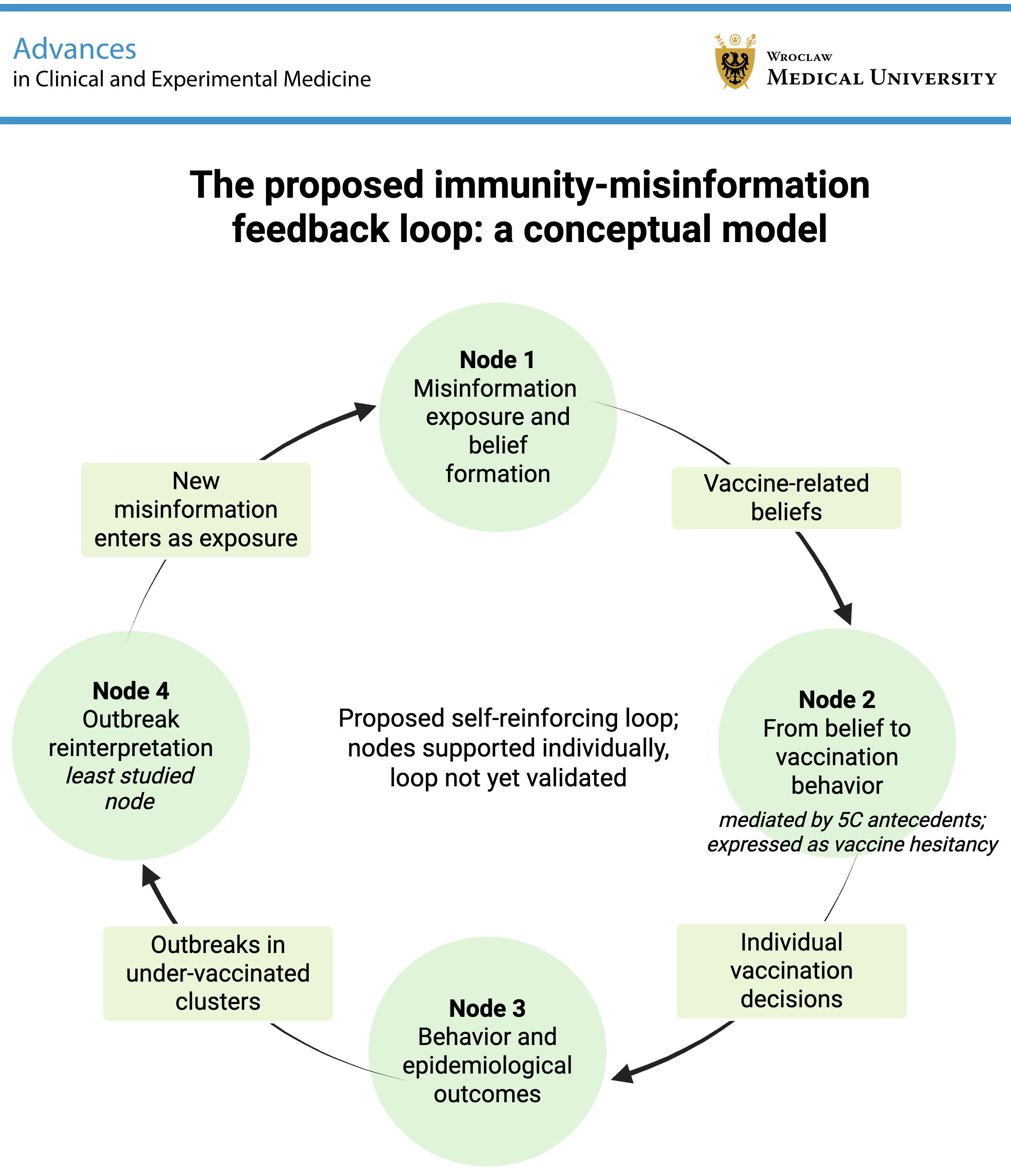
Vaccine hesitancy and health misinformation are typically treated as exogenous pressures on immunization systems, reducible in principle by targeted communication and educational interventions. This editorial argues that this framing is structurally inadequate and proposes modeling misinformation and reduced population immunity as coupled variables within a self-reinforcing feedback loop. Declining vaccine coverage increases outbreak risk, and outbreaks provide material for new misinformation that further erodes confidence and coverage. The proposed loop operates through 4 sequential nodes: misinformation exposure shapes vaccine-related beliefs; those beliefs drive individual vaccination decisions, mediated by psychological antecedents such as confidence, complacency, and collective responsibility; individual decisions aggregate into population-level coverage patterns that shape outbreak probability, particularly in spatially clustered undervaccinated communities; and disease outbreaks are reinterpreted by antivaccine actors through recurrent rhetorical strategies that generate new misinformation. Evidence from epidemiological surveillance, behavioral science, and communication research supports each node individually, but not yet the complete loop. The European measles resurgence of 2023–2025, with 127,350 cases reported in 2024 alone, illustrates the epidemiological consequences of sustained coverage decline. Effective countermeasures require simultaneous intervention at multiple nodes rather than a sequential, outbreak-by-outbreak response. The strongest experimental support for prebunking strategies comes from psychological inoculation theory, although measured outcomes reflect recognition of manipulation techniques rather than vaccination uptake or coverage. Addressing the confidence deficit underlying hesitancy requires sustained trust-building in public health institutions rather than information-deficit corrections. Integrating real-time surveillance of vaccine coverage, hesitancy clustering, and misinformation volume into a unified monitoring framework remains an unmet methodological priority.
Key words: public health, vaccine hesitancy, science communication, herd immunity, health misinformation
Introduction
Reported measles incidence in the World Health Organization (WHO) European Region reached its lowest level in 2016 during the 2009–2018 period, with 5,273 cases. By the end of 2017, endemic transmission had been interrupted for at least 36 months in 37 of the 53 countries in the Region, which were verified as having eliminated the disease.1 In 2024, the Region recorded 127,350 measles cases in the same 53 countries, the highest annual figure since 1997. These figures were reported by the WHO and the United Nations Children’s Fund (UNICEF) in March 2025.2 Of all cases reported in the EU/EEA in 2024 with known vaccination status, 87% occurred in unvaccinated individuals.3 The pathogen had not changed. The vaccine had not changed. What changed was population-level immunity.
The standard explanatory framework positions vaccine hesitancy as the proximal cause of declining coverage and declining coverage as the proximal cause of outbreaks.4 This is accurate but incomplete. It treats health misinformation as an exogenous variable, that is, a pressure applied to an otherwise stable system that reduces vaccine uptake and thereby depletes herd protection. What this model fails to capture is the reverse pathway: the epidemiological consequences of reduced coverage provide material for new misinformation, which may in turn deepen hesitancy and further erode coverage. Misinformation and reduced population immunity may be better described as coupled variables in a self-reinforcing feedback loop than as cause and effect in a linear chain.
The concept of herd immunity as a population-level threshold is well established.5 For measles, the threshold is approx. 92–94% population immunity, which requires 2-dose vaccination coverage above 95%. The risk of sustained transmission after importation is greatest in populations where vaccine-hesitant individuals cluster spatially.6 Much of the European Region has remained below this level, leaving it sufficiently susceptible for importations to result in sustained transmission.3
Less often examined is what happens after an outbreak begins. Disease resurgence does not simply reflect a public health failure; it may also be reinterpreted by actors promoting antivaccine narratives as evidence of vaccine inefficacy.7 This reinterpretation creates new misinformation, whose circulation is amplified by automated and coordinated accounts and may reinforce hesitancy among individuals who have not yet decided on vaccination.8 Randomized experimental evidence indicates that exposure to such content reduces stated vaccination intent among previously willing adults.9 The individual steps of this sequence are supported to differing degrees, and the sequence has not been observed in full within a single population over time.
This editorial proposes a formalized 4-node model of the immunity-misinformation feedback loop, outlined below. The aim is not to restate that misinformation is harmful, which is well established, but to argue that treating it as exogenous systematically underestimates its persistence and misdirects countermeasures. Understanding the loop as an endogenous dynamic has direct implications for when, where, and how to deploy interventions.
This editorial is a perspective article rather than a systematic review, and its selective reference list is intended to establish the plausibility of each link in the proposed model rather than the operation of the loop as a whole. The model addresses the informational and attitudinal pathway to undervaccination; the structural and service-delivery determinants of coverage operate in parallel and are considered separately below.
Herd immunity thresholds and the epidemiology of coverage decline
The concept of herd immunity rests on a straightforward mathematical relationship: for any directly transmitted pathogen, there exists a threshold proportion of immune individuals in a population above which the effective reproduction number falls below 1, and sustained transmission cannot be maintained.5 Immunity and vaccination coverage are not the same quantity, and the distinction matters when comparing threshold values with surveillance data. The herd immunity threshold is defined as 1 − 1/R0 and refers to the proportion of the population that is effectively immune. For measles, with a basic reproduction number of 12 to 18, the threshold is approx. 92–94%.10 The coverage required to achieve that level of immunity is approx. (1 − 1/R0)/E, where E is vaccine effectiveness, and is therefore higher than the threshold itself. With a 2-dose effectiveness of approx. 96%,11 the required coverage ranges from roughly 96% to 98%, consistent with and marginally above, the WHO operational target of 95% 2-dose coverage. The correspondence between coverage and immunity is further modified by the number of doses received and the interval between them, by immunity acquired through natural infection in cohorts born before elimination, by waning immunity and secondary vaccine failure, and by age-structured contact patterns. The homogeneous mixing assumption underlying the threshold formula does not hold in real populations, so the threshold is best treated as an approximate reference value rather than as an exact quantity, and a single national threshold is not strictly defined when mixing is heterogeneous.5, 6 The relationship between coverage and outbreak risk is nonlinear. A decline in coverage from 95% to 90% does not produce a proportional increase in that risk, but rather a disproportionate increase, because the susceptible pool expands linearly while the expected size of an outbreak grows sharply once the effective reproduction number rises above 1.
This nonlinearity is compounded by the spatial and social clustering of vaccine-hesitant individuals. Standard herd immunity models assume homogeneous mixing within a population, yet real populations are heterogeneous. Vaccine-hesitant individuals tend to cluster in specific communities, schools, religious groups, and geographic areas.6 In such settings, local effective coverage may be far below the national mean. A country reporting 92% 2-dose MMR (measles, mumps, and rubella) coverage nationally may simultaneously harbor communities with coverage below 70%, where local immunity falls below the threshold despite aggregate statistics. The 2018–2019 measles outbreak in New York illustrated this dynamic, with 649 cases concentrated in communities whose local coverage had fallen well below the threshold. 12
The same pattern is evident across the broader European resurgence of vaccine-preventable diseases in 2023–2025.2 Within the EU/EEA, 35,212 cases were confirmed in 2024, a nearly tenfold increase from 3,973 in 2023, with Romania alone accounting for approx. 87% of the total.3 Case counts fell substantially in 2025 relative to 2024. Several explanations are consistent with this decline, including partial depletion of the susceptible pool as the virus moved through undervaccinated communities, outbreak response and catch-up immunization in the most affected countries, and fewer importations. Surveillance data do not distinguish among them. Transmission nevertheless continued into 2026. Between March 2025 and February 2026, the 30 EU/EEA Member States reported 4,623 measles cases and 6 deaths, with outbreaks ongoing in Bulgaria and Latvia during the 1st quarter of 2026.13 Only 4 EU/EEA countries (Hungary, Malta, Portugal, and Slovakia) achieved the ≥95% 2-dose coverage target recommended for elimination.3 Measles was not the only indicator. In 2024, nearly 300,000 pertussis cases were reported across the WHO European Region, more than 3 times the number reported in the preceding year.14 Within the EU/EEA, 209,674 pertussis cases were confirmed, representing an eightfold increase in incidence from 6.7 to 54.9 per 100,000 population. Infants aged <1 year were the most affected group, with a notification rate of 318.5 per 100,000.15
These data illustrate a structural vulnerability that predates the COVID-19 pandemic but deepened during and after it. Between 2019 and 2024, 2-dose MMR coverage in the WHO European Region declined from 92% to 91%, and in 2024 more than half of the countries in the Region did not meet the herd immunity target for MMR or DTP, with almost a 3rd reporting coverage below 90%.14 Within the EU/EEA, weighted MCV1 (measles-containing-vaccine first-dose) coverage stood at 93.9% and MCV2 (measles-containing-vaccine second-dose) at 88.8% in 2023, with only 4 Member States reaching the ≥95% 2-dose threshold, down from 7 in 2019.3 The pandemic disrupted routine immunization services, but the subsequent failure to recover pre-pandemic coverage levels reflects more than logistical disruption. In countries where vaccine hesitancy was already concentrated in specific communities, the pandemic period coincided with amplified distrust and new antivaccine narratives that persisted after immunization services resumed. Recovery has also been uneven for reasons unrelated to belief, including workforce shortages, incomplete immunization registries, and difficulty reaching mobile and unregistered populations. The observed pattern was not a uniform decline in coverage but an increase in the depth and geographic extent of undervaccinated clusters, precisely the epidemiological configuration most favorable to outbreak initiation and spread.
Non-informational determinants of coverage
Incomplete vaccination is not attributable to belief alone. Children remain unvaccinated because of limited access to primary care, lack of registration with a family physician, geographic distance from services, poverty, language and literacy barriers, high residential mobility and migration, interruptions in immunization services, administrative and registry failures, armed conflict, and the absence of reminder-recall systems. These determinants operate independently of the informational environment and, in some settings, account for a larger share of the coverage deficit than refusal. The 5C framework applied below recognizes this by treating structural constraints on access as an antecedent of vaccination behavior distinct from confidence and complacency.16 Romania, which accounted for approx. 87% of EU/EEA measles cases in 2024,3 illustrates the point. In a survey of 520 caregivers of measles cases conducted during the 2016–2018 outbreak, 14.0% reported that the vaccine had not been available when their child needed it, 17.9% considered the waiting times at the health facility inappropriate, and 6.9% found the clinic location inconvenient, indicating that physical opportunity, not motivation alone, contributed to non-vaccination in the population that was subsequently most affected by the European resurgence.17
The immunity-misinformation feedback loop: A 4-node model
The dominant framework in public health communication research treats health misinformation as an exogenous stressor that reduces vaccine uptake. This framing is analytically convenient but incomplete. It cannot explain why antivaccine narratives recur after disease outbreaks, nor why interventions targeting individual misinformation items rarely produce durable effects. This editorial proposes modeling misinformation and reduced immunity as coupled variables within a closed feedback loop. The proposed loop has 4 sequential nodes: misinformation exposure shapes beliefs; beliefs drive vaccination behavior; behavior shapes epidemiological outcomes; and those outcomes generate new misinformation, which re-enters the system as exposure.
Misinformation exposure and belief formation
Exposure to online antivaccine content is dose-dependent. In a randomized controlled trial with 8,001 participants in the UK and the USA, Loomba et al. demonstrated that a single exposure to recent COVID-19 vaccine misinformation reduced stated vaccination intent by 6.2 and 6.4 percentage points, respectively, among adults who had previously reported definite willingness to vaccinate.9 The magnitude of this effect is substantial in populations where elimination requires 2-dose coverage above 95%. The exposure mechanism is not neutral. Antivaccine content generates disproportionately high engagement on social media platforms, and a small number of high-volume producers account for a disproportionate share of that content. An analysis by the Center for Countering Digital Hate (CCDH) found that 12 individual accounts were responsible for approx. 65% of antivaccine content shared across major social media platforms during the early COVID-19 vaccine rollout.18 Recommendation algorithms optimize for engagement rather than accuracy, systematically amplifying content from these sources.
From belief to vaccination behavior
Belief does not translate directly into behavior. Psychological antecedents mediate this relationship, and the 5C model developed by Betsch et al. identifies confidence in vaccines and in the institutions delivering them, complacency about disease risk, structural constraints on access, individual calculation of costs and benefits, and collective responsibility as distinct predictors of vaccination behavior.16 Confidence has emerged as the most consequential of these determinants. Vaccine Confidence Index data collected in 2015, 2018, 2019, and 2022 and analyzed for the UNICEF State of the World’s Children 2023 report indicate that the perceived importance of vaccines for children declined in 52 of 55 countries for which data were available, with the largest declines in younger age groups.19 Over the same period, routine immunization coverage fell in many of these countries. These 2 trends are concurrent, and the available data do not establish their temporal ordering or exclude a common upstream driver affecting both.
If changes in confidence precede changes in uptake, reactive interventions deployed only after coverage has already fallen would be correspondingly limited, but this remains a conjecture rather than a measured relationship.
Behavior and epidemiological outcomes
Individual vaccination decisions aggregate to population-level epidemiological outcomes through 2 mechanisms that amplify each other: aggregate coverage and its spatial distribution. The aggregate mechanism follows directly from the threshold relationship. Coverage translates into immunity only after adjustment for vaccine effectiveness, as set out above, and when the resulting proportion of susceptible individuals exceeds 1/R0; i.e., when population immunity falls below 1 − 1/R0, the effective reproduction number rises above 1, enabling sustained transmission. Reduced immunity is necessary but not sufficient for sustained transmission. Whether sustained transmission occurs also depends on pathogen introduction, contact patterns, seasonality, population movement, and the spatial distribution of susceptible individuals, so coverage decline raises the probability and expected size of an outbreak rather than guaranteeing one. The spatial mechanism is less often quantified but is empirically well documented. Vaccine-hesitant individuals are not randomly distributed across a population. Using spatial scan statistics on electronic health records for 154,424 children in Northern California, Lieu et al. identified statistically significant geographic clusters in which underimmunization rates reached 18–23%, compared with 11% in surrounding areas, and vaccine refusal rates reached 5.5–13.5%, compared with 2.6% outside the clusters.6 Similar clustering has been documented in European settings, most extensively in the Dutch Orthodox Protestant communities, where the 2013 measles epidemic originated.20
The epidemiological consequences of clustered hesitancy are not evenly distributed across populations. The burden of morbidity and mortality falls disproportionately on individuals who cannot be vaccinated: infants below the recommended age for first vaccination, immunocompromised patients, and those with medical contraindications. In the EU/EEA in 2024, infants aged <1 year had a measles notification rate of 1,175.4 per 1,000,000 population, the highest of any age group and roughly 15 times the overall rate. Of infant cases, 98% occurred in unvaccinated children who were not yet eligible for MMR.3 The pertussis pattern was analogous, with the notification rate among infants aged <1 year more than 5 times the population average, as reported above.15 These infants derive their protection almost entirely from herd immunity and maternal vaccination programs; when local coverage falls, they bear the epidemiological cost first. This distributional pattern is critical to the loop-closing dynamics analyzed in the next subsection, because the visible harm concentrated in undervaccinated communities becomes the raw material for reinterpretation.
Outbreak reinterpretation
as a loop-closing mechanism
This node closes the loop and is empirically the least studied of the four. Published analyses of antivaccine rhetoric describe several strategies for reinterpreting outbreak-related information. However, the recurrence of these strategies across different outbreaks, diseases, and vaccine platforms has not been systematically established.7, 21
The 1st strategy exploits the arithmetic of paradoxical proportions in highly vaccinated populations. When 95% of a population is vaccinated, even a highly effective vaccine can produce a situation in which the absolute number of cases among vaccinated individuals in an outbreak exceeds the number of cases among unvaccinated individuals, because the vaccinated group is far larger. Antivaccine content routinely presents case counts without normalizing them by population denominators, inverting the underlying epidemiological signal. When surveillance intensifies during an outbreak response, additional cases are detected, and the coincidence of increased vaccination activity with increased case counts is presented as causal. The 2nd strategy positions the audience as capable of independently evaluating complex biomedical evidence, encouraging them to “do their own research” rather than defer to professional expertise. This strategy has been coded as “Do-Your-Own-Research” (DYOR) in a qualitative codebook of antivaccine rhetoric developed from social media content circulating during the COVID-19 pandemic. It accounted for 8.4% of coded rhetorical items and was one of 4 patterns that together represented just over 40%. All 9 codes in that study appeared across the 4 sampled platforms: YouTube, Twitter, Facebook, and Instagram.21 The 3rd strategy inverts the logic of the herd immunity threshold, framing any outbreak in a vaccinated population as prima facie evidence of vaccine ineffectiveness, while ignoring the empirical relationship between coverage decline and outbreak probability.
Taken together, these strategies illustrate plausible ways in which outbreak-related information may be reframed in antivaccine narratives. However, the available studies do not establish how consistently they recur across geographic contexts, disease types, or vaccine platforms.7 Their potential recurrence provides a rationale for investigating whether this node may be amenable to intervention, as discussed below.
Closing the loop
If the model holds, then without disruption at 1 or more nodes, it would be expected to accelerate. This expectation has not been tested directly, and the evidentiary status of the individual nodes is considered next.
Evidentiary status and limitations of the model
The 4 nodes differ substantially in the strength of the evidence supporting them, and the loop as a whole has not been validated. Node 1 rests on randomized experimental evidence linking exposure to misinformation with reduced vaccination intent,9 supplemented by quasi-experimental and ecological studies linking exposure to realized vaccination uptake at the population level.22, 23 Node 2 rests on validated psychometric instruments and multi-country longitudinal confidence monitoring,16, 24 although the translation of stated intent into actual vaccination behavior is constrained by the intention–behavior gap; the population-level studies cited above indicate that exposure effects are not confined to stated intent. Node 3 is supported by robust epidemiological and spatial statistical evidence.3, 6, 15 Node 4 remains the weakest link.
The pathway described in node 4 is best assessed step by step. The sequence comprises 4 steps: an outbreak occurs, followed by increased production of antivaccine content; that content reaches a larger audience; increased exposure lowers confidence; and lowered confidence reduces realized uptake.
For the 1st step, the evidence is temporal rather than causal. Broniatowski et al. analyzed 204 Facebook pages expressing vaccine opposition between 2009 and 2019 and identified sharp increases in the activity of pages framing vaccine refusal as a civil liberty in January 2015 and January 2019, coinciding with the Disneyland measles outbreak and the measles resurgence in the USA, respectively. A 3rd increase in April 2016 coincided with a documentary release rather than an outbreak, and the authors do not attribute these changes causally to outbreak occurrence.25 For the 2nd step, no study has quantified whether outbreak-related antivaccine content reaches audiences beyond those already exposed. The 3rd step rests on the randomized evidence discussed above.9 For the 4th step, 2 studies link exposure to realized uptake rather than to stated intent: Carrieri et al. combined the 2012 Court of Rimini ruling on the MMR vaccine with regional variation in broadband penetration in a difference-in-differences design and found that a 10-percentage-point increase in local broadband coverage was associated with significant reductions in measured immunization rates, sufficient to bring coverage below the 95% target.23 Dunn et al. found that the composition of information exposure explained 68% of the variance in state-level 1-dose human papillomavirus (HPV) vaccine coverage among females and 63% among males, with lower coverage where safety concerns, misinformation, and conspiracy content accounted for a larger share of exposures.22
No study has followed the full sequence from outbreak to reduced uptake within a single population, and the 2nd step, in particular, remains unmeasured. This node is therefore the one most vulnerable to falsification.
No study has measured the loop gain, established the time constants governing transitions between nodes, or demonstrated that the system completes more than 1 cycle in an identifiable population. Intervention evidence is also heterogeneous with respect to outcomes. Studies of prebunking measure recognition; studies of misinformation exposure measure intention; and population-level studies measure coverage, so that no single chain of evidence connects an intervention to an epidemiological endpoint. The evidence assembled here is therefore compatible with the proposed structure but does not exclude alternative explanations, including a common upstream driver such as declining institutional trust that independently affects both misinformation susceptibility and vaccination behavior, or unidirectional causation without a closing pathway. A further limitation concerns scope. The model does not partition the coverage deficit between informational and structural causes, and no study has estimated the share of undervaccination attributable to each. In populations where access barriers predominate, interventions directed at the loop would be expected to have limited effect, and the relative contribution of the 2 classes of determinants is likely to vary substantially between and within countries. If the loop operates as proposed, 3 predictions follow. First, the volume of antivaccine content referring to a given pathogen should rise measurably in the weeks following the onset of an outbreak of that pathogen, relative to a matched pre-outbreak baseline and to control pathogens not experiencing outbreaks. Second, that rise should be followed by a measurable decline in confidence indices in the affected population, with a lag measurable in months. Third, geographic units experiencing outbreaks should show subsequent coverage decrements exceeding those in comparable units without outbreaks, after adjustment for pre-existing coverage trends and access barriers. Failure to observe the 1st or 3rd of these would constitute evidence against the closing pathway. Testing the model would require designs not yet applied to this question: cross-lagged panel analyses of misinformation volume, hesitancy indices, and coverage measured repeatedly in the same geographic units; interrupted time-series analyses of misinformation output before and after defined outbreak events; and agent-based or compartmental models in which the loop is specified explicitly and its parameters are estimated using observed coverage and incidence data. Until such work is available, the model should be treated as a framework for organizing evidence and generating testable predictions.
The COVID-19 pandemic is the most extensively documented episode of acute informational stress against which the plausibility of the loop model can be examined, although it does not test the model. The experimental effect of misinformation exposure on vaccination intent described above9 was documented during this period, while de Figueiredo et al. had already recorded declining vaccine confidence in multiple European countries in the years preceding the pandemic, indicating that the informational conditions that facilitated the spread of pandemic-era hesitancy were present beforehand.24 These observations are consistent with a pre-existing dynamic that accelerated under conditions of maximal informational stress, rather than with a dynamic created by the pandemic itself. The coverage deficits that persist beyond the acute phase, as described above, are consistent with this interpretation.
Intervention points and the evidence base for loop disruption
Each of the 4 nodes admits interventions, and the evidence base varies across them in both strength and the outcomes measured. The subsections below follow the nodes in order. Integrated surveillance is treated separately because it is a measurement requirement spanning the whole loop rather than an intervention at any single node.
Node 1: Reducing the effect of exposure on belief
The strongest experimental support exists for interventions at this node, specifically prebunking strategies derived from psychological inoculation theory. Unlike debunking, which attempts to correct established false beliefs after exposure, prebunking preemptively exposes individuals to weakened doses of the rhetorical techniques used to produce misinformation, building cognitive resistance before full-strength exposure. In 7 preregistered studies, including a field experiment on YouTube with 22,632 participants, Roozenbeek et al. demonstrated that short inoculation videos improved the ability to identify manipulation techniques, increased confidence in distinguishing credible from noncredible content, and improved the quality of sharing decisions, with effects robust across the political spectrum.26 The scalability of this approach through social media platforms represents a structural advantage over individual-level educational interventions. Interventions at this node are not limited to recipients. Because a small number of high-volume producers account for a disproportionate share of antivaccine content, measures that reduce the algorithmic amplification of those accounts act on the same node by lowering exposure rather than by increasing resistance to it.18
The outcomes require careful specification because the intervention literature and the epidemiological literature do not measure the same thing. Four outcome levels can be distinguished: recognition, meaning the ability to identify manipulation techniques and discriminate between credible and noncredible content; intention, meaning stated willingness to vaccinate; individual uptake, meaning receipt of a vaccine dose; and population coverage, meaning the proportion of a target population immunized. The evidence for prebunking sits at the first of these levels. The outcomes reported by Roozenbeek et al. were recognition of manipulation techniques, confidence in that judgment, and the quality of sharing decisions,26 and a meta-analysis of 42 independent studies with 42,530 participants found that psychological inoculation reduced the perceived credibility of misinformation (d = −0.36; 95% CI: −0.50 to −0.23) without measuring any behavioral endpoint.27 No study has shown that prebunking increases individual vaccine uptake or population coverage.
Two further considerations limit extrapolation across these levels. Inoculation effects decay without repeated exposure or booster interventions,28 whereas vaccination decisions are typically made at scheduled immunization visits that may occur months after any campaign. The step from recognition to uptake must pass through both the intention–behavior gap and the structural barriers described above, either of which can attenuate an effect measurable at the recognition level. Prebunking is therefore the best-supported intervention at node 1 in terms of experimental design and consistency of effects, but its effect on the epidemiological endpoint that the loop model concerns remains untested.
Node 2: From belief to vaccination behavior
Two classes of intervention operate at this node: those that directly address established hesitancy and those that address the institutional trust underpinning confidence. Behavioral interventions targeting established hesitancy show smaller, less consistent effects than prebunking, in part because reduced confidence, as the 5C model indicates, reflects distrust of the institutions recommending vaccination rather than a deficit in factual knowledge. This distinction has direct clinical implications: vaccination messages that are perceived as limiting freedom of choice may elicit psychological reactance, whereas explicitly emphasizing autonomy can reduce reactance and improve message evaluation and vaccination intention.29
Institutional trust serves as a foundational condition for the entire loop. When trust in public health institutions is low, accurate information from those institutions carries less persuasive weight, regardless of its content. The decline in the perceived importance of vaccines for children described above indicates the scale of this erosion.19 Restoring that confidence requires sustained, transparent communication over time and cannot be achieved through one-off corrections.
Node 3: Coverage and its spatial distribution
Interventions at node 3 do not act on belief. They act on how individual decisions translate into aggregate coverage and on the spatial distribution of susceptibility. Because outbreak risk depends on local rather than national immunity, catch-up campaigns targeted at identified undervaccinated clusters raise effective coverage where it matters epidemiologically, whereas uniform national campaigns may leave those clusters untouched. Outreach vaccination, complete immunization registries, and reminder-recall systems act at the same node by converting intention into realized uptake. Reminder and recall interventions, in particular, have an established evidence base. These measures also address the structural determinants described above, which the loop model does not represent, and they complement rather than replace interventions directed at the informational nodes.30
Node 4: Outbreak reinterpretation
Node 4 offers an intervention opportunity that follows from the predictability of the reinterpretive strategies described above. Because those strategies are structurally similar across geographic contexts, disease types, and vaccine platforms, the content of misinformation likely to follow a given outbreak can be anticipated before it appears, and countermessaging keyed to that outbreak’s specific epidemiological configuration can be prepared in advance rather than composed reactively. Prebunking campaigns should therefore be deployed in anticipation of predictable reinterpretive narratives, not after those narratives have circulated. Whether this approach is effective in an actual outbreak remains to be established.
Integrated surveillance
Interventions at all 4 nodes depend on a measurement infrastructure that does not yet exist. Monitoring of vaccine coverage, hesitancy clustering, and misinformation volume needs to be integrated into a single framework at a fine spatial resolution. The model implies that the 3 variables are dynamically coupled, and this implication cannot be tested with indicators collected separately and reported at aggregate geographic scales. Such a system would establish whether the coupling exists and determine its strength. Effective loop disruption would require simultaneous intervention at multiple nodes rather than a sequential response to each outbreak as it occurs. However, no trial has yet evaluated a multi-node intervention using vaccination coverage as an endpoint.
Conclusions
The immunity-misinformation feedback loop described in this editorial is a conceptual model. Each of its 4 nodes has empirical correlates documented across multiple pathogens and geographic contexts, but the loop has not been observed or quantified as a complete dynamic system. The argument should be read as a framework for organizing evidence and guiding future measurement rather than as a demonstrated mechanism. Its central implication is that vaccine hesitancy and health misinformation are better treated as endogenous components of the immunization system rather than as exogenous disturbances to it, with the qualification that this model concerns only 1 pathway and does not address the structural and service-delivery determinants of coverage. Two consequences follow. Coverage, hesitancy, and misinformation would need to be measured within a single framework at a fine spatial resolution, whereas current surveillance tracks them separately and at scales that obscure clustering. Because reinterpretive narratives around outbreaks are structurally predictable, the informational environment can, in principle, be prepared in advance, shifting communication from outbreak response to outbreak anticipation. Whether this raises coverage is the most consequential unanswered question in the evidence reviewed here. On this account, the loop would not close because individuals make irrational decisions. It would close because the system produces, in the sequence the model predicts, the conditions under which those decisions appear rational. Whether that sequence occurs as described remains to be measured.
Use of AI and AI-assisted technologies
During the preparation of this work, the author used Grammarly (Grammarly Inc., San Francisco, USA) to verify language accuracy and obtain style and tone recommendations. After using this tool, the author reviewed and edited the content as necessary and takes full responsibility for the content of the publication.