Abstract
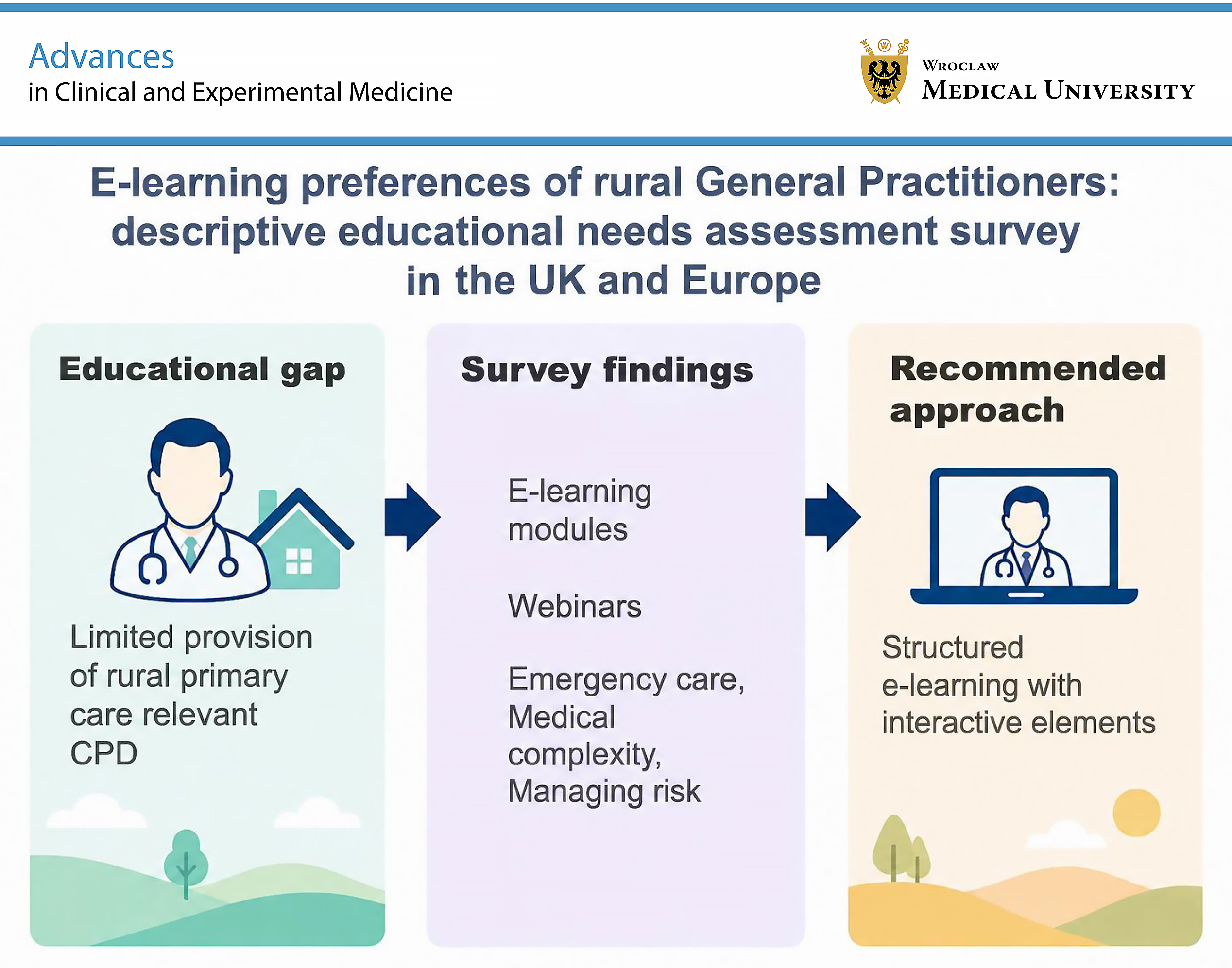
Background. Rural general practitioners (GPs) encounter unique challenges in accessing continuing professional development (CPD). E-learning offers a potential solution by overcoming geographic and time constraints, particularly when the content is relevant to the rural primary care context.
Objectives. To identify rural GPs’ preferences regarding the format, duration, and content of e-learning and to assess their current engagement with and awareness of CPD specific to rural primary care.
Materials and methods. A single cross-sectional online survey was distributed through 2 recruitment channels: the Royal College of General Practitioners (RCGP) in the UK and the European Rural and Isolated Practitioners Association (EURIPA), a pan-European network of the World Organization of Family Doctors (WONCA). A total of 157 RCGP members responded to the survey, with an unknown response rate; 30 of 94 active EURIPA members responded after the survey was distributed through its newsletter and Google Group. The survey assessed e-learning engagement, preferred formats and durations, and priority topics. Descriptive statistics were used to summarize the responses.
Results. Five of the 67 survey participants who answered the question on whether they used any rural primary care-relevant e-learning responded positively (8%). Preferred formats for rural primary care-relevant e-learning included interactive e-modules, webinars, online lectures, and podcasts; the preferred duration was 30–40 min. Priority topics included emergency care, mental health and addiction, multimorbidity and complexity, managing risk and uncertainty, frailty, and telemedicine.
Conclusions. Rural GPs favor short, interactive, context-specific e-learning. These findings can guide the design of pan-European rural primary care modules. Future studies should evaluate educational effectiveness and implementation feasibility.
Key words: rural health, general practitioners, primary healthcare, continuing education, telemedicine
Background
In 2023, approx. 21% of Europe’s population lived in rural areas.1 Primary care, specifically general practitioners (GPs), plays a central role in delivering healthcare to rural populations, often serving as the first point of contact for patients and coordinating ongoing care. Rural GPs and the communities they serve face unique challenges that differ from those of their urban counterparts.2 They often provide health and urgent care in resource-poor healthcare environments, have limited access to specialist services compared with urban practitioners, necessitating a broader scope of practice and high skill levels to deal with risk and uncertainty, and care for an expanding rural elderly population with multimorbidity.1, 3, 4 In addition to clinical demands, rural practitioners often deal with professional isolation, compounded by challenges in recruiting and retaining healthcare professionals.2, 5
Despite increasing recognition of the distinct nature of rural primary care, there remains a limited understanding of how this shapes the specific educational needs of rural GPs. Rural healthcare professionals frequently encounter additional barriers to fulfilling continuing professional development (CPD) requirements, including time constraints, passive learning formats, and insufficient institutional support.6 Existing educational models often reflect urban-centric assumptions, which may not be applicable or effective in rural environments. This underlines the need for context-sensitive, flexible, and practitioner-informed approaches to CPD that address the realities of rural primary care delivery.
Continuing professional development, often facilitated through continuing medical education (CME), is a formal requirement for GPs in many countries, including those practicing in rural settings.7 Evidence suggests that peer interaction among rural practitioners can also mitigate stress and reduce the risk of burnout, contributing positively to professional wellbeing and potentially increasing retention.8 The European Academy of Teachers in General Practice and Family Medicine (EURACT), an educational network within the World Organization of Family Doctors (WONCA) Europe, outlined key principles for CME for general practitioners in its evidence-based report titled “Current State of the Evidence-Base for Effective Continuous Medical Education for Family Medicine and General Practice.” Among other recommendations, the report emphasizes that CME should be grounded in relevant learning needs and delivered using methods that actively engage practitioners and promote reflection.9
Geographical isolation remains a significant challenge in the provision of CPD for rural GPs. E-learning, also known as distance learning, offers a viable solution to this issue and is increasingly recognized as a preferred modality among rural healthcare professionals.8
E-learning encompasses a diverse range of formats, including synchronous and asynchronous delivery, interactive modules, modules of varying durations and formats, and both accredited and non-accredited programs. This diversity complicates efforts to categorize or evaluate e-learning uniformly. Therefore, a good starting point would be to understand the specific preferences of rural GPs regarding the content, format, and timing of e-learning, as this would indicate whether it is relevant, accessible, and potentially more impactful. It has been demonstrated that activities with participant and peer engagement tend to have a higher impact on professional practice.9 A survey among GPs practicing in Ireland showed that CPD activities that encourage peer engagement and interaction are considered of most benefit to patient care and that GPs appear to be adept at selecting CPD activities that suit their practice needs and translating this into enhanced patient care.10
Encouragingly, evidence suggests that e-learning, which offers greater flexibility and accessibility, is at least as effective as traditional face-to-face learning methods. Moreover, it has demonstrated superiority over no instruction in enhancing healthcare professionals’ knowledge and behavior, thereby supporting its integration into rural medical education strategies.11, 12 Technology-based delivery options are useful; however, the complex interrelatedness of time, use, travel, location, costs, interactivity, learning outcomes, and educational design suggests a need for careful consideration by educational providers.13
Objectives
The objectives of the survey were to assess rural GPs’ current engagement with and awareness of e-learning resources relevant to their rural primary care context; identify rural GPs’ preferences regarding the format, duration, and delivery of e-learning; explore rural GPs’ perceived learning needs and priority topics for rural primary care; and generate preliminary insights to inform the future development of context-appropriate e-learning provision for rural GPs.
Materials and methods
This was a descriptive learning-needs assessment based on a single survey questionnaire distributed to rural GPs through 2 organizations: The European Rural and Isolated Practitioners Association (EURIPA), which is a network of the European branch of WONCA, and the Royal College of General Practitioners (RCGP) in the UK, to understand their learning needs as rural GPs and to inform future educational planning (Table 1).
In this study, no formal geographic classification or population-density threshold was used to determine rurality. Respondents self-identified as working in rural primary care settings. The survey collected information from these self-defined rural GPs on awareness and use of rural primary care-relevant e-learning, preferred formats and durations, and perceived priority topics for CPD. Rural primary care-relevant e-learning was defined as online CPD designed for or directly relevant to the rural primary care context. This included e-learning addressing clinical, organizational, and professional challenges commonly encountered by rural GPs. It did not refer simply to any online CPD accessible to rural clinicians.
The survey did not collect any demographic data as the focus was on a general educational needs assessment. The survey was conducted in English as this is the formal language of both organizations. It included closed-response items and optional free-text fields. The survey was developed by expert consensus approach among scientific and executive board members of both organizations and was not piloted or validated before distribution. For the RCGP sample, the survey was distributed after an event organized by the RCGP Rural Forum and was explicitly addressed to rural GPs. For the EURIPA sample, respondents were members of a rural-practice network. This project was undertaken as a survey to understand members’ learning needs within RCGP and EURIPA. In line with UK Health Research Authority (HRA) guidance, learning needs assessments or service evaluations do not require review by a Research Ethics Committee. Survey participation was voluntary, no identifiable data were collected, and all responses were anonymized and processed in accordance with GDPR. Completion of the survey implied consent.
The RCGP sent out the survey as part of an evaluation questionnaire following a webinar on emergency care in October 2024. The survey was separate from the evaluation survey for the emergency webinar. Participation was voluntary. The RCGP used its internal survey platform. EURIPA members responded to an online, voluntary survey using Google Forms, distributed via the EURIPA newsletter and Google Group, with a reminder sent 4 weeks after the survey opened. The survey was open from 11 October to 22 December 2024. Quantitative data were summarized as percentages, and optional free-text responses were reviewed descriptively. No identifiable data were collected.
Results
A total of 187 rural GPs participated voluntarily: the RCGP sample comprised 157 respondents (as the total number of webinar attendees was not recorded, a response rate cannot be calculated), and 30 responses were received from 94 active EURIPA members (30/94, 32%).
Together, these samples represent convenience samples of rural GPs affiliated with either the RCGP or EURIPA rather than population-based cohorts. Responses from both recruitment streams were combined for analysis because all participants completed the same survey questionnaire.
When asked about awareness and use of rural primary care-relevant e-learning, defined as online CPD designed for or directly relevant to rural primary care rather than general online CPD, the majority (120, 64%) did not answer the question. Of the 67 out of 187 respondents who answered, 5 (8%) reported using rural primary care-specific e-learning (Table 2). The high non-response rate limits conclusions regarding overall awareness and use.
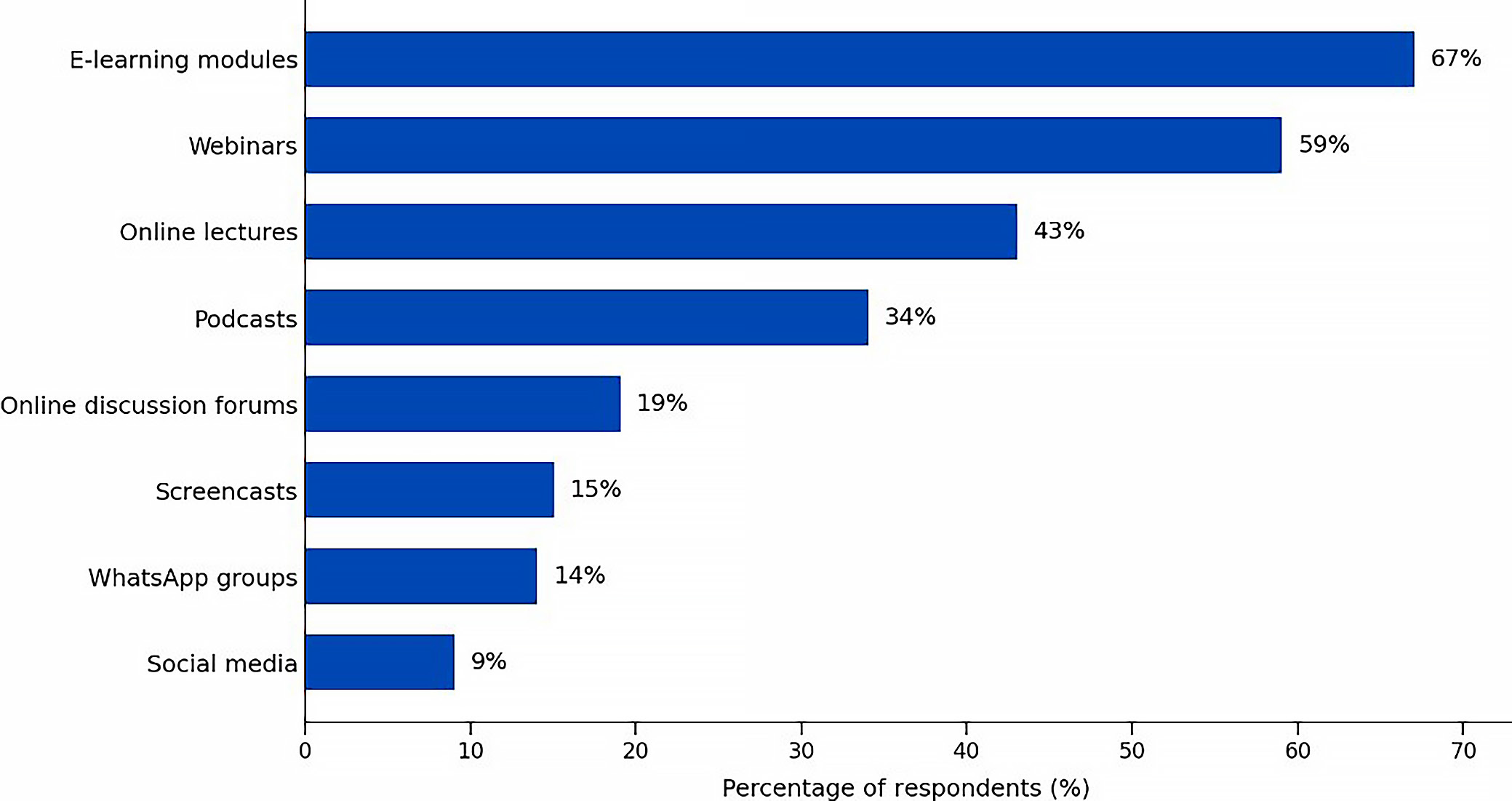
Fifty percent (93/187) of respondents favored 20–40 min, with 30–40 min being the clear preference (60 responses, 32%) for e-learning session length. Preferences for e-learning formats yielded 485 selections from 187 respondents (Figure 1). The most frequently selected formats were e-learning modules (125, 67%), webinars (110, 59%), and online lectures (81, 43%). Podcasts (63, 34%) and online discussion forums (36, 19%) were selected less often, while screencasts (28, 15%), WhatsApp groups (26, 14%), and social media (16, 9%) were the lowest-ranked options.
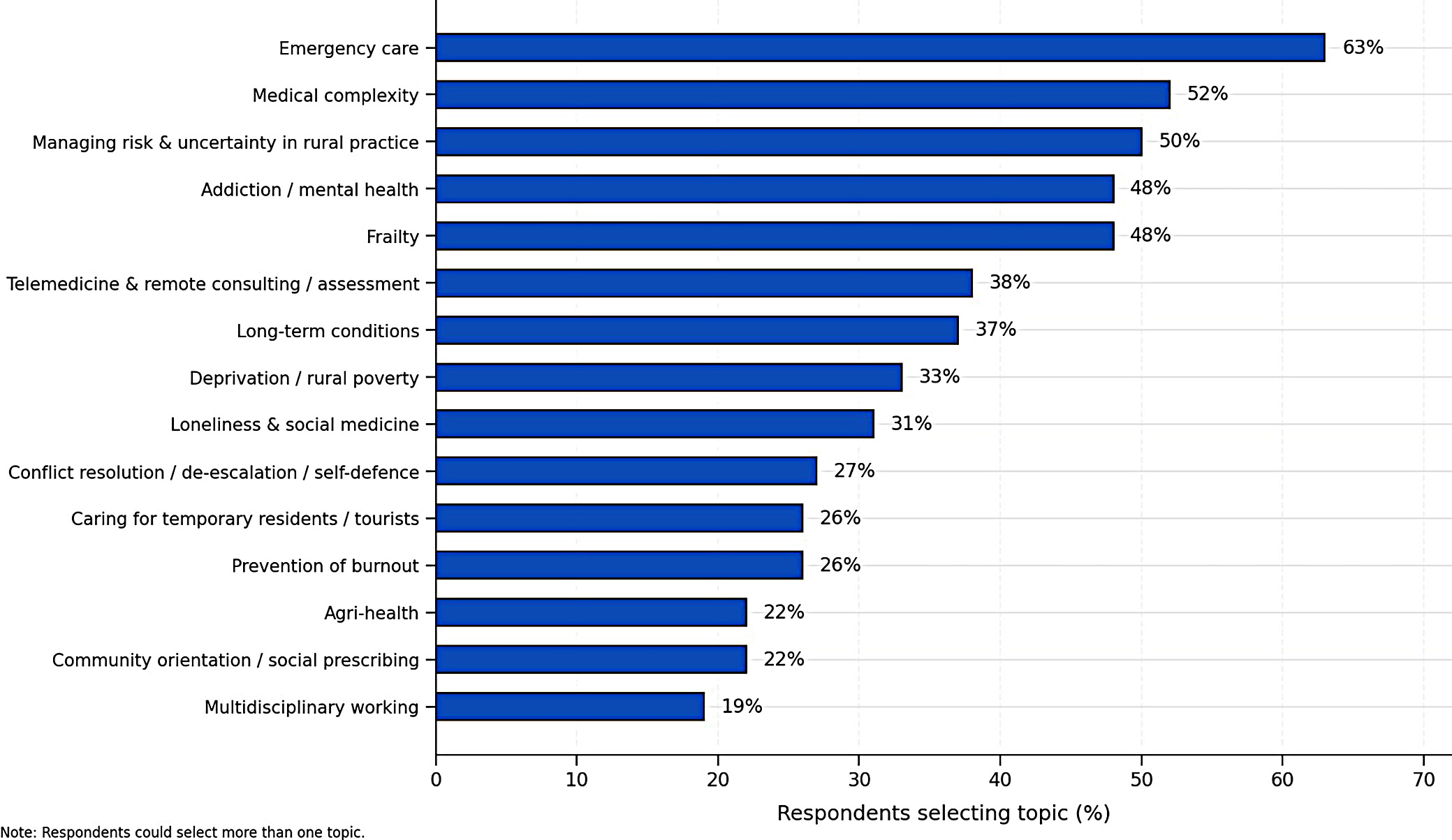
Respondents identified a wide range of clinical and nonclinical topics that they considered relevant to rural primary care e-learning, resulting in 1,011 topic selections (Figure 2). The highest-ranked topics were emergency care (117 selections, 63%), medical complexity (97, 52%), and managing risk and uncertainty in rural practice (94, 50%). Addiction and mental health (90, 48%), frailty (90, 48%), telemedicine and remote consulting or assessment (71, 38%), and long-term conditions (69, 37%) were also prominent. Topics of lower priority included deprivation and rural poverty (62, 33%), loneliness and social medicine (58, 31%), conflict resolution and de-escalation (50, 27%), caring for temporary residents or tourists (48, 26%), and prevention of burnout (48, 26%). The lowest-ranked topics were agri-health (41, 22%), community orientation and social prescribing (41, 22%), and multidisciplinary working (35, 19%).
Open-text responses provided further insight into respondents’ preferences. Suggestions included content addressing the social context of rural general practice, professional–personal boundary challenges, and the importance of platforms accessible across Europe. Respondents emphasized the value of interactive, case-based formats; opportunities for peer support (particularly for early-career or isolated primary care practitioners); skills-focused modules such as near-patient diagnostics (e.g., point-of-care ultrasound); hybrid learning options; and signposting to existing high-quality resources. Additional topics included supervision and teaching in rural practice, climate-related health impacts, and short observational visits to rural colleagues in low- or middle-income countries.
Discussion
The survey findings indicate that most respondents are interested in using interactive e-modules, webinars, and online lectures for their CPD. The preferred session length was 30–40 min, with a focus on topics relevant to rural general practice, such as emergency care, multimorbidity and complexity, managing risk and uncertainty, mental health and addiction, frailty, and telemedicine. This aligns with EURACT’s guidance, which emphasizes that CPD should be interactive, address relevant topics, and incorporate reflective practice to positively influence clinical behavior.9 Incorporating interactive elements into e-learning not only supports behavioral change but also helps mitigate burnout among practitioners.8
Although this descriptive, UK-weighted sample cannot establish Europe-wide priorities, the findings align with literature describing shared challenges in rural primary care. These include service delivery in resource-constrained environments, limited access to specialist care, geographical barriers to care for patients and practitioners, and the need for a broad, high-level clinical skill set to manage risk, uncertainty, and increasingly complex multimorbid aging populations.5 This supports the development of coordinated CPD resources for GPs at a pan-European or even global level through EURIPA or Rural WONCA, for example. These could include CPD resources on how to adapt as a clinician to resource constraints, develop a high tolerance for uncertainty and risk, expand the scope of practice to address multimorbidity in an elderly population and agriculture-specific occupational issues, respond to emergencies, and be skilled in telemedicine to overcome geographical barriers.
However, while certain rural challenges are common across countries, the implementation of more practice-based or local and national solutions is influenced by local systems, regulations, language, and care infrastructure that are particularly relevant to rural primary care in these different national contexts; therefore, some CPD content is more country-specific and best delivered through national CPD platforms. The study cannot support country-level conclusions or recommendations because nationality- or country-level data were not collected or reported.
Efforts are underway to secure a platform and appropriate funding to develop e-learning modules focused on rural primary care in the UK. This is also currently happening at a more global level, initiated by Rural WONCA.
Limitations of the study
The study used 2 recruitment streams for the distribution of the same survey questionnaire to ensure an acceptable response rate and draw general observations on the educational needs of rural GPs that are contextually relevant to rural settings. Survey participants from the RCGP, and therefore from the UK, were disproportionately represented, accounting for 157/187 respondents, resulting in the combined results being heavily UK-weighted. The RCGP survey was sent out alongside the evaluation of a webinar on emergency care, which could have influenced responses regarding topic selection. Both samples were convenience samples and subject to selection bias, as participants were volunteers and likely to be individuals already highly engaged and proactive in their CPD. Therefore, the results should be interpreted as descriptive. A further limitation of the study is that it does not investigate educational effectiveness and implementation feasibility.
Conclusions
Use of rural primary care-specific e-learning was reported by only a small number of respondents; however, high item nonresponse limits conclusions regarding overall awareness, availability, and use. E-learning could potentially bridge a gap in provision. Rural GPs expressed a preference for e-learning in a structured format, such as e-modules, with an interactive element, such as webinars. Rural GPs particularly value content that covers both clinical and non-clinical topics relevant to rural primary care, such as emergency care and the management of complexity, risk, and uncertainty. The study highlights the need for further research into which e-learning resources relevant to rural GPs could be developed and delivered on a European or global scale, and which would be better suited to local or national learning platforms.
Supplementary data
The supplementary materials are available at https://doi.org/10.5281/zenodo.21373992. The package contains the following files.
Supplementary Table 1. Preferred duration of e-learning sessions.
Supplementary Table 2. Preferred e-learning formats.
Supplementary Table 3. Survey questions.
Supplementary Table 4. Priority topics for rural e-learning.
Data Availability Statement
Data sharing does not apply to this article, as all data are already included in the manuscript and its supplementary files.
Consent for publication of personal information
Not applicable.
Use of AI and AI-assisted technologies
Not applicable.