



Abstract
Industrial societies have experienced exponential growth in both technological innovation and life expectancy. “High-tech medicine” – the dominant paradigm – assumes that technological innovation is the primary pathway to improving health. However, trade-offs among patient care, environmental impacts, public health, costs, and accessibility are rarely made explicit. In the context of multiple global crises, including climate change, biodiversity loss, rising inequalities, and geopolitical instability, we argue that perpetual and unrestricted technological development in healthcare is unsustainable. As an alternative framework, we explore the concept of “low-tech medicine” and seek to clarify its definition and scope. A standard scoping review methodology proved unsuitable: a literature search using MEDLINE and Web of Science restricted to “low-tech medicine” and related terms yielded very few relevant references, whereas broadening the search retrieved thousands of heterogeneous results across diverse fields. We therefore adopted a hybrid approach combining selected peer-reviewed literature with additional sources (grey literature, web-based resources, and textbooks), structured through an analytical framework derived from the multidisciplinary reflections of the LowTechMed group.
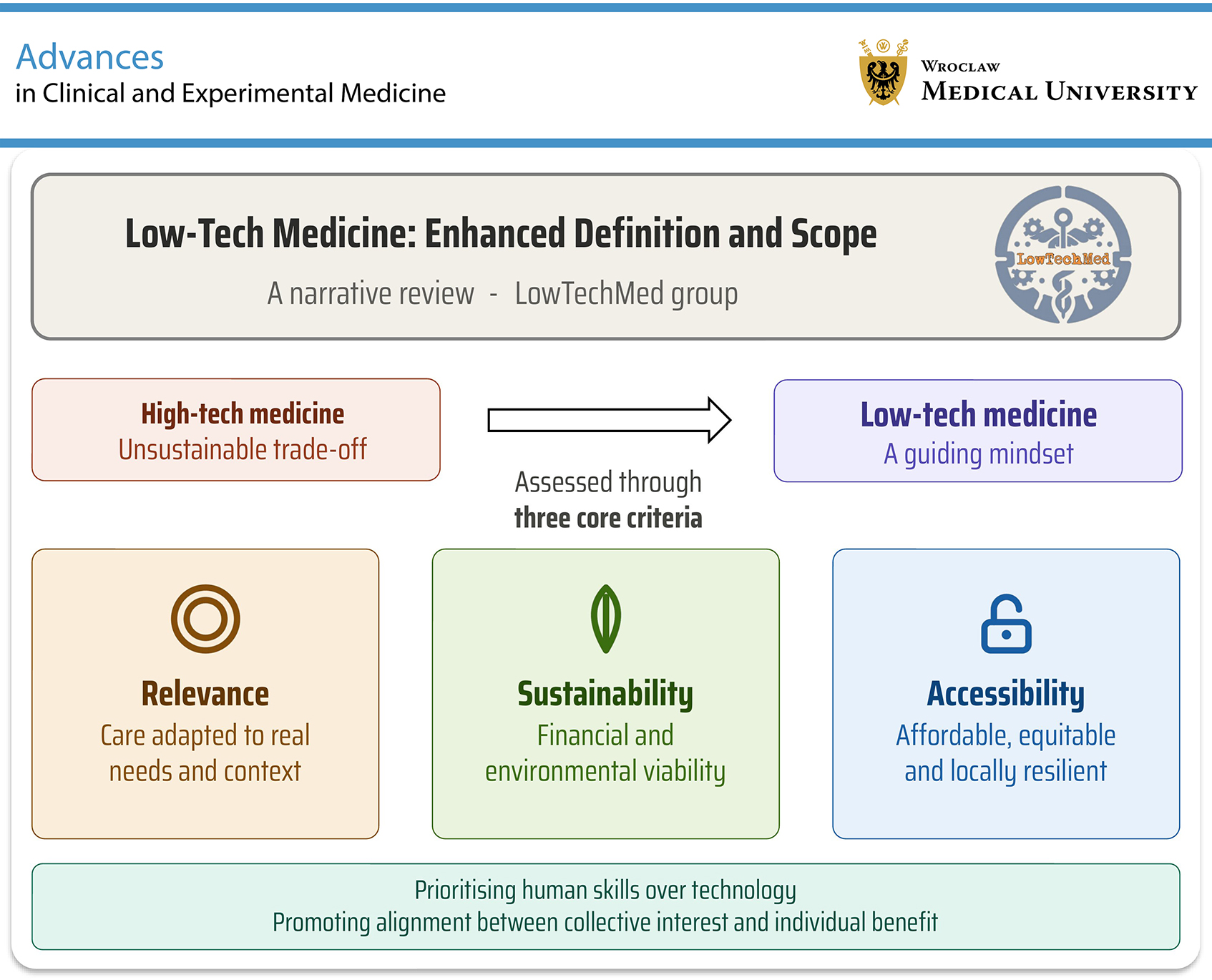
Rather than a strict definition, “low-tech medicine” should be understood as a guiding mindset for medical research and practice, based on 3 core criteria: 1) relevance, referring to usefulness within a given context; 2) sustainability, encompassing financial and environmental considerations; and 3) accessibility, including local resilience and the reduction of health inequalities. “High-tech medicine” presents an increasingly unsustainable benefit–harm trade-off. A “low-tech medicine” mindset may offer a pathway toward more effective, equitable, and resilient healthcare systems.
Key words: health policy, climate change, natural resources, appropriate technology, sustainable development
Introduction
Over the past 2 centuries, health outcomes in high-income countries (HICs) have improved dramatically, facilitated to a large extent by economic growth, scientific advances, and abundant resources. In recent decades, many low- and middle-income countries (LMICs) have followed a similar trajectory, contributing to a global average life expectancy of 73 years. At the same time, health expenditure has increased substantially. Over the past 5 decades, health expenditure in Organization for Economic Co-operation and Development (OECD) countries has risen from approx. 5% of gross domestic product (GDP) in the 1970s to 10%, reaching as much as 16% in the USA.1 However, economic growth has slowed considerably since the 2008 global financial crisis.
Moreover, resource-intensive “high-tech medicine” is not environmentally sustainable. In 2023, the World Health Organization (WHO) identified climate change as the greatest threat to human health. Yet, the 2025 Lancet Countdown report on health and climate change demonstrated that healthcare contributes substantially to climate change, accounting for more than 4% of global greenhouse gas emissions.2
Anthropogenic climate change therefore highlights the consequences of the largely unquestioned progression toward increasingly technology-intensive healthcare: “As medical treatments become increasingly resource-intensive, the likelihood increases that the public health damage of a treatment outweighs the individual benefit to a patient, especially in old age”.3 This “benefit–harm trade-off” is rarely made explicit in the medical literature; however, technological development entails increasing economic and environmental costs, as well as dependence on fragile supply chains, as demonstrated during the COVID-19 pandemic.4 The assumption that technological innovation alone drives further improvements in public health warrants scrutiny. For example, the USA is a global leader in high-tech medicine, spending approx. 10 times more per capita on healthcare than its neighbor Cuba. Yet, the difference in life expectancy between the 2 countries is minimal, arguably because the Cuban healthcare system emphasizes family medicine5 and low-tech organizational measures.6 In an unstable and resource-constrained world, high-tech healthcare systems may become vulnerable to collapse.7 We face a limited window of opportunity to implement the structural changes necessary to preserve the viability of healthcare systems. In response to these challenges, we founded the LowTechMed group, a multidisciplinary initiative that brings together experts from diverse fields, including medicine, social psychology, engineering, management sciences, philosophy, and ethics, with the aim of defining an approach to low-tech medicine. We have outlined this concept as a transdisciplinary approach that integrates medical and non-medical expertise to optimize resources, reduce costs, and minimize environmental impact, and which could be developed in both HICs and LMICs.8
Objectives
The concept of low-tech solutions in healthcare remains scarcely addressed in the medical literature. In this work, we aimed to provide a conceptual definition and a preliminary overview of the scope of low-tech medicine and healthcare, with the goal of establishing a framework for future applied research.
Materials and methods
The traditional systematic scoping review methodology proved unsuitable for this exploratory work due to the absence of established terminology for low-tech approaches in the medical literature. A literature search was conducted between January and December 2025 using the MEDLINE (via PubMed) and Web of Science databases. An initial search using the exact terms “low-tech medicine”, “low-technology medicine”, “low-tech health”, and “low-technology health” yielded very few directly relevant references, with only 1 specifically focused on the concept of low-tech medicine.8
To broaden the scope, additional searches were performed. The expanded search in PubMed using the query “low-cost medicine” OR “frugal medicine” OR (“frugal innovation” AND “health”) OR (“appropriate technology” AND “healthcare”) OR “sustainable healthcare” yielded 1,642 references. The expanded search in the Web of Science using the query (AK = (“low tech” or “low-tech” or “lowcost” or “low cost” or “low-cost” or “lowtech” or “low resources” or “affordable technology” or “basic technology”) OR AB = (“low tech” or “low-tech” or “lowtech”)) AND TS = (medicine or medical or health) retrieved 4,471 heterogeneous references across diverse fields, which were beyond the scope of manual analysis.
The traditional systematic scoping review methodology proved unsuitable for this exploratory work due to the absence of established terminology and the conceptual nature of the inquiry. Using artificial intelligence (AI) to achieve this goal was paradoxical for a project dedicated to low-tech approaches. We therefore adopted a hybrid method, combining selected peer-reviewed literature with additional sources of data (e.g., grey literature, web-based resources, and textbooks), integrated through an analytical framework derived from our group’s multidisciplinary reflections, with the aim of developing criteria for a low-tech medicine approach.
Sources were selected by consensus among members of the LowTechMed group, a multidisciplinary initiative that brings together experts from various fields, including medicine, social psychology, engineering, management sciences, philosophy, and ethics, to define low-tech medicine. Priority was given to peer-reviewed publications, while grey literature and non-academic sources were included when they provided foundational conceptual contributions not available in the indexed literature.
Our qualitative analysis was based on the Standards for Reporting Qualitative Research (SRQR), in accordance with the guidelines of the international EQUATOR Network (Enhancing the QUAlity and Transparency Of Health Research). Ultimately, this work constitutes an enriched conceptual article, laying the foundations for the subsequent development of normative frameworks.
Results
Definition of low-tech medicine
Reflections on the appropriate role of technology emerged in the 1970s in response to its environmental and social impacts. Ellul studied the impact of technological development on societies9; Illich proposed increasing personal autonomy through human-scale, convivial tools rather than uncontrollable large-scale infrastructure10; and Schumacher introduced the notion of intermediate, or appropriate, technologies.11 Several overlapping definitions of “low-tech” exist (Table 1).3, 12, 13, 14, 15
Low-tech does not mean “no-tech”16 but rather calls for “techno-discernment”15 and greater consideration of social and organizational factors to encourage the development of empowering and accessible solutions to unmet societal needs.17, 18, 19 Regarding low-tech medicine, we follow the Belmont Report20 in defining medicine as comprising both medical research (knowledge generation) and medical practice (benefiting patients). Illich criticized modern medicine for disempowering patients by depriving them of the autonomy and knowledge necessary for self-care,10 while De Decker devoted an article in Low-Tech Magazine to the concept of low-tech medicine.3
We define low-tech medicine as a mindset in medical practice and research based on 3 criteria: 1) accessibility, 2) sustainability, and 3) relevance (Figure 1). Low-tech medicine represents a multidimensional continuum in which high-tech precision approaches are recognized as indispensable for certain conditions, yet in some contexts, low-tech approaches may match or outperform high-tech alternatives. This concept of a contextual continuum avoids binary thinking and encourages context-appropriate, value-driven technological choices.
Relevance
Relevance links the concept of meaningfulness to utility, ensuring that care is adapted to the actual context and genuine needs. Care is relevant when it addresses authentic medical needs rather than artificially created ones. However, high-tech innovation increasingly drives demand instead of responding to it. A recent report from the French National Academy of Medicine21 emphasizes the importance of avoiding unnecessary medicalization and promoting interventions aligned with patients’ actual needs.
Low-tech approaches invite a broader reassessment of how value is defined in medicine and medical education. Rather than prioritizing technological complexity, they shift the focus toward appropriateness, resilience, cost-effectiveness, and scalability. This reframing presents low-tech solutions not as inferior alternatives but as credible, future-oriented components of balanced medical practice.
Sustainability
In 1987, the United Nations defined sustainable development as “development that meets the needs of the present without compromising the ability of future generations to meet their own needs”.22 We adopt this definition in the context of adaptable and resilient healthcare systems.23 Low-tech medicine should rely on minimal infrastructure and enable rapid deployment and local maintenance, particularly in austere environments (e.g., certain LMICs, disaster settings, and war zones). Interventions should be sustainable by design, incorporating principles such as reuse, remanufacturing, and recyclability whenever appropriate. Bonnet et al.24 demonstrated that ultrasound-guided percutaneous venous port insertion under local anesthesia combined with conversational hypnosis reduced environmental impact 6-fold compared with surgery, while also improving caregivers’ quality of life through greater perceived relevance and enhanced patient interactions.
During the COVID-19 crisis, engineers from sectors outside healthcare were rapidly redeployed to develop hybrid solutions that combined low-tech improvisation with advanced methods.25 In parallel, the local low-tech production of medical devices demonstrated the resilience of community-driven manufacturing when global supply chains failed.
In educational settings, emergency thoracostomy simulators constructed from discarded hospital materials26 and low-cost neurosurgical skull models built by trainees27 illustrate how learners, through active participation in design, repair, and adaptation, become co-producers of their environment rather than passive consumers of predefined solutions. However, sustainability also implies both avoiding unnecessary interventions and eliminating wasteful products, requiring 2 fundamental shifts: the adoption of a Product–Service System model instead of a “take–make–dispose” mentality,28 and a stronger emphasis on preventive healthcare.3
Accessibility
Accessibility refers to the ability of an individual or population to receive, understand, and benefit from healthcare. It encompasses both the cost of treatment and its availability: if care reaches only a minority of the population in need because of limited economic or human resources, it cannot be considered low-tech. Therefore, a low-tech mindset is largely oriented toward empowerment rather than dependence, promoting technologies that are affordable (low-cost), understandable (transparent), and manageable (open-source). It facilitates shared responsibility, thereby strengthening individual agency in healthcare, and should support local and national sovereignty. These 3 criteria are summarized in Table 2.24, 29, 30
The scope of low-tech medicine
Here, we provide examples of low-tech health approaches that enable healthcare delivery in resource-limited settings.
Prevention
De Decker suggests that low-tech medicine should prioritize “building up the body’s inherent resistance to disease”.3 Referred to as “ground-state prevention” by Blasimme,31 prevention should target broad risk factors shared across multiple diseases, which are relevant worldwide in relation to overlapping conditions such as cardiovascular disease (CVD), obesity, diabetes, and dementia.
Congenital anomalies (CAs) provide an early-life example. They are responsible for substantial mortality (3.3 million deaths among children under 5 years of age) and disability (3.2 million affected children).32 Evidence suggests the existence of disease-agnostic risk factors (e.g., obesity, infection, and toxicity) and protective factors (e.g., folic acid supplementation and glycemic control in women with diabetes) across CAs that can be addressed through low-tech interventions.
Direct involvement of the population in education and prevention, together with peer-facilitated community-based interventions, improves outcomes, including those related to mental health.29 It is essential to design inclusive health-promotion strategies that maximize population reach.
Education
There are many successful examples of low-tech educational devices developed using common, locally available materials. For instance, simple training simulators for surgical skills have been created using acetic silicone mixed with maize starch, enabling effective suture practice at minimal cost.33 Other notable examples include do-it-yourself laparoscopic box trainers constructed from everyday household items, which students rated as equivalent to expensive commercial alternatives.34 A study comparing low-cost handmade cricothyrotomy simulators with high-fidelity commercial models found no significant differences in knowledge and skill acquisition among medical interns.35
This accessibility further facilitates the development of a shared cultural foundation among stakeholders around these solutions. This was exemplified by Filipino nursing students who successfully used low-cost simulators made from household materials for remote skills demonstrations during the COVID-19 pandemic, thereby reinforcing community-based learning and collective resilience.36 This exchange of experiences and expertise among communities is a key determinant of collective resilience and represents an opportunity for the large-scale deployment of healthcare interventions in disaster settings.37
Diagnostics
Timely diagnosis ensures appropriate and proportionate care. The case of Alzheimer’s disease (AD), for which diagnosis currently relies heavily on high-tech approaches, provides another illustrative example. Diagnosing dementia due to AD requires the identification of clinical dementia (Step 1), together with positivity for brain biomarkers (amyloid and/or tau proteins) detected using positron emission tomography (PET) imaging30 (Step 2). However, blood tests are now available that can reliably detect amyloid pathology in the brain. Given the limited availability of PET scanners in most countries and their substantial carbon footprint, the use of blood tests to confirm a clinical diagnosis of dementia due to AD represents a step toward low-tech medicine. Although these tests may not necessarily improve relevance, they offer greater accessibility and sustainability.38
Aligning clinical expertise39 with low-tech solutions can prevent unnecessary downstream treatments and interventions, thereby reducing environmental impact while avoiding both under-treatment and over-medicalization.
Treatment
High-tech treatment options are widely adopted even when their additional effectiveness compared with existing alternatives has not been demonstrated.40, 41 Robotic surgery is driven more by a mindset of technological progress than by a response to a specific clinical need. Based on the current literature, its cost–benefit ratio (both financial and environmental) appears unfavorable. Robotic surgery is significantly more expensive and resource-intensive, yet current evidence42 has generally failed to demonstrate a meaningful improvement in patient outcomes compared with conventional procedures (although, in specific circumstances, modest benefits may be observed). Despite these considerations, the use of robotic surgery increased exponentially from 1.8% in 2012 to 15.1% in 2018.43 This expansion creates pressure on resource-constrained LMICs to adopt the technology44 and may negatively affect the development of fundamental surgical skills among trainees.45
Low-tech approaches to surgery could be inspired by the “low-tech pragmatism” of Greco-Roman surgeons. By focusing on necessity rather than novelty,46 their surgical equipment remained limited through deliberate restraint (i.e., “low-tech/high-skill”). Low-tech surgery should integrate the principles of the Disease Control Priorities initiative, which defined essential surgery as a set of 44 cost-effective, life-saving procedures critical to universal health coverage, particularly in LMICs. These procedures were selected because of their high public health impact, affordability, and feasibility in resource-limited settings. Expanding access to them could prevent millions of deaths and disabilities annually, making essential surgery a cornerstone of global health equity.
The development of the Retractor for Abdominal Insufflation-less Surgery (RAIS) is one of the few published examples of a low-tech approach in surgery. The context-specific participatory approach, involving both healthcare providers and local stakeholders in a low-resource setting, translates a concrete health need into a fully realized, commercially viable instrument.47 Organizationally, a low-tech approach also involves improving workflows with a substantial impact on outcomes and mortality.48
Patient follow-up
Several publications describe how telemedicine can represent a low-tech solution for patient follow-up. Telephone consultations, which constitute a lower-tech option than video-based consultations, were found to be more equitable and patient-centered during the COVID-19 pandemic.49 Telephone-based care provides a scalable and context-appropriate approach to follow-up in low-resource settings and improves appointment adherence among patients receiving chronic treatments such as antiretroviral therapy in resource-limited African settings.50
Discussion
We define low-tech medicine as a mindset in medical research and practice that relies on 3 core criteria for evaluating medical practices and research proposals: relevance, sustainability, and accessibility. Rather than a well-defined field, low-tech medicine should be regarded as both a perspective and a direction. Our definition is not rigid but rather a flexible and adaptive framework of defining characteristics. This task remains challenging, however, because the boundaries of such an underexplored field are difficult to delineate (e.g., the distinction between low-tech and low-cost).
Currently, low-tech medical solutions are primarily described in resource-limited settings, where they are tolerated or even encouraged51 in the absence of adequate infrastructure or specialized personnel, but are rarely valued as legitimate alternatives in high-income settings. On the one hand, this association is understandable, given that the overwhelming majority of patients live in LMICs. For example, according to the WHO, more than 80% of the world’s 600 million people with disabilities live in LMICs. On the other hand, the relationship between HICs and LMICs with regard to low-tech approaches has often been asymmetrical. Technologies are frequently developed in HICs and subsequently transferred to LMICs without sufficient consideration of the local context, or are reduced to simple donations from HICs to LMICs.52 The inaccurate framing of low-tech as synonymous with “low-cost” also oversimplifies its meaning and limits its relevance. In some cases, cost reduction and low-tech objectives are aligned, for instance in the development of simpler ultrasound devices with replaceable components53 or the Jaipur Foot, a low-tech prosthesis developed in India that has provided affordable mobility to more than one million amputees worldwide.51 Yet, when low-tech is reduced to cost-cutting, it loses its transformative capacity to respond to global challenges. More critically, this perspective perpetuates the fallacy that wealth alone can solve systemic environmental problems, thereby reinforcing hierarchical inequities between populations and perpetuating defective and unsustainable systems.
It is important to distinguish low-tech medicine from several related but distinct concepts. Low-cost care focuses primarily on cost reduction without necessarily addressing sustainability or relevance. Frugal innovation emphasizes resource efficiency and affordability but may not systematically incorporate environmental sustainability or the mindset dimension that is central to our framework. Appropriate technology, a concept originating from Schumacher’s work,11 shares historical roots with low-tech thinking but does not encompass the broader systemic and mindset-oriented perspective that we propose. Sustainable healthcare, although substantially overlapping with our sustainability criterion, does not systematically integrate relevance and accessibility as coequal pillars. Low-tech medicine is distinguished by the conjunction of all 3 criteria – relevance, sustainability, and accessibility – and by its nature as a mindset rather than a category of objects or technologies.
We acknowledge the overlap between our criteria and the 3 proposed by Low-tech Lab: useful, accessible, and sustainable.12 However, we emphasize 2 key differences. First, our criterion of relevance differs from their criterion of usefulness (as explained in the “Relevance” subsection). Second, we define low-tech as a mindset (always singular), whereas Low-tech Lab uses the term “low-techs” (plural) to describe “objects, systems, techniques, services, know-hows, practices, behaviors, and even ways of thinking.” We therefore restrict our definition of low-tech medicine to a mindset. We do not advocate an arbitrary or ideologically driven opposition to technology. On the contrary, we are convinced that appropriately developed technologies can generate meaningful medical benefits. However, we also contend that, in many respects, the current unrestrained expansion of high-tech medicine is unsustainable, given its environmental impact, particularly its growing carbon footprint, waste generation, and high levels of energy and material consumption. In contrast, our conception of low-tech medicine directly addresses the recommendation of the Declaration of Helsinki: “Medical research should be designed and conducted in a manner that avoids or minimizes harm to the environment and strives for environmental sustainability”.41 To capture the full value of low-tech approaches, alternative evaluation frameworks are needed. Rather than relying on conventional indicators that treat healthcare primarily as an industry, new tools and metrics should assess the overall value of care while accounting for its negative externalities. This requires a system-wide perspective capable of identifying optimal trade-offs. Such a framework would enable evaluation not only in terms of cost, but also in terms of relevance, sustainability, and accessibility. We will soon propose a low-tech score to assess healthcare interventions within a systemic, multi-criteria framework.
As previously highlighted,8 the concept of low-tech medicine risks creating divisions among healthcare professionals and the public, particularly in HICs. Physicians, trained to deliver precision care, may resist what appears to be a “downgrade”, while patients accustomed to high-tech solutions may reject lower-tech alternatives. Therefore, substantial pedagogical efforts are required to contextualize our proposals within the broader polycrisis and to encourage inclusive debates on priority-setting among stakeholders across diverse contexts. In addition, low-tech encompasses a broad spectrum of mindsets and may be perceived as folkloric, utopian, or even subversive, particularly when radical interpretations reject significant aspects of healthcare systems in HICs. Furthermore, in the context of financial and human resource constraints, low-tech medicine must strike a delicate balance and avoid critical pitfalls. First, it must avoid ableism – the deprioritization of care for people with disabilities in favor of those already in good health – and healthism, which frames well-being as solely an individual responsibility and shifts the burden away from collective and systemic support.54 Such an approach would risk transforming medicine into a luxury service, accessible only to those who can afford to comply with healthcare systems, rather than preserving it as a universal priority, as envisioned in the founding mission of the WHO.
Crucially, low-tech medicine must not be used to justify lower-quality care or cost-cutting policies targeting vulnerable populations. Any low-tech approach must aim to deliver the safest and most effective care achievable within a given context and be held to the same standards of evidence as available high-tech alternatives. Its adoption should be driven by demonstrated equivalent or superior outcomes rather than by budgetary convenience alone.
Limitations of the study
This narrative review is limited by the potential for selection bias in the grey literature and by the absence of quantitative synthesis. The examples presented are illustrative rather than exhaustive, and the heterogeneity of source types (peer-reviewed literature, grey literature, textbooks, and web-based sources) limits strict reproducibility. In addition, the authors’ involvement in the LowTechMed initiative introduces a risk of conceptual circularity, which we have sought to mitigate through multidisciplinary reflection and external peer review. The hybrid methodology, although appropriate for this exploratory work, does not provide the level of systematic transparency typically expected from conventional reviews. However, the multidisciplinary composition of our team – including physicians, pharmacists, paramedics, and experts in engineering, psychology, philosophy, and ethics – strengthens the interpretive validity of our conclusions.
Conclusions
Appropriately developed technologies can lead to meaningful health benefits. Yet, in an era of multiple global crises, “high-tech medicine” presents an increasingly unsustainable benefit–harm trade-off. We define low-tech medicine as an alternative mindset in medical research and practice that relies on 3 core criteria for evaluating medical practices and research proposals: relevance, sustainability, and accessibility. Currently, low-tech medical solutions are primarily described in resource-limited settings, where they are tolerated or even encouraged,51 but are rarely valued as legitimate alternatives in high-income settings. Moreover, our conception aligns with the Declaration of Helsinki, which states that medical research “should be designed and conducted in a manner that avoids or minimizes harm to the environment and strives for environmental sustainability”.41 Alternative assessment frameworks are required to capture both the value of and the trade-offs between high-tech and low-tech approaches. We encourage inclusive debates on priority-setting among different stakeholders across diverse contexts. Given financial and human resource constraints, medicine must strike a delicate balance and avoid critical pitfalls. Future work will propose a “low-tech score” to assess healthcare interventions within this framework. Pilot implementations in both HICs and LMICs will be essential for testing its operational validity and demonstrating that low-tech approaches can achieve equivalent or superior outcomes while reducing environmental and economic burdens.
Use of AI and AI-assisted technologies
Not applicable.
.jpg)