



Abstract
Agricultural sciences and medicine are converging toward a shared mechanistic framework that links plant biology to human health. This editorial proposes Translational Agricultural Medicine (TAM) as a conceptual and hypothesis-generating framework. Translational Agricultural Medicine positions plant molecular responses, particularly stress-induced redox regulation and phytochemical biosynthesis, as biologically relevant factors that may inform preventive nutrition and translational health research. Evidence from plant stress biology, including redox networks, parallels key biochemical processes underlying metabolic disorders and cancer in humans. Plant-derived bioactives, such as glucosinolates and phenolics, as well as legume proteins, further illustrate how agricultural variables influence the nutritional and biochemical properties of diets relevant to health outcomes. Climate-driven changes in crop physiology reinforce the need to align breeding and agroecological management with public health priorities. Collectively, this perspective reframes plants not as passive dietary components but as upstream contributors to the nutritional modulation of human metabolism, positioning climate-resilient crops and targeted dietary strategies as important components of future preventive health approaches.
Key words: nutrition, phytochemicals, plant proteins, preventive medicine, translational medical research
Introduction
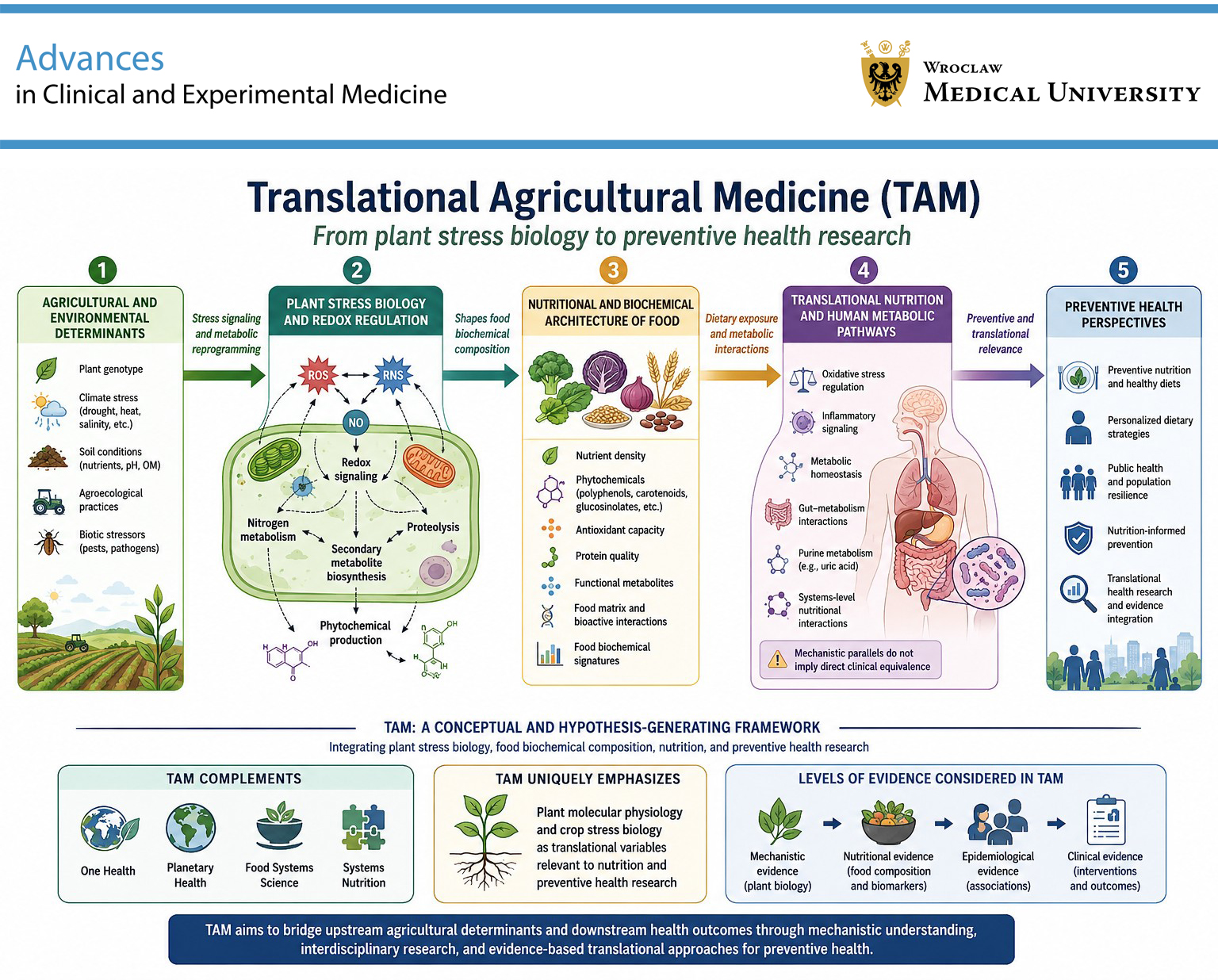
Modern clinical medicine continues to treat diet as a downstream lifestyle factor, while its upstream biological origins in agricultural systems remain largely unaddressed.1 This disconnect limits the effectiveness of preventive strategies, which rarely account for how plant genotype, environmental stress, and agroecological practices shape the biochemical composition of food.2 Agriculture should be considered an upstream determinant of diet quality and long-term health outcomes.3, 4, 5 In this context, Translational Agricultural Medicine (TAM) is introduced as a framework that integrates plant sciences, agronomy, and clinical nutrition within a mechanistic translational continuum linking agriculture, nutrition, and preventive health research. By positioning plant molecular responses, particularly redox regulation and phytochemical biosynthesis, as biologically and nutritionally relevant variables, this approach reframes crops not as passive dietary inputs but as active contributors to nutritional and metabolic health processes.
Translational Agricultural Medicine, while aligned with the interdisciplinary ethos of One Health, Systems Nutrition, and Food Systems Science, differs from these frameworks in 3 key respects. First, it places plant sciences and crop-level molecular processes at the core of translational pathways linking agriculture to nutrition and preventive medicine. Unlike existing approaches, it explicitly accounts for interactions among plant genotype, environmental conditions, stress responses, and post-harvest processing as determinants of nutritionally and translationally relevant outcomes. Second, TAM establishes a mechanistic translational continuum linking agriculture, nutrition, and preventive health research, in which agronomic variables, environmental stress physiology, and phytochemical profiles function as biologically informative predictors rather than contextual modifiers. This shifts agriculture from a background determinant to an integral component of preventive nutrition and translational health research. Third, TAM introduces a bidirectional translational model: agriculture informs medicine, while clinical priorities actively shape agricultural practices. This reverse translation is enabled by targeting shared biochemical pathways, including redox regulation and metabolic control, with implications for conditions such as obesity, inflammation, diabetes, insulin resistance, purine-related disorders, and cancer. In contrast, prevailing frameworks remain largely unidirectional and do not systematically integrate clinical needs into crop development, breeding strategies, or agroecological design. Translational Agricultural Medicine is proposed here as a conceptual and hypothesis-generating framework rather than an established clinical discipline. Its purpose is to stimulate integration among plant sciences, agronomy, nutrition, and preventive medicine by identifying mechanistic and translational links that may guide future interdisciplinary research. Translational Agricultural Medicine does not seek to replace existing frameworks such as One Health, Planetary Health, or Food Systems Science, but rather to complement them by placing plant molecular physiology and crop stress biology at the center of translational nutrition research. Unlike broader public health-oriented frameworks, TAM specifically emphasizes plant physiology and stress biology as translational variables relevant to nutrition research.
The conceptual gap between agricultural sciences and medicine, both clinical and preventive, is rapidly narrowing, moving toward functional convergence.6, 7 Plant foods should therefore not be regarded as passive nutritional matrices,8, 9, 10 but as integrated biological outputs11, 12, 13 shaped by plant genetics,14 stress physiology, agroecological conditions,15, 16, 17 and post-harvest handling and processing.18, 19 Consequently, many diet-associated risk20 and protective factors are embedded within agricultural practices well before they become apparent in clinical contexts. Evidence from plant biochemistry,21 stress biology, and nutrition research22, 23 shows that mechanisms underlying plant stress resilience24 parallel pathways central to human metabolic health and disease prevention.25 Compounds such as glucosinolates from cruciferous vegetables, polyphenols,26 and legume proteins, alongside redox defense systems characterized in barley, exemplify how agricultural biochemistry yields translationally relevant insights. These mechanisms extend beyond crop performance, informing dietary strategies and nutrition-informed preventive approaches,27, 28 including the modulation of redox balance,29 metabolic regulation,30 and purine metabolism in complex disease settings, thereby positioning plant sciences as a foundational contributor to prevention, nutrition science, and translational health research.31, 32, 33, 34, 35
In parallel, the development of TAM aligns with broader contemporary efforts to bridge mechanistic research and evidence-based healthcare practice. Modern translational medicine increasingly emphasizes the integration of biological plausibility, contextual relevance, and clinically meaningful evidence rather than relying solely on isolated reductionist observations. In this perspective, TAM is intended not as a clinically validated discipline, but as a conceptual framework designed to stimulate interdisciplinary integration among plant sciences, agronomy, nutrition, and preventive medicine. Similar to evidence-based healthcare models that seek to connect research generation, evidence synthesis, and practical implementation, TAM aims to strengthen the translational continuum linking agricultural biology with nutritional and preventive health research.36 The aim of this editorial is to introduce TAM as a conceptual and translational research framework integrating plant science, agronomy, nutrition, and preventive medicine, and to outline key mechanistic and translational pathways that may guide future interdisciplinary research.
Conceptual scope and literature selection
This article is a conceptual, perspective-style editorial rather than a systematic review or meta-analysis. The examples discussed were selected to illustrate representative mechanistic, nutritional, and translational aspects relevant to the proposed TAM framework. The literature selection was therefore narrative and hypothesis-driven, with an emphasis on studies linking plant stress biology, food composition, nutrition, and preventive health.
Mechanistic and nutritional foundations of TAM
Mechanistic evidence from plant stress biology
How do plants sense, integrate, and resolve oxidative and nitrosative pressures? In barley simultaneously challenged by nematodes and cadmium, an atypically coordinated antioxidant response has been documented: superoxide dismutase (SOD) activity increased, the Foyer-Halliwell–Asada pathway efficiently scavenged H2O2, S-nitrosoglutathione accumulated via inhibition of S-nitrosoglutathione reductase, and polyamine biosynthesis was preferentially activated, collectively limiting lipid and protein oxidation while preserving membrane integrity.37 When barley was co-infested with nematodes and mites, photosystem electron transport was retuned, redox buffers were redistributed, and cellular ultrastructure adapted, providing an instructive model of metabolic resilience.38 Under combined salinity and mite stress, distinct stress-specific reactive oxygen species (ROS) signatures and differential activation of catalases, peroxidases, and SODs were observed, underscoring how combinatorial stress elicits non-additive redox logic.39 In parallel, exposure to barium induced nitrooxidative responses in barley leaves, characterized by concentration- and time-dependent shifts in the nitric oxide (NO)/H2O2 balance and in antioxidant gene expression and activity, further demonstrating that plants deploy flexible, tiered defense strategies to maintain homeostasis.40 Notably, these plant redox adaptations share mechanistic parallels with pathways involved in human redox biology, in which oxidative and nitrosative stress play central roles in carcinogenesis, cardiometabolic disease, neurodegeneration, and chronic inflammation.41, 42, 43, 44, 45, 46, 47, 48, 49, 50 However, mechanistic similarities alone should not be interpreted as direct evidence of clinical efficacy or causality.
Nutritional and food-composition evidence
Contemporary redox systems biology increasingly conceptualizes nutrition as a regulator of interconnected redox networks, offering a mechanistic framework that may explain why reductionist interventions based on isolated bioactive compounds frequently yield inconsistent outcomes.51, 52, 53, 54 In contrast, dietary patterns that act on multiple network nodes may help modify disease-related risk pathways.8 In this context, plants function not only as nutritional sources but also as repositories of biochemical templates and bioactive molecules that can be translated into diet-based prevention strategies.55, 56 Two examples are particularly illustrative.
First, the glucosinolate-myrosinase system in cruciferous vegetables generates isothiocyanates and indoles, including sulforaphane, phenethyl isothiocyanate, and indole-3-carbinol, following tissue disruption; these compounds activate nuclear factor erythroid 2-related factor 2 (Nrf2)-dependent detoxification pathways, modulate apoptosis, and influence epigenetic programming, thereby supporting mechanisms associated with chemopreventive potential.11 Because glucosinolate profiles are shaped by plant genotype, soil conditions, weather, agricultural practices, and culinary processing, potential chemopreventive exposure is determined as much by agronomy as by food preparation.11 Second, sorghum, often primarily associated with drought tolerance, emerges as a functional grain, as its polyphenols (including phenolic acids and 3-deoxyanthocyanidins), dietary fiber, and peptides align with antioxidant, anti-inflammatory, glycemic-regulatory, satiety-enhancing, and microbiota-modulating effects that support cardiometabolic prevention.15, 17 Together, these cases illustrate how agricultural variables may influence the nutritional and translational relevance of foods.
Climate change further magnifies these relationships. Studies on legumes demonstrate that elevated CO2 and heat stress can reduce protein content and key micronutrients (Fe, Zn), reshape phenolic and isoflavone profiles, and alter pest and mycotoxin risk patterns, thereby constituting an upstream public health challenge given the global reliance on legumes as accessible sources of protein and health-promoting phytochemicals. Consequently, climate adaptation emerges as an important component of preventive health planning: breeding strategies targeting thermotolerance and pest resistance, ecologically integrated pest management, and soil fertility optimization function as potential contributors to preventive health strategies by safeguarding nutrient density and food safety.18
Translational interfaces between plant biochemistry and clinical nutrition
The newly established clinical nutrition axis provides a substantive translational bridge, grounded in research on purine metabolism and uric acid (UA) homeostasis in patients with cancer and ileostomies.57 In this population, anatomical alterations, hydration challenges, electrolyte imbalances, and treatment-related toxicities substantially complicate dietary management. Evidence from this analysis indicates that plant-based proteins and bioactive phytochemicals may help reduce purine burden while simultaneously providing potential anti-inflammatory, antioxidant, and uricosuric effects. Legumes, soy products, nuts, whole grains, vegetables, and fruits generally have low to moderate purine content, and when selected judiciously, these foods can lower serum UA levels despite their inherent purine content. This effect is mediated by factors such as dietary fiber, vitamin C, and polyphenols, which modulate xanthine oxidase activity and renal urate handling.57 In individuals with ileostomies, who are particularly vulnerable to dehydration and micronutrient deficiencies, well-designed plant-based dietary patterns may support wound healing, maintain fluid and electrolyte balance, and promote overall metabolic control. This clinical scenario, therefore, illustrates how agricultural biochemistry can be translated into personalized nutrition strategies.57 In parallel, recent systems-level analyses of adiposity and diet-driven endometrial carcinogenesis further provide translational proof of concept that diet-modifiable biochemical networks rooted in plant-derived foods can be systematically mapped, stratified, and targeted, thereby exemplifying the translational potential of TAM.58 Although this example concerns a specific clinical population, it illustrates the broader translational rationale underlying the TAM framework and should not be interpreted as broad clinical validation of the concept.
Limitations and future directions
Several limitations should be acknowledged. Translational Agricultural Medicine currently represents a conceptual and translational framework rather than a clinically validated discipline. Many of the proposed links remain supported primarily by mechanistic, nutritional, and observational evidence, while direct interventional clinical validation remains limited. Future interdisciplinary studies integrating agronomy, crop science, systems nutrition, biomarker profiling, epidemiology, and clinical trials will be required to further validate and operationalize the TAM framework.
Conclusions
The convergence of plant sciences and medical practice indicates that the foundations of translational medicine extend into agricultural biology. Integrating agronomic knowledge with clinical and nutritional research enables the intentional design of health-promoting crops, foods, and dietary strategies, thereby strengthening the agriculture-to-health continuum as a translational research pathway. Progress in this direction requires aligning agricultural variables with human biomarkers, moving beyond reductionist nutrition toward network-based dietary approaches, and recognizing climate adaptation as an integral component of preventive medicine. Strengthening transdisciplinary integration will further enable predictive nutrition approaches that integrate upstream agricultural variables with downstream nutritional and clinical research. Together, these advances support the view that agriculture is an important and potentially modifiable determinant of food quality, nutrition, and preventive health. Future progress will require interdisciplinary validation integrating agronomy, crop science, systems nutrition, biomarker profiling, epidemiological studies, and clinical research. At its current stage, TAM should primarily be viewed as a translational and hypothesis-generating framework intended to stimulate interdisciplinary research rather than direct clinical implementation.
Use of AI and AI-assisted technologies
During the preparation of this work, the author used Grammarly (v1.2.215.1793; Superhuman Platform Inc., San Francisco, USA) to verify language accuracy and obtain style and tone recommendations. After using this tool, the author reviewed and edited the content as necessary and takes full responsibility for the content of this publication.