


Abstract
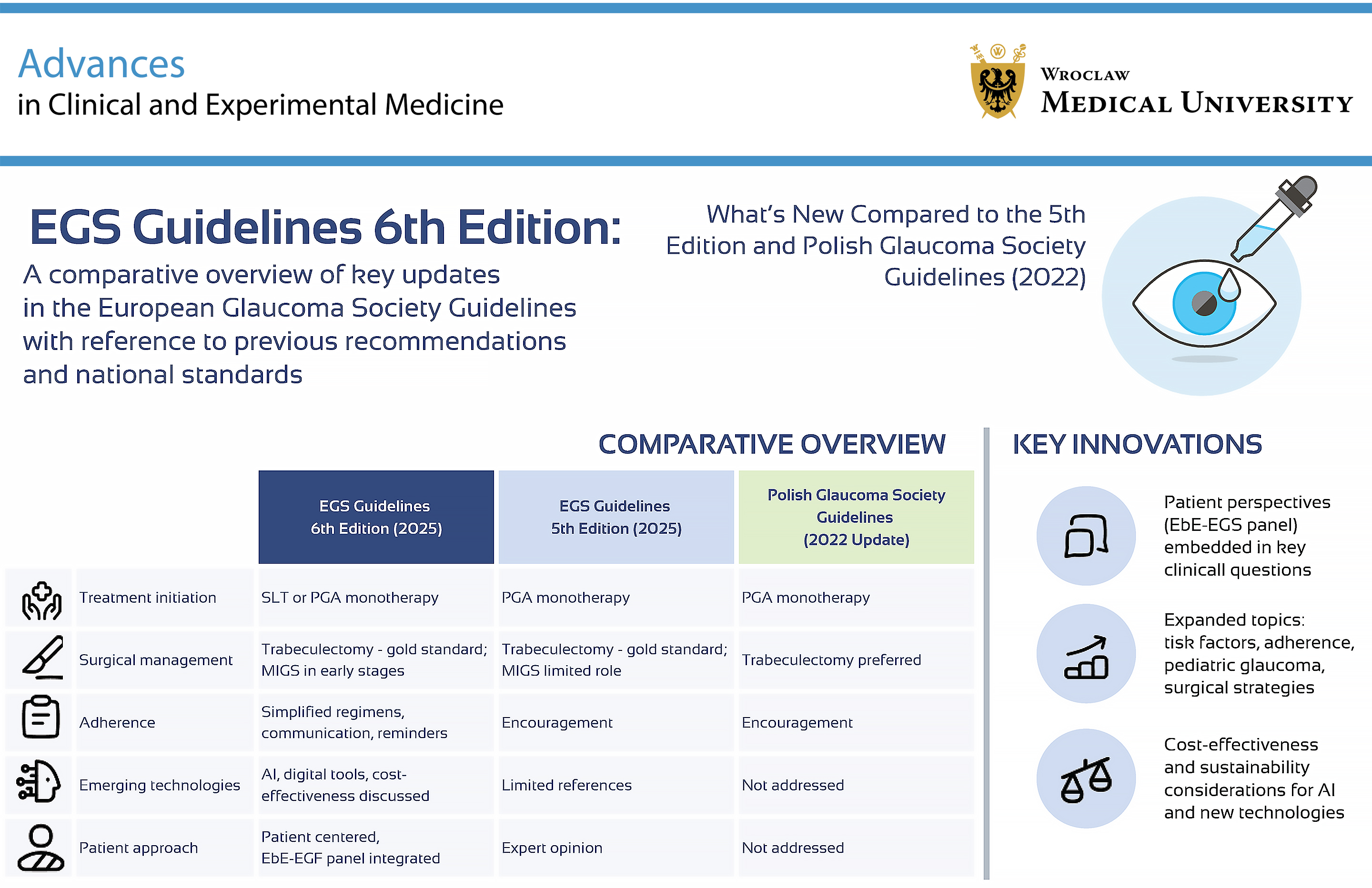
This article presents selected recommendations included in the 6th Edition of European Glaucoma Society (EGS) guidelines and highlights key differences compared to the previous (5th) and the latest revisions of Polish Ophthalmology Society (PTO) guidelines. The current edition is primarily an update to the earlier guidelines, incorporating the context of new technologies, the results of recent scientific research, and responses to important clinical questions – including those informed by input from the Experts by Experience (EbE-EGS) patient panel. These guidelines constitute a comprehensive, coherent, and evidence-based set of information and recommendations, useful both for making complex therapeutic decisions and in everyday clinical practice.
Key words: glaucoma, intraocular pressure, practice guidelines as topic, evidence-based medicine, patient participation
Introduction
On September 9, 2025, the 6th edition of the European Glaucoma Society (EGS) Guidelines was published in the British Journal of Ophthalmology. The authors stated their mission as follows: “The aim of care for patients with glaucoma or at risk of developing it is to promote well-being and quality of life (QoL) within a sustainable healthcare system.”1 Published regularly for nearly 30 years, the European Glaucoma Society Guidelines have served as an important source of knowledge for clinicians involved in glaucoma care since their inception. The current 6th edition updates and expands upon the 5th edition in response to the rapid growth of scientific evidence and technological advances. It places particular emphasis on evidence synthesis, patient-centered care, and the incorporation of new clinical questions, especially in areas such as artificial intelligence (AI), cost-effectiveness analyses, strategies to improve adherence to recommendations, and pediatric glaucoma.
Evidence was collected in 2024 through systematic reviews addressing diagnostics, prognosis, and treatment, in collaboration with the US Cochrane Eyes and Vision Group. Rigorous methodological criteria based on the GRADE system were again applied to address key clinical questions. These questions were developed on the basis of surveys conducted among EGS members and the EGS Experts by Experience (EbE EGS) patient panel. The inclusion of patient perspectives in the development of clinical questions reflects the principles of patient-centered medicine, and patient feedback became an integral component of the methodological framework. In addition to answers to the key clinical questions, the recommendations and guidance included in the publication were also based on expert consensus.1, 2
Key clinical questions and evidence-based recommendations
The core of the guidelines consists of a series of key clinical questions addressing a broad spectrum of diagnostic and therapeutic issues. This edition expands the discussion of risk factors, treatment selection, surgical options, strategies to improve adherence, and the role of emerging technologies.
Among the recognized risk factors, the following were identified as significant: elevated intraocular pressure (IOP), pseudoexfoliation syndrome, advanced age, non-White ethnicity, family history, myopia, unstable blood pressure, and cardiovascular comorbidity. The evidence regarding certain systemic diseases as risk factors, including hypertension, Alzheimer’s disease, migraine, and Raynaud’s syndrome, was considered inconclusive.1
According to the recommendations, treatment of primary open-angle glaucoma should begin with monotherapy, most commonly a prostaglandin analog, which remains the most effective pharmacological option, or with selective laser trabeculoplasty (SLT), which has been shown to be at least as effective as pharmacological treatment in patients with mild-to-moderate disease. The choice of therapy should take into account patient comorbidities, treatment costs, the ability to self-administer eye drops, and individual patient preferences.1
Regarding surgical management, trabeculectomy remains the gold standard for the treatment of open-angle glaucoma, although minimally invasive glaucoma surgery (MIGS) procedures may reduce the pharmacological burden in the earlier stages of the disease. In advanced glaucoma, trabeculectomy is preferred because MIGS procedures are generally insufficient to achieve the target IOP.
The Guidelines also address the choice of surgical procedure in patients with coexisting cataract. Phacoemulsification alone is usually insufficient to adequately control IOP, although it may result in a modest reduction in IOP, particularly in pseudoexfoliative glaucoma. Combined procedures should be considered when the target IOP cannot be achieved with cataract surgery alone. If a filtering bleb procedure is planned, cataract surgery is recommended as the first step, when clinically appropriate, followed by glaucoma surgery, as simultaneous phacoemulsification has been shown to compromise bleb function.1
To improve adherence, it is advised to simplify treatment regimens, enhance education, ensure effective communication, and provide regular reminders of recommendations.1 Attention was also drawn to the lack of strong evidence supporting the efficacy of acupuncture, cannabinoids, or alternative therapies. Research is ongoing regarding the potential neuroprotective effects of citicoline and nicotinamide.1 The optimal frequency of follow-up examinations was not explicitly defined. For ocular hypertension (OHT), intervals shorter than 1 year were generally considered not cost-effective. Increased frequency of examinations may be justified in patients with additional risk factors, failure to achieve target IOP, or evidence of progression.1
Despite promising results in screening, diagnosis, and predicting progression, the use of AI models is not yet recommended for routine clinical use due to limited evidence, generalization issues, and concerns about personal data protection.1 Questions from the previous edition were reiterated and enriched by feedback from the patient panel. A questionnaire facilitating patient interviews at both the diagnosis and follow-up stages was also suggested.
An important section of the guidelines is the “Choosing Wisely” component. It indicates interventions to avoid due to insufficient evidence, promoting effective resource utilization and evidence-based practice. Noteworthy recommendations include refraining from routine laser iridotomies in eyes with suspected angle closure without additional risk factors, not modifying IOP measurements using algorithms that rely on central corneal thickness, and avoiding the diagnosis of glaucoma based solely on optical coherence tomography (OCT) findings.1
Diagnostics, classification, and terminology
In the current edition, greater emphasis is placed on integrating new technologies in diagnostics rather than on innovations in fundamental issues. Although the changes in classification are minor, they reflect trends observed in current scientific research related to secondary glaucoma and pediatric ophthalmology. Pediatric glaucoma is divided into primary congenital glaucoma, juvenile open-angle glaucoma, and secondary glaucoma, with specific underlying causes.1
Open-angle glaucoma is categorized into primary open-angle glaucoma and secondary glaucoma, including glaucoma caused by eye diseases (with specification of the underlying cause), trauma, iatrogenic factors, and systemic diseases.1 Angle-closure glaucoma is divided into primary and secondary types. Primary angle-closure glaucoma is further classified according to the timing of onset into acute and chronic forms. For secondary glaucoma, the classification has been expanded based on the underlying causes.1 The importance of performing gonioscopy is once again emphasized due to its impact on prognosis and the effectiveness of therapeutic methods.1, 2
Treatment
In this edition of the guidelines, recommendations were expanded to include issues related to patients’ lifestyles and QoL as well as the likelihood of adherence to therapeutic regimens. The authors recognize patients’ behavioral aspects and their actual adherence to recommendations as key determinants of therapeutic outcomes. Among the methods proposed to improve cooperation, the importance of simplifying the regimen for instilling eye drops and suggesting technological support through reminder systems and alarms is emphasized. An intriguing development in enhancing treatment efficacy involves emerging methods of sustained drug delivery, including prostaglandin-releasing implants, drug-eluting contact lenses, and subconjunctival implants. However, these methods are currently not available in Europe.
Therapeutic strategies prioritize preserving visual function and QoL by lowering IOP to a predetermined target level. The guidelines define the target pressure as the upper limit of IOP that allows halting or sufficiently slowing the progression of visual field loss in order to maintain QoL for the expected duration of the patient’s life. The target is determined by the severity of neuropathy, baseline IOP, rate of progression, and risk factors.1
In the general principles of therapeutic interventions developed by the EGS, strong emphasis is placed on individualization to achieve the target IOP, which requires regular re-evaluation.
The recommendations for pharmacological therapy uphold prostaglandin analogs as first-line treatment due to their efficacy and safety profiles. The escalation ladder includes switching to an alternative monotherapy and subsequently to combination therapy if the target IOP is not achieved. The use of preservative-free formulations may improve tolerance.1, 2
Selective laser trabeculoplasty is an effective alternative to pharmacological treatment for many patients with primary open-angle glaucoma (POAG) and OHT Laser iridotomy remains an important treatment for angle closure. Peripheral thermal iridoplasty is indicated as a supportive treatment for plateau iris in patients with angle closure who have undergone iridotomy, although its effectiveness in lowering IOP is limited.1
Regarding surgical interventions, the central role of trabeculectomy is again emphasized as the procedure that provides the greatest reduction in IOP, particularly in cases of advanced disease. Minimally invasive glaucoma surgery is appropriate in selected cases of early and moderate glaucoma to reduce the pharmacological burden. Cycloablative procedures are reserved for cases in which filtration surgery has a low likelihood of success, for the acute management of malignant glaucoma due to aqueous misdirection, and for treatment-resistant cases.1 The guidelines also address treatment during pregnancy, dietary supplementation, and neuroprotection.
Patient feedback and impact on diagnostics
Feedback from patients in the EbE panel informed revisions to recommendations on diagnostic tests. Examinations conducted during the initial visit should include visual acuity assessment, gonioscopy, tonometry, central corneal thickness measurement, visual field assessment, and optic nerve head evaluation. Optical coherence tomography has been recognized as useful but insufficient as a standalone diagnostic tool. Patients emphasized the importance of understanding the purpose and sequence of tests, the concept of target IOP, and the reasons for measuring corneal thickness. Gonioscopy remains an essential examination and, according to the authors, cannot be replaced solely by imaging techniques.
PTO vs EGS recommendations comparison
A clear distinction between the 6th edition of the EGS guidelines and the Polish Ophthalmological Society (PTO) guidelines lies in the degree of emphasis placed on methodological rigor and patient participation. The EGS document relies extensively on systematic reviews, evidence synthesis, and structured input from the EbE patient panel. In contrast, the PTO guidelines, while clinically practical and aligned with most EGS principles, maintain a more expert opinion-based approach, focusing on applicability within the national healthcare system and providing more operational detail on diagnostic sequencing, treatment organization, and follow-up logistics.1, 3
Specific divergence emerges in therapeutic recommendations, particularly regarding laser therapy, pharmacological choices, and the sequencing of surgical interventions. The EGS strongly elevates SLT to a first-line option equivalent to prostaglandin analogs for POAG and OHT, emphasizing its efficacy and cost-effectiveness across mild and moderate stages of the disease. In contrast, the PTO guidelines still present topical monotherapy, especially prostaglandin analogs, as the standard starting point, reserving SLT mainly for inadequate response, intolerance, or anticipated adherence issues.1, 3
Differences are also visible in the approach to medication sequencing. The EGS explicitly promotes switching within monotherapy classes before escalating to fixed combinations and highlights the importance of minimizing preservatives, whereas the Polish guidelines more readily move to combination therapy and strongly emphasize the use of preservative-free preparations for ocular surface protection, even earlier in the treatment course.1, 3
In cataract-related decision-making, the EGS states that phacoemulsification alone is insufficient for meaningful IOP control, except for modest reductions in pseudoexfoliative glaucoma, and recommends performing cataract surgery before trabeculectomy when both procedures are indicated, as combined procedures compromise bleb survival. The PTO guidelines, while acknowledging these principles, provide more detailed procedural pathways, reflecting a more step-by-step, sequential approach.1, 4
Moreover, the EGS consistently positions trabeculectomy as the gold standard for achieving a low target IOP in advanced glaucoma, with MIGS primarily recommended to reduce medication burden in early or moderate disease. By contrast, the Polish surgical guidelines provide broader indications for seton implants and describe a larger role for cyclodestructive procedures in selected cases, including those with a poor visual prognosis or a low probability of success with filtration surgery.1, 4
Together, these differences reflect the complementary roles of international evidence-based frameworks and national practice-oriented recommendations.
Conclusions
The EGS guidelines are a comprehensive and exhaustive source of scientific knowledge on glaucoma. By integrating systematic reviews, expert opinions, and patient perspectives, this publication serves not only as a compendium for researchers but also as a practical framework for clinicians. By considering the psychosocial dimensions of care and patient interests, it offers recommendations that facilitate clinical decision-making in real-world settings.
The transition from the 5th to the 6th edition of the EGS guidelines represents a necessary update and further development of strategies for understanding the disease and improving communication in the care of patients with glaucoma. In contrast to previous editions, the methodology used to develop recommendations was updated to incorporate patient consultations; the evidence base was expanded; and issues related to new technologies (including AI models) and adherence were further addressed. Compared with the PTO guidelines, the EGS guidelines present a more general, evidence-based perspective, whereas the PTO guidelines adopt a more procedural, practice-oriented approach.
The new edition of the guidelines is a richer and more practical resource that does not abandon the clinical foundations established in the previous edition.
Use of AI and AI-assisted technologies
Not applicable.