



Abstract
Translation research into practice remains one of the critical yet underdeveloped aspects of scientific progress. This editorial explores how academic mediation can transform fragmented research activities into sustainable translational ecosystems. Drawing from Thailand’s experience in laser dentistry, the paper illustrates a progression from individual projects to collective research networks and the institutionalization of the Hub of Knowledge in Orofacial Laserology (HKOL). The model demonstrates how innovation can move beyond diffusion and normalization to achieve implementation grounded in education and community relevance through structured collaboration, standardized protocols, and academic stewardship. By addressing theoretical gaps and aligning practice with governance, the academic mediator-driven model offers an adaptable framework for integrating research, clinical service, and policy. It underscores that effective translation is not a spontaneous outcome of evidence but the result of deliberate structure, shared accountability, and long-term academic continuity.
Key words: oral health, development, laser therapy, evidence-based practice, translational science
Introduction
All academic knowledge and innovation in medicine ultimately aim to improve clinical practice, often described as the pathway from bench to bedside. However, evidence indicates a substantial delay between discovery and adoption: a review of 23 studies from the 1980s to the 2000s revealed an average lag of approx. 17 years before research findings achieved widespread clinical implementation.1 Meanwhile, the linkage between biomedical patents and scientific papers has expanded exponentially over the past 37 years, doubling every 2.9 years, particularly among biotechnology and U.S. Food and Drug Administration (FDA)-related drug patents.2
Despite this growing scientific output, the persistent gap between research and patient benefit remains evident, as reflected in recent systematic reviews published between 2023 and 2025.3, 4, 5 Worldwide, research institutions produce an unprecedented volume of studies; however, only a small proportion of these findings is translated into improvements in clinical practice, public health policy, or community wellbeing.6, 7 The current challenge is no longer how to create knowledge but rather how to make that knowledge meaningful.
This issue is particularly critical in healthcare systems of low- and middle-income countries, where innovation often relies on imported technologies and external evidence. Despite global investments in research, implementation is often hampered by a limited research and development ecosystem, including inadequate infrastructure, fragmented governance, and a lack of local ownership. As Alonge et al.6 noted, advancing equity in implementation research requires adapting evidence to context and transforming the power relations that determine whose knowledge is valued and whose health truly improves.
Even in high-income countries like the UK and Australia, integrating research, education, and healthcare delivery remains a challenge. In the UK, initiatives such as Academic Health Science Centers, Networks, and Collaborations (AHSCs) aim to promote innovation in the National Health Service (NHS). Similarly, Australia’s National Health and Medical Research Council (NHMRC) accredits centers to enhance health research translation. Based on reviews of 41 projects or centers under those organizations on the website by Robinson et al.,8 barriers such as fragmented governance, short funding cycles, uneven public involvement, and limited long-term evaluation persist. Infrastructure alone has not ensured integration; strong leadership and cross-sector collaboration remain crucial.
Recent editorials in orthopedics and sports medicine have highlighted the concept of evidence-based research (EBR), emphasizing that new studies must rely systematically on prior evidence and ensure the practical implementation of findings rather than merely contributing to publication volume. Prill et al.9 argue that research achieves value only when it is transparently justified, methodologically rigorous, and integrated into clinical decision-making and guideline development. This perspective reframes implementation not as a downstream activity but as an essential dimension of responsible evidence generation. Within this broader evidence-based discourse, academic mediation can be understood as an institutional mechanism that operationalizes EBR principles across healthcare systems.
Over the past decade, several theoretical frameworks, such as Diffusion of Innovations,10 Normalization Process Theory,5 and Implementation Science,11, 12 have attempted to explain and assess the causes of delayed translation of research to practice in healthcare services. While each provides valuable insights, their practical impact has varied. Translation often diverges from the neat patterns proposed by these theories, unfolding in complex, context-specific ways influenced by multiple levels of relationships, including connections among academic institutions, hospitals, and grading agencies, as well as administration, trust, and social and organizational values.
In this context, Thailand’s experience offers a unique perspective on the role of translation and implementation under academic mediation. Instead of keeping research confined within universities, the Thai model positions academia as a bridge connecting clinical researchers and communities through micro- and meso-level collaboration. In the field of orofacial laserology, this approach blends isolated clinical trials with translational research and implementation, along with workforce capacity building through networks.
Objectives
This editorial addresses the role of academic mediators in research translation, focusing on the achievements of the Lasers in Dentistry Group at Khon Kaen University and the Hub of Knowledge in Orofacial Laserology (HKOL) in Thailand. In this editorial, academic mediation refers to the institutional function of universities in aligning evidence generation with clinical implementation and policy coordination. It begins by examining the reasons behind the frequent failures of research translation on a global scale. The editorial then explores how the intentional creation of research networks and transfer mechanisms, grounded in education and community partnership, can convert knowledge into sustainable practices. The Thai experience illustrates that when innovations are directly transferred to local practices through academic networks rather than through a top-down system, they can spread and be sustained, effectively transforming research into practice. Additionally, a content analysis is presented alongside relevant theories.
From research to reality: Why translation often fails and when it succeeds
Over decades of scientific progress, one paradox remains: while research output has grown exponentially, only a small portion of this knowledge is ever put into practice. Numerous studies, ranging from the study by Grimshaw et al.11 in 2012 to Williams et al.5 in 2023, consistently show that most research remains unutilized, trapped within the academic cycle of publication rather than being translated into real-world applications. In healthcare, this gap between research and practice has become one of the most enduring challenges of modern science. Translation fails not because of a lack of evidence, but because of a lack of mediation. The Thai model of orofacial laserology demonstrates how networks of academic mediation can operationalize theory into practice. According to previous reviews and analyses, several recurring reasons explain why translation frequently stalls.
Linear diffusion myth
The classical Diffusion of Innovations model suggests that new ideas spread naturally once they are proven effective.13 However, Greenhalgh and Papoutsi14 argue that this linear and individual-focused model overlooks the complex and adaptive nature of real health systems. In these systems, social, political, and institutional factors play a crucial role in determining whether innovations are sustainable or fade away. They emphasize that sustainability depends not only on the spread of an innovation but also on ongoing sense-making, local adaptation, and alignment with the values and resources of the system – processes that the traditional diffusion curve cannot capture.
Dissemination but not implementation
Merely publishing or presenting findings does not ensure application. Grimshaw et al.11 demonstrated that the distance between what is known and what is done persists because academic channels, such as papers, conferences, and presentations, rarely connect with practitioners’ daily realities.
Organizational and cultural barriers
System-level inertia often hinders the translation of evidence. Abu-Odah et al.3 conducted systematic reviews that identified barriers such as limited leadership incentives, scarce resources, and a lack of structured feedback loops as major reasons why evidence fails to influence policy or practice. These results illustrate the common global situation in healthcare, where the research and service sectors often operate as parallel universes.
The challenge of using theories without implementation
Ironically, even implementation science, the discipline created to close the gap, has developed its own gap. Westerlund et al.7 described this as the “implementation paradox,” where new frameworks proliferate but remain unadopted by practitioners. A similar pattern is evident with Normalization Process Theory (NPT): although widely cited, few studies have applied its core principles in real-world clinical settings. Williams et al.5 reviewed trials referencing NPT and found that only a small number operationalized its mechanisms to support genuine normalization in practice.
Malalignment of scientific advancements and clinical application
Despite rapid scientific advancements, the path from discovery to patient benefit remains misaligned. Fernandez-Moure15 identified key obstacles, such as reduced protected time for clinician-scientists, academic incentives favoring publication over application, and significant funding shortages between initial discovery and implementation.
These issues delay innovation and hinder promising technologies from gaining the necessary support for regulatory approval and real-world use. Thus, the challenge lies not in a lack of knowledge, but in fragmented systems that fail to support its application.
Unsustainable collaborations
Without long-term structures, collaborative projects dissolve once funding ends. Systematic reviews of the websites of research centers and projects showed that many university–health service partnerships fade after the project phase, lacking governance mechanisms to sustain shared learning and accountability.8
What enables translation and implementation
Across the literature, 5 enabling conditions consistently appear3, 5, 7, 8, 11, 14, 15:
1. Co-production of knowledge: Engaging end-users such as healthcare providers, patients, and stakeholders early in research design ensures that questions and outcomes are meaningful beyond academia.
2. Academic mediation: Universities and research networks are trusted intermediaries that interpret findings, train users, and monitor outcomes.
3. Feedback integration: Real-world data loop into research, closing the cycle between evidence and improvement.
4. Incentivized networks: Translation thrives when collaboration, not competition, is rewarded.
5. Adaptive education: Embedding translational principles within curricula cultivates practitioners who can generate and apply evidence.
When these elements align, research ceases to be an isolated endeavor. It becomes a living, self-renewing ecosystem. The following lessons were learned from the Lasers in Dentistry Research Group (LDRG) in Thailand. Despite facing ongoing challenges, these collective failures highlight how successful translation can occur. The translation of laser use for oral health in community hospitals becomes achievable when evidence effectively functions within a real network of equality. Academia takes on a purposeful role as the translator, trainer, and guardian of innovation. This is where the Thai model offers its most valuable insights.
From individual discovery to collective networks
Thailand’s experience with orofacial laserology vividly illustrates these lessons. The development of this field signifies more than just technological advancement; it embodies a continuous journey of exploration, adaptation, and integration that connects academic innovation with public health priorities.
In 1993, when Khon Kaen University’s Faculty of Dentistry acquired its first dental laser, it represented more than just an equipment purchase; it marked the beginning of an intellectual movement. By 1998, the first Thai specialist had completed a PhD in laser dentistry, establishing domestic expertise and reducing reliance on imported knowledge. By 2001, laser courses were formally integrated into both undergraduate and continuing education curricula, cultivating foundational literacy across dental disciplines. An expansion in 2007, supported by national and international partners, positioned Thai initiatives within a broader professional community.
The LDRG at the Khon Kaen University, founded in 2011, formalized the transition from isolated projects to a coherent research network. Among the various approaches to conducting research and innovation in dentistry, the group’s early laboratory and clinical studies clarified how low-intensity photobiomodulation and diode laser photocoagulation could be adapted for mucosal surgery, soft-tissue welding, and wound control.16, 17, 18 These techniques were accepted and adopted by tertiary hospitals via participatory action research due to the demand to treat oral potentially malignant disorders.19
By 2017, collaboration expanded beyond tertiary hospitals to include local health services in rural areas. This shift was driven by the clinical demand for safe, minimally invasive procedures and effective hemostatic support, all in line with the goal of promoting oral health. Between 2020 and 2022, a prototype low-intensity diode laser for primary care was co-developed with local clinicians and engineers, with support from the National Research Council of Thailand (NRCT). The device, which operates at a compact wavelength of 810–830 nm, offers intensity ranges from 0.2 W to 1.0 W, optimized for wound healing, pain control, and blood clot initiation. It was specifically designed for health-promoting hospitals to address the needs of older adults with systemic health risks while aligning with the demands and utilization practices of dental healthcare providers.
This initiative demonstrated that successful translation requires not only a device but also an ecosystem of learning. Community hospitals became both service and learning centers, forwarding anonymized data to a PhD candidate, including a multicenter hemostasis study by Tanya et al. in 2025.20 These clinical translational studies have confirmed the safety and effectiveness of laser-mediated hemostasis and photobiomodulation therapy, which promote healing and alleviate pain for older patients. The results consistently showed that socket hemostasis could be achieved within minutes, which improved treatment acceptance, particularly among patients on antithrombotic therapy. Additionally, there was a positive response from dental healthcare providers in local hospitals regarding the technological aspects of these advancements.
Academic mediation and the Hub Model
The next transformation came with the recognition that sustainability required structure.
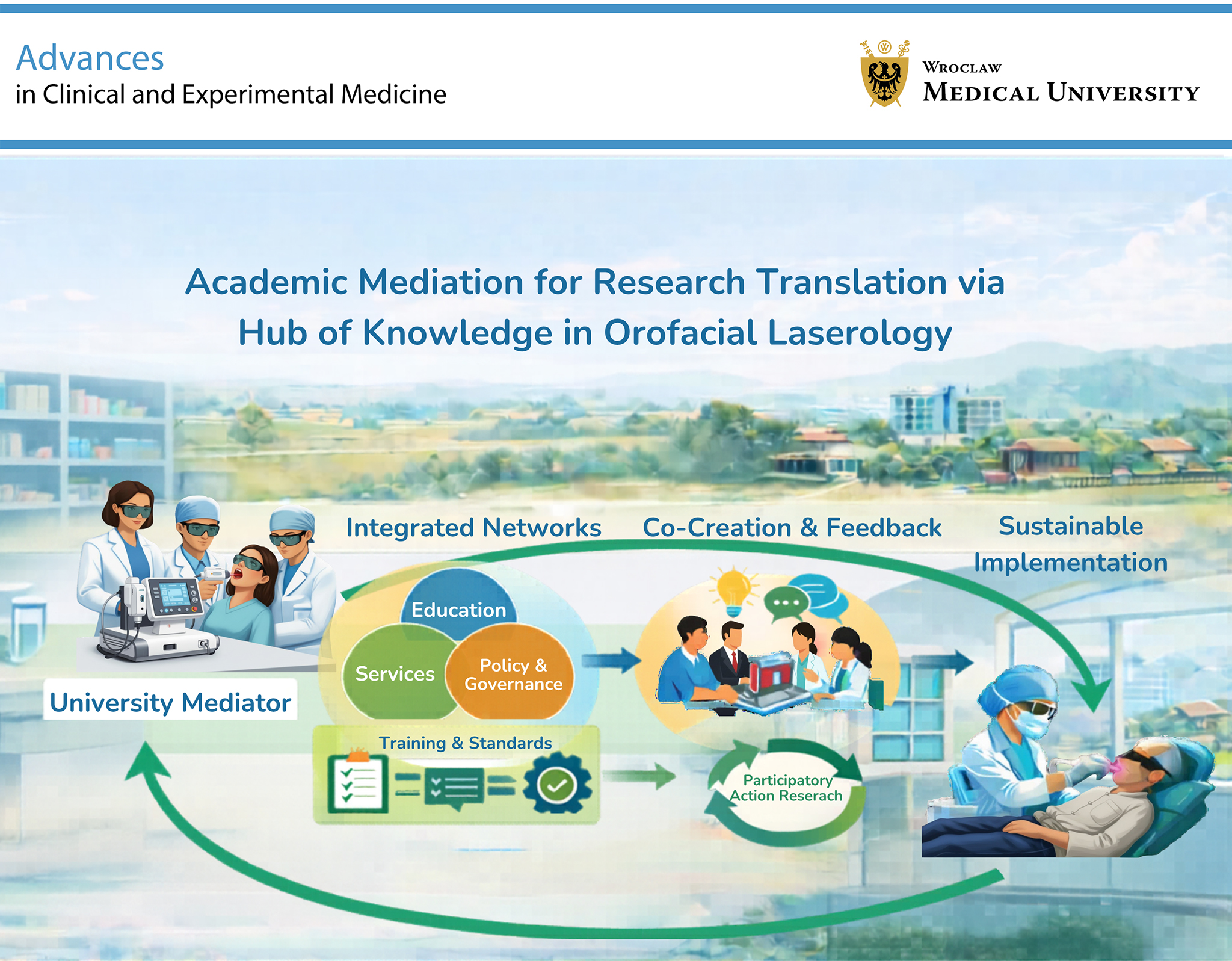
In 2024, the HKOL, supported by the NRCT, was established to integrate research, education, and clinical service into a single translational system.
The need for this formal structure became evident when the first primary-care network, Bua Ngoen Primary Hospital (Khon Kaen, Thailand), successfully translated the routine use of lasers for oral healthcare in primary hospitals to 7 neighboring health-promoting hospitals by organizing local workshops and peer-to-peer learning. This demonstrated that knowledge transfer could truly propagate through academic mediation in practice rather than theory.
As expansion reached a nationwide scale, new challenges arose. According to Thailand’s public procurement regulations, acquiring laser devices for primary and secondary hospitals requires clear and standardized specifications. The HKOL took on an official role in defining academic specifications for each level of healthcare to ensure that quality, safety, and educational alignment were maintained. These specifications align well with the real-world experiences of the Lasers in Dentistry networks at Khon Kaen University and the HKOL, which have been utilized for at least 10 years.
The HKOL established standardized device categories: low-intensity presets for primary hospitals, adjustable diode systems for secondary facilities, and CO2 or Er:YAG lasers for tertiary centers. These were all implemented under unified safety protocols, operator certification, and academic endorsement. Additionally, the HKOL coordinated postgraduate research, national workshops, and collaborative data collection in community hospitals, effectively transforming research translation into an organized, self-sustaining system.
The HKOL embodies the principle of academic mediation: knowledge transfer as stewardship, not diffusion. Evidence becomes education; education becomes service; and service feeds new evidence. The model’s success lies in its continuity, supported not by transient grants but by a shared academic identity across institutions. It is a living network that keeps translation alive in lifelong education.
From local innovation to global learning
Thailand’s trajectory in orofacial laserology illustrates what global literature repeatedly calls for but seldom achieves: a functioning translational ecosystem.
It demonstrates that innovation can originate from a middle-income setting, provided the process is relationship-driven, ethically grounded, and academically mediated. Local research became globally relevant through continuous collaboration linking the LDRG, HKOL, and international partners such as the World Federation for Laser Dentistry (WFLD). What began as a clinical response to limited surgical options for older adults evolved into a community-based translational model that others can learn from. In this model, transfer is not a one-time event but an ongoing conversation among researchers, practitioners, and patients.
From barriers to bridges
The global literature highlights the reasons for translation failures and suggests that success can emerge when these failures are intentionally addressed. While frameworks like diffusion, normalization, and implementation science each offer insights into the translational process, none guarantees sustained progress without a mediating structure to integrate them.
In Thailand, this structure is achieved through academic mediation, where universities serve as both sources of innovation and custodians of translation. By turning research networks into engines of education and collaboration, the orofacial laserology community demonstrates that theory is only durable when linked to practice, which, in turn, must be grounded in evidence.
The analytical synthesis (Table 1 3, 5, 7, 8, 12, 13, 14) summarizes how this network-based academic mediation model overcomes theoretical limitations by transforming diffusion into direction, embedding into endurance, and implementation into institutionalization.
Discussion
Academic mediation does not introduce a new theoretical framework. It serves as an operational layer that integrates existing implementation frameworks. While diffusion theory explains how innovations spread, and normalization process theory outlines the integration of practices into routine, neither alone ensures continuity across institutions.
Academic mediation institutionalizes feedback loops, aligns educational practices, and coordinates policies, functioning as the infrastructure that transforms theoretical insights into sustainable practices. Thus, it represents the institutional architecture for implementing evidence-based practices. The synthesis presented in Table 1 demonstrates how the academic mediator-driven translation model transforms theoretical frameworks into practical applications. Instead of dismissing diffusion, normalization, or implementation science, our approach operationalizes these frameworks by providing institutional continuity and structured feedback mechanisms linking evidence generation, education, and clinical service. This transformation was intentional and reflected the development philosophy of His Majesty King Bhumibol Adulyadej (Rama IX), who emphasized that sustainable progress must begin with “Understand, Access, and Develop” and should be driven by “development from within.”21
The process highlighted the importance of contextual relevance by prioritizing an accurate understanding of the networks prior to implementation. It encouraged collaboration among micro- and meso- levels of universities, community hospitals, and practitioners by ensuring resource access. Additionally, fostering development within the local organization, in this case, enhanced local capabilities and ownership. Through this approach, academic mediation transcended its role as merely a means of translation; it became a form of stewardship in which knowledge flows between academia and the community, continuously sustained through education and shared responsibility.
The HKOL and its national collaborations illustrate the evolution of the field. Supported by the NRCT, the HKOL transformed translation from a mere project into a comprehensive system that integrates innovation, governance, and compassion. This model from Thailand demonstrates that effective translation research relies not just on scientific validity but also on moral clarity: progress should be rooted in empathy, participation, and internal growth.
Ultimately, the Thai experience shows that compassionate science serves as the true bridge between theory and practice. When universities act as mediators that listen before acting, reach out before prescribing solutions, and empower before directing.
The transferability of this operational model to other healthcare systems relies on several key contextual factors. First, a minimum level of academic infrastructure is necessary, which includes high research capacity and a strong institutional commitment to long-term collaboration. Second, funding mechanisms should prioritize continuity over short-term project cycles. Third, clear regulations, especially regarding procurement and professional certification, are important for standardization across healthcare tiers. Lastly, building relational trust among universities, healthcare personnel, and related administrative organizations is essential. Without these enabling factors, academic mediation may remain an aspirational goal rather than become operational. While the Thai context is one example, the fundamental principle of embedding implementation within institutional governance can be applied to various systems with appropriate contextual adjustments.
Conclusions
The development of research networks in orofacial laserology in Thailand is a good example that successful translation depends on institutional structure rather than technological novelty alone. The Thai model operationalized innovation through a multi-level system linking university-based research, primary care services, and postgraduate education within a coordinated governance framework. Through academic mediation, universities functioned not merely as producers of evidence but as institutional stewards aligning research generation, professional training, and community implementation.
This experience suggests 3 broader implications for research translation:
1. Implementation should be embedded within institutional governance rather than treated as a downstream activity following evidence generation.
2. Sustainability requires permanent networks and standardized protocols that transcend project-based funding cycles and support continuity across healthcare levels.
3. Co-creation with practitioners, supported by structured feedback loops, is essential to transform evidence into routine clinical practice.
While contextual conditions influence transferability, the underlying principle remains consistent: research achieves impact when supported by structured collaboration, accountability mechanisms, and long-term institutional commitment. Translation, therefore, is best understood not as a linear transfer of knowledge but as a sustained organizational process integrating evidence, education, and service within a continuous learning ecosystem.
Use of AI and AI-assisted technologies
AI-assisted tools were used partially for grammatical checking and for preparing the graphical abstract based on the authors’ design. The tools that we used were OpenAI’s ChatGPT (GPT-5.4 Thinking) and Grammarly.