


Abstract
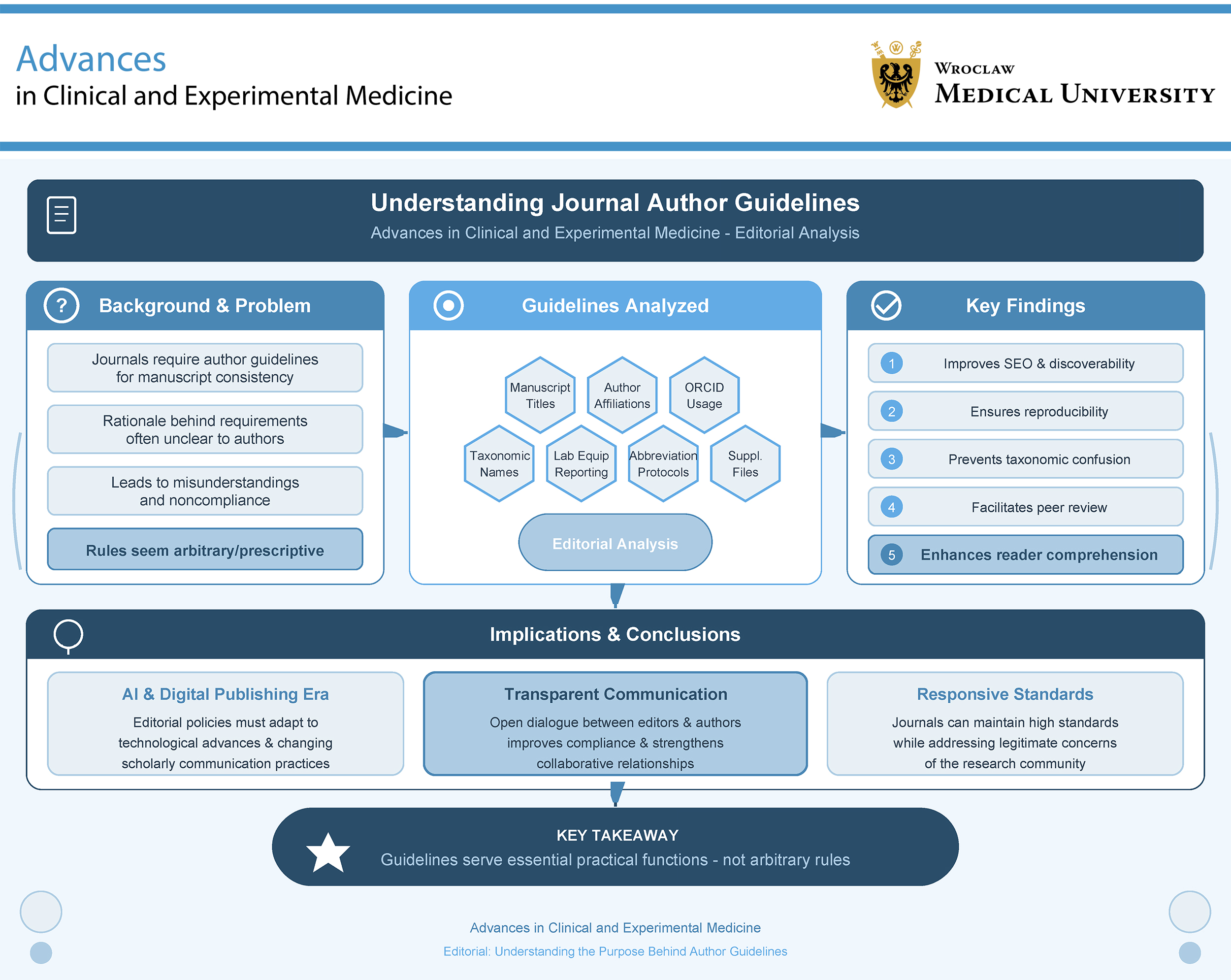
Scientific journals establish author guidelines to ensure manuscript consistency, enhance readability, and maintain editorial standards. However, the rationale behind specific requirements is not always apparent to submitting authors, leading to misunderstandings and noncompliance. This editorial examines the instructions for authors currently applied at Advances in Clinical and Experimental Medicine (Adv Clin Exp Med), explaining the purpose behind selected regulations that may initially seem arbitrary or overly prescriptive. We analyze requirements concerning manuscript titles (sentence case, study design specification, avoidance of nonstandard abbreviations), author affiliations (institutional hierarchy, geographic formatting), ORCID (Open Researcher and Contributor ID) usage, highlights preparation, taxonomic nomenclature (italicization of genus and species, distinction between genes and proteins), laboratory equipment reporting (manufacturer details, catalog numbers, software versions), abbreviation protocols, and supplementary file management. We demonstrate that these requirements serve essential practical functions: improving search engine optimization and discoverability, ensuring experimental reproducibility, preventing taxonomic and nomenclatural confusion, facilitating rigorous peer review, and enhancing reader comprehension across different formats and access points. The editorial also addresses the evolving nature of author guidelines in the era of artificial intelligence (AI) and digital publishing, emphasizing that editorial policies should function as adaptable documents that respond to technological advances and changing scholarly communication practices. By fostering open dialogue between editors and authors regarding the rationale behind publication requirements, journals can maintain high standards while remaining responsive to the legitimate concerns of the research community. We conclude that transparent communication about editorial policies not only improves compliance but also strengthens the collaborative relationship between journals and the researchers they serve.
Key words: scientific writing, scientific publishing, scientific journal, editorial policies, guidelines as a topic
Introduction
Most scientific journals formulate specific requirements that must be met by manuscripts submitted to them – as a rule, these are posted on the journal’s website, and sometimes links to them can also be found on the journal’s social media profiles. If the article is prepared with a specific journal in mind, the submitting author or the whole team should review the journal’s instructions for authors before they start writing the manuscript and preparing figures and tables – it can save a lot of work. If the authors choose the place of publication (or at least select the journal) after completing the article, they need to carefully review the preliminary requirements and adapt their manuscript to them.
Some rules provided by editorial offices stem from practical issues – following them facilitates comprehension of articles by both human readers and search engines and AI tools that scan the papers’ content. Other regulations are more or less conventional – grounded in editorial traditions or more recent principles widely accepted among editors of scientific journals. Although some requirements stem from editorial traditions, their importance lies in preserving consistency and stylistic coherence, which are central to professional scholarly publishing. Adherence to – and, when necessary, enforcement of – the rules formulated in a given journal is not primarily a question of prestige but of the journal’s standing among other journals since many databases and evaluators take into account whether the editors actually perform their duties in the journal in question. In this context, taking such requirements seriously is also in the authors’ best interest, since most researchers want to publish in highly esteemed journals.
Editors should explain the reasons behind specific regulations because rules that are understood are more likely to be followed; moreover, it shows that the authors are treated with respect and that the editors do not expect anybody to follow their orders without understanding their rationale but can prove that each tenet in the long run makes both working on the manuscript before publication and reading it following publication easier. It should also be noted that instructions for authors in journals with a similar scope are often significantly different and may even be contradictory when compared – such divergence may be exacerbated by different editorial traditions across various parts of the world (although English serves as the global language of science). Many misunderstandings between authors and editors stem from habit. When experienced researchers submit their manuscripts to journals that follow rules similar to those of other journals, they may not realize that both general and specific requirements are not universally accepted.
Objectives
This editorial outlines selected elements of the Instructions for Authors1 currently in effect (as of February 2026) at Advances in Clinical and Experimental Medicine (Adv Clin Exp Med). Where appropriate, explanations are provided for rules whose rationale may not be immediately evident. The 1st aim of the present paper is to help authors interested in submitting manuscripts to our journal understand our requirements and to show them that they are not arbitrary but rooted in widely accepted practices in medical journals and editorial experience. The 2nd aim is to stimulate discussion around the journal’s guidelines – they are not written in stone. They should be continually reassessed, as the landscape of scientific publishing is evolving rapidly in the era of AI and editorial rules must evolve accordingly. Examples are provided both from papers published in Adv Clin Exp Med and 2 other journals owned by the same publisher – Wroclaw Medical University (Poland): Dental and Medical Problems (Dent Med Probl) and Polimery w Medycynie – Polymers in Medicine (Polim Med).
Title of the manuscript
There are 3 rules regarding manuscripts titles in Adv Clin Exp Med:
1) Titles should be written in sentence case (only the first word of the title, proper nouns, and genus names are capitalized).
2) The title should include the study design for clinical trials, systematic reviews, or meta-analyses.
3) Other types of reviews should also be defined in the title (e.g., narrative review, scoping review), as determined by Grant and Booth2 and Ghosh and Choudhury.3
If possible, specialist abbreviations in titles should be avoided – for 2 reasons. First, it is always risky to assume that all readers, even specialists in a given field, know the meanings of all abbreviations and acronyms used in publications within their specialty. Second, using too many acronyms (particularly less well-known ones) negatively affects the chances of a paper being highly ranked by search engines (search engine optimization (SEO)). It should be noted that in Adv Clin Exp Med, editors often modify the titles of accepted manuscripts to make them more SEO-friendly, and the revised versions are provided to authors for approval during the linguistic editing process.
Only the length of the shorter version of the title (used in pagination) is limited (to 45 characters with spaces); however, it should be borne in mind that overly long titles tend to become convoluted and may overwhelm or confuse readers, while overly short titles may lack essential information. Effective titles balance brevity and completeness, often including the central intervention, outcome, and population studied without unnecessary words.
Formulating an appropriate title for a scientific manuscript may therefore require some reflection, but several studies offer in-depth analysis of this problem, going beyond mere advice. Tullu4 provided both a classification of papers’ titles and suggestions on what a good title should look like in the form of easy-to-comprehend tables. Annesley5 offered concise advice with many examples. Bahadoran et al.6 proposed a different classification, with particular emphasis on the length of articles’ titles and well-thought-out word choice. Matsubara7 focused on titles of medical articles – particularly his observations regarding the relationship between titles and manuscript structure are particularly noteworthy. Bavdekar8 described a proposed procedure for writing a manuscript title and prepared a dedicated checklist based on his insights. Hyland and Zou9 explored the key features of 5,070 titles in the leading journals of 6 disciplines in the human and physical sciences to identify their typical structural patterns and content; their study does not provide direct recommendations but offers a broader perspective on the issue. Jamali and Nikzad10 analyzed the relationship between article title type and the number of downloads and citations. Valuable advice has also been offered by Springer Nature,11 Researchers’ Writing Academy,12 and Multidisciplinary Digital Publishing Institute (MDPI).13
In light of the above publications, a good scientific title should be:
− Informative and specific – it should include key elements of the study, such as subject, variables, or outcome;
− Concise and focused – optimal titles are typically short but comprehensive, often recommended at about 10–15 words (though conventions vary by field);
− Precise and accurate – the title must be unambiguous and avoid misleading readers about the content;
− Keyword-rich – include the most critical scientific terms that reflect the study’s focus and that researchers would likely use when searching literature;
− Free from jargon and nonstandard abbreviations – these can confuse readers and reduce discoverability through search engines and indexing services;
− Professionally toned – humor, puns, or overly creative phrasing might attract attention in some contexts, but they are usually discouraged in scientific titles because they can reduce clarity and seriousness.
Examples of papers published in our journal with titles formulated according to the rules and suggestions listed above can be divided into 3 groups: 1) articles (mainly clinical trials) with the study design clearly stated in the title – Matys et al.,14 Yao et al.,15 and Gao et al.16; 2) reviews with a precisely defined type – Jiang and Hou17 and Szymański et al.18; 3) meta-analyses – Qu et al.19
Affiliations
A correct affiliation should include 2 components: 1) the name of the institution; 2) the city and country in which the institution is located. If the institution with which an author is affiliated is divided into smaller units (e.g., departments, clinics, institutes, faculties, branches), the name of the specific unit must be provided, rather than only the general name of the institution (university, hospital, etc.). If an author is affiliated with more than 1 entity, each should be listed as a separate affiliation; 2 or more entities should not be merged into a single long affiliation. Names of states or provinces (in the USA, Canada, South Africa, Mexico, Brazil, China, etc.) should not be provided. Names of countries should be given in their shorter forms (e.g., China, not the People’s Republic of China or PRC) and in English, even if the name in a given language is also used in English-language sources (e.g., Turkey, not Türkiye). The reason for this rule is to ensure uniformity by providing the names of the same countries in a consistent form, not according to authors’ preferences.
Detailed rules regarding affiliations are rare in medical journals – the Medical School of the University of Melbourne (Australia) issued a guideline on affiliations, although it is general in scope (it covers all types of publications, not only journal articles).20 This issue has been only scarcely studied so far: Khalifa et al.21 examined different reporting patterns of author affiliations in a cross-sectional evaluation of publications from an Egyptian academic medical institution, while Bachelet et al.22 offered a protocol for an exploratory case study of author misrepresentation of institutional affiliations.
A fine example of diligently prepared affiliations is a paper by Petrazzuoli et al.,23 in which the authors were affiliated with 20 different entities. An article by Martínez-Sabater et al.24 showcases how to solve an issue frequently encountered involving authors from Spanish- and Portuguese-speaking countries, as well as Italy – multiple scientific and health institutions there have English-language names but are often better known by acronyms of their original (non-English) names – in such a situation, we elect to provide the English name first. The non-English acronym in parentheses is used to ensure the correct identification of a given entity in both languages. In turn, a meta-analysis by Shao et al.25 exemplifies a problem characteristic of Chinese papers. In this country, a hospital affiliated with a university often forms a single legal entity with that university, and combining them into a single affiliation is not an error. Well-formatted affiliations can also be found in Dent Med Probl – e.g., in Yadav et al.26 and Orzechowska-Wylęgała et al.27
ORCIDs
Authors submitting their manuscripts to Adv Clin Exp Med are advised to use a unique ORCID number (Open Researcher and Contributor ID). This popular digital tool enables the identification of authors and their research output. A permanent 16-digit identifier distinguishes its holder from other researchers, even if they have a common name, change their surname for any reason, or their name is spelled differently in different publications. It prevents confusion and ensures their work is always correctly attributed. Many journals, publishers, and databases (e.g., Scopus, Web of Science, Crossref) can automatically link their publications to their ORCID profile. An ORCID profile can serve as a portable, standardized academic CV, including publications, grants, affiliations, peer-review activity, and awards.
It should be emphasized here that while the editors make sure, following acceptance of the manuscript, that all authors who have provided ORCIDs are properly indentified, there is no requirement to register in the ORCID database. Using this identifier is a widespread practice in the scientific community, but not an obvious choice, and many renowned researchers choose not to use this identifier; also, in some countries, ORCID registration is less common, particularly among practice-oriented specialists who publish only occasionally and are not full-time researchers. Editors of Adv Clin Exp Med respect all motivations for refraining from using this identifier and never inquire about the reasons for not having an ORCID.
Highlights
Authors submitting manuscripts to Adv Clin Exp Med are required to begin the main body of the manuscript with the “Highlights” section, which should appear before the Background/Introduction section and provide a concise summary of the most significant findings and the relevance of the article. It aims to help readers quickly understand the key aspects of the study and enhance the article’s visibility in scientific databases. Highlights are also helpful in promoting papers on social media and the Internet– in Adv Clin Exp Med, they are routinely optimized for search engines using AI tools.
Detailed requirements for highlights are: 1) 3–5 bullet points; 2) maximum 20–25 words per bullet point (avoid complex sentences); 3) short, one-sentence bullet points containing key information; 4) specific, scientific or technical terms should be used instead of abbreviations and jargon (unless they are commonly understood in a given context); 5) active verbs should be used, e.g., ‘identify’, ‘highlight’, ‘suggest’, ‘demonstrate’; 6) keywords should be easily understood by search engines (e.g., ‘breast cancer relapse’, ‘PTSD biomarkers’).
Examples of appropriately prepared highlights are those in an editorial by Giorgetti et al.,28 in an original paper by Jędrzejczyk et al.,29 in a meta-analysis by Fei et al.,30 and in a review by Lauricella et al.31 Highlights are also employed in Polim Med, like in de Brouwer and Maqsood,32 and in Dent Med Probl, as seen in Pelechá-Salvador et al.33 or Dąbrowski et al.34
Names of species and genes
Names of genus and species should always be provided in italics (e.g., Homo sapiens) – this ensures that readers can distinguish between genus/species and:
1) taxonomic names of higher rank (e.g., taxonomic family);
2) viruses (e.g., human papillomavirus); and
3) Latin names of diseases and conditions (e.g., erythema infectiosum).
In the title of the manuscript and at the first mention of an organism in a paper, the name of the genus and species should be written in full. After the first mention, the first letter of the genus name followed by the full species name should be used (e.g., H. sapiens), except from situations when the name of the species begins a sentence.
All names of genes should be in italics. The primary reason for this rule is distinguish between genes and proteins.
Strict adherence to rules discussed in this paragraph is crucial in papers dealing with different genera of bacteria – e.g., Erinmez and Zer.35 The importance of distinguishing between bacteria and disease names is clearly evident in Zhang et al.,36 while Kim et al.37 demonstrate that using italics prevents confusion between non-taxonomic plant names and taxonomic nomenclature. In papers published in Polim Med, the former is crucial in Adegbolagun et al.38 and the latter in Sadiq and Ghafil.39 Discerning between genes and proteins proved paramount, e.g., in Jabłonowska-Babij et al.40 and Sui and Xi,41 as well as in Łacina et al.42 and Rady et al.43
Laboratory equipment, reagents, and software
If any equipment, software, reagents, antibodies, or any materials obtained from external sources were used, the following information should be provided:
− exact model of equipment, full name of assay or reagent, catalog number of the antibody, etc.;
− name of the manufacturer;
− location of the manufacturer (country and city (not state or province – e.g., Los Angeles, not California);
− for software – exact version of the software (e.g., IBM SPSS v. 24.0);
− for freeware software (e.g., R) or databases (e.g., Kyoto Encyclopedia of Genes and Genomes (KEGG) or Gene Ontology (GO)), a direct URL for downloading the required version is sufficient.
The rationale for these requirements is clear– only detailed information about used equipment, chemical and biological agents, and software allows for the replication of the described experiments (provided, of course, that the procedures themselves are also clearly outlined). Good examples of such information abundance are papers describing complicated laboratory research – e.g., Rutkowska et al.,44 Pulathan et al.,45 Piszko et al.,46 and Gasztych and Jurczak.47
Abbreviations
Rules concerning abbreviations have 2 aims: 1) to enhance clarity – the exact term or name is always denoted by the same abbreviation or acronym; 2) to reduce text length where appropriate. The 1st reason is more important – clarity should never be sacrificed for brevity.
If an abbreviation is introduced in the text, it should be explained when the term or institutional name first appears; then, only the abbreviation should be used, not the full expression (unless the expression occurs at the beginning of the sentence); alternating between the acronym and the full term may confuse some readers. An important rule is that sentences should not begin with an abbreviation or acronym, although if the full name is very long, this rule is not enforced for reasons of brevity and clarity. This is more an editorial convention than a rule with a rational basis. Still, it has been widely accepted in English-language scientific editing for a long time and is also in force in journals published by Wroclaw Medical University.
All abbreviations in the abstract should be explained in the abstract and repeated in the main text, since the abstract and the main text are treated as separate entities (in many instances, only the abstract is read). All abbreviations appearing in a table, figure, or caption must be explained in the legend of a given table/figure, even if they occur also in the main text or in other tables/figures since each table/figure has to be fully comprehensible when viewed outside the context of the whole paper, since some readers focus only on single tables or figures. These practices are intended to accommodate such reading patterns.
In rare cases, when an acronym is more familiar than the expansion, the abbreviation alone can be used (in our journal, this applies to DNA, USA, and SPSS, but not to, e.g., DMSO, DMEM, or PBS). The authors should use standard abbreviations and acronyms, as introducing nonstandard ones can lead to confusion when a new acronym is introduced. Moreover, several combinations of letters are already widely used to denote specific terms (e.g., SD is usually understood as ‘standard deviation’, OS as ‘overall survival’, and OD as ‘optical density’) and should not be employed for other terms, although there are several acronyms with several different possible explanations – that is why only a fraction of abbreviations and acronyms should be seen as truly “obvious”, even in a particular context.
All abbreviations used in the text should be explained in the article, not on a separate list – readers should not be forced to refer to a list on another page whenever they encounter a new abbreviation.
Several authors showed how to properly use abbreviations and acronyms in complex papers to improve clarity and avoiding cumbersome, overlong sentences – e.g., Rakotoarison et al.,48 Li and Ma,49 or Rogowski et al.50 This issue is critical in Polim Med because papers appearing there frequently describe experiments on various chemical compounds and other substances, as exemplified by Masoom and Khan51 or Knefel et al.52 Confusion regarding notation in publications in these research fields could easily lead to a distorted understanding of whole papers.
Supplementary files
Supplementary data are not raw data but any other materials that cannot be published within the paper but are necessary for reviewers and readers to fully understand the study. Therefore, there are 2 reasons for making supplementary data available:
1) Ensuring the integrity of peer review and statistical review since the reviewers have unlimited access to all data required to assess the manuscript fully;
2) Enhancing the informative value of the paper for readers (reproducibility is more related to the shared raw data, which are not discussed here).
There can be both shared and supplementary data for a single manuscript, or only shared or only supplementary data.
The main difference between shared data and supplementary data lies in 3 issues:
1) Shared data are raw data that were analyzed in the paper, while supplementary data are the results of this analysis that, for various reasons, cannot or should not be published within the main body of the text.
2) Shared data are made available for transparency and replicability, while supplementary data are released primarily for clarity and completeness.
3) For original papers and research letters, data sharing is mandatory (with only a few exceptions), while supplementary data are left to authors’ discretion; however, in certain situations, peer reviewers or statistical reviewers may request additional data, which may then be included as supplementary files.
There are 3 main reasons for releasing a given set of data as supplementary files instead of including them in the paper itself:
1) The format of the data makes them incompatible with publication in PDF or HTML – e.g., large tables, Excel spreadsheets, highly complex figures that do not fit on a single page and cannot be divided into several smaller items, or datasets in other formats that are not publishable.
2) The number of tables and/or figures exceeds the limit of 10 tables and 10 figures per article, set for manuscripts submitted to Adv Clin Exp Med.
3) The authors deem these materials less necessary – including them in the article itself would make it too long; nevertheless, they still contain key information and, in the authors’ opinion, should be available to readers.
The supplementary files should be deposited in a repository – public or institutional – openly available for researchers to download; such a repository should offer the option to assign digital object identifiers (DOIs) to the deposited file packages. The editors can deposit the files in the Zenodo repository (https://zenodo.org) if the authors encounter any problems storing the supplementary data themselves. Neither Adv Clin Exp Med nor the publisher of this journal (Wroclaw Medical University) is in any way associated with Zenodo – neither financially nor organizationally. The entire dataset should have a single DOI. Each file should be numbered (Supplementary Table 1, Supplementary Fig. 1, etc.), and at least a one-sentence description of the contents of each file should be provided. The DOI and descriptions are then included at the end of the article’s main text. Typical errors in this context include a single description for multiple files within a supplementary materials package and a separate DOI for each supplementary file.
Good examples of supplementary files that enhance understanding of a scientific paper are publications by Martínez-Sabater et al.24 and Doménech-Briz et al.53
Supplementary files may seem purely technical; however, Pop and Salzberg54 showed that, in many cases, supplementary material today is so extensive that it is reviewed superficially or not at all. To address potential issues, several publishers have developed varying levels of guidance regulating their submission for their availability – i.e., Sage Publishing,55 Springer Nature,56 Taylor & Francis,57 Wiley,58 IOP Publishing,59 Cambridge University Press,60 and Dove Medical Press.61
Conclusions
Consistent application of instructions for authors supports clarity, reproducibility, and discoverability of scientific work, while also facilitating efficient editorial handling. Moreover, editorial standardization directly contributes to the journal’s visibility and positioning in major indexing databases such as Web of Science and Scopus. Consistent formatting, transparent policies, and rigorous enforcement of submission standards enhance credibility, support accurate indexing, and strengthen the journal’s reputation and bibliometric performance. In an increasingly metrics-driven environment, clarity and consistency are not merely aesthetic considerations, but strategic elements of sustainable journal development.
Importantly, editorial guidelines should be viewed as “living” documents (i.e., having the capacity to evolve) rather than immutable regulations. Ongoing changes in scientific publishing – particularly those driven by digital platforms, bibliometric evaluation, and AI – require continuous reassessment of editorial standards. Open communication and mutual understanding between authors and editors are crucial to ensuring that journal policies remain relevant, transparent, and supportive of high-quality scientific output. Therefore, authors should should not hesitate to ask questions and share their comments or concerns, particularly concerning rules that, in their view, pose unnecessary challenges and are unjustified obstacles to many researchers. Dialogue between authors and editors may result in:
− providing a clearer explanation of specific requirementsand using more convincing examples;
− reformulating the rules to make them more transparent;
− relaxing specific regulations or even abandoning them entirely (although the latter rarely occurs);
− postponing certain requirements to later stages of manuscript processing (e.g., from initial assessment following submission to after acceptance for publication).
We thus encourage authors to engage in dialogue with us – while we cannot always promise to be flexible, we are always eager to explain and offer support and guidance.
Use of AI and AI-assisted technologies
Not applicable.