



Abstract
Background. Endoscopic retrograde cholangiopancreatography (ERCP) induces substantial psychological distress and physiological stress responses that may adversely affect clinical outcomes. Although psychological nursing interventions have demonstrated efficacy in attenuating perioperative stress across various surgical settings, robust evidence regarding their application in ERCP remains limited.
Objectives. To evaluate the effectiveness of a structured preoperative psychological nursing intervention on psychophysiological stress responses and clinical outcomes in patients undergoing ERCP.
Materials and methods. This prospective cohort study enrolled 297 consecutive patients undergoing ERCP at a tertiary care center between June 2022 and June 2025. Participants were allocated to either a control group (n = 148) receiving standard care or an intervention group (n = 149) receiving standard care plus a psychological nursing protocol comprising trust-building communication, procedural education, and relaxation training. The primary outcome was psychological stress measured using the Self-Rating Anxiety Scale (SAS) and Self-Rating Depression Scale (SDS). Secondary outcomes included intraoperative hemodynamic parameters, behavioral stress-response grades, and postoperative complication rates. Outcome assessors were blinded to group allocation.
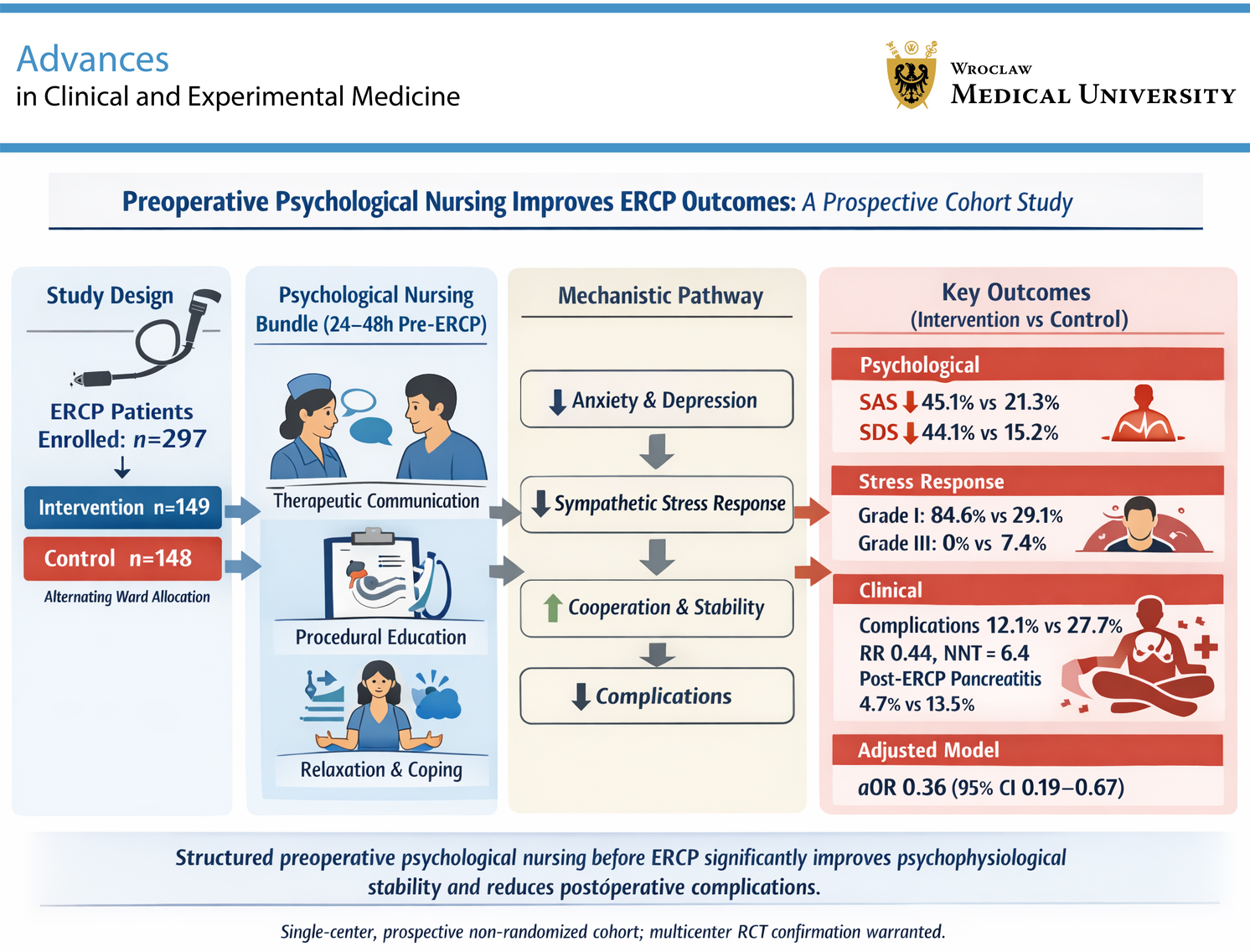
Results. Post-intervention, the intervention group demonstrated significantly lower anxiety (SAS: 28.92 ±4.78 vs 41.85 ±8.97; t-test: degrees of freedom (df) = 295; p < 0.001; Cohen’s d = 1.79, 95% confidence interval (95% CI): 1.52–2.06) and depression (SDS: 27.89 ±5.14 vs 42.67 ±9.83; t-test: df = 295; p < 0.001; Cohen’s d = 1.88, 95% CI: 1.61–2.15) scores compared with controls. Patients receiving the intervention exhibited superior intraoperative hemodynamic stability, including reduced heart rate variability (coefficient of variation: 0.07 ±0.03 vs 0.14 ±0.06; t-test: df = 295; p < 0.001) and fewer severe behavioral stress responses (grade III: 0% vs 7.4%; χ2 test: df = 2; p < 0.001). The intervention group experienced significantly fewer overall postoperative complications (12.1% vs 27.7%; χ2 test: df = 1; p = 0.001; risk ratio (RR) = 0.44, 95% CI: 0.26–0.73; number needed to treat (NNT) = 6.4).
Conclusions. Structured preoperative psychological nursing intervention significantly attenuates psychophysiological stress responses and reduces postoperative complications in patients undergoing ERCP. These findings support integration of psychological support protocols into perioperative care pathways, although confirmation through multicenter randomized controlled trials is warranted.
Key words: endoscopic retrograde cholangiopancreatography, psychological stress, perioperative nursing, anxiety, postoperative complications
Background
Endoscopic retrograde cholangiopancreatography (ERCP) constitutes a fundamental therapeutic modality for pancreatobiliary disorders, integrating diagnostic precision with interventional capability.1 Despite technological refinements that have enhanced procedural safety, ERCP remains an inherently stressful experience characterized by considerable psychological burden and physiological stress responses that may influence clinical outcomes.2 The invasive nature of the procedure, combined with patient unfamiliarity with the complex endoscopic environment, generates substantial anxiety that can compromise both immediate procedural success and postoperative recovery.3
Contemporary understanding of perioperative stress extends beyond patient comfort and recognizes psychological distress as a determinant of clinical outcomes.4 Preoperative anxiety activates the hypothalamic–pituitary–adrenal axis and sympathetic nervous system, initiating physiological responses including elevated heart rate, blood pressure fluctuations, and altered immune function.5 In the context of ERCP, stress-induced changes may manifest as reduced patient cooperation, increased sedation requirements, and heightened complication risk, particularly post-ERCP pancreatitis, which occurs in 3–15% of high-risk patients.1, 2, 3
The psychological burden associated with ERCP encompasses fear of the unknown, anticipatory anxiety regarding potential complications, concerns about procedural discomfort, and apprehension regarding diagnostic findings.6 Research has demonstrated that patients undergoing complex endoscopic procedures experience anxiety levels comparable to those of patients facing major surgical interventions.7 Elevated stress hormone levels may affect sphincter of Oddi function, potentially complicating cannulation attempts and increasing technical difficulty, while sympathetic overactivation predisposes patients to hemodynamic instability.8 Furthermore, procedure-related factors, including difficult cannulation and the use of advanced cannulation techniques such as precut papillotomy, transpancreatic sphincterotomy, and double-guidewire access, independently contribute to complication risk, particularly post-ERCP pancreatitis.9, 10
Psychological nursing interventions have emerged as evidence-based strategies to mitigate perioperative stress.5, 11 Grounded in Lazarus and Folkman’s transactional model of stress and coping, these interventions propose that individuals’ responses to stressful situations are mediated by cognitive appraisal of the threat and perceived coping resources.12 By providing accurate information, enhancing patients’ sense of control, and teaching practical stress-management techniques, psychological interventions may fundamentally alter the stress appraisal process.8, 11 Recent investigations have examined nursing interventions for patients undergoing ERCP, including programmed nursing plans based on thinking-map guidance13 and video-assisted preoperative education,6 demonstrating reductions in anxiety and improvements in hemodynamic stability. However, these previous studies predominantly evaluated single-component interventions, such as cognitive mapping for informational processing or video education for procedural familiarization, each targeting isolated aspects of procedural anxiety.5, 13 Evidence from surgical populations suggests that multicomponent interventions addressing emotional, informational, and behavioral dimensions simultaneously may yield superior outcomes compared with single-modality approaches.14, 15
Objectives
While the benefits of psychological support have been established across various procedural contexts, rigorous evidence specific to ERCP remains limited.5, 7 The unique characteristics of ERCP, including conscious sedation requirements, the need for patient cooperation, and specific anatomical challenges, suggest that targeted psychological interventions may be particularly beneficial.16 Accordingly, this study aimed to evaluate the effectiveness of a comprehensive multicomponent preoperative psychological nursing intervention – integrating trust-building communication, procedural education, and relaxation training – on psychophysiological stress responses and clinical outcomes in patients undergoing ERCP.
Materials and methods
Study design and setting
This prospective cohort study was conducted at the Second Affiliated Hospital of Qiqihar Medical University (Qiqihar, China), a tertiary care center performing more than 500 ERCP procedures annually. The study was conducted in accordance with the Declaration of Helsinki and adhered to the STROBE (Strengthening the Reporting of Observational Studies in Epidemiology) guidelines for observational studies. The protocol was approved by the Institutional Review Board of the Second Affiliated Hospital of Qiqihar Medical University (approval No. 2022-IRB-089). All participants provided written informed consent.
Participants and selection criteria
The study enrolled 297 consecutive patients undergoing ERCP between June 2022 and June 2025. Sample size calculation using G*Power 3.1.9.7 software (Heinrich Heine University Düsseldorf, Germany; https://www.psychologie.hhu.de/arbeitsgruppen/allgemeine-psychologie-und-arbeitspsychologie/gpower) with an effect size of 0.5, an alpha error of 0.05, and a power of 0.90, indicated a minimum requirement of 172 participants. To account for potential dropout and ensure adequate power for secondary outcomes, including complication rates, enrollment was extended to 297 participants.
Inclusion criteria comprised: 1) patients aged 18–75 years with confirmed pancreatobiliary disorders requiring therapeutic ERCP based on clinical presentation, laboratory findings, and cross-sectional imaging; 2) American Society of Anesthesiologists (ASA) physical status classification I–III; 3) cognitive ability to understand and complete psychological assessments; and 4) provision of informed consent.
Exclusion criteria comprised: 1) severe cardiac, cerebral, or renal dysfunction affecting stress-response mechanisms; 2) diagnosed psychiatric disorders or current psychotropic medication use; 3) previous ERCP experience, as prior procedural exposure may influence baseline anxiety levels and coping mechanisms; 4) pregnancy or lactation; 5) inability to complete psychological assessments because of language barriers or cognitive impairment; and 6) emergency procedures precluding adequate preoperative psychological preparation.
Psychiatric disorder exclusion was determined through a 2-stage screening process: initial review of electronic medical records for documented psychiatric diagnoses and current psychotropic medication prescriptions, followed by direct patient inquiry during the admission nursing assessment using a standardized screening questionnaire. Patients were excluded if either source indicated a current psychiatric diagnosis or active psychotropic medication use.
Group allocation
Allocation to the intervention or control groups was determined by the nursing ward to which patients were admitted, which operated on alternating monthly protocols. During months designated for standard care (control periods), patients received conventional perioperative nursing. During intervention months, patients received the enhanced psychological nursing protocol in addition to standard care. This allocation strategy was selected to minimize contamination between groups, as nursing staff delivering the intervention were physically separated from those providing standard care during their respective assignment periods. Baseline demographic and clinical characteristics were prospectively documented.
Intervention protocol
Standard care protocol (both groups)
All participants received standardized preoperative preparation comprising: complete metabolic panel assessment with attention to pancreatic enzymes, hepatic function, and coagulation parameters; hypersensitivity testing for iodinated contrast agents and prophylactic antibiotics; nil per os status for 8 h preceding the procedure; and standardized premedication consisting of intravenous diazepam 10 mg and anisodamine hydrochloride 10 mg administered 15 min prior to procedure initiation, supplemented by topical pharyngeal anesthesia with 10 mL of 10% lidocaine hydrochloride solution. The sedation protocol targeted moderate (conscious) sedation as defined by the ASA, characterized by a decreased level of consciousness during which patients respond purposefully to verbal commands or light tactile stimulation, maintain spontaneous ventilation, and require no airway intervention.
Standard-care nursing contact comprised routine preoperative assessments lasting approx. 10–15 min, including vital sign measurement, medication administration, verification of fasting status, and communication of procedural logistics. These interactions were primarily task-oriented and did not include structured psychological support components, relaxation training, or extended therapeutic communication beyond what was necessary for safe procedural preparation.
Enhanced psychological nursing intervention (intervention group)
The intervention was developed through systematic literature review and expert consensus, incorporating evidence-based strategies for perioperative anxiety reduction. The protocol was delivered by a dedicated team of 8 registered nurses who completed a 16-h training program encompassing theoretical foundations of stress and coping, therapeutic communication techniques, relaxation training delivery, and standardized protocol adherence. Training was provided by a clinical psychologist and senior nurse educator. Training included review of audio-recorded exemplar sessions demonstrating ideal therapeutic communication techniques and paired observation sessions during the initial training period with individualized feedback. Intervention fidelity was monitored through weekly supervision sessions and standardized checklists completed after each patient encounter. Additionally, random auditing of 10% of intervention sessions was conducted by the senior nurse educator using a structured fidelity checklist to ensure consistency across the 8 intervention nurses.
The intervention comprised 3 integrated components delivered over 24–48 h preceding the procedure, requiring approx. 55–70 min of additional nursing contact time per patient beyond standard care:
Component 1: Trust-building and therapeutic communication. Dedicated nursing staff established therapeutic relationships through active listening, empathetic communication, and individualized emotional support. Sessions lasted 20–30 min and occurred within 24 h of admission. Patients received detailed information about their primary nurse and attending physician credentials. Environmental familiarization included guided tours of the endoscopy unit, introduction to equipment and monitoring devices, and explanation of the procedural environment.
Component 2: Comprehensive patient education. A structured educational program utilized illustrated procedural brochures, anatomical diagrams, and step-by-step procedural explanations tailored to individual educational levels. Educational materials were developed in collaboration with gastroenterology physicians and underwent readability assessment. Content encompassed ERCP indications, procedural steps, expected sensations, safety measures, and post-procedural recovery expectations. Educational sessions lasted 15–20 min. Comprehension was assessed through teach-back methodology, with additional clarification provided as needed.
Component 3: Psychological relaxation and coping skills training. Patients received individualized training in progressive muscle relaxation and diaphragmatic breathing exercises. Training sessions of 15–20 min were conducted twice daily under nursing supervision, using audio-guided instructions standardized across all intervention nurses. Cognitive-behavioral strategies were introduced to help patients develop effective coping mechanisms and challenge anxiety-provoking thoughts. Patients received printed materials summarizing techniques for independent practice.
Outcome measurements
Primary outcome
The primary outcome was the change in psychological stress scores from baseline to the immediate pre-procedure assessment. The Self-Rating Anxiety Scale (SAS) and Self-Rating Depression Scale (SDS), both validated in Chinese populations,17 were employed. Both instruments utilize 20-item questionnaires with 4-point Likert scales, yielding total scores ranging from 20 to 80, with higher scores indicating greater psychological distress. For clinical interpretation, raw scores are converted to index scores by multiplying by 1.25, with standard thresholds as follows: index scores below 50 indicate no significant anxiety or depression; scores of 50–59 indicate mild distress; scores of 60–69 indicate moderate distress; and scores of 70 or above indicate severe distress. Assessments were conducted at baseline (within 24 h of admission) and immediately pre-procedure (within 2 h of ERCP initiation).
Secondary outcomes
Intraoperative physiological monitoring: Continuous hemodynamic monitoring was performed using standardized equipment (GE Healthcare CARESCAPE Monitor B650; GE Healthcare, Chicago, USA). Heart rate, systolic blood pressure (SBP), diastolic blood pressure (DBP), and mean arterial pressure (MAP) were recorded at 5-min intervals throughout the procedure.
Intraoperative behavioral stress response: A validated 3-tier classification system was employed: grade I (no or mild fear and discomfort; patient able to tolerate and continue the examination); grade II (obvious fear and discomfort with behaviors indicating attempts to avoid the procedure); and grade III (severe fear, restlessness, and intense discomfort leading to active avoidance or requests for procedure termination). Behavioral assessments were performed by endoscopy nurses blinded to group allocation who had not participated in delivering the intervention.
Postoperative complications: All participants underwent standardized post-procedural monitoring. Complications were defined according to the Cotton consensus criteria1 and comprised: post-ERCP pancreatitis (abdominal pain with serum amylase elevation greater than 3 times the upper limit of normal at 24 h, requiring prolonged hospitalization or intervention); cholangitis (fever above 38°C with clinical signs of biliary infection); hemorrhage (clinical evidence of bleeding with a hemoglobin decrease greater than 2 g/dL or requiring intervention); and perforation (confirmed with imaging). Complications were graded according to severity using the Cotton criteria. All patients were monitored continuously during hospitalization with standardized clinical assessments and laboratory evaluation at 24 h post-procedure. Additionally, structured telephone follow-up was conducted at 7 days and 30 days post-discharge to ascertain delayed complications requiring medical attention. The reported complication rates represent cumulative incidence over the 30-day follow-up period.
Procedural variables: To account for procedure-related confounders, the following variables were prospectively recorded: cannulation difficulty (easy, moderate, or difficult); use of advanced cannulation techniques (precut sphincterotomy, pancreatic duct guidewire-assisted technique, and transpancreatic septotomy); procedure duration; and operator experience level. Cannulation difficulty was classified according to objective criteria detailed in Supplementary Table 2. Easy cannulation was defined as successful biliary access achieved within 5 attempts and 10 min without inadvertent pancreatic duct cannulation; moderate difficulty was defined as successful cannulation requiring 6–10 attempts or 10–20 min, or involving 1–2 inadvertent pancreatic duct cannulations; and difficult cannulation was defined as requiring more than 10 attempts, exceeding 20 min, involving 3 or more inadvertent pancreatic duct cannulations, or necessitating advanced cannulation techniques. These criteria were prospectively applied by the endoscopy team and documented immediately following each procedure.
All ERCP procedures were performed by 1 of 4 board-certified gastroenterologists with dedicated hepatobiliary training, each with a minimum of 8 years of independent ERCP experience and individual lifetime case volume exceeding 1,500 procedures. Procedures were distributed comparably across endoscopists between allocation periods.
Clinical indications were classified according to the primary indication for ERCP as determined by the treating gastroenterologist based on the predominant clinical presentation and imaging findings. When multiple pathologies coexisted, a hierarchical classification system was applied: choledocholithiasis requiring stone extraction took precedence, followed by biliary stenosis requiring stenting or sampling, whereas chronic pancreatitis was classified as primary only when pancreatic duct intervention was the principal therapeutic objective.
Blinding
Patients and intervention nurses could not be blinded to group allocation. However, outcome assessors evaluating psychological scores, behavioral stress grades, and postoperative complications were blinded to allocation status. Data analysts remained blinded until completion of the primary analyses.
Statistical analyses
Statistical analyses were performed using IBM SPSS v. 28.0 (IBM Corp., Armonk, USA), with significance set at p < 0.05. The primary outcome (psychological stress scores) was pre-specified as the confirmatory endpoint, whereas all secondary outcomes were designated as exploratory analyses. To address potential inflation of type I error rates arising from multiple secondary outcome comparisons, the Benjamini–Hochberg procedure for false discovery rate (FDR) control was applied to all secondary analyses. Both unadjusted and FDR-adjusted p-values are reported for secondary outcomes (Supplementary Table 5).
Normality of continuous variables was assessed using the Shapiro–Wilk test, with visual inspection of histograms and quantile–quantile plots to evaluate distributional characteristics. Normality testing was performed separately for the intervention group (n = 149) and the control group (n = 148) to verify distributional assumptions within each group independently (Supplementary Table 3). Homogeneity of variances was evaluated using Levene’s test prior to independent-samples t-tests. When the assumption of equal variances was violated (Levene’s test p < 0.05), Welch’s correction was applied. All baseline continuous variables demonstrated acceptable normality (Shapiro–Wilk p > 0.05 in both groups). For primary and secondary outcome variables in which variance heterogeneity was detected, Welch-corrected t-tests were employed, and supplementary nonparametric analyses (Mann–Whitney U tests) were conducted to verify the robustness of the findings. Detailed results of assumption testing are provided in Supplementary Tables 3 and 4. Baseline characteristics were compared using independent-samples t-tests for normally distributed continuous variables, Mann–Whitney U tests for non-normally distributed continuous variables, and χ2 tests for categorical variables.
For the primary outcome, between-group differences in post-intervention psychological scores were analyzed using independent-samples t-tests. Within-group changes from baseline were analyzed using paired t-tests. Effect sizes were calculated using Cohen’s d, with values of 0.2, 0.5, and 0.8 interpreted as small, medium, and large effects, respectively.
For secondary outcomes, hemodynamic parameters were compared using independent-samples t-tests. Behavioral stress-response grades were compared using χ2 tests. Complication rates were compared using χ2 tests, with risk ratios (RRs) and 95% confidence intervals (95% CIs) calculated. Given the multiple secondary outcomes, findings were interpreted with appropriate caution, and the primary outcome was pre-specified to avoid inflation of type I error.
Multivariable logistic regression was performed to assess the association between group allocation and overall complications, adjusting for potential confounders including age, sex, ASA classification, primary diagnosis, cannulation difficulty, rectal indomethacin prophylaxis, and use of advanced cannulation techniques. Logistic regression model assumptions were verified according to ACEM statistical guidelines.18 Linearity between the continuous predictor (age) and the log-odds of the outcome was assessed using the Box–Tidwell test. Multicollinearity among explanatory variables was evaluated using generalized variance inflation factors (GVIFs). Influential observations were examined using standardized residuals and Cook’s distance values. Model diagnostics are presented in Supplementary Table 6. Results are presented as adjusted odds ratios (ORs) with 95% CIs.
Missing-data handling followed a pre-specified protocol whereby sensitivity analyses using multiple imputation would be conducted if missing data exceeded 5% for any primary outcome variable. As detailed in the Results section, data completeness was excellent across all domains, with no variable approaching this threshold. The minimal missing observations were confirmed to occur completely at random using Little’s Missing Completely at Random (MCAR) test, supporting the use of complete-case analysis without risk of systematic bias.
Results
Participant flow and baseline characteristics
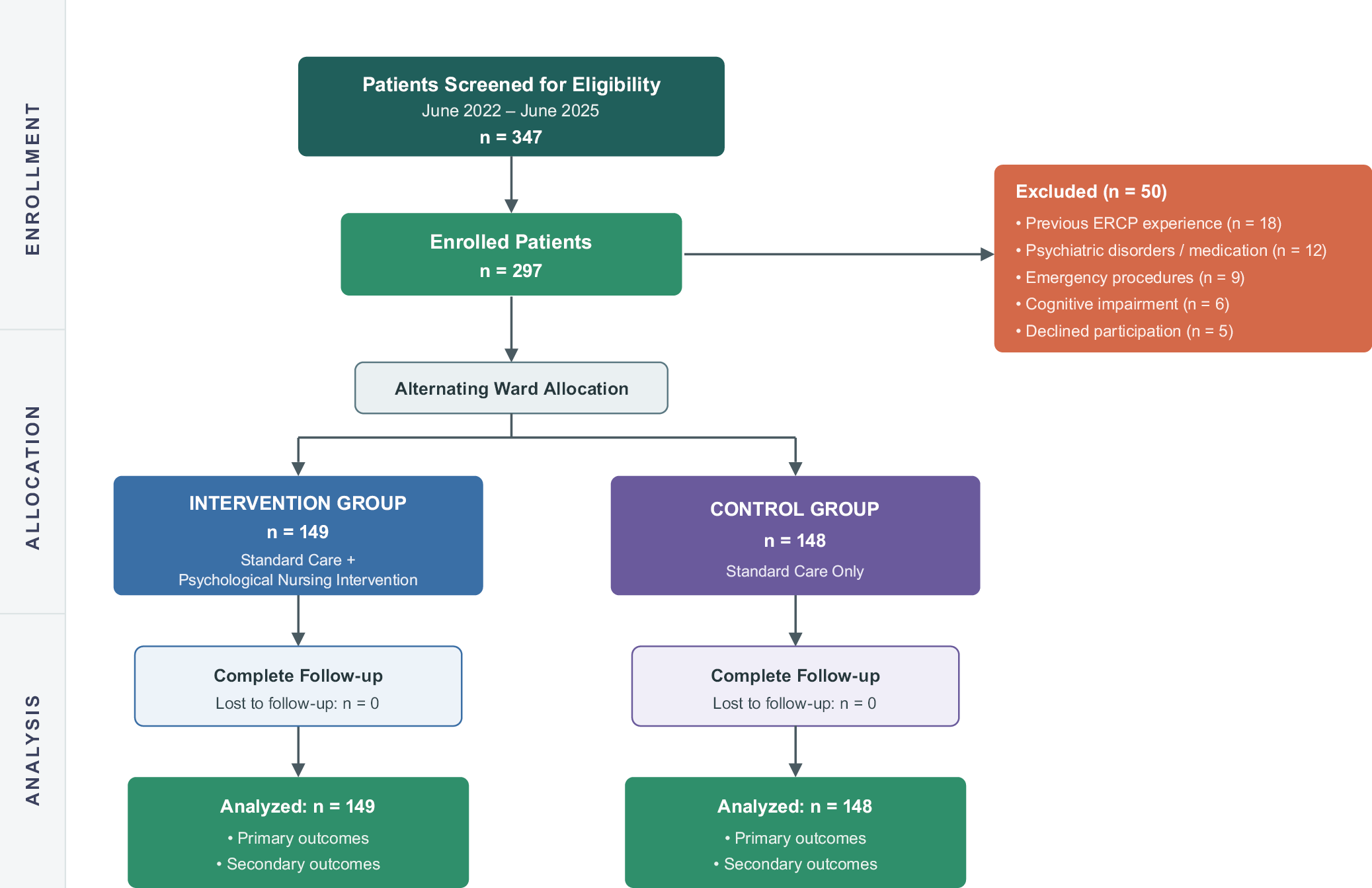
Of 347 patients screened for eligibility between June 2022 and June 2025, 297 met the inclusion criteria and were enrolled (Figure 1). Fifty patients were excluded: 18 because of previous ERCP experience, 12 because of psychiatric disorders or psychotropic medication use, 9 because of emergency procedures, 6 because of cognitive impairment precluding assessment completion, and 5 because of declining participation. The intervention group comprised 149 patients, and the control group comprised 148 patients. All enrolled patients completed the study with no losses to follow-up. Data completeness was excellent across all outcome domains, with missing values occurring in only 2 observations (0.7%) for psychological scores and 4 observations (1.3%) for hemodynamic parameters; behavioral stress grades and complication outcomes were complete for all participants. Little’s test confirmed that these minimal missing data occurred completely at random (MCAR test: χ2 = 8.42, degrees of freedom (df) = 12, p = 0.687), supporting the use of complete-case analysis without risk of systematic bias.
Baseline demographic and clinical characteristics demonstrated no statistically significant differences between groups (Table 1). The overall cohort comprised 163 male patients (54.9%) and 134 female patients (45.1%), with a mean age of 52.34 ±11.52 years. Sex distribution did not differ significantly between groups (χ2 test: df = 1; p = 0.958). Clinical indications included choledocholithiasis (145 patients, 48.8%), biliary stenosis (103 patients, 34.7%), and chronic pancreatitis (49 patients, 16.5%). Baseline SAS scores were 52.67 ±8.38 vs 53.21 ±8.65 (t-test: df = 295; p = 0.578), and baseline SDS scores were 49.89 ±7.82 vs 50.34 ±7.91 (t-test: df = 295; p = 0.621) for the intervention and control groups, respectively, confirming comparable pre-intervention psychological states. These baseline index scores, corresponding to mild psychological distress, are consistent with the anticipated anxiety associated with impending invasive procedures.
Procedural characteristics were similar between groups. Difficult cannulation occurred in 22 patients (14.8%) in the intervention group and 24 patients (16.2%) in the control group (χ2 test: df = 1; p = 0.726). Advanced cannulation techniques were employed in 19 patients (12.8%) in the intervention group and 21 patients (14.2%) in the control group (χ2 test: df = 1; p = 0.716). Mean procedure duration was 29.1 ±8.9 min vs 30.8 ±9.4 min (t-test: df = 295; p = 0.108). Rectal indomethacin prophylaxis was administered to 47 patients (31.5%) in the intervention group and 51 patients (34.5%) in the control group (χ2 test: df = 1; p = 0.584).
Analysis of temporal confounders
To assess potential confounding by temporal factors related to the alternating monthly allocation strategy, we compared patient characteristics and case volumes between intervention and control periods (Supplementary Table 1). Monthly patient volumes were comparable (mean 8.3 ±1.9 vs 8.2 ±2.1 patients per month for intervention and control periods, respectively; t-test: df = 34; p = 0.892). Seasonal distribution was similar, with enrollment distributed across calendar quarters as follows: 1st quarter 26.2% vs 25.0%, 2nd quarter 24.8% vs 25.7%, 3rd quarter 24.2% vs 24.3%, and 4th quarter 24.8% vs 25.0% for intervention and control periods, respectively (χ2 test: df = 3; p = 0.987). Case acuity, as reflected by ASA classification distribution, did not differ significantly between allocation periods (χ2 test: df = 2; p = 0.812). These analyses suggest that temporal factors did not systematically confound group comparisons.
Primary outcome: psychological stress response
Post-intervention psychological assessments revealed significant improvements in the intervention group (Table 2, Figure 2). SAS scores were 28.92 ±4.78 in the intervention group compared with 41.85 ±8.97 in the control group (t-test: df = 295; p < 0.001; Cohen’s d = 1.79, 95% CI: 1.52–2.06), while SDS scores were 27.89 ±5.14 vs 42.67 ±9.83 (t-test: df = 295; p < 0.001; Cohen’s d = 1.88, 95% CI: 1.61–2.15).
Within the intervention group, SAS scores decreased by 23.75 ±6.18 points from baseline (45.1% reduction), whereas control-group SAS scores decreased by 11.36 ±4.02 points (21.3% reduction). The between-group difference in score reduction was statistically significant (t-test: df = 295; p < 0.001; Cohen’s d = 2.38, 95% CI: 2.08–2.68). Similar patterns were observed for SDS scores, with reductions of 22.00 ±5.72 points in the intervention group (44.1% reduction) vs 7.67 ± 3.84 points in the control group (15.2% reduction; t-test: df = 295; p < 0.001; Cohen’s d = 2.93, 95% CI: 2.60–3.26).
Secondary outcomes
Intraoperative hemodynamic parameters
The intervention group demonstrated superior hemodynamic stability throughout the procedure (Table 2, Figure 3). Peak intraoperative heart rate was 88.7 ±12.2 bpm vs 107.9 ±17.8 bpm (t-test: df = 295; p < 0.001; Cohen’s d = 1.26, 95% CI: 1.01–1.51). Heart rate variability, expressed as the coefficient of variation, was 0.07 ±0.03 vs 0.14 ±0.06 (t-test: df = 295; p < 0.001; Cohen’s d = 1.48, 95% CI: 1.22–1.74). Mean arterial pressure variation was 8.2 ±4.0 mm Hg vs 15.9 ±8.6 mm Hg (t-test: df = 295; p < 0.001; Cohen’s d = 1.15, 95% CI: 0.91–1.39). Hypertensive episodes (SBP exceeding 160 mm Hg) occurred in 11 patients (7.4%) in the intervention group compared with 49 patients (33.1%) in the control group (χ2 test: df = 1; p < 0.001).
Intraoperative behavioral stress response
The distribution of intraoperative behavioral stress responses differed significantly between groups (χ2 test: df = 2; p < 0.001; Table 2, Figure 4A). In the intervention group, 126 patients (84.6%) exhibited grade I responses, 23 patients (15.4%) exhibited grade II responses, and no patients exhibited grade III responses. In the control group, 43 patients (29.1%) exhibited grade I responses, 94 patients (63.5%) exhibited grade II responses, and 11 patients (7.4%) exhibited grade III responses.
Postoperative complications
Overall complications occurred in 18 patients (12.1%) in the intervention group compared with 41 patients (27.7%) in the control group, representing a significant difference (χ2 test: df = 1; p = 0.001; RR = 0.44; 95% CI: 0.26–0.73; Table 3, Figure 4B). The number needed to treat (NNT) to prevent 1 complication was 6.4.
Post-ERCP pancreatitis occurred in 7 patients (4.7%) in the intervention group compared with 20 patients (13.5%) in the control group (χ2 test: df = 1; p = 0.007; RR = 0.35; 95% CI: 0.15–0.80). Among patients who developed pancreatitis, severity distribution also differed: all 7 cases in the intervention group were classified as mild, whereas the control group included 12 mild, 6 moderate, and 2 severe cases (χ2 test: df = 2; p = 0.048). Cholangitis occurred in 5 patients (3.4%) in the intervention group vs 9 patients (6.1%) in the control group (χ2 test: df = 1; p = 0.265). Hemorrhage occurred in 4 patients (2.7%) vs 6 patients (4.1%) (χ2 test: df = 1; p = 0.507). Perforation occurred in 2 patients (1.3%) vs 3 patients (2.0%) (χ2 test: df = 1; p = 0.640). Mean length of stay was 2.3 ±1.1 days vs 3.0 ±1.7 days (t-test: df = 295; p < 0.001). No additional complications were identified during the post-discharge telephone follow-up assessments at 7 and 30 days.
Multivariable analysis
In multivariable logistic regression adjusting for age, sex, ASA classification, primary diagnosis, cannulation difficulty, rectal indomethacin prophylaxis, and use of advanced cannulation techniques, allocation to the intervention group remained significantly associated with a reduced risk of overall complications (adjusted OR = 0.36; 95% CI: 0.19–0.67; p = 0.001; Table 4). Difficult cannulation (adjusted OR = 2.41; 95% CI: 1.28–4.54; p = 0.006) and use of advanced cannulation techniques (adjusted OR = 2.18; 95% CI: 1.12–4.25; p = 0.022) were independently associated with increased complication risk. Rectal indomethacin prophylaxis was not significantly associated with complication risk in the multivariable model (adjusted OR = 0.78; 95% CI: 0.42–1.45; p = 0.432). A summary of effect sizes across all primary and secondary outcomes is presented in Figure 5.
Discussion
This prospective cohort study demonstrates that a structured preoperative psychological nursing intervention significantly improves psychological outcomes, physiological stability, and clinical outcomes in patients undergoing ERCP. The observed effect sizes for anxiety and depression reduction were large, and the intervention was associated with a 56% relative reduction in overall postoperative complications.
The magnitude of psychological improvement observed was both statistically significant and clinically meaningful. The approx. 45% reduction in anxiety and depression scores represents substantial improvement likely translating into an enhanced patient experience. These findings align with Lazarus and Folkman’s transactional model of stress and coping, which posits that providing patients with accurate information and enhancing their perceived coping resources fundamentally alters threat appraisal.12 The multicomponent nature of our intervention, incorporating trust-building, education, and relaxation training, likely addressed multiple pathways through which psychological distress manifests.11
Our findings are consistent with recent investigations examining nursing interventions for patients undergoing ERCP. Lu and Wang13 reported that programmed nursing based on thinking-map guidance improved hemodynamic stability and intestinal function recovery following ERCP. Çevik and Rizalar6 demonstrated that video-assisted preoperative education reduced anxiety and improved satisfaction in patients undergoing ERCP. Our study extends this evidence by employing a comprehensive multicomponent intervention and examining a broader range of outcomes, including postoperative complications. The larger effect sizes observed in our study compared with those reported for single-component interventions may reflect the synergistic benefits of simultaneously addressing emotional support needs, informational deficits, and coping-skill development.
The translation of psychological improvements into measurable physiological stability represents an important finding with clinical implications. The significantly reduced heart rate variability and blood pressure fluctuations observed in the intervention group suggest effective modulation of autonomic nervous system responses to procedural stress.5 This physiological stabilization may have contributed to the improved behavioral responses observed, with no patients in the intervention group experiencing severe stress reactions requiring procedural modification.
The reduction in overall complication rates associated with the intervention warrants careful interpretation. While statistical significance was achieved for overall complications and post-ERCP pancreatitis specifically, the study was not powered to detect differences in less common complications such as cholangitis, hemorrhage, and perforation, and these individual comparisons should therefore be considered exploratory. The pathophysiological basis for the potential protective effects likely involves multiple mechanisms. We hypothesize that reduced sympathetic activation may improve sphincter of Oddi function, potentially facilitating cannulation and reducing the risk of trauma-induced pancreatitis, although this mechanism remains speculative in the absence of direct manometric assessment.19 Enhanced patient cooperation may also allow for more precise endoscopic manipulation.20 Additionally, attenuated stress responses may preserve immune function and promote healing.21
Importantly, procedure-related factors, including cannulation difficulty and use of advanced cannulation techniques, remained significant independent predictors of complications in our multivariable analysis, consistent with the established literature.9, 10 The effect of the psychological intervention persisted after adjustment for these technical factors as well as rectal indomethacin prophylaxis, suggesting that the intervention operates through pathways distinct from procedural technique optimization. This finding supports the hypothesis that patient psychological state influences complication risk through physiological mechanisms rather than solely through effects on procedural conduct.
The observed hemodynamic benefits may be partially mediated by differential sedation requirements between groups. Although intra-procedural sedation doses beyond the standardized premedication protocol were not systematically recorded in this study, it is plausible that reduced baseline anxiety in the intervention group translated into lower supplemental sedation requirements, which in turn contributed to greater hemodynamic stability. Future studies should prospectively record cumulative sedation doses to elucidate this potential mechanistic pathway.
Several methodological strengths of this study merit consideration. The prospective design with blinded outcome assessment mitigates recall and detection biases inherent in retrospective studies. The standardized intervention protocol with documented fidelity monitoring enhances reproducibility. Inclusion of procedure-related variables allows assessment of confounding by technical factors. The larger sample size compared with previous studies provides improved statistical power. Analysis of temporal factors demonstrated no significant differences in patient volumes, seasonal distribution, or case acuity between allocation periods, reducing concern regarding systematic confounding related to the alternating monthly allocation strategy.
Future research should prioritize multicenter randomized controlled trials (RCTs) to establish causality, factorial designs to identify optimal intervention components, and prospective recording of sedation requirements to elucidate potential mediating mechanisms. Cost-effectiveness analyses incorporating the 0.7-day reduction in length of stay and the number needed to treat of 6.4 would help quantify economic benefits, as the approx. 55–70 min of additional nursing time per patient may be offset by reduced complication-related costs and shorter hospitalizations.22 Implementation studies examining workflow integration and scalability across diverse healthcare settings are also warranted.
Limitations of the study
This study has several limitations that warrant consideration. The non-randomized allocation design, despite minimizing contamination, introduces the potential for confounding by unmeasured factors, and RCTs are needed to confirm causality. The single-center design and moderate-sedation protocol employed may limit generalizability to settings with different patient populations, nursing resources, or sedation practices. The multicomponent nature of the intervention precludes identification of the specific elements that are most effective, and the absence of formal inter-rater reliability assessment and systematic recording of intra-procedural sedation requirements represents an additional methodological limitation.
Conclusions
This prospective cohort study provides evidence that a structured preoperative psychological nursing intervention significantly attenuates psychophysiological stress responses and reduces postoperative complication rates in patients undergoing ERCP. A standardized protocol combining trust-building communication, procedural education, and relaxation training, delivered by trained nursing staff, was associated with substantial reductions in anxiety and depression, improved intraoperative hemodynamic stability, and a 56% relative reduction in overall complications. These findings support consideration of integrating psychological support into perioperative ERCP care pathways. Confirmation through multicenter RCTs is warranted to establish causality and determine the optimal intervention components and delivery strategies.
Supplementary data
The supplementary materials are available at https://doi.org/10.5281/zenodo.18519365. The package contains the following files:
Supplementary Table 1. Analysis of temporal confounders.
Supplementary Table 2. Cannulation difficulty classification criteria.
Supplementary Table 3. Normality assessment results by group.
Supplementary Table 4. Sensitivity analysis using nonparametric tests.
Supplementary Table 5. Secondary outcome comparisons with multiple testing adjustment.
Supplementary Table 6. Logistic regression model diagnostics.
Data Availability Statement
Strict legal definition of anonymization: Under the Personal Information Protection Law (PIPL), data are considered truly anonymized (and thus exempt from privacy restrictions) only when it is impossible to restore specific individuals’ identities or re-identify them. Given the detailed clinical nature of our prospective study, standard de-identification procedures (e.g., removal of names and identification numbers) do not meet this stringent legal threshold for public release, as re-identification remains statistically possible when variables are combined.
Scope of patient consent: Participants provided consent for the use of their data in this research and for verification by qualified personnel. They did not consent to public release of individual-level data, even in de-identified form. Open public sharing of these data would therefore exceed the scope of the obtained consent and conflict with the ethical principles of the Declaration of Helsinki.
Controlles-access data sharing: The proposed data-sharing approach does not conceal the data; rather, it enables access to de-identified data for qualified researchers through a secure review mechanism administered by the Ethics Committee. This represents a widely accepted best practice for handling sensitive clinical data, balancing scientific transparency and reproducibility with legal and ethical obligations.
Consent for publication
Not applicable.
Use of AI and AI-assisted technologies
Not applicable.
.jpg)
.jpg)
.jpg)
.jpg)