Abstract
Background. Quality indicators (QIs) are central to safe delivery of cytoreductive surgery with hyperthermic intraperitoneal chemotherapy (CRS–HIPEC), yet program-level benchmarking across tumor types is scarce.
Objectives. To describe the structure, process, and outcome QIs of a single-center CRS–HIPEC program (2014–2024) and to assess temporal trends in cytoreduction completeness, early mortality, length of stay (LOS), renal safety, and multidisciplinary team (MDT) integration against contemporary international benchmarks.
Materials and methods. A retrospective cohort study of consecutive CRS–HIPEC procedures (2014–2024) was conducted at a Polish tertiary center. Prespecified QIs included complete or near-complete cytoreduction (CC-0/1), 30- and 90-day mortality, LOS, LOS > 10 days, unplanned reoperation, 30-day readmission, MDT uptake, and acute kidney injury (AKI; defined using Kidney Disease: Improving Global Outcomes (KDIGO) serum creatinine criteria). Time trends were displayed with Shewhart charts and funnel plots; Wilson’s 95% confidence intervals (95% CIs) were used for proportions.
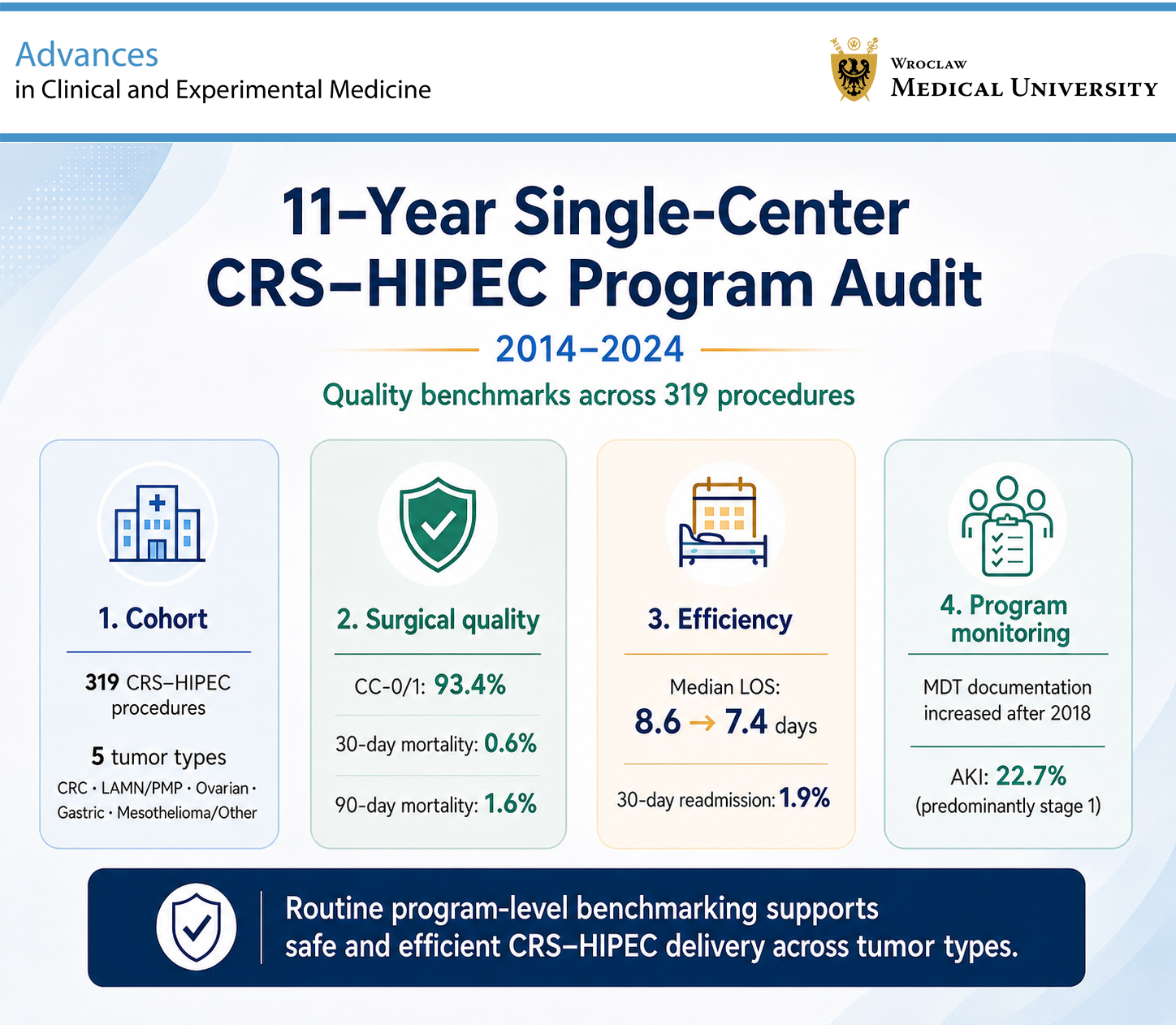
Results. Among 319 procedures (colorectal cancer (CRC) 111; ovarian cancer 87; mesothelioma/other 57; low-grade appendiceal mucinous neoplasm/pseudomyxoma peritonei (LAMN/PMP) 52; gastric cancer 12), the CC-0/1 rate was 93.4% overall (CRC 96.4%; LAMN/PMP 100%; ovarian cancer 90.8%; gastric cancer 91.7%; mesothelioma/other 86.0%). Thirty- and 90-day mortality were 0.6% and 1.6%, respectively; tumor-specific 30-day mortality ranged from 0% to 1.9%. Median LOS fell from 8.6 to 7.4 days (2014–2018 vs 2019–2024), and LOS > 10 days declined from 25.0% to 13.2%. Peritoneal cancer index (PCI) correlated weakly with LOS (Spearman’s ρ = 0.13, p = 0.019), while AKI occurred in 70/308 (22.7%, 95% CI: 18.4–27.7), predominantly stage 1; AKI did not differ by cisplatin exposure (26.0% vs 21.2%, p = 0.389). The proportion of procedures with documented MDT discussion increased to approx. 20–33% after 2018.
Conclusions. Over 11 years, a single-center CRS–HIPEC program achieved high-quality cytoreduction with low early mortality and a reduction in LOS, meeting or exceeding contemporary QI standards. Incorporating AKI and MDT uptake into routine audit supports comprehensive, program-level benchmarking.
Key words: cytoreductive surgery, hyperthermic intraperitoneal chemotherapy, quality indicators, healthcare, postoperative complications
Background
Hyperthermic intraperitoneal chemotherapy (HIPEC) after complete cytoreductive surgery (CRS) has moved from experimental use to routine practice in selected peritoneal surface malignancies. The main indications include colorectal cancer (CRC), pseudomyxoma peritonei from low-grade appendiceal mucinous neoplasms (LAMN/PMP), epithelial ovarian cancer, gastric cancer, and malignant peritoneal mesothelioma.1, 2, 3 Contemporary consensus statements note that, although oncologic benefit is disease-specific, all indications require prolonged operating time, specialized perfusion equipment, and a coordinated perioperative pathway. Current guidance therefore gives equal weight to structure and process (center volume, dedicated anesthesia and intensive care unit (ICU) teams, protocolized perioperative care) and to outcomes such as completeness of cytoreduction (CC score) and early mortality.2
Beyond disease-specific efficacy, program value depends on surgical quality and perioperative workload. Surgical quality is captured most directly by the CC score (CC-0/1), which correlates with survival across indications and is sensitive to patient selection, operative strategy, and team experience.4, 5, 6 Equally, HIPEC imposes a distinctive resource footprint, characterized by prolonged operating time, planned ICU admission, and higher nursing intensity; accordingly, workload measures such as ICU utilization, length of stay (LOS), unplanned reoperation, and 30-day readmission are essential companion metrics to traditional endpoints. Perioperative management choices can measurably affect recovery and hospital stay, underscoring the value of tracking operational indicators such as LOS and readmission alongside traditional surgical endpoints.7 Embedding these indicators in routine audit allows centers to balance oncologic benefit with sustainable delivery and failure-to-rescue performance, while using statistical process control (SPC) tools (e.g., funnel plots) to detect unsafe drift.8 Experience from enhanced-recovery pathways further supports the link between structured perioperative processes and improved outcomes in surgical oncology cohorts.9
Against this backdrop, several groups have proposed concrete quality standards and registry frameworks for CRS–HIPEC. For colorectal peritoneal metastases, disease-specific standards propose benchmark thresholds for key indicators, including CC-0/1 rate (≥89%), 30-day mortality (<3%), median LOS (≤16 days), readmission (<10%), and reoperation (~13%).10 National programs define practical process indicators, including surgical-site infection surveillance and readmission measures, for routine comparison. Audit infrastructures then enable risk-adjusted benchmarking across centers; e.g., the Dutch CRS–HIPEC Quality Registry reports hospital-level variation with 90-day mortality close to 2%.11 Safety also relates to structure: a French nationwide analysis identified lower 90-day mortality and failure-to-rescue in higher-volume centers (approx. 45 or more procedures per year).12 Process standardization is supported by Enhanced Recovery After Surgery (ERAS) Society guidance specific to CRS–HIPEC, linking perioperative protocols to reduced complications and shorter hospital stay.13 Together, these developments justify a program-level audit that reports a compact, reproducible set of quality indicators (QIs) for benchmarking and improvement.
Building on these standards, registry infrastructures translate QIs into routine audit and feedback. The Dutch CRS–HIPEC Quality Registry and France’s RENAPE (Réseau national de prise en charge des tumeurs rares du péritoine) network exemplify audited, multicenter reporting with center-level benchmarking rather than single-center case series. In the Polish setting, accreditation guidance specifies structure and process requirements for CRS–HIPEC providers, although a national outcomes registry has not yet been established. Aligning program audits with these frameworks facilitates external comparison and accreditation.2, 11, 14
Despite this momentum, most published audits are disease-specific, typically focused on colorectal peritoneal metastases. This leaves a gap in program-level performance data for centers that treat multiple tumor types side by side. Such a “pan-tumor” perspective is crucial for administrators, payers, and regulators who accredit HIPEC centers and allocate resources; it also captures learning-curve effects that transcend individual indications.15
Poland currently has no national HIPEC registry. Our tertiary referral center began its CRS–HIPEC program in 2014 and has since performed more than 300 consecutive procedures across 5 primary tumor types. Disease-specific analyses suggested oncologic outcomes comparable with international series; however, a comprehensive, program-wide audit of QIs has not yet been undertaken.
Objectives
We aimed to: 1) describe the structural and process characteristics of a single-center CRS–HIPEC program from 2014 to 2024 (annual caseload, ICU policy, and multidisciplinary team (MDT) uptake); 2) quantify universal outcome QIs: 30- and 90-day mortality, CC-0/1 rate, LOS, unplanned reoperation, and 30-day readmission – stratified by primary tumor; and 3) visualize learning-curve signals from 2014 to 2024 using run charts and examine temporal trends in MDT uptake, to provide a program-level benchmark against emerging European standards.
Materials and methods
Ethics
The study was conducted in accordance with the Declaration of Helsinki and approved by the Bioethics Committee of the Lower Silesian Chamber of Physicians (protocol No. 03/BNBO/2025; January 15, 2025). The requirement for informed consent was waived due to the retrospective, anonymized design.
Study design and setting
We conducted a retrospective cohort study of a prospectively maintained CRS–HIPEC database at a tertiary referral center in Poland, covering the period from 1 January 2014 to 31 December 2024. Reporting follows the Strengthening the Reporting of Observational Studies in Epidemiology (STROBE) guidelines for observational studies and incorporates relevant Standards for Quality Improvement Reporting Excellence (SQUIRE) 2.0 elements for quality-improvement reporting.16, 17 Accordingly, the analysis was designed to describe and monitor program-level performance and safety indicators rather than to estimate causal effects or patient-level prognostic associations.
Unit of analysis and participants
The unit of analysis was the procedure rather than the patient. A total of 319 CRS–HIPEC procedures were performed in 292 unique patients. Twenty-one patients underwent more than 1 CRS–HIPEC procedure, accounting for 27 repeat procedure episodes. The unit of analysis for perioperative quality indicators was the procedure, whereas long-term vital status was summarized at the patient level. We included all consecutive CRS-HIPEC procedures performed during the study period; the only exclusion criterion was missing surgical data. Primary tumor categories were CRC, LAMN/PMP, ovarian, gastric, and mesothelioma/other. Primary site was abstracted from the operative record and coded in the database as a 5-level categorical variable. Each procedure was treated as an independent clinical episode, consistent with program-level quality-improvement and benchmarking methodology. The potential for limited pseudoreplication is acknowledged.
Perioperative pathway (structure/process)
By institutional policy, all patients were admitted to the ICU for a planned 48-h stay after CRS–HIPEC; duration beyond 48 h was not captured; therefore, ICU use is reported as a binary, policy-level variable (100%). Multidisciplinary team discussion was recorded as a binary variable (documented vs not documented) and analyzed by calendar year to reflect temporal changes in local policy. The center’s pathway and reporting framework align with elements of national accreditation guidance for CRS–HIPEC providers.14
Variables and definitions (outcomes)
Surgical quality: Completeness of cytoreduction (CC score) was analyzed as CC-0/1 vs non-CC-0/1. CC-0 indicated no visible residual disease, and CC-1 indicated residual nodules ≤2.5 mm.4 No CC-3 procedures were recorded in the analysis dataset. Procedures without documentation confirming CC-0/1 cytoreduction were conservatively retained in the non-CC-0/1 category. Where available, peritoneal cancer index (PCI) was extracted as a descriptive case-mix variable.
Mortality: 30-day and 90-day mortality were derived from the difference between the dates of surgery and death registered in the hospital record/registry.
Workload/safety: LOS in days (from operation to discharge); unplanned reoperation during the index admission (yes/no); readmission within 30 days of discharge (yes/no). A post hoc indicator, LOS > 10 days, was also calculated for service planning.
Renal safety: Acute kidney injury (AKI) was defined using Kidney Disease: Improving Global Outcomes (KDIGO) serum creatinine criteria: an increase of ≥0.3 mg/dL within 48 h or ≥1.5 × baseline within 7 days (staged 1–3 by fold increase). Baseline was the last preoperative creatinine; the peak postoperative creatinine within days 1–5 was used for staging. We report AKI incidence (any stage) with Wilson’s 95% confidence intervals (95% CIs) and the percentage change from baseline.
Study outcomes
The primary outcomes of this study were program-level QIs reflecting the effectiveness and safety of the CRS–HIPEC program. These included completeness of cytoreduction (defined as CC-0/1 resection), 30- and 90-day postoperative mortality, and LOS. Secondary outcomes included AKI defined according to KDIGO criteria, the reoperation rate, and documentation of a preoperative multidisciplinary tumor board (MDT) discussion.
Variables and data collection
Collected variables included patient demographics, primary tumor origin, peritoneal cancer index (PCI), operative characteristics, and perioperative outcomes. All variables were extracted from a prospectively maintained institutional CRS–HIPEC database and cross-checked against electronic medical records where necessary. Variables were selected a priori based on their relevance to established QIs in peritoneal surface malignancy surgery and the feasibility of consistent retrospective capture across the study period.
Statistical analyses
Continuous variables are summarized as medians and interquartile ranges (IQRs), and categorical variables as counts and percentages. Program-level QIs are reported overall and stratified by primary tumor type. For proportions, Wilson’s 95% CIs were calculated given the modest event counts.
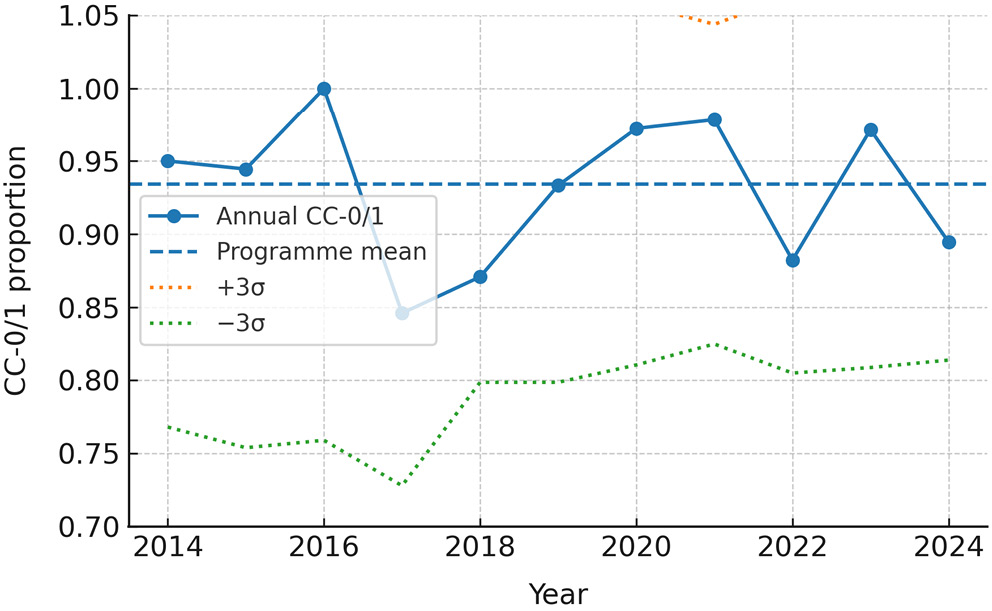
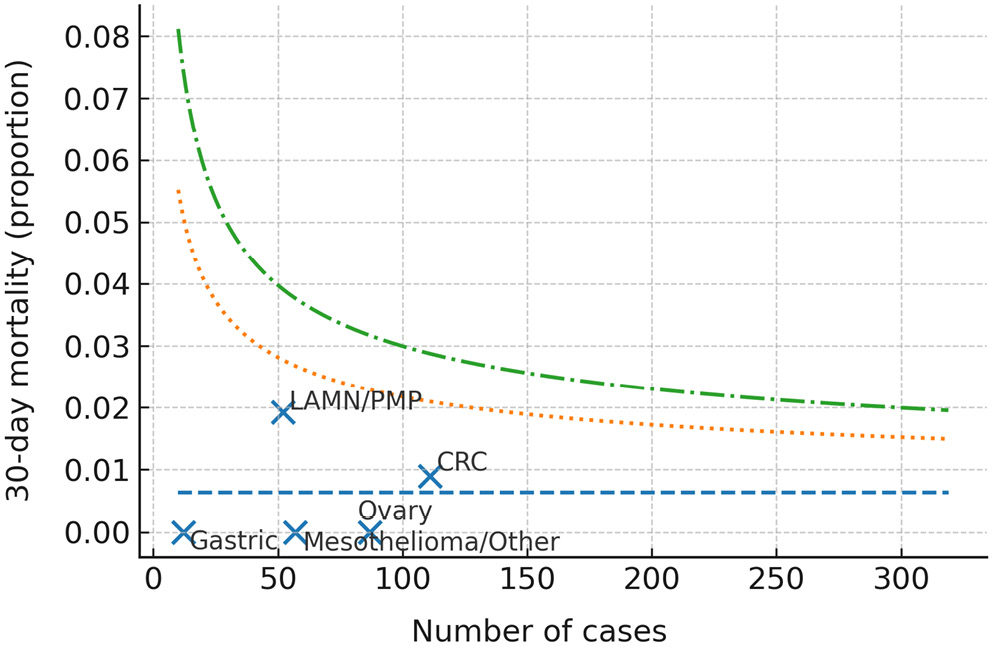
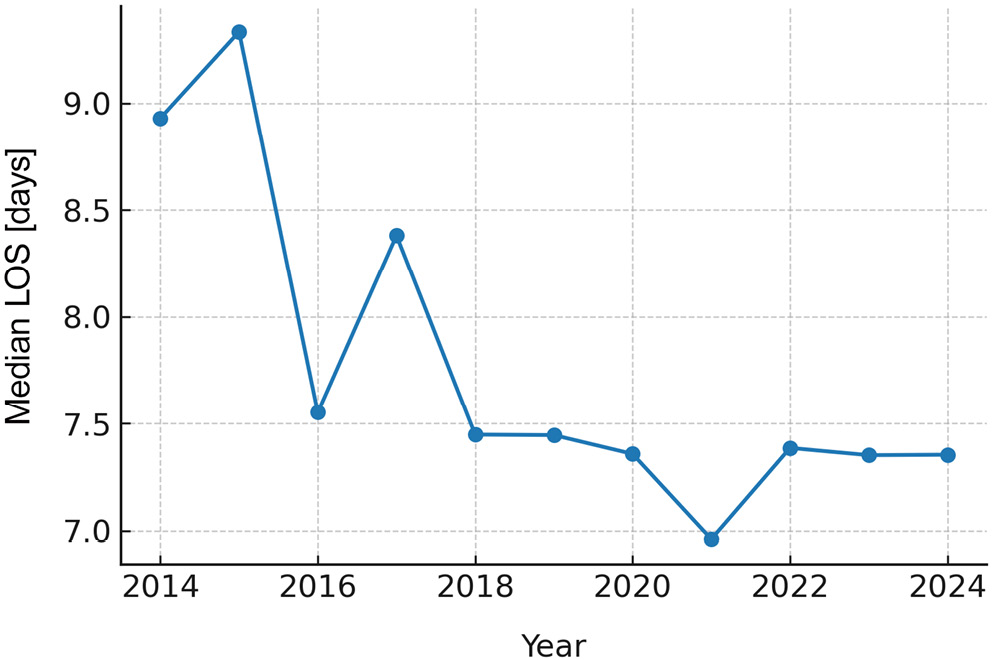
Associations between non-normally distributed continuous variables were assessed using Spearman’s rank correlation. Comparisons of categorical outcomes with small expected cell counts were performed using Fisher’s exact test. Temporal trends in program-level indicators were explored using simple linear regression, with reporting of regression coefficients (β), 95% CIs, p-values, and coefficients of determination (R2). To visualize time trends and the program-level learning curve, run charts were constructed for annual median LOS and Shewhart control charts for annual CC-0/1 proportions. Funnel plots displayed 30-day mortality against case volume with 95% and 99.8% binomial control limits centered on the program mean, in line with statistical process control methodology for quality improvement reporting.
Missing data were handled by complete-case analysis for the relevant indicator; no imputation was performed. All tests were two-sided, with a significance threshold of α = 0.05. Analyses were performed using R (R Foundation for Statistical Computing, Vienna, Austria) and Python (Python Software Foundation, Wilmington, USA). No a priori sample size calculation was performed; all consecutive CRS–HIPEC procedures from 2014 to 2024 were included to maximize precision for quality indicator estimates.
Results
Cohort
Between 1 January 2014 and 31 December 2024, 319 CRS–
HIPEC procedures were performed (Table 1): CRC (n = 111), ovarian cancer (n = 87), mesothelioma/other (n = 57), LAMN/PMP (n = 52), and gastric cancer (n = 12). By institutional policy, all patients were admitted to the ICU for a planned 48-h postoperative stay. The PCI was available for the vast majority of procedures and is summarized in Table 1, with median values predominantly within the low to intermediate ranges across tumor types, consistent with contemporary selection criteria for CRS–HIPEC.
Surgical quality
Across the program, complete or near-complete cytoreduction (CC-0/1) was achieved in 298/319 procedures (93.4%): CRC 96.4% (107/111), LAMN/PMP 100% (52/52), ovarian cancer 90.8% (79/87), gastric cancer 91.7% (11/12), and mesothelioma/other 86.0% (49/57) (Table 2). Annual CC-0/1 proportions remained generally high, with occasional values below 90%. All annual estimates remained within their corresponding 3σ control limits, with no evidence of special-cause variation (Figure 1). Linear regression showed no significant temporal drift in the CC-0/1 proportion over the study period (β = 0.003 per year; 95% CI: −0.004 to 0.010; p = 0.380; R2 = 0.07), supporting a stable process. The CC-0/1 rate was 92.0% (92/100) in 2014–2018 and 94.1% (206/219) in 2019–2024.
Mortality and perioperative safety
At the program level, 30-day mortality was 0.6% (2/319; 95% CI: 0.2–2.3), and 90-day mortality was 1.6% (5/319; 95% CI: 0.7–3.6). By primary tumor type, 30-day mortality was 0.9% (CRC 1/111) and 1.9% (LAMN/PMP 1/52), with 0% (0/87, 0/12, 0/57) in ovarian cancer, gastric cancer, and mesothelioma/other; corresponding 90-day figures were 1.8% (CRC 2/111), 1.9% (LAMN/PMP 1/52), 1.1% (ovarian cancer 1/87), and 8.3% (gastric cancer 1/12) (Table 2). Tumor-specific 30-day mortality ranged from 0% to 1.9%, and all tumor groups remained within the funnel-plot control limits (Figure 2).
Renal safety: Based on preoperative and postoperative creatinine (peak across days 1–5), AKI occurred after 70/308 evaluable procedures (22.7%, 95% CI: 18.4–27.7), predominantly stage 1 (n = 45); stage 2–3 events were less frequent (n = 18 and n = 7). The median rise in creatinine from baseline was 9.3% (IQR: −3.2% to 32.5%). In an exploratory analysis, AKI did not differ significantly by cisplatin exposure (26.0% vs 21.2%, Fisher’s exact test, p = 0.389).
Unplanned reoperation during the index admission occurred after 6.0% of procedures (19/319) and 30-day readmission occurred in 1.9% (6/319); neither metric showed an upward temporal trend (Table 2).
Length of stay and resource workload
Median LOS shortened from 8.6 days in 2014–2018 to 7.4 days in 2019–2024 (≈14% reduction; Figure 3). Linear regression demonstrated a significant downward temporal trend in annual median LOS (β = −0.175 days/year; 95% CI: −0.286 to −0.064; p = 0.006; R2 = 0.586). The proportion with LOS > 10 days also fell (2014–2018: 25.0%; 2019–2024: 13.2%). By primary tumor, median LOS was 6.9 days for LAMN/PMP, 7.4 days for CRC, 7.5 days for ovarian cancer, 7.4 days for mesothelioma/other, and 9.9 days for gastric cancer (Table 1). In the pooled cohort with both variables available (n = 318), PCI showed a small but significant association with LOS (Spearman’s ρ = 0.13, p = 0.019); an unadjusted linear fit corresponded to ~0.10 days per PCI point. Nevertheless, median LOS was essentially stable across PCI bands: PCI 0–9: 7.4 days (n = 148); PCI 10–19: 7.5 days (n = 132); PCI ≥ 20: 7.4 days (n = 38), suggesting that protocolized perioperative pathways (planned ICU, standardized care) constrain postoperative stay despite differences in peritoneal disease burden.
Multidisciplinary integration and era effects
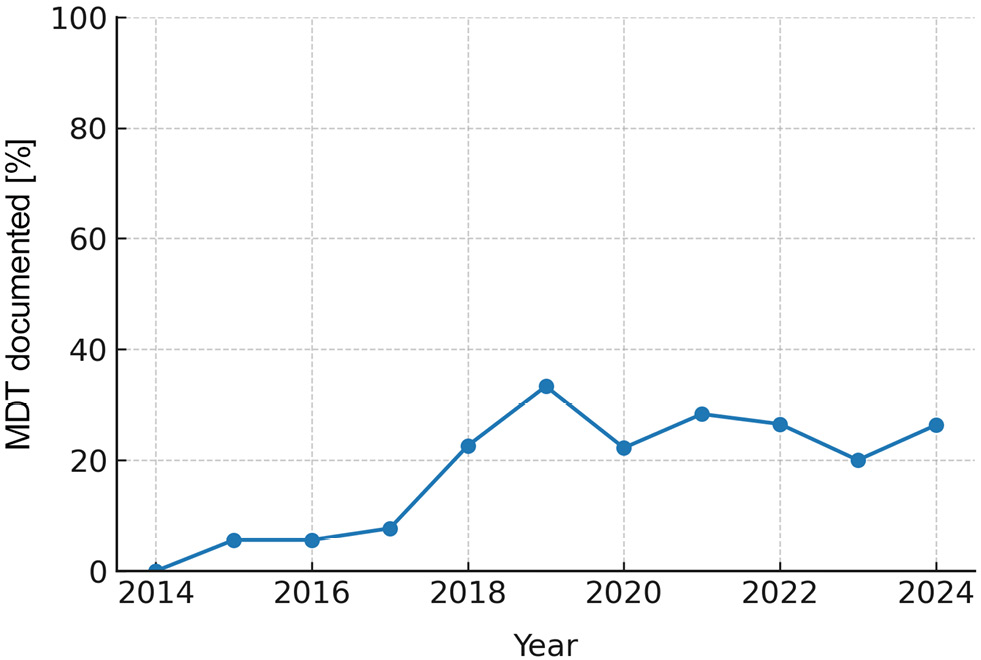
Multidisciplinary team documentation was <10% in 2014–2017 and ~20–33% during 2018–2024 and remained within this range after the 2023 policy formalized MDT review (Figure 4). Annual caseload rose after program launch and then stabilized; variability in operative metrics was greater early and clustered more tightly in later years (Figure 1, Figure 3). Favorable trends were observed across tumor types: LOS shortened, CC-0/1 rates remained high, and early mortality stayed low. Year-to-year fluctuations were greater in smaller cohorts (e.g., gastric), but no sustained adverse trend was evident.
Missing data
Outcomes were analyzed by complete cases for each indicator; missingness was low and confined mainly to non-essential fields (e.g., ICU stay beyond the planned 48 h). No imputation was performed.
Exploratory oncological outcomes
Long-term oncological outcomes were assessed descriptively. Follow-up data were available for the majority of patients, with a median follow-up of 43 months. Among the 292 unique patients, 118 (40.4%) had died, while 174 (59.6%) remained alive at the time of analysis. The vast majority of deaths occurred beyond the early postoperative period and reflected disease progression rather than procedure-related mortality. Given the heterogeneity of primary malignancies and variable follow-up duration across tumor types, overall survival, disease-free survival, and recurrence outcomes were not subjected to tumor-specific modeling or time-trend analyses and are reported here solely to provide clinical context for the quality-of-care indicators evaluated in this study.
Discussion
Benchmarking is more than an accounting exercise: systematic comparison of structure, process, and outcome indicators is a prerequisite for safe innovation and value-based care. Donabedian’s framework places outcomes at the apex of a causal chain that begins with measurable structures and processes.18 Transparent, risk-adjusted benchmarking enables centers to distinguish common-cause from special-cause variation, identify outliers in near real time, and direct resources to remedial failure-to-rescue points.8 In surgical oncology, public reporting and peer-group feedback have been associated with measurable performance gains, including reductions in anastomotic leak after colorectal resection and lower mortality after esophagectomy.19 Benchmarking also underpins external accreditation: the PSOGI/RENAPE consensus cites audited CC-0/1 and mortality rates as minimum criteria for center designation.2 Finally, by adopting funnel plots and Shewhart charts, which integrate case volume with outcome rates, we follow international recommendations and detect unsafe drift more sensitively than conventional significance testing based on p-values.20 In this context, our compact QI panel provides a reproducible template for local improvement and cross-center comparison in CRS–HIPEC programs.
In this single-center audit of 319 consecutive CRS–HIPEC procedures (2014–2024), we observed favorable perioperative outcomes across tumor types. The overall CC-0/1 rate was 298/319 (93.4%), exceeding the quality standard (QS) of 89% proposed for colorectal peritoneal metastases (PM) by García-Fadrique et al.10 and the critical quality limit (CQL) of 80%. Our CC-0/1 rate also exceeds the pooled 84% reported in a recent PSOGI/RENAPE meta-analysis of mixed-indication series.2 Early mortality was low: 30-day mortality was 0.6% and 90-day mortality was 1.6%, within the lower range reported in contemporary systematic reviews (0.8–4%) and below the 3% QS/8% CQL thresholds for colorectal PM.10 These figures compare favorably with other high-risk oncologic resections (e.g., pancreaticoduodenectomy, major hepatectomy), which report 30-day mortality of approx. 2.5–4% in population-based studies.21
Process indicators mirrored the safety profile. Median LOS decreased from 8.6 days in 2014–2018 to 7.4 days in 2019–2024. The latter was shorter than the proposed 16-day QS and 19-day CQL for colorectal PM.10 Unplanned reoperation (6.0%) and 30-day readmission (1.9%) likewise were well below the 13% and 10% QS values suggested for benchmarking. In the mortality funnel plot, all tumor groups fell within the 95% binomial control limits. The Shewhart chart demonstrated a stable CC-0/1 process centered on the program mean, a pattern consistent with safe delivery as volume accrued.8 Renal toxicity was low-to-moderate and largely stage 1 by KDIGO, consistent with protocolized hydration and ICU oversight; AKI rates did not differ by cisplatin exposure on exploratory testing. Using creatinine-only KDIGO criteria may underestimate transient oliguria, but these data support including AKI incidence as a pragmatic safety indicator in program-level audit.22
Temporal trends display a classical learning-curve signature: decreasing LOS and diminishing year-to-year dispersion in CC-0/1 without upward drift in early mortality. Similar trajectories have been reported in other large series, with inflection points attributed to refined case selection (e.g., PCI thresholds, medical fitness), protocolized anesthesia/ICU care, and an increasingly standardized operative strategy.10 In our program, improvements preceded the formal adoption of mandatory MDT review.
Multidisciplinary team documentation itself rose stepwise from <10% before 2018 to a plateau of 20–33% thereafter. Meta-analyses across solid tumors associate MDT involvement with higher guideline adherence and a modest survival benefit.23, 24 We therefore set phased targets of ≥70% MDT coverage in 2025 and ≥90% in 2026, to be enforced through electronic prompts and real-time dashboards. Achieving these targets should consolidate selection discipline and provide a platform for enhanced failure-to-rescue monitoring once structured complication grading (Clavien–Dindo, Comprehensive Complication Index) is implemented.25
The study’s limitations are intrinsic to a single-center retrospective design. We lacked granular morbidity grading and ICU overstay data, and the gastric cohort (n = 12) is too small for firm inference. Nonetheless, the audit adheres to contemporary methodological standards, including maintenance of a prospective database, transparent definitions of QIs, and the application of statistical process control methods to distinguish common- from special-cause variation. Embedding a concise set of QIs that includes CC-0/1, 30- and 90-day mortality, median LOS and the proportion with LOS > 10 days, unplanned reoperation, 30-day readmission, and MDT uptake into routine reporting should facilitate accreditation and cross-center comparison, particularly in jurisdictions such as Poland where a national CRS–HIPEC registry has not yet been established.
Limitations of the study
This audit has several limitations inherent to a single-center retrospective design. Detailed grading of postoperative morbidity and ICU overstay duration was unavailable, which precluded full analysis of failure-to-rescue events. The relatively small gastric cancer subgroup (n = 12) limits tumor-specific inference, and external generalizability may be constrained by institutional protocols and national caseload thresholds.
In addition, data on patients assessed but not ultimately qualified for CRS–HIPEC were not captured in a structured manner throughout the entire study period, particularly during the early years of the program. Consequently, turn-down rates and reasons for non-qualification could not be analyzed reliably. The present study therefore focuses on intra-program performance and outcomes among treated patients, while prospective capture of referral and turn-down data has been identified as a priority for future quality-improvement initiatives.
Nonetheless, the study’s prospective data collection, consecutive case inclusion, and decade-long observation period support the robustness and representativeness of the findings.
Conclusions
Over 11 years, this single-center CRS–HIPEC program achieved high-quality cytoreduction with low early mortality and a sustained reduction in length of stay across tumor indications, meeting or exceeding contemporary international quality benchmarks. Rates of unplanned reoperation, 30-day readmission, and creatinine-defined AKI, predominantly stage 1, were low to moderate, and statistical process control analyses demonstrated stable performance without evidence of safety drift. Together, these findings support the feasibility of routine, program-level benchmarking using a compact quality-indicator panel and highlight continued multidisciplinary team expansion and formal complication grading as key targets to further reduce variability and improve failure-to-rescue performance.
Data Availability Statement
The anonymized analytical dataset and R scripts supporting the analyses reported in this study are openly available in Zenodo at https://doi.org/10.5281/zenodo.23956686.
Consent for publication of personal information
Not applicable.
Use of AI and AI-assisted technologies
Not applicable.