


Abstract
Alzheimer’s disease (AD) remains one of the most pressing challenges in contemporary neurology, with growing evidence highlighting the limitations of the amyloid hypothesis and monomodal therapies. This editorial advocates for a shift toward multidimensional research and therapeutic frameworks that integrate molecular, electrophysiological, neuroimaging, and behavioral data. Emphasis is placed on the potential of microRNA-based biomarkers, electroencephalography (EEG) analysis, and non-invasive methods to improve early diagnosis. Emerging multimodal treatment strategies – including immunotherapy, neurostimulation, and nutraceuticals – are discussed alongside ethical and regulatory challenges in implementing novel interventions. The authors propose an integrated, patient-centered model that combines precision medicine with preventive approaches rooted in lifestyle, digital biomarkers, and AI-powered personalization. A paradigm shift toward systemic, translational, and ethically grounded strategies is urgently needed to meet the growing burden of AD.
Key words: biomarkers, Alzheimer’s disease, multimodal therapy, amyloid hypothesis
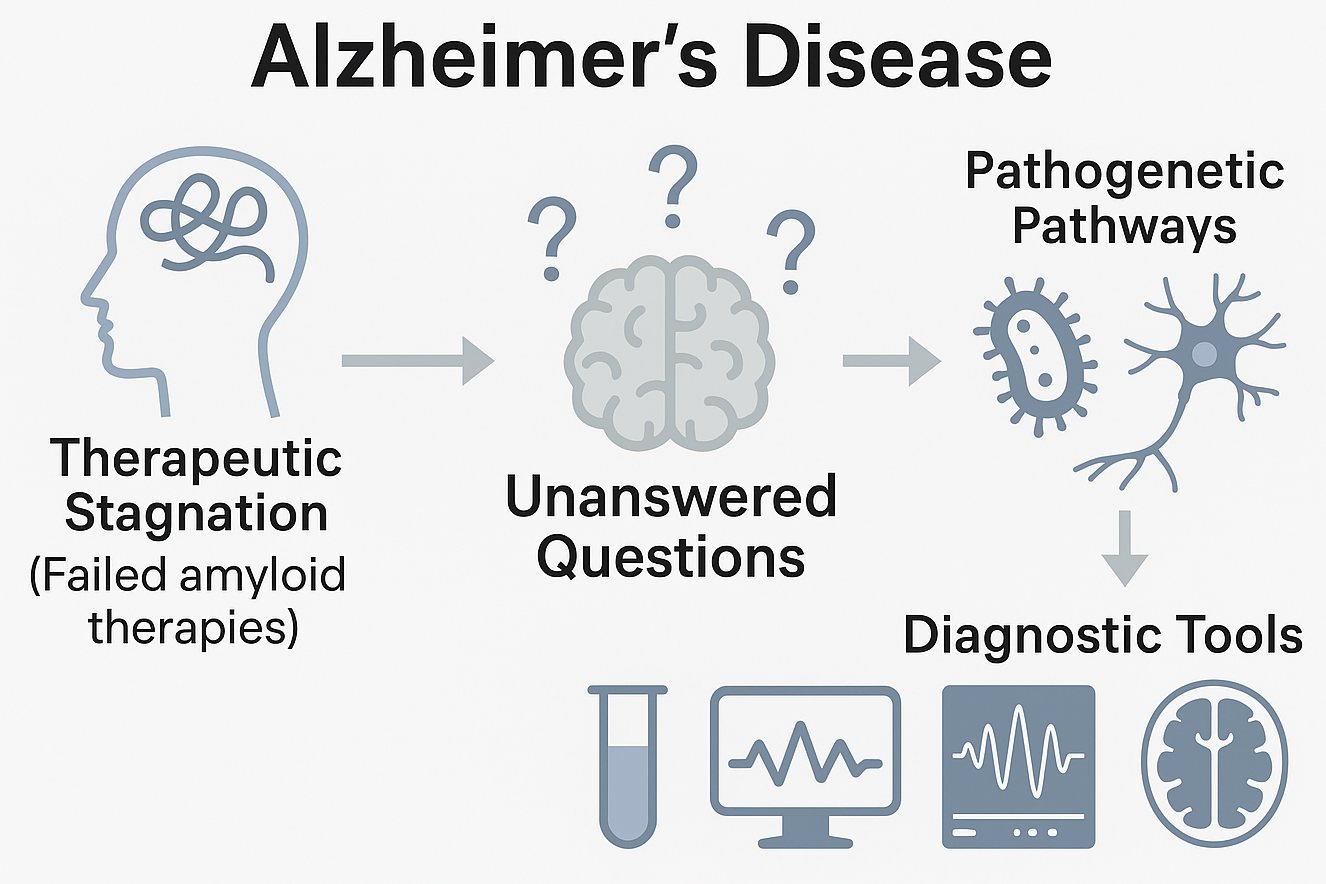
Introduction: Therapeutic stagnation and unanswered questions
Alzheimer’s disease (AD) remains one of the most urgent challenges in modern neurology and public health. The number of affected individuals worldwide now exceeds 55 million, and World Health Organization (WHO) projections suggest that this figure could double by 2050, reaching up to 139 million. This trend is particularly alarming in the context of global population aging. Every day, new cases of dementia are diagnosed, with AD representing the most common cause. As life expectancy increases, the burden on healthcare systems and families also grows, with substantial economic and emotional consequences.1, 2, 3, 4
Despite decades of intensive research and massive investments from both the public and private sectors, there is still no therapy available that effectively modifies the course of the disease. Existing medications are symptomatic and offer only modest and temporary benefits. In recent years, the highest hopes were pinned on monoclonal antibodies targeting β-amyloid; however, the results of clinical trials have proven disappointing.5
Although some of these therapies, such as aducanumab, lecanemab, and donanemab, have been approved by the U.S. Food and Drug Administration (FDA), they are accompanied by controversies regarding both their limited clinical benefit and potentially serious side effects, including brain edema and microhemorrhages.5, 6
In this context, the need for a fundamental reassessment of the prevailing approach is increasingly evident; a redefinition of research priorities, efficacy and safety criteria, and the pursuit of new, more complex models of pathogenesis and therapy are urgently needed.
A critical look at the amyloid hypothesis
For more than 3 decades, the amyloid hypothesis has served as the dominant framework for AD research.7 It posits that the pathological accumulation of β-amyloid (Aβ) in the brain initiates a cascade of events leading to neurodegeneration: from plaque formation to oxidative stress, inflammation, and ultimately neuronal death. Based on this concept, dozens of therapeutic strategies have been developed – primarily monoclonal antibodies, secretase inhibitors, and active or passive immunotherapies.8
However, with the exception of rare early-onset cases, growing evidence challenges the causal role of Aβ in typical AD. First, neuropathological data show that the presence of plaques does not consistently correlate with cognitive impairment.9 Second, many older individuals with high amyloid levels remain clinically asymptomatic. Third, randomized clinical trials (RCTs) have demonstrated that amyloid clearance from the brain does not translate into meaningful cognitive improvement.10
Neuroinflammation, the microbiome, and other pathogenetic pathways
In light of the increasing number of negative results from anti-amyloid therapies, the scientific community is turning its attention to alternative or complementary mechanisms of AD pathogenesis. In recent years, particular importance has been assigned to neuroinflammation, microglial activation, and disruptions in immune homeostasis. The inflammatory response in the central nervous system, once considered secondary, may in fact play a triggering or co-contributing role in disease progression.
A more complete account of AD pathobiology also requires acknowledging additional hypotheses that are not merely “alternatives” to amyloid, but often intersect with it. The tau hypothesis emphasizes the abnormal phosphorylation, misfolding, and spread of tau pathology, culminating in neurofibrillary tangle formation and network disintegration.11 Importantly, tau burden and topography frequently show a closer association with clinical progression than amyloid deposition alone,12 suggesting that amyloid-centered strategies may be insufficient if downstream neurodegenerative processes are already established.
In parallel, neurotransmitter and network-level hypotheses provide mechanistic bridges between molecular pathology and symptoms. Glutamatergic dysfunction – including impaired synaptic homeostasis and excitotoxic signaling – can contribute to synapse loss and circuit instability,13 aligning with emerging interest in electroencephalography (EEG)-based signatures and neuromodulation approaches. The cholinergic hypothesis, rooted in degeneration of basal forebrain projections and cortical cholinergic deficits, remains clinically relevant14: It underpins the symptomatic efficacy of acetylcholinesterase inhibitors and highlights the need to preserve synaptic communication, not only to remove aggregated proteins.
At the same time, there is growing interest in the gut–brain axis and the influence of the intestinal microbiome. Alterations in microbial composition, increased intestinal permeability, and the interaction of microbial metabolites with the immune and nervous systems may trigger chronic inflammation and modify neuroimmune responses. Similar importance is attributed to metabolic dysregulation (e.g., insulin resistance), cerebral hypoxia, mitochondrial dysfunction, and epigenetic modifications.
New diagnostic tools: Biomarkers, EEG, and neuroimaging
One of the greatest challenges in AD diagnostics is detecting the disease at a very early, preclinical stage. In this context, so-called liquid biomarkers are particularly promising – including microRNAs (miRNAs), plasma neurodegenerative proteins, and indicators of inflammation and neuronal injury. MiRNAs, as stable regulatory molecules found in serum, saliva, and cerebrospinal fluid, have demonstrated both diagnostic and predictive potential.15
These molecular data are complemented by non-invasive functional methods such as EEG – especially the analysis of theta and alpha activity – which can detect subtle disruptions in neural network dynamics. When combined with advanced neuroimaging techniques (positron emission tomography [PET], structural and functional magnetic resonance imaging [MRI]), it becomes possible to develop integrated diagnostic algorithms that may one day support risk prediction and treatment response monitoring.
Increasing importance is also attributed to clinical observation and digital behavioral biomarkers. A striking example is progressive loss of smell (anosmia) and hearing (hypoacusis), which – according to several studies – may occur 10–15 years before the onset of cognitive symptoms in AD.16 This phenomenon is thought to reflect early pathological changes in the olfactory bulb and temporal cortex. However, its diagnostic value has been complicated in recent years by the COVID-19 pandemic, which has caused transient or persistent anosmia in millions of people worldwide, reducing the specificity of this symptom as a prodromal marker.
In parallel, artificial intelligence algorithms are being developed to analyze facial expressions and emotional responses in patients – e.g., during clinical interviews or video recordings. Preliminary research suggests that subtle alterations in facial dynamics – such as delayed emotional reactivity, facial asymmetry, or diminished expressiveness – may be detectable even in early prodromal phases.17 This opens up the possibility of a low-cost, non-invasive screening tool applicable in outpatient or home-based settings.
Multimodal therapies: Beyond conventional pharmacology
Given the complexity of AD pathogenesis, there is a growing consensus among experts on the need to move away from the “one target – one drug” paradigm. Multimodal therapies, which combine multiple mechanisms of action, are increasingly recognized as more appropriate for the biological and clinical reality of AD. Such an approach includes targeting neuroinflammation, oxidative stress, cellular metabolism, protein aggregation, cognitive function, and neuroplasticity simultaneously.
Examples include experimental hydrophobic peptides that inhibit the aggregation of β-amyloid or tau protein without triggering immune responses.18 Other strategies encompass transcranial direct current stimulation (tDCS), electromagnetic stimulation, or optogenetics, which can modulate synaptic plasticity and cortical activity in memory-related regions.19 Nutraceutical interventions – particularly those based on polyphenols, curcumin, melatonin, and omega-3 fatty acids – also show promise due to their anti-inflammatory, antioxidant, and neuroprotective properties.20
However, these therapies require further translational research, standardized protocols, and long-term monitoring of safety and efficacy across diverse age and genetic populations.17, 18, 19, 20
Ethics, safety, and transparency in research
As increasingly advanced experimental therapies, particularly immunological and molecular approaches, are introduced, ethical considerations become more crucial. Patients with mild cognitive impairment may have limited ability to fully comprehend the risks associated with participating in clinical trials, especially invasive ones.21 It is therefore essential to implement informed consent procedures that are precise, empathetic, and cognitively appropriate.22
Moreover, the reporting of results – in both scientific publications and public media – must adhere to the highest standards of transparency. Misleading language (e.g., “breakthrough,” “Alzheimer’s cure”) can lead to misinformation and unrealistic public expectations. This underscores the growing need for independent platforms for therapy assessment, ethical oversight mechanisms, and international standards for drug approval and monitoring.23
Looking ahead: An integrated model for treatment and prevention
A modern approach to AD requires a strategic shift toward integrating knowledge from multiple levels of biology and medicine. Increasing evidence suggests that effective treatment must address multiple pathophysiological mechanisms simultaneously, while also accounting for individual patient characteristics – genetic, environmental, and psychosocial.24 In this context, multi-omics analysis, machine learning, and artificial intelligence-based predictive technologies play a crucial role.25, 26
Such an integrated approach enables not only the precise tailoring of therapy to a patient’s biological profile but also the development of effective prevention strategies. Lifestyle modifications (diet, physical activity, sleep), metabolic and neurocognitive prevention, and health education are essential components of a modern public health strategy for AD.24
Conclusion: Time for a paradigm shift
Alzheimer’s disease is not merely a medical challenge – it is also a test for contemporary science, ethics, and healthcare systems. Clinging to a single dominant model of pathogenesis, despite repeated therapeutic failures, risks cognitive stagnation and costly strategic missteps. The time has come to acknowledge the limitations of the current paradigm and boldly embrace integrative, multidisciplinary, and personalized models. Only through the synergy of biological, technological, and social knowledge can we realistically hope to improve the quality of life for millions of patients and their families.
Use of AI and AI-assisted technologies
Not applicable.