



Abstract
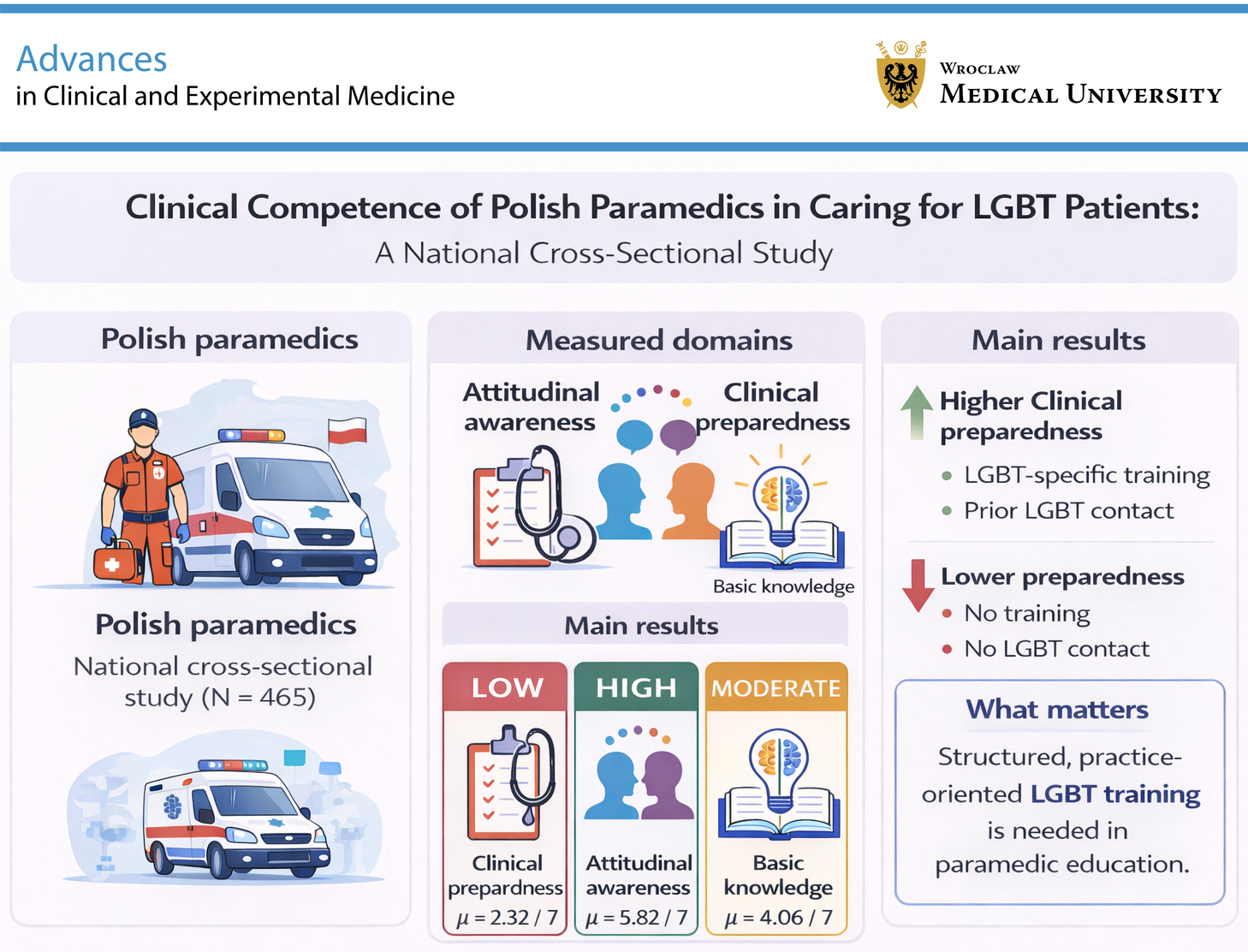
Background. Systemic preparation for the care of lesbian, gay, bisexual, and transgender (LGBT) patients in Poland remains limited, despite the increasing visibility of sexual and gender minorities in clinical settings. Emergency medical services, often the first and sometimes the only point of contact with healthcare, operate without structured guidance on inclusive practice. For paramedics, this gap translates into uncertainty at the bedside and inconsistent quality of care. However, the clinical competence of Polish paramedics in responding to the needs of LGBT patients has never been empirically examined.
Objectives. This study aimed to assess the clinical preparedness, attitudinal awareness, and basic knowledge of Polish paramedics regarding LGBT patients.
Materials and methods. In a national cross-sectional survey (n = 465), 289 participants completed the LGBT-Development of Clinical Skills Scale (LGBT-DOCSS) scale. Data were analyzed using beta-inflated generalized additive model for location, scale, and shape (GAMLSS) regression with least absolute shrinkage and selection operator (LASSO)-based predictor selection.
Results. Clinical preparedness was low (predicted μ = 2.32/7), particularly among those without prior LGBT-specific training or exposure. Attitudinal awareness was high (μ = 5.82), while basic knowledge scores were moderate (μ = 4.06). Recent LGBT-related training was associated with higher clinical preparedness (β = 0.779, p < 0.001), and prior informal experience also showed a positive association (β = 0.553, p < 0.001). Male sex (β = 0.369, p < 0.001) was associated with higher clinical preparedness, while homosexual orientation (β = 0.349, p = 0.001) was associated with higher overall clinical competence. Lower attitudinal awareness was observed among men (β = −0.545, p < 0.001) and those without LGBT contact (β = −0.688, p < 0.001). Recent training had no significant effect on basic knowledge (β = 0.280, p = 0.295).
Conclusions. Polish paramedics express attitudinal awareness but lack clinical readiness, with a low baseline clinical preparedness score (μ = 2.32/7). Given the frontline role of emergency medical services, these findings highlight an urgent need for structured, practice-oriented LGBT training within paramedic education and continuing professional development.
Key words: LGBT, health knowledge, sexual and gender minorities, paramedics, LGBT health
Background
LGBT individuals experience profound health disparities globally, including elevated risks of mental health disorders, substance misuse, and poorer access to care compared with cisgender heterosexual populations.1, 2, 3, 4 These disparities are not solely the result of individual-level bias but are sustained and amplified by structural stigma defined as societal-level conditions, institutional policies, and cultural norms that systematically disadvantage sexual and gender minorities.4, 5 Structural stigma manifests in both explicit legal exclusions and the absence of inclusive systems, including in healthcare education and practice.6, 7
In Poland, a country ranking among the lowest in the European Union in terms of LGBT equality,8, 9 structural stigma is not merely theoretical. It is reflected in national policies, public discourse, and professional training frameworks. Political rhetoric labelling LGBT identities as an “ideology” rather than a human reality has contributed to a hostile environment, culminating in declarations of “LGBT-free zones” by local governments and repeated legislative attempts to block marriage equality or limit access to gender-affirming care.10, 11 Although many of these declarations were symbolic, the last remaining “LGBT-free zone” was formally repealed in April 2025 following sustained domestic and international pressure.12 Despite condemnation from international bodies, these developments have real consequences: LGBT individuals in Poland have reported widespread discrimination in healthcare settings, fear of disclosing their identity, and delayed access to essential services.13, 14, 15
While there is growing international emphasis on LGBT-inclusive education for healthcare professionals, this effort has failed to meaningfully reach Poland.13, 16, 17 In particular, emergency medical services (EMS) have received little to no attention, despite their pivotal role in prehospital care. Paramedics are often the first and sometimes the only point of clinical contact for LGBT individuals in crisis. Yet Polish paramedic training curricula omit sexual and gender minority health entirely, and no national data have been published to date assessing paramedic preparedness in this area.
This absence of empirical evidence represents a critical blind spot in efforts to reduce health disparities for LGBT populations. While studies have linked cultural competence and LGBT-specific training with improved patient outcomes and professional attitudes,13, 18 the unique sociopolitical context of Poland, marked by religious conservatism, legal exclusion, and political hostility, raises important questions about how these factors influence paramedic attitudes, clinical preparedness, and factual knowledge.
Objectives
In this study, we aimed to fill this gap by conducting a nationwide cross-sectional assessment of LGBT-related clinical competence among paramedics in Poland. A secondary objective was to identify sociodemographic, professional, and experiential factors associated with variation in clinical competence. To our knowledge, this is the first study to empirically evaluate LGBT-related clinical competence in prehospital care in Poland.
Materials and methods
Study population
This cross-sectional study was conducted in Poland between January and June 2025. Data were collected using an anonymous, self-administered online questionnaire hosted on the Webankieta.pl platform. To ensure data integrity and reduce the risk of duplicate entries, IP filtering was implemented as part of the platform’s built-in security features.
Participation was voluntary and preceded by a detailed information page explaining the study’s purpose, data confidentiality, and the participants’ right to withdraw at any stage without consequence. Informed consent was obtained electronically prior to survey initiation.
Eligible participants were certified paramedics aged 18 or older and actively employed in the profession for at least 1 year. Recruitment was carried out using convenience sampling via targeted social media campaigns, primarily on Facebook and Instagram. Invitations were disseminated by the study authors and further shared within professional networks.
A total of 750 individuals accessed the survey link. The questionnaire was administered in 3 sequential sections: study information and informed consent, sociodemographic characteristics, and the clinical competence assessment LGBT-Development of Clinical Skills Scale (LGBT-DOCSS). Among those who accessed the survey, 465 paramedics met the inclusion criteria and completed the consent and sociodemographic sections. Of these, 289 participants proceeded to complete the clinical competence assessment and were included in the final analysis.
Ethics approval and consent to participate
The study was conducted in accordance with the Declaration of Helsinki and approved by the Bioethics Committee of Wroclaw Medical University, Poland (approval No. KB 976/2022). This research is part of the Health Exclusion Research in Europe 2 (HERE2) project. Participation in the survey was entirely voluntary, with no collection of personal data, ensuring anonymity throughout. All potential participants were provided with written information outlining the study’s purpose, objectives, procedures, and data protection measures. They were also able to contact the investigators with any questions at any point during the study. Informed consent was obtained from all participants before their involvement in the study.
Instruments
Data were collected using a self-administered questionnaire consisting of 2 main sections. The 1st section focused on gathering detailed sociodemographic information, including gender, age, place of residence, marital status, educational attainment, professional role, years of work experience, prior participation in LGBT-related training (e.g., workshops, webinars) within the past 5 years, and direct clinical experience with LGBT patients outside of formal training settings. Prior LGBT experience (outside formal training) was defined as self-reported personal or professional contact with LGBT individuals occurring outside structured educational or training settings and was operationalized as a binary variable (yes/no). “Close LGBT ties” referred to having close friends and/or family members who identify as LGBT and was categorized as none vs any close ties (friends, family, or both), without a specified timeframe. The 2nd section employed the LGBT Development of Clinical Skills Scale – Polish version (LGBT-DOCSS-PL),19 adapted from the original LGBT-DOCSS developed by Bidell.20 This validated instrument comprises 18 items rated on a 7-point Likert scale, where responses range from 1 (“strongly disagree”) to 7 (“strongly agree”). Eight items are reverse-coded to reduce response bias and ensure accurate measurement. The scale provides both an overall LGBT-DOCSS score and 3 distinct subscale scores: Clinical Preparedness, Attitudinal Awareness, and Basic Knowledge. Higher scores reflect greater clinical preparedness, more affirmative attitudes, and stronger foundational knowledge regarding the care of LGBT patients. The Polish version of the LGBT-DOCSS demonstrated satisfactory internal consistency in this study, with a Cronbach’s alpha of 0.789, supporting its reliability and cultural applicability in assessing healthcare professionals’ competencies in LGBT-inclusive care.19
Statistical analyses
All DOCSS domain scores, originally measured on a 1–7 Likert scale, were linearly rescaled to the (0,1) interval to meet the distributional requirements of beta-inflated modelling. We analyzed 3 psychometric outcomes clinical preparedness, attitudinal awareness, and basic knowledge scaled to (0,1) and modeled using generalized additive model for location, scale, and shape (GAMLSS) with a beta-inflated (BEINF) distribution. This modelling framework was chosen to account for the bounded and non-normal distribution of the outcomes, as well as potential floor and ceiling effects inherent to self-assessed competence scales. Unlike standard linear or beta regression models, the BEINF-GAMLSS approach allows simultaneous modelling of the central tendency, response variability, and extreme values, providing a more informative and clinically interpretable representation of competence. Predictor selection was performed via least absolute shrinkage and selection operator (LASSO) regression, following preprocessing and collinearity reduction. Final models estimated distributional parameters for location (μ), dispersion (σ), and inflation at the bounds (ν, τ). Key predictors of μ were selected empirically; σ was informed by theory; ν and τ were modeled as intercepts. Full methodological details, including outcome transformations, predictor definitions, preprocessing steps, the feature selection pipeline, the rationale for GAMLSS, and model implementation (Python/R) are provided in the supplementary data.
Results
Descriptive characteristics by sexual orientation and DOCSS completion
All reported group-wise statistics are descriptive and non-inferential. They are intended to inform the reader about patterns in the observed data, not to support hypothesis testing or substantiate claims about group differences. Such comparisons, especially when unadjusted and based on small subgroups, risk misinterpretation and should not be overinterpreted.
Participant demographics varied across sexual orientation groups and DOCSS completion status. The median age ranged from 25 to 31 years, with younger respondents more common among those who did not complete the DOCSS. Non-completers were also more likely to identify as heterosexual and to report no prior contact with LGBT individuals or training on LGBT topics. Workload (median hours/month) was broadly comparable, although bisexual respondents completing the DOCSS reported slightly fewer hours.
In terms of DOCSS outcomes, bisexual and homosexual participants showed slightly higher scores in clinical preparedness, attitudinal awareness, basic knowledge, and total score compared to heterosexual participants.
Women predominated among bisexual respondents (66%) and among homosexual DOCSS completers (56%). Urban residence, particularly in cities with more than 500,000 inhabitants, was the most common setting across all groups.
The majority of respondents reported no formal training on LGBT topics during their education. Recent LGBT-specific training was rare. Still, bisexual and homosexual respondents more frequently reported having contact with LGBT individuals and felt better prepared to work with this population.
Religious affiliation and political views differed by sexual orientation: heterosexual respondents were more likely to report right-wing political views and religious affiliation, whereas bisexual and homosexual respondents were more often non-religious and left-leaning. Legal marriage was uncommon outside the heterosexual group.
Most participants held at least a bachelor’s degree. Emergency medical teams were the most common workplace setting, followed by emergency departments. A minority of respondents felt that their personal beliefs strongly influenced their clinical practice. This proportion was highest among homosexual participants (48%) and lowest among heterosexual participants (20%). A comprehensive overview of participant characteristics is available in Supplementary Table 1.
Multivariate modelling
Clinical preparedness
The full model report is shown in Table 1. Model performance, depending on the number of features, is shown in Supplementary Fig. 1.
Modelling the mean level (μ): The reference profile was associated with a low predicted level of clinical preparedness on the original 1–7 scale, indicating generally limited baseline self-assessed preparedness among respondents without prior LGBT-related exposure or recent training. Several predictors were associated with higher predicted preparedness relative to this reference profile.
Male sex, prior informal experience with LGBT individuals, and recent LGBT-specific training showed the strongest positive associations, with training representing the largest shift in predicted preparedness. Political orientation was also associated with preparedness, with both left-leaning and right-leaning respondents reporting higher predicted scores compared with politically centrist individuals. Work experience was not associated with mean preparedness in this submodel.
Statistically significant adjusted effects from the μ submodel are summarized graphically in Figure 1. Modelling the dispersion of responses (σ): Baseline variability in preparedness ratings within the reference group was low. Greater heterogeneity was observed among male respondents and among individuals identifying as religious, particularly those reporting moderate or high levels of religiosity. Political orientation showed an asymmetric association with dispersion, with higher variability observed only among right-leaning respondents. These effects on dispersion were not accompanied by corresponding shifts in mean preparedness, suggesting differences in internal conceptualization rather than systematic changes in average self-assessment.
Modelling floor and ceiling responses (ν and τ): The ν submodel indicated a very low baseline probability of extreme responses, while the τ submodel showed no evidence of systematic floor or ceiling inflation. Extreme preparedness ratings were therefore rare and not meaningfully associated with covariates.
Attitudinal awareness
The full model report is shown in Table 2. Model performance, depending on the number of features, is shown in Supplementary Fig. 2.
Modelling the mean level (μ): The reference profile was associated with a relatively high predicted level of attitudinal awareness on the original 1–7 scale, indicating generally favorable self-assessed attitudes among respondents with close LGBT ties and lower workload. Several predictors were associated with lower predicted attitudinal awareness relative to this reference profile.
Male respondents and individuals without close LGBT ties showed the largest negative shifts in predicted scores. Religiosity was also inversely associated with attitudinal awareness, with both slightly and moderately/highly religious respondents reporting lower predicted values. No statistically significant associations were observed for sexual orientation or average workload in the μ submodel. Statistically significant adjusted effects are summarized in Figure 2.
Modelling the dispersion of responses (σ): Baseline variability in attitudinal awareness ratings was moderate within the reference group. Lower dispersion was observed among bisexual respondents, indicating more homogeneous self-assessments. In contrast, respondents with prior informal LGBT experience and those reporting high average workload exhibited greater heterogeneity in attitudinal awareness ratings.
Modelling floor responses (ν): The ν submodel included only an intercept, indicating a very low baseline probability of floor responses. This suggests that a complete self-perceived lack of attitudinal awareness was exceedingly rare and not systematically associated with covariates.
Modelling ceiling responses (τ): In contrast, the τ submodel indicated structured ceiling responses. While the baseline probability of maximum scores was low, several predictors were associated with a differential likelihood of endorsing the highest rating. Male respondents and individuals with high workload were less likely to exhibit ceiling responses, whereas bisexual or homosexual orientation and prior informal LGBT experience were associated with an increased probability of maximum scores.
Basic knowledge
The full model report is presented in Table 3. Model performance as a function of the number of features is shown in Supplementary Fig. 3.
Modelling the mean level (μ): The reference profile was associated with a moderate predicted level of basic knowledge on the original 1–7 scale. Several predictors were associated with deviations from this baseline.
Male respondents showed slightly lower predicted knowledge, whereas homosexual orientation was associated with substantially higher predicted scores. Moderate or high religiosity was inversely associated with basic knowledge, with lower predicted values relative to non-religious respondents. No statistically significant associations were observed for recent LGBT-specific training, prior informal LGBT-related experience, or beliefs regarding the influence of personal values on working with LGBT patients. Statistically significant adjusted effects from the μ submodel are presented in Figure 3.
Modelling the dispersion of responses (σ): Baseline variability in knowledge ratings was moderate within the reference group. Lower dispersion was observed among respondents identifying as slightly or moderately/highly religious, indicating more homogeneous self-assessments of knowledge in these groups. A similar trend toward reduced variability was observed among bisexual respondents, although this did not reach conventional statistical significance.
Modelling floor responses (ν): The ν submodel indicated a very low baseline probability of floor-level knowledge ratings, with no evidence of meaningful floor inflation.
Modelling ceiling responses (τ): Baseline ceiling responses were rare; however, recent LGBT-specific training was associated with a higher likelihood of endorsing the maximum basic knowledge score, suggesting an effect on the upper tail of the response distribution rather than on the mean level alone.
Average overall score
The full model report is shown in Table 4. Floor and ceiling effects were not modelled because none were observed. Model performance, depending on the number of features, is shown in Supplementary Fig. 4.
Modelling the mean level (μ): The reference profile was associated with a moderately high predicted overall DOCSS score on the original 1–7 scale. Several predictors were associated with higher overall competence relative to this baseline.
Homosexual orientation, recent LGBT-specific training, and prior informal LGBT-related experience showed clear positive associations with predicted scores, with informal experience representing one of the strongest effects. In contrast, moderate or high religiosity, high workload, and lack of close LGBT ties were associated with lower predicted overall competence. Sex and bisexual orientation showed weaker, nonsignificant trends.
Statistically significant adjusted effects from the μ submodel are summarized in Figure 4.
Modelling the dispersion of responses (σ): Baseline variability in overall competence scores was low among respondents without recent LGBT-specific training. However, recent training was associated with increased dispersion, indicating greater heterogeneity in self-assessed competence despite higher average scores. This pattern suggests that training may increase awareness and differentiation in self-evaluation rather than uniformly shifting perceived competence.
Discussion
This national cross-sectional study is the first to examine LGBT-related clinical competence among paramedics in Poland, a group with unique responsibilities in emergency and prehospital care. We found that while participants reported relatively high levels of attitudinal awareness toward LGBT patients, substantial deficits emerged in both clinical preparedness and basic knowledge. These gaps were particularly pronounced among respondents with limited prior exposure to LGBT individuals or no formal training in LGBT health. An important distinction emerging from these findings is the divergence between attitudinal awareness and practical clinical preparedness. While paramedics reported high levels of openness and affirmative attitudes toward LGBT patients, this did not translate into comparable levels of self-assessed clinical skills, suggesting that positive attitudes alone may be insufficient to ensure competent care in emergency settings. It should also be acknowledged that self-assessed competence reflects perceived readiness rather than directly observed clinical performance and should therefore be interpreted as a proxy for actual practice under emergency conditions.
This deficit in clinical preparedness and knowledge reflects the persistent lack of training and education in LGBT health and competence across the healthcare field. In a recent study of urban healthcare workers, the majority reported receiving less than 2 h of formal education in LGBT health, and most felt unprepared to provide adequate care to LGBT patients.21
Part of this gap may be attributed to normative structures within educational institutions, particularly in the broader healthcare system, which continue to prioritize heterosexual identities while overlooking LGBT needs, identities, and health considerations.22 Importantly, this lack of integration extends beyond undergraduate education.
In emergency medicine residency programs, e.g., the median time allocated to LGBT health topics is as little as 2 h per year. Hsiang et al. reported that nearly half of emergency medicine residents experienced difficulty conducting basic clinical assessments with transgender patients. Notably, a small but concerning minority of trainees (6%) did not agree that LGBT individuals deserve the same standard of care as heterosexual patients.23 These findings point to a concerning failure of professional formation that may reinforce bias and perpetuate disparities in high-stakes clinical environments.
Without the deliberate inclusion of LGBT health topics in formal curricula and training, meaningful improvements in the clinical and professional readiness of healthcare professionals are unlikely to occur. Importantly, the observed associations between LGBT-related training, informal exposure, and higher self-assessed competence should not be interpreted as causal. Given the cross-sectional design, self-selection into training and differential attrition may partially explain these associations.
This interpretation is supported by intervention studies. For example, a pre–post study by Bristol et al. demonstrated that even a brief, 2-h interdisciplinary LGBT cultural competency training program for emergency department personnel resulted in statistically significant and sustained improvements across 3 key domains: knowledge and skills, openness and support, and awareness of oppression.24 These findings highlight not only the effectiveness of short-format interventions but also their scalability and practical relevance in high-pressure clinical environments, such as emergency and prehospital care.
The results of this study further underscore the importance of both formal and informal exposure in building competence, increasing foundational knowledge, and improving clinical skills and care delivery. In a study of psychiatry residents, exposure to approx. 40 LGBT patients and around 20 total hours of training was associated with significant improvements in preparedness and knowledge,25 highlighting not only the value of exposure but also that meaningful gains in clinical preparedness and basic knowledge do not require substantial time investment, particularly in educational settings.
This notion is further supported by a recent quality improvement initiative by Goodall et al., in which a single, structured, 60-min LGBT cultural competency session for pediatric emergency staff significantly improved clinical preparedness and basic knowledge, as measured using the LGBT-DOCSS tool. As a result, the training was institutionalized as a mandatory component of staff onboarding.26 This example underscores the feasibility of integrating effective LGBT training into existing educational structures without imposing excessive demands on time or resources.
Another important finding is the lower levels of attitudinal awareness and basic knowledge among respondents who identified as religious. This association has been consistently documented in the literature across different countries. In a recent review of 70 studies examining the relationship between religious beliefs among healthcare and social work professionals and their interactions with LGBT adults across 25 countries, individuals identifying as religious were more likely to hold negative attitudes toward LGBT people.27 Additionally, Westwood reported that the religious attitudes of educators and professionals responsible for training programs significantly influenced curricular decisions, including whether LGBT-related health topics were incorporated into educational frameworks.27 The influence of personal beliefs and religious attitudes on health education curricula – particularly in relation to LGBT health and clinical preparedness – requires careful consideration. Addressing these factors is essential for the improvement and redesign of healthcare and medical education programs to better meet the needs of current and future LGBT patients.
Practical implications in public health
These findings have direct implications for public health practice, particularly in emergency and prehospital care settings. As demonstrated in previous studies, formal training in LGBT health not only improves knowledge and attitudes but also enhances clinical confidence and the ability to deliver person-centered care. For example, Rees et al. found that paramedics who had received prior LGBT health education were significantly more comfortable engaging with LGBT patients and more likely to recognize the impact of stigma on health outcomes.18
Embedding structured, evidence-based LGBT health education into undergraduate and professional training programs for emergency medical personnel is therefore both feasible and effective. Public health curricula should adopt inclusive approaches that explicitly integrate minority health topics, including the needs of LGBT individuals, as part of a broader commitment to equity, cultural safety, and person-centered care.
This institutional perspective is further supported by the position statement of the National Association of EMS Physicians (NAEMSP), which calls for mandatory LGBT health and cultural humility training for all EMS personnel. The statement outlines practical and system-level interventions, such as revising clinical protocols, updating documentation systems to reflect gender diversity, and integrating inclusive communication standards. These recommendations provide a clear framework for translating individual competence into operational practice, thereby strengthening the public health impact of LGBT training in emergency medical services.28
Limitations of the study
This study has several important limitations. Recruitment was conducted exclusively online via social media platforms, which may limit the representativeness of the sample. Individuals with strong opinions – either supportive or oppositional toward LGBT populations – may have been more likely to participate, whereas those less engaged or holding more ambivalent views may have been underrepresented. Notably, patterns of incomplete responses suggest that participants identifying with right-leaning political views or strong religious convictions were more likely to discontinue the survey at an early stage. This selective attrition may have biased the final sample toward individuals with more liberal or LGBT-affirming perspectives, potentially inflating mean scores, particularly in the domain of attitudinal awareness. Additionally, the cross-sectional design limits the ability to draw causal inferences or assess the temporal dynamics of the observed associations. For example, while prior personal contact with LGBT individuals was associated with higher levels of clinical preparedness, it remains unclear whether such exposure enhances competence or whether individuals with more open attitudes are simply more likely to engage with LGBT people.
Although the sample included respondents from all regions of Poland, it may not fully capture the diversity of the national paramedic workforce, particularly among professionals working in rural areas, those with longer work experience, or those less engaged with digital platforms. Future studies should aim for more balanced sampling strategies and incorporate behavioral assessment tools and longitudinal designs to evaluate the effectiveness and durability of training interventions over time. An additional methodological consideration relates to the use of data-driven variable selection for the mean (μ) submodels. Although LASSO was used solely as a screening tool and all reported estimates are derived from unpenalized GAMLSS refits, some degree of post-selection optimism cannot be entirely excluded. Accordingly, the reported associations should be interpreted as conditional on the selected model rather than as definitive population parameters. To mitigate the risk of overinterpretation, we emphasize effect sizes and their associated uncertainty on the original response scale and avoid causal language. Importantly, the main findings were robust to alternative specifications of the dispersion submodel, supporting the stability of the observed associations despite the potential for selection-related optimism.
Conclusions
Polish paramedics report high levels of attitudinal awareness toward LGBT patients but lack the clinical preparedness and foundational knowledge required to deliver inclusive care. Clinical competence appears to be strongly shaped by prior informal exposure to LGBT individuals and, to a lesser extent, by recent training; however, the quality of such training may be inconsistent, as improvements in knowledge were not statistically significant. Religious affiliation and limited LGBT social ties remain significant barriers to competence development. These findings underscore an urgent need to integrate structured, evidence-based LGBT health content into national emergency medical education and continuing professional development programs. Reforms should extend beyond changes in attitudinal awareness and focus on clinical decision-making and factual knowledge through immersive, skills-based training. In the broader context of structural stigma and political hostility toward LGBT individuals in Poland, healthcare systems – and emergency medical services in particular – have a critical role in safeguarding equity and human dignity.
Supplementary data
The supplementary materials are available at https://doi.org/10.5281/zenodo.17882620. The package contains the following files:
Supplementary Material 1. Methodology of the study.
Supplementary Fig. 1. Selection of regularization parameter (λ) via 10-fold cross-validation in LASSO regression, modelling the DOCSS clinical preparedness.
Supplementary Fig. 2. Selection of regularization parameter (λ) via 10-fold cross-validation in LASSO regression, modelling the DOCSS attitudinal awareness.
Supplementary Fig. 3. Selection of regularization parameter (λ) via 10-fold cross-validation in LASSO regression, modelling the DOCSS basic knowledge.
Supplementary Fig. 4. Selection of regularization parameter (λ) via 10-fold cross-validation in LASSO regression, modelling the DOCSS average overall score.
Supplementary Table 1. Full population sample characteristics in context of sexual orientation and completeness of the DOCSS questionnaire (excluding sexual orientation denoted as “other” or “I’d rather not tell” – 4 records overall)
Data Availability Statement
The data that support the findings of this study are not openly available due to reasons of sensitivity and are available from the corresponding author upon reasonable request. Data are located in controlled access data storage at Wroclaw Medical University.
Consent for publication
Not applicable.
Use of AI and AI-assisted technologies
OpenAI’s ChatGPT was used solely for language editing and proofreading to improve clarity, coherence, and linguistic accuracy. No AI tools were used for study design, data analysis or data interpretation.
.jpg)
.jpg)
.jpg)
.jpg)