Abstract
Background. TP53 gene aberrations, including deletions (del(17p)) and mutations, are the strongest predictors of shorter response duration and survival with most therapies for chronic lymphocytic leukemia (CLL). However, the impact of isolated TP53 mutations (without concomitant deletion of the 2nd allele) on outcomes of treatment with Bruton tyrosine kinase inhibitors remains less clear, especially in the context of low-burden mutations.
Objectives. This retrospective analysis aimed to assess the efficacy of ibrutinib in patients with relapsed/refractory CLL and TP53 mutations.
Materials and methods. Patients were selected from a large observational study conducted by the Polish Adult Leukemia Group (PALG) based on the following criteria: the presence of a low- or high-burden TP53 mutation detected by next-generation sequencing (NGS), the absence of del(17p), and treatment with ibrutinib.
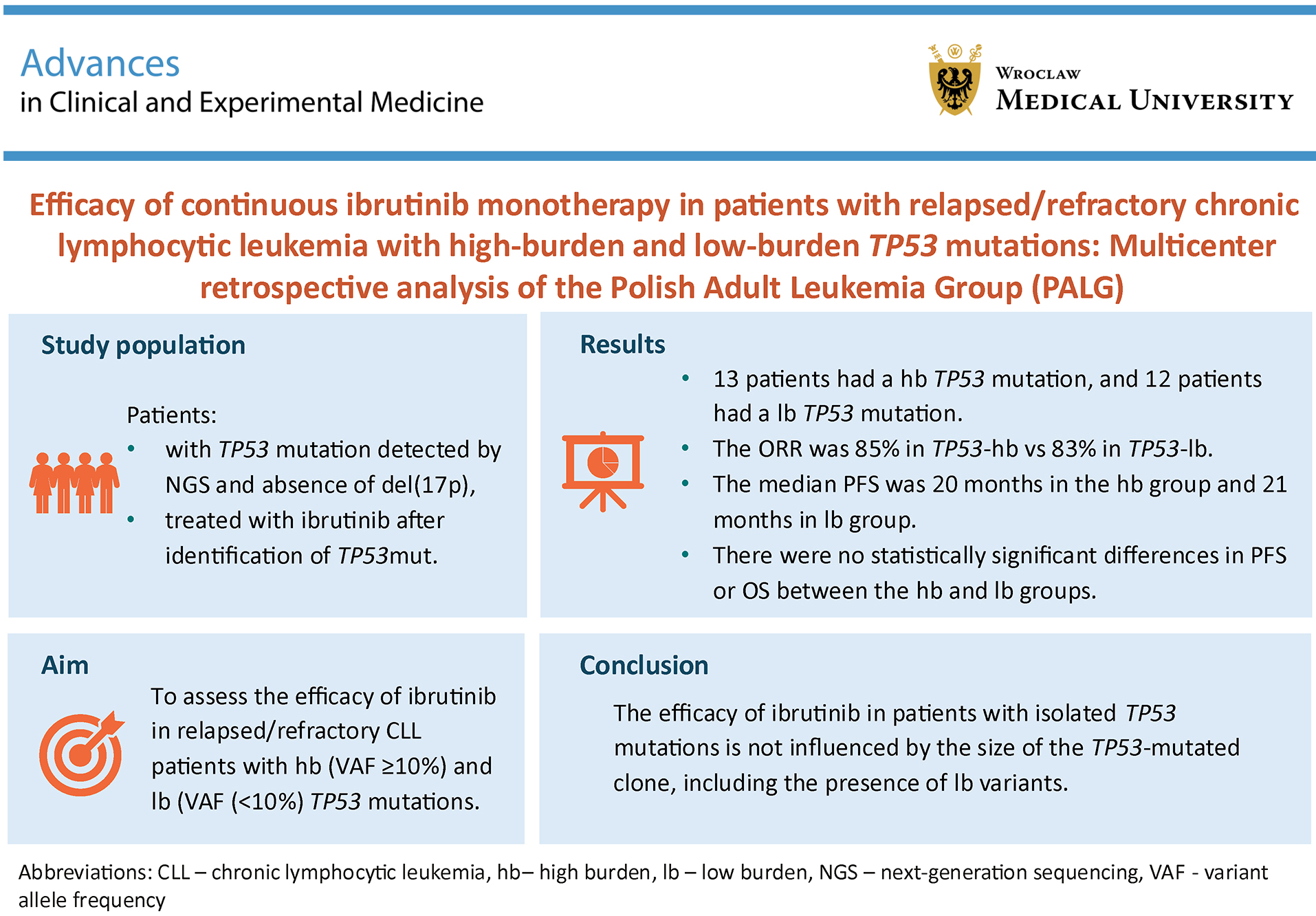
Results. Of the 468 patients tested using NGS, isolated TP53 mutations were identified in 76 patients, 25 of whom received ibrutinib. This cohort included 13 patients with high-burden mutations (variant allele frequency (VAF) ≥10%) and 12 with low-burden mutations (VAF < 10%). After a median follow-up of 19 months (range: 1–40 months), the best overall response rate (ORR) in the entire study cohort was 84%, with a median progression-free survival (PFS) of 21 months and a median overall survival (OS) of 21 months. There were no statistically significant differences in PFS or OS between the high- and low-burden groups (hazard ratio (HR) = 0.74 (95% confidence interval (95% CI): 0.28–2.01); p = 0.559 and HR = 0.75 (95% CI: 0.28–2.01), respectively).
Conclusions. In patients with isolated TP53 mutations, the efficacy of ibrutinib did not appear to differ according to mutational burden.
Key words: chronic lymphocytic leukemia, ibrutinib, next-generation sequencing, TP53 mutations
Background
Chronic lymphocytic leukemia (CLL) is characterized by a highly heterogeneous clinical course, ranging from indolent disease with prolonged survival without treatment to aggressive forms with rapid progression and poor prognosis.1, 2, 3 This variability is partly attributed to genetic abnormalities in CLL cells, most notably disruptions of the TP53 gene through deletion of the chromosome 17p13.1 region (del(17p)), leading to loss of one TP53 allele, and/or mutations within the TP53 coding region.
TP53 aberrations are the strongest prognostic and predictive markers in CLL and are associated with poor treatment response and markedly shorter survival in patients treated with chemoimmunotherapy (CIT).4, 5, 6 Recent advances in CLL therapy have markedly improved outcomes, offering patients with TP53 abnormalities access to effective targeted agents, B-cell receptor (BCR) and BCL2 inhibitors.7, 8, 9, 10, 11 Therefore, assessment of TP53 abnormalities significantly influences therapeutic decision-making in CLL.12, 13, 14
Historically, TP53 mutations in CLL were primarily investigated using conventional Sanger sequencing, which has a detection sensitivity limited to mutations with a variant allele frequency (VAF) of at least 10%. Currently, next-generation sequencing (NGS) is increasingly employed, enabling the detection of low-burden TP53 mutations, even at a VAF below 1%. Studies have shown that among isolated TP53 mutations, low-burden mutations are more common.15, 16, 17 According to the recently updated guidelines from the TP53 network of ERIC (European Research Initiative on CLL), a fixed VAF threshold is no longer recommended for reporting TP53 mutations. It remains essential to thoroughly validate or verify testing methods, particularly when identifying mutations present at low allele frequencies.15 Reporting all TP53 variants above the laboratory-defined detection limit is recommended. The preferred method is NGS, but Sanger sequencing can still be used if NGS is unavailable.15 Furthermore, ERIC highlights the importance of accurate classification of TP53 abnormalities – distinguishing between del(17p) and TP53 mutations, and between monoallelic and biallelic events. Inclusion of low-VAF TP53 variants in clinical trial designs is encouraged to generate robust evidence for personalized treatment approaches.15
In previous studies, isolated low-burden TP53 mutations have been observed in approx. 15–18% of patients with CLL.18, 19 While biallelic TP53 disruption, typically a TP53 mutation accompanied by del(17p), is clearly associated with inferior survival, the prognostic and predictive significance of isolated high-burden TP53 mutations remains less well defined. Inconsistent data from studies evaluating low-level TP53 mutations in patients receiving CIT suggest that these alterations may not clearly correspond to either high- or low-risk categories, but may instead indicate an intermediate-risk profile.20, 21, 22, 23, 24 Recently, results of an ERIC-coordinated multicenter study involving our laboratory on the role of low-VAF variants confirmed that such variants affected outcomes in patients receiving CIT.25 However, additional evidence is needed regarding the clinical impact of minor-clone TP53 mutations in the context of novel targeted therapies.
Objectives
The aim of the study was to assess the clinical significance of TP53 mutations in patients with relapsed/refractory CLL without del(17p) who were treated with ibrutinib.
Materials and methods
Study population
This retrospective analysis included a cohort of patients selected from a large observational study conducted by the Polish Adult Leukemia Study Group (PALG), entitled “Assessment of genetic and immunologic prognostic and predictive factors in relapsed and refractory chronic lymphocytic leukemia patients treated with B-cell receptor inhibitors: an observational study of the PALG”.26 Centralized data collection and peripheral blood biobanking were performed in accordance with the Declaration of Helsinki and with approval from the Ethics Committee of the Institute of Hematology and Transfusion Medicine in Warsaw, Poland (approval No. 47/2018). The inclusion criteria for the original PALG observational study, the NGS methodology, and a subset of the TP53 sequencing results have been described previously.26
For the present analysis, patients were selected based on the following criteria: 1) the presence of a TP53 mutation detected using NGS and the absence of del(17p); and 2) initiation of ibrutinib treatment immediately after identification of a TP53 mutation. TP53 mutations were categorized as high-burden or high-VAF (VAF ≥ 10%) and low-burden or low-VAF (VAF < 10%).
Assessment of the treatment response and adverse events
Clinical data for the selected patients were retrospectively collected from PALG centers through a review of medical records. Treatment responses were assessed according to the 2018 International Workshop on Chronic Lymphocytic Leukemia (iwCLL) criteria, and the clinical response was defined as the best response achieved during the treatment period.27 Adverse events (AEs) occurring during ibrutinib treatment were graded according to the National Cancer Institute Common Terminology Criteria for Adverse Events, v. 5.0.28
Statistical analyses
Time-to-event endpoints were progression-free survival (PFS) and overall survival (OS), measured from treatment initiation (time zero) to the corresponding event, with censoring at the last contact. Medians and 95% confidence intervals (95% CIs) were estimated using the Kaplan–Meier method, with numbers at risk reported. The proportional hazards assumption was assessed using Schoenfeld residuals. Group comparisons included: 1) the log-rank test and weighted Fleming–Harrington tests (ρ = 0, γ = 1 for late differences; ρ = 1, γ = 0 for early differences); 2) restricted mean survival time (RMST) analyses, which do not require proportional hazards, up to τ = 24 months as the primary horizon, with 36 months used for a sensitivity analysis, and between-group differences estimated with 95% bootstrap CIs based on 1,000 replicates (B = 1,000; seed = 123); and 3) univariable Cox proportional hazards models (using the Efron method to handle ties). Analyses were performed in R v. 4.5.1 (R Foundation for Statistical Computing, Vienna, Austria), using the survival v. 3.8-3 (https://CRAN.R-project.org/package=survival) and survRM2 v. 1.0-4 (https://CRAN.R-project.org/package=survRM2) packages, and verified using custom scripts. A p < 0.05 was considered statistically significant.
Results
Patients
Between November 2018 and February 2023, as part of the PALG observational study, TP53 sequencing using NGS was performed in 468 patients with relapse/refractory CLL, all of whom tested negative for del(17p) (fluorescence in situ hybridization (FISH) was used). Pathogenic or likely pathogenic TP53 mutations were identified in 76 patients (16.2%). Of these, subsequent treatment data were retrospectively available for 29 patients, of whom 25, from 11 hematology centers, received ibrutinib. The analyzed cohort included 15 men and 10 women, with a median age of 67 years (range: 58–83 years).
In the high-burden TP53 mutation cohort, unmutated IGHV (umIGHV) was observed in 7 patients (53.8%) and mutated IGHV (mIGHV) in 2 patients (15.4%), while 4 patients (30.8%) had borderline or nonproductive IGHV. Similarly, in the low-burden cohort, umIGHV was found in 6 patients (50.0%) and mIGHV in 2 patients (16.7%), with 4 patients (33.3%) also having borderline or nonproductive IGHV. Patient characteristics are summarized in Table 1.
The TP53 NGS analysis identified 13 patients with high-burden mutations and 12 patients with low-burden variants. All mutations were located within exons 2–11. Point mutations were the most common, although frameshift mutations were detected in 4 patients. Seven patients carried 2 distinct mutations. Detailed NGS results are provided in Table 2.
Treatment results
The median follow-up was 19 months (range: 1–40 months). The overall response rate (ORR) in the entire study cohort was 84%, and median PFS and OS were both 21 months. The 12-month PFS rate was 75.2% (95% CI: 52.7–88.0%), and the 12-month OS rate was 75.2% (95% CI: 52.7–88.0%).
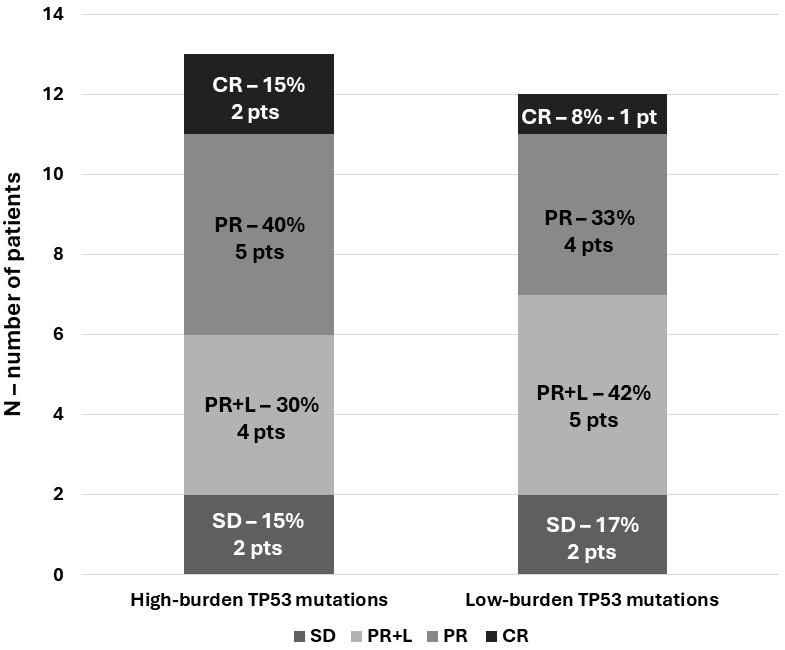
Due to the small sample size, only univariable analyses were conducted to compare treatment outcomes in patients stratified by high- and low-burden TP53 mutations. The ORR was similar in both subgroups (84.6% and 83.3% in the high- and low-burden groups, respectively) (Figure 1). The ORR was compared between the TP53-high and TP53-low groups. Effect sizes are reported as the absolute risk difference (RD), risk ratio (RR), and odds ratio (OR) with 95% CIs. The ORR was 85% (11/13) in the TP53-high group vs 83% (10/12) in the TP53-low group. The RD was +1% (95% CI: −28% to +31%), the RR was 1.02 (95% CI: 0.72–1.45), and the OR was 1.10 (95% CI: 0.14–8.35). Fisher’s exact test did not show a significant difference (group sizes: 13 and 12; OR = 1.10, 95% CI: 0.14–8.35; p = 1.000) (Table 3).
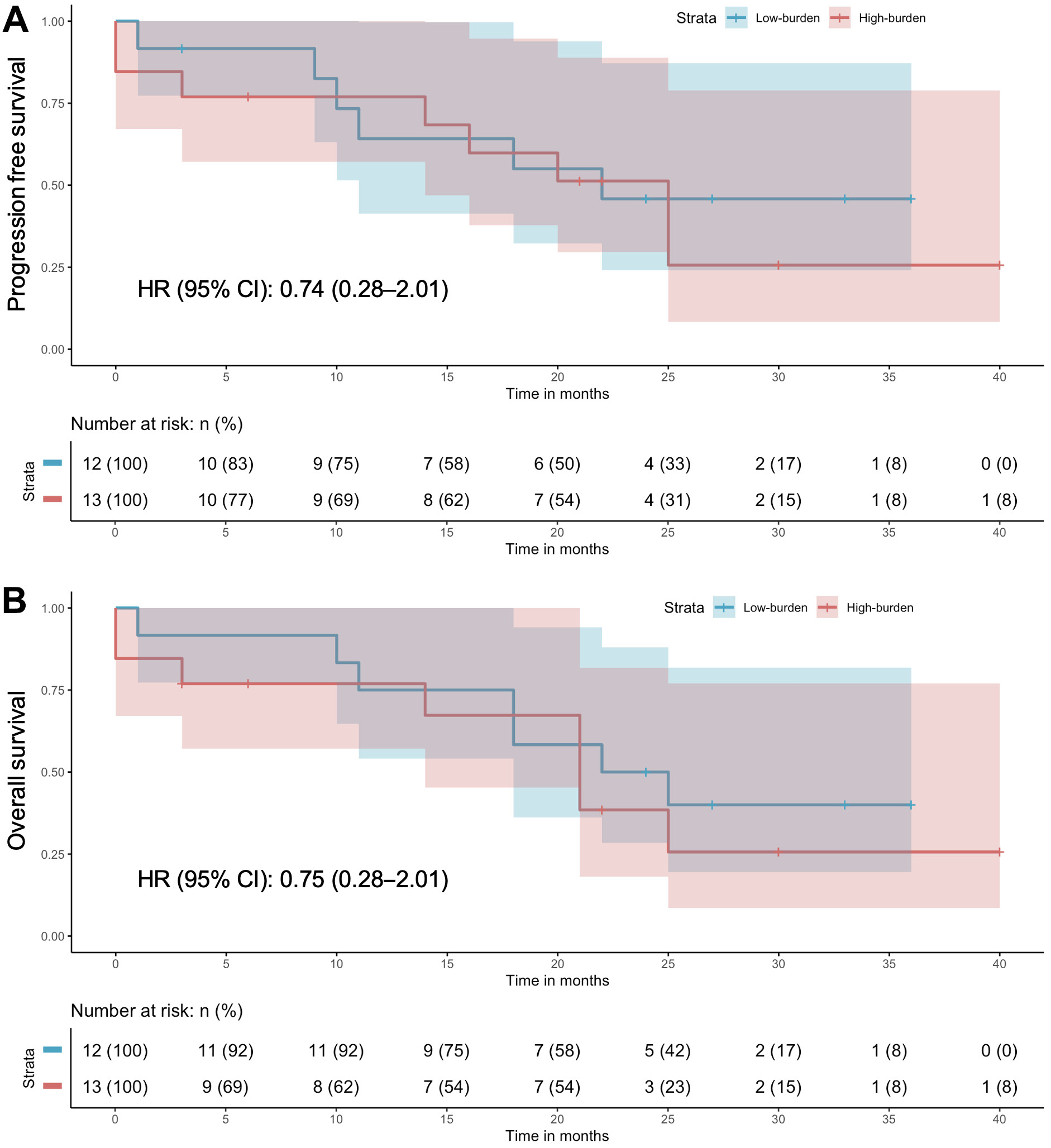
The median PFS in the high-burden group was 20 months, compared with 21 months in the low-burden group (hazard ratio (HR) = 0.87, 95% CI: 0.31–2.49). There were no statistically significant differences in PFS between the groups (HR = 0.74, 95% CI: 0.28–2.01; p = 0.559) (Figure 2, Table 4).
Ibrutinib therapy was discontinued in 15 patients (60%). The reasons for discontinuation were AEs in 7 patients (28%), progressive disease in 7 patients (28%), and an unknown reason in 1 patient (4%). Two patients experienced Richter transformation, with diffuse large B-cell lymphoma (DLBCL) diagnosed in both cases. Adverse events leading to ibrutinib discontinuation included infections, mainly pneumonia (in 5 patients, 20%), including 3 cases related to COVID-19.
The median OS in the high-burden TP53 mutation group was 22 months, compared with 21 months in the low-burden group (HR = 0.78, 95% CI: 0.28–2.19). Overall survival did not differ significantly between the groups (HR = 0.75, 95% CI: 0.28–2.01; p = 0.562) (Figure 2). The most frequent causes of death among the 15 patients who died were infections (6 patients, 40%) and CLL progression (6 patients, 40%). Among infection-related deaths, COVID-19 was the confirmed cause in 4 patients (27%). The cause of death was either unknown or not reported for 3 patients (20%).
The Schoenfeld residuals test did not demonstrate a violation of the proportional hazards assumption (PFS: p = 0.730; OS: p = 0.860). However, as the Kaplan–Meier curves appeared to cross, we also report RMST estimates as summary measures that do not require proportional hazards. RMST analysis up to τ = 24 months showed a restricted mean PFS of 16.7 months for TP53 = 0 (low-burden TP53-mutation) vs 18.1 months for TP53 = 1 (high-burden TP53 mutation), with a difference of +1.4 months (95% CI: −4.8 to 10.5 months). For OS, RMST was 17.3 months vs 18.9 months, with a difference of 1.6 months (95% CI: −4.6 to 7.8 months). Sensitivity analyses at τ = 36 months yielded consistent results (PFS difference: +6.3 months; 95% CI: −8.2 to 23.3 months; OS difference: +6.5 months; 95% CI: −7.2 to 22.5 months). The RMST analysis up to 24 months did not demonstrate significant differences between TP53 groups. The restricted mean PFS and OS were approx. 1–2 months longer in the TP53 = 1 (high-burden TP53 mutation) group; however, the 95% CIs included differences favoring either group as well as no difference. In the sensitivity analysis at 36 months, differences increased to about 6 months yet remained statistically nonsignificant, with wide CIs. Additionally, Fleming–Harrington weighted tests were consistent with the log-rank test, showing no significant differences between groups (PFS: FH(0.1) p = 0.392; FH(1.0) p = 0.701; OS: FH(0.1) p = 0.399; FH(1.0) p = 0.701). These results support the finding that no statistically significant differences between the survival curves were detected.
The observed toxicity profile of ibrutinib was consistent with previous reports. The most frequent AEs observed during ibrutinib therapy included infections (mainly pneumonia and COVID-19) and diarrhea. Overall, 12 patients (48%) experienced at least 1 grade 3 or 4 AE. Infections of any grade were reported in 21 patients (84%), including 4 cases of COVID-19 (16%). Diarrhea was observed in 5 patients (20%), all with grade 2 events. Rash was reported in 2 patients (8%), and bleeding-related AEs occurred in 2 patients (8%), one of whom experienced severe epistaxis (grade 3). Atrial fibrillation occurred in 2 patients (8%), with both events classified as grade 2. Most AEs resolved without the need for treatment interruption. However, 7 patients (28%) required ibrutinib dose reductions, primarily due to recurrent infections and thrombocytopenia.
Discussion
Given the uncertain significance of isolated minor-clone TP53 mutations in the context of targeted therapies in CLL, our study aimed to compare the impact of isolated low-burden and high-burden TP53 mutations on the efficacy of ibrutinib in patients with relapse/refractory CLL treated in routine clinical practice. We found that in heavily pretreated patients with relapse/refractory CLL and an isolated TP53 mutation, PFS was unsatisfactory despite a relatively high response rate to ibrutinib. Our results did not identify statistically significant associations between TP53 mutant clone burden and the likelihood of response to ibrutinib or survival in this patient population.
TP53 abnormalities, including both deletions (del(17p)) and mutations at the TP53 locus, are associated with an adverse prognosis and predict chemoresistance in CLL.29 Ibrutinib has demonstrated the ability to induce apoptosis and disrupt BCR signaling independently of p53 function.30 This suggests that its antitumor effect may not rely on intact p53 pathways. Preclinical studies support the notion that ibrutinib can bypass p53-dependent apoptotic signaling, which could explain its activity in CLL with TP53 mutations or deletions.30, 31 Nevertheless, the precise mechanisms remain under investigation, and further research is warranted to determine whether these agents modulate p53 function or act through entirely alternative pathways.
The most recent guidelines from the TP53 network of ERIC recommend precise classification of TP53 aberrations (del(17p) vs TP53 mutation, monoallelic vs biallelic aberrations), although a specific VAF cutoff for reporting TP53 mutations is no longer recommended. Instead, the guidelines emphasize the need for thorough method validation or verification, especially for detecting low-VAF TP53 mutations.15 In many published studies examining new therapies in CLL, del(17p) and TP53 mutations were not distinguished,32, 33, 34 while in others, only del(17p) was considered.35 In the context of targeted treatments, patients harboring both TP53 mutations and del(17p) tend to have less favorable prognoses, indicating an independent negative prognostic impact.36
In contrast, the clinical significance of single-hit TP53 aberrations (isolated del(17p) or TP53 mutation only) remains less clear.36, 37, 38, 39 Studies have shown that treatment-naïve (TN) patients with CLL and del(17p) or high-burden TP53 mutations who receive ibrutinib have shorter OS than patients without these aberrations.37, 40 However, recent analyses have indicated that single-hit TP53 aberrations (either a single TP53 mutation or del(17p) alone) in patients with CLL treated with ibrutinib are associated with better outcomes than multi-hit TP53 aberrations.36, 41 Furthermore, evidence regarding the significance of isolated low-burden TP53 mutations in the context of targeted therapies remains limited, and the results are inconsistent.36, 40, 42
Our results are consistent with the findings of Bomben et al.,37 who analyzed a larger cohort of patients with TN or relapse/refractory CLL, including 60 patients with isolated TP53 mutations (28 with low-burden mutations) treated with ibrutinib. As in our study, no differences in OS or PFS were observed between the low- and high-VAF TP53 mutation groups. Importantly, patients with TP53 mutations, regardless of whether VAF was <10% or ≥10%, had shorter OS than those with TP53 wild-type disease. Cherng et al.40 presented a retrospective analysis of 130 patients with CLL and baseline TP53 alterations who received first-line Bruton tyrosine kinase inhibitor (BTKi)-based therapy. This analysis showed favorable 4-year PFS and OS rates of 72.9% and 83.6%, respectively, with no significant difference in PFS among patients with both del(17p) and TP53 mutations, del(17p) only, or TP53 mutation only. The clone size (VAF) of TP53 mutations was not associated with PFS (HR = 1.0, 95% CI: 0.34–2.88). However, this study did not report a comparison of isolated low-burden and high-burden TP53 mutations.40 In another study, Brieghel et al.36 analyzed TP53 alterations in 51 patients with TN or relapse/refractory CLL treated with ibrutinib. They found that a VAF cutoff of 1% was an appropriate threshold for TP53 mutation “positivity,” maintaining the predictive value of TP53 mutations. Patients with a single TP53 aberration (either del(17p) or a TP53 mutation) had superior PFS and OS to those with multiple TP53 alterations. However, a limitation of the study was the lack of stratification by TP53 clone size, along with the inclusion of both newly diagnosed and previously treated individuals.36
Importantly, our results can also be contrasted with the findings of Pula et al.,43 who reported the outcomes of a large, real-world cohort of patients with relapsed/refractory CLL treated with ibrutinib from the PALG. In that multicenter observational study, which included 171 patients, the median PFS and OS in the entire cohort were not reached, and the estimated 4-year PFS and OS rates were 60.9% and 65.4%, respectively – substantially more favorable than in our population, in which median PFS and OS were both 21 months.
In the subgroup of 42 patients with del(17p), Pula et al. reported a median PFS of 38.9 months and a median OS of 52.9 months – still more favorable than those observed in our group (PFS: 21 months; OS: 21 months). Several factors may have contributed to these differences, including variations in baseline characteristics, such as greater prior treatment exposure and a higher comorbidity burden in our cohort. Importantly, the study by Pula et al. was conducted before the COVID-19 pandemic, whereas our analysis includes patients treated during the pandemic period, which may have adversely affected clinical outcomes. In our cohort, COVID-19-related complications were a leading cause of death and a major reason for treatment discontinuation. This factor may have contributed substantially to the shorter survival observed, particularly in a patient population already characterized by immunosuppression and frailty.
In addition to TP53 mutations, other factors may have contributed to the unfavorable prognosis in our study. These include extensive prior treatment exposure (a median of 3 previous lines of therapy), poor performance status (28% of patients had an ECOG performance status score >1), and a substantial burden of comorbidities (a median Cumulative Illness Rating Scale (CIRS) score of 6). Furthermore, treatment occurred during the COVID-19 pandemic, which may have adversely affected outcomes. Infections, potentially exacerbated by both disease-related and treatment-related immunosuppression, were a joint leading cause of death in this cohort (6 of 15 deaths, 40%), with COVID-19-related pneumonia confirmed in 4 patients (27% of deaths). Importantly, pneumonia was also the most frequent AE leading to permanent discontinuation of ibrutinib (5 patients, 20%), including 3 COVID-19-related cases. Ibrutinib itself may also contribute to increased susceptibility to infections through its immunomodulatory and immunosuppressive effects. Several studies have reported an increased incidence of both opportunistic infections and severe bacterial, fungal, or viral infections – including respiratory tract infections – during ibrutinib therapy, particularly in previously treated patients or those with comorbidities.44, 45
Limitations of the study
This study highlights an important aspect of the prognostic relevance of isolated TP53 mutations in patients with CLL treated with ibrutinib. Despite its strengths, several limitations must be acknowledged. Most notably, the relatively small sample size reduces statistical power, widens the CIs for HR estimates, and precludes robust conclusions regarding subgroup differences. The absence of multivariable adjustment further limits the ability to distinguish the association between TP53 mutation burden and survival outcomes from the effects of potential confounders, such as IGHV mutation status, comorbidities, and patient performance status. Additionally, the retrospective design introduces the potential for bias, and the influence of treatment timing during the COVID-19 pandemic cannot be ruled out. Despite these limitations, our study adds to the growing body of evidence suggesting that TP53 clone size may not be a decisive factor in predicting outcomes during ibrutinib treatment, at least in relapse/refractory CLL.
Conclusions
The results of our analysis did not reveal statistically significant differences in ibrutinib outcomes between patients with isolated low- and high-burden TP53 mutations. However, given the retrospective nature of the study and the limited sample size, these observations should be interpreted with caution. Further prospective studies involving larger patient cohorts are warranted to assess the association between mutation burden and treatment outcomes and to clarify the prognostic and predictive significance of TP53 mutation burden in the context of BTKi therapy in CLL.
Data Availability Statement
The datasets supporting the findings of the current study are openly available in Zenodo at https://doi.org/10.5281/zenodo.18014723.
Consent for publication of personal information
Not applicable.
Use of AI and AI-assisted technology
Not applicable.