



Abstract
Background. Rocuronium injection often causes limb withdrawal reactions in preschool children during anesthesia induction, which can lead to adverse effects. Esketamine has been reported to reduce such reactions, but the optimal dose remains unclear.
Objectives. To observe the effect of different doses of esketamine administered in advance on limb withdrawal reactions caused by rocuronium in preschool children.
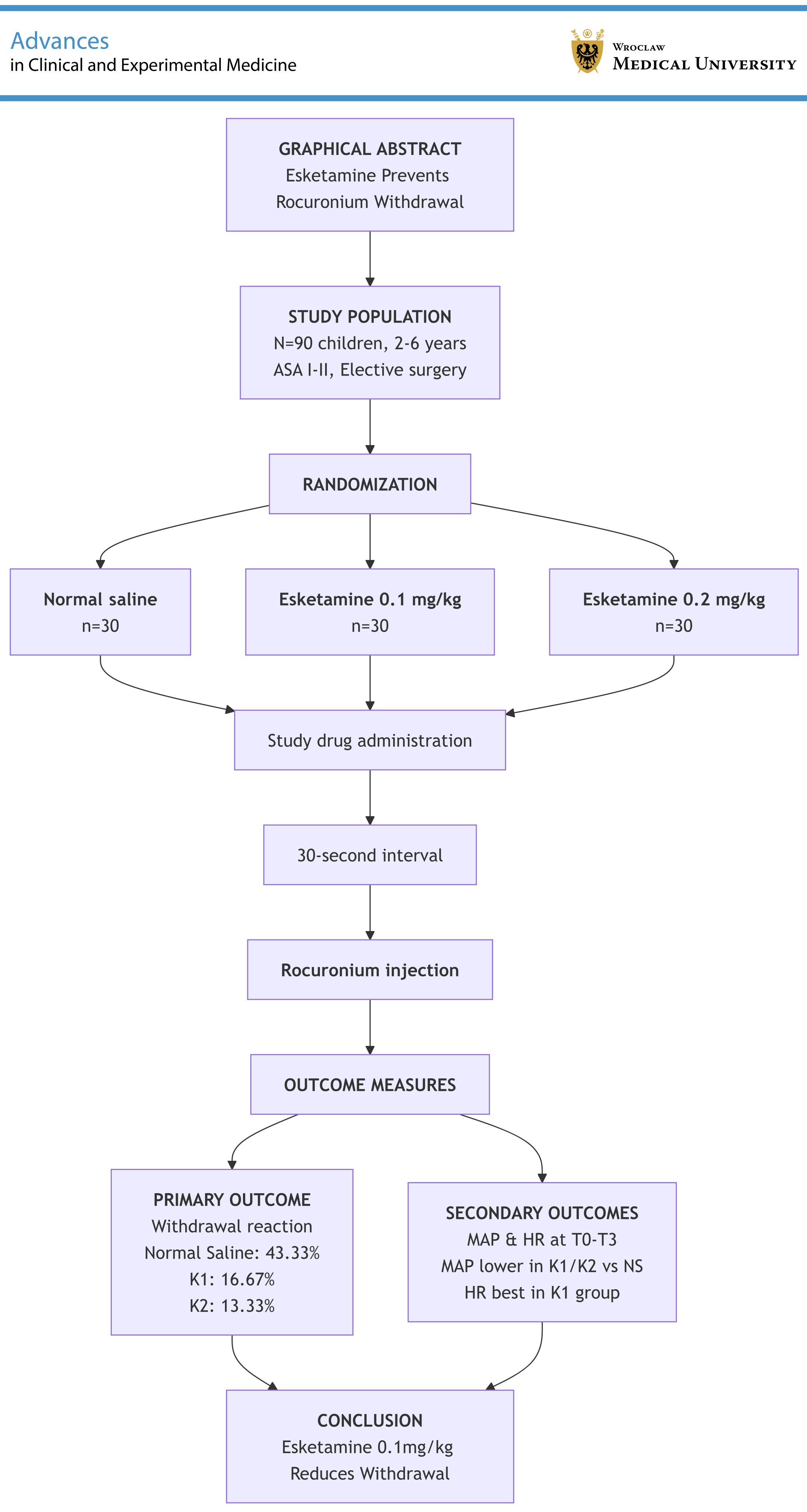
Materials and methods. From January to December 2024, children aged 2–6 years (American Society of Anesthesiologists Physical Status Classification System (ASA) I–II) undergoing elective surgery with general anesthesia induction using rocuronium at Hangzhou Children’s Hospital were enrolled, regardless of gender (90 cases in total). Patients were divided using a random number table into 3 groups: a control group (group C), an esketamine 0.1 mg/kg group (group K1), and an esketamine 0.2 mg/kg group (group K2). Each group received either saline (group C), 0.1 mg/kg esketamine (group K1), or 0.2 mg/kg esketamine (group K2), with 30 cases in each group. Thirty seconds later, all patients were administered rocuronium intravenously. Mean arterial pressure (MAP) and heart rate (HR) were recorded at 4 time points: before anesthesia induction (T0), before test drug injection (T1), before rocuronium injection (T2), and after rocuronium injection (T3). The incidence and severity of limb withdrawal reactions after rocuronium injection and adverse reactions were recorded.
Results. Compared with T0, MAP and HR significantly decreased in all 3 groups before test drug injection (T1) (p < 0.05). After rocuronium injection (T3), MAP and HR significantly increased in group C (p < 0.05). Heart rate significantly increased at T2 and T3 in group K2 (p < 0.05). The incidence of limb withdrawal reactions was 43.33% in group C, 16.67% in group K1, and 13.33% in group K2, with statistically significant differences among the groups. The severity of limb withdrawal reactions also differed significantly among the 3 groups.
Conclusions. Prophylactic intravenous injection of 0.1 mg/kg esketamine effectively reduces the limb withdrawal reaction caused by rocuronium injection.
Key words: esketamine, rocuronium bromide, pediatric anesthesia, injection pain, drug dose–response relationship
Background
Rocuronium bromide is a widely used intermediate-to-long-acting non-depolarizing muscle relaxant for general anesthesia induction.1 It is a cornerstone medication for rapid sequence induction in patients with a full stomach. However, intravenous (IV) administration of rocuronium often causes injection pain of varying severity. Even after the loss of consciousness during anesthesia induction, the pain may still trigger an involuntary limb withdrawal reaction.2, 3 According to relevant studies, the incidence of pain following rocuronium injection exceeds 50% in adult patients and can be as high as 80% in pediatric patients.4, 5, 6 The limb withdrawal reaction may lead to complications such as dislodgement or removal of the IV cannula, extravasation of IV medications, swelling at the injection site, and delays in anesthesia induction. In severe cases, whole-body movement may cause regurgitation and aspiration, increasing the perioperative risk for pediatric patients.7 Esketamine, the S-enantiomer of ketamine, is 2–3 times more potent than ketamine in terms of anesthetic efficacy.8, 9 It offers strong sedative and analgesic effects as well as rapid onset, requires a smaller dose, and causes fewer cardiovascular and neuropsychiatric side effects.10 It also has a fast metabolism, high clearance rate, minimal impact on respiratory and circulatory function in children, and enables quick recovery, making it especially suitable for pediatric anesthesia.11, 12 Currently, most domestic and international studies on the prevention of rocuronium-induced injection pain have focused on adult patients, with limited attention to pediatric populations, especially preschool children.
Objectives
This study aims to investigate the effect of different doses of esketamine in preventing limb withdrawal reactions caused by rocuronium injection in preschool children, providing a clinical reference for alleviating injection pain in this age group.
Materials and methods
General information
This clinical study was approved by the Hangzhou Children’s Hospital (China) ethics committee (approval No. 2025-006(Scientific)-01). From January to December 2024, children scheduled for elective surgery requiring tracheal intubation and general anesthesia induction with rocuronium bromide at Hangzhou Children’s Hospital were selected. Gender was not limited; age ranged from 2 to 6 years; American Society of Anesthesiologists Physical Status Classification System (ASA) physical status I–II; a total of 90 cases. Exclusion criteria were as follows: significant liver or kidney dysfunction; high risk of elevated blood pressure or intracranial pressure; severe heart disease; neuropsychiatric disorders; history of eye disease; difficulty with peripheral venous access; use of sedatives or analgesics within 24 h preoperatively; and allergy to the study drug; or emergency surgery. Elimination criteria were as follows: transfer to the intensive care unit (ICU) postoperatively or failure to complete the study due to interference. Patients were randomly divided using a random number table into a control group (group C), an esketamine 0.1 mg/kg group (group K1), and an esketamine 0.2 mg/kg group (group K2), with 30 cases in each group.
Anesthesia method
No premedication was used in any group. All patients fasted for 8 h and refrained from drinking for 2 h before anesthesia. Peripheral intravenous access was established in the forearm in the pre-anesthesia room. Upon entering the operating room, routine electrocardiographic (ECG) monitoring was conducted, including ECG, noninvasive blood pressure (NIBP), heart rate (HR), and pulse oxygen saturation (SpO2). Lactated Ringer’s solution was infused via a peripheral vein at 5–10 mL/kg/h. The arm used for injection was placed flat on an arm board to observe any limb movement due to injection pain. Anesthesiologists prepared the study drugs, diluting the corresponding dose of esketamine with saline to 2 mL. After adequate preoxygenation, anesthesia induction was initiated with IV propofol dose of 2–4 mg/kg. Loss of consciousness was defined as the disappearance of the eyelash reflex or no response after calling the child’s name twice. Then, 2 mL of either normal saline or the appropriate dose of esketamine was injected. After a 30-s interval, rocuronium 0.6 mg/kg was administered intravenously. The assessment was conducted separately by 2 anesthesiologists who were unaware of the group allocation. Limb withdrawal reaction was scored within 20 s of rocuronium injection. One minute after rocuronium injection, sufentanil 0.3 µg/kg was administered. Tracheal intubation was performed once intubation conditions were met. Anesthesia was maintained with 1–2% sevoflurane and continuous IV infusion of propofol (35–50 µg/kg/min) combined with remifentanil (0.2–0.3 µg/kg/min). Drug dosages were adjusted according to Bispectral Index (BIS) monitoring to maintain mean arterial pressure (MAP) and HR within ±20% of baseline values. Pressure-controlled mechanical ventilation was used, and respiratory parameters were adjusted to maintain partial pressure of end-tidal carbon dioxide (PetCO2) at 35–45 mm Hg. Rocuronium 0.2 mg/kg was administered every hour, with muscle relaxants discontinued 1 h before the end of surgery. All patients were extubated in the operating room and transferred to the recovery room and returned to the ward once discharge criteria from the recovery room were met.
Observation indicators
Mean arterial pressure and HR were recorded at the following time points: before induction (T0), before test drug injection (T1), before rocuronium injection (T2), and after rocuronium injection (T3). Limb withdrawal reaction was scored within 20 s after rocuronium injection. The injection pain withdrawal movement (IPWM) score6 was defined as: 1 point (none) – no reaction; 2 points (mild) – movement limited to the wrist; 3 points (moderate) – movement of the elbow or shoulder on the injection side; 4 points (severe) – movement of the whole body, possibly accompanied by coughing or vomiting. Adverse reactions after esketamine administration, such as dizziness, nausea, and psychiatric symptoms, were also recorded. The assessment of psychiatric symptoms was conducted as follows: During the preoperative visit, the anesthesiologist inquired about the child’s typical behaviors in daily life to establish a baseline. Twenty-four hours after the child was discharged from the recovery room, an anesthesiologist who was unaware of the group allocation followed up with the parents, actively asking whether there had been any changes in the child’s attention, emotions, memory, or sleep patterns. Tachycardia (HR > 20% of baseline) and hypertension (NIBP > 20% of baseline) were also recorded.
Statistical analyses
Statistical analysis was performed using IBM SPSS v. 25.0 (IBM Corp., Armonk, USA). Measurement data that were normally distributed are presented as the mean ± standard deviation (SD; x– ±s), while non-normally distributed data are presented as the median (interquartile range (IQR)). Categorical data are expressed as number (percentage). For the primary outcome, the incidence of the withdrawal response, the χ2 test was used to compare differences among the 3 groups. If the overall difference was statistically significant, pairwise comparisons were further conducted using the χ2 partitioning method, with the significance level adjusted using the Bonferroni correction. For the ordinal categorical variable of withdrawal response severity, the Kruskal–Wallis H test was employed for comparisons across the 3 groups. A statistically significant overall finding was followed by pairwise comparisons using the Mann–Whitney U test, with an adjusted significance level. For repeated-measures data such as MAP and HR that conformed to a normal distribution, repeated-measures analysis of variance (ANOVA) was used to assess between-group effects, time effects, and interaction effects. The data underwent a sphericity test; if the sphericity assumption was not met, the Greenhouse–Geisser correction was applied. If the group × time interaction effect was statistically significant, a simple-effects analysis was performed. In the simple-effects analysis, paired-samples t-tests were used for pairwise comparisons at different time points within a group, whereas independent-samples t-tests were used for pairwise comparisons at the same time point between groups. All p-values from the t-tests were corrected using the Bonferroni method. A p < 0.05 was considered statistically significant.
Results
Comparison of general information among the 3 groups
A total of 90 children were enrolled in this study. There were no statistically significant differences among the 3 groups in terms of gender, age, body mass index (BMI), or ASA classification (p > 0.05), as shown in Table 1.
Comparison of mean arterial pressure and heart rate among the 3 groups
Compared to pre-induction values, differences in MAP and HR before administration of the test dose in groups C, K1, and K2 were statistically significant (p < 0.05). In group C, significant differences were observed in MAP (p = 0.022) and HR (p = 0.006) after rocuronium injection compared to before injection. In group K1, no statistically significant difference in HR was found before and after rocuronium injection (p = 0.062). In group K2, a statistically significant difference in HR was noted after rocuronium injection compared to before injection (p = 0.001). No statistically significant differences in MAP or HR were observed among the 3 groups at the time points of pre-induction and before test dose administration (Table 2, Table 3).
Comparison of incidence and severity of limb withdrawal reaction among the 3 groups
As illustrated in Table 4, there was no statistical significance difference observed between group K1 and group K2 (p = 1.00) via Bonferroni correction. However, the incidence of limb withdrawal reaction was 43.33% in group C, 16.67% in group K1, and 13.33% in group K2, with statistically significant differences among the 3 groups (p < 0.05) (Table 5). Additionally, comparison of the severity of limb shrinkage reaction among the 3 groups also showed statistically significant differences (p < 0.05) (Table 6). Specifically, there was a statistically significant difference in severity between group C and group K1 (p = 0.021), as well as between group C and group K2 (p = 0.009).
Comparison of other observational indicators
No dizziness, nausea, psychiatric symptoms, tachycardia (HR > 20% above baseline), or hypertension (NIBP > 20% above baseline) were observed in any of the 3 groups.
Discussion
Based on a pre-specified effect size (f = 0.25), an ANOVA power analysis indicated that a minimum of 27 participants per group would be required to achieve 80% statistical power (α = 0.05). Accounting for an estimated dropout rate of approx. 10% (e.g., due to loss to follow-up or incomplete data), we planned to enroll 30 participants per group, resulting in a total sample size of 90. After IV administration, esketamine reaches its peak pharmacological effect within 1 min. Therefore, administering rocuronium intravenously approx. 30 s later aligns with the window of its strongest analgesic efficacy, which is advantageous for the evaluation of study outcomes.
Rocuronium bromide is widely used in clinical anesthesia due to its rapid onset, absence of histamine release, lack of significant cardiovascular adverse effects, and the availability of a specific antagonist.1, 2, 3 However, IV injection of rocuronium often causes injection pain and limb withdrawal reactions, which can negatively impact pediatric patients’ anesthesia experience, increase the risk of anesthetic-related adverse events, and reduce perioperative satisfaction.4, 5 The mechanism of rocuronium-induced injection pain has not been fully elucidated and may be related to various factors, including its low pH value, non-physiological osmolarity, storage temperature, and stimulation of chemoreceptors by endogenous inflammatory mediators.6, 7, 8 Esketamine has multiple targets of action; its anesthetic and analgesic effects mainly stem from non-competitive antagonism of NMDA receptors, alleviating pain by blocking NMDA receptors in the vascular endothelium and central nervous system.9, 10 It also acts on Na+ channels, opioid receptors, and GABA receptors. Even at low doses, esketamine provides strong analgesic and sedative effects and can significantly reduce opioid requirements.11
Pre-injection of lidocaine intravenously, regardless of whether venous occlusion was applied, can reduce the incidence of rocuronium-induced injection pain or limb withdrawal reaction and is more effective in preventing moderate to severe reactions.12 However, study indicated that the efficacy of lidocaine in preventing rocuronium-induced limb withdrawal is dose-dependent and shows a ceiling effect, with a recommended dose below 1 mg/kg.13, 14 Lidocaine is a peripheral local anesthetic that acts by blocking sodium channels in nerve endings at the injection site. However, if the drug is administered into a larger vein with rapid blood flow, it may be quickly diluted and carried away from the local tissue, potentially reducing its anesthetic efficacy.
Considering efficacy and convenience, pretreatment with opioids during anesthesia induction can reduce the incidence of rocuronium-induced limb withdrawal reactions.15 Intravenous alfentanil (10 µg/kg) is more effective and has fewer side effects than remifentanil (1 µg/kg) in preventing rocuronium-induced injection pain.5, 15 Nonsteroidal anti-inflammatory drugs (NSAIDs), commonly used in multimodal analgesia, can reduce postoperative incision pain and discomfort at the surgical site.16 A systematic review10 indicated that pretreatment with IV antipyretic analgesics can reduce pain and limb withdrawal reactions caused by rocuronium injection.17 5-hydroxytryptamine-3 (5-HT3) receptor antagonists, commonly used to prevent and treat postoperative nausea and vomiting, have also been found in studies to prevent rocuronium
injection pain.18, 19
Esketamine at 0.05–0.1 mg/kg has a dose–effect relationship; with increasing dose, the effect in reducing propofol-induced injection pain becomes more pronounced.20, 21 Pre-injection of 0.1 mg/kg esketamine can effectively suppress pain caused by propofol injection, with almost no effect on hemodynamics.22 Liou et al. found that prophylactic injection of 0.1 mg/kg esketamine effectively reduces limb withdrawal reactions induced by rocuronium.23 However, that study was limited to female patients and did not eliminate the potential influence of intravenously administered opioids on the limb withdrawal response induced by rocuronium during the sequence of anesthetic induction.
Children differ from adults in both pain perception and drug sensitivity and are more prone to anesthesia non-cooperation, airway obstruction, and agitation during recovery, increasing anesthetic risk and affecting recovery safety.24 The results of this study indicate that pre-injection of esketamine at both 0.1 mg/kg and 0.2 mg/kg during anesthesia induction can effectively reduce the incidence and severity of limb withdrawal reactions caused by rocuronium injection in preschool children. However, administration of 0.2 mg/kg esketamine led to a significant increase in HR. Although increasing the dose further reduced limb withdrawal, it also increased the risk of cardiovascular adverse effects.25
Esketamine effectively inhibits limb withdrawal reactions triggered by rocuronium injection, possibly through non-competitive antagonism of vascular endothelial NMDA receptors to attenuate peripheral nociceptive transmission and through central NMDA receptor blockade to provide central analgesia.26 Esketamine exerts its central analgesic effect by acting on both the brain and spinal cord, directly elevating the pain threshold throughout the entire central nervous system. Regardless of which vein rocuronium is administered through, esketamine’s central analgesic efficacy remains consistently stable.
The plasma concentration of esketamine required for inducing anesthesia is much higher than that required for analgesia. A plasma level ≥0.05 mg/L can raise the pain threshold, and its analgesic effect may persist even after the anesthetic effect wears off.27 Moreover, adverse effects of esketamine are dose-dependent; thus, low-dose use can achieve adequate analgesia while minimizing side effects.28
Furthermore, the use of low-dose esketamine during anesthesia induction can produce synergistic effects with induction agents (propofol/etomidate) and opioids (fentanyl/sufentanil/remifentanil). This combination results in a smoother induction process, attenuates stress responses triggered by procedures such as endotracheal intubation, and may also prevent hyperalgesia, particularly in patients receiving remifentanil. Additionally, esketamine effectively preserves spontaneous breathing and airway reflexes. By stimulating the sympathetic nervous system, it induces transient elevation in blood pressure and HR, which helps counteract hypotension potentially caused by propofol and other induction agents, thereby maintaining hemodynamic stability during the induction phase.
Limitations of the study
This study has certain limitations. First, it was a randomized controlled trial (RCT) conducted in a single center with a total sample size of 90 cases. Although the sample size met statistical requirements, the relatively small sample size may limit the power to detect rare adverse reactions (such as severe psychiatric symptoms). Second, the primary outcome measure – the IPWM score – relies on the visual observation and subjective judgment of the anesthesiologist. Although blinding was used for the assessors, there is still a risk of subjective assessment bias. Third, for possible neuropsychiatric adverse reactions caused by esketamine, our follow-up period was limited to 24 h postoperatively. Some delayed or more subtle behavioral changes may not have been fully captured within this time window. Fourth, the subjects of this study were children aged 2–6 years with ASA I–II undergoing elective surgery. Therefore, the conclusions of this study may not be applicable to newborns, infants, children with more severe conditions (ASA III and above), or children undergoing
emergency surgery.
Conclusions
Pre-injection of 0.1 mg/kg esketamine during anesthesia induction can significantly reduce the incidence and severity of limb withdrawal reactions caused by IV rocuronium injection in preschool children. It has no effect on cognitive function and causes no cardiovascular adverse reactions, providing a reference for the safe and effective clinical use of esketamine to prevent limb withdrawal reactions during IV rocuronium injection for tracheal intubation in pediatric general anesthesia induction.
Data Availability Statement
The anonymized datasets generated and analyzed during this study may be obtained from the corresponding author upon reasonable request, subject to approval by the Ethics Committee of Hangzhou Children’s Hospital.
Consent for publication of personal information
Not applicable.
Use of AI and AI-assisted technologies
Not applicable.