



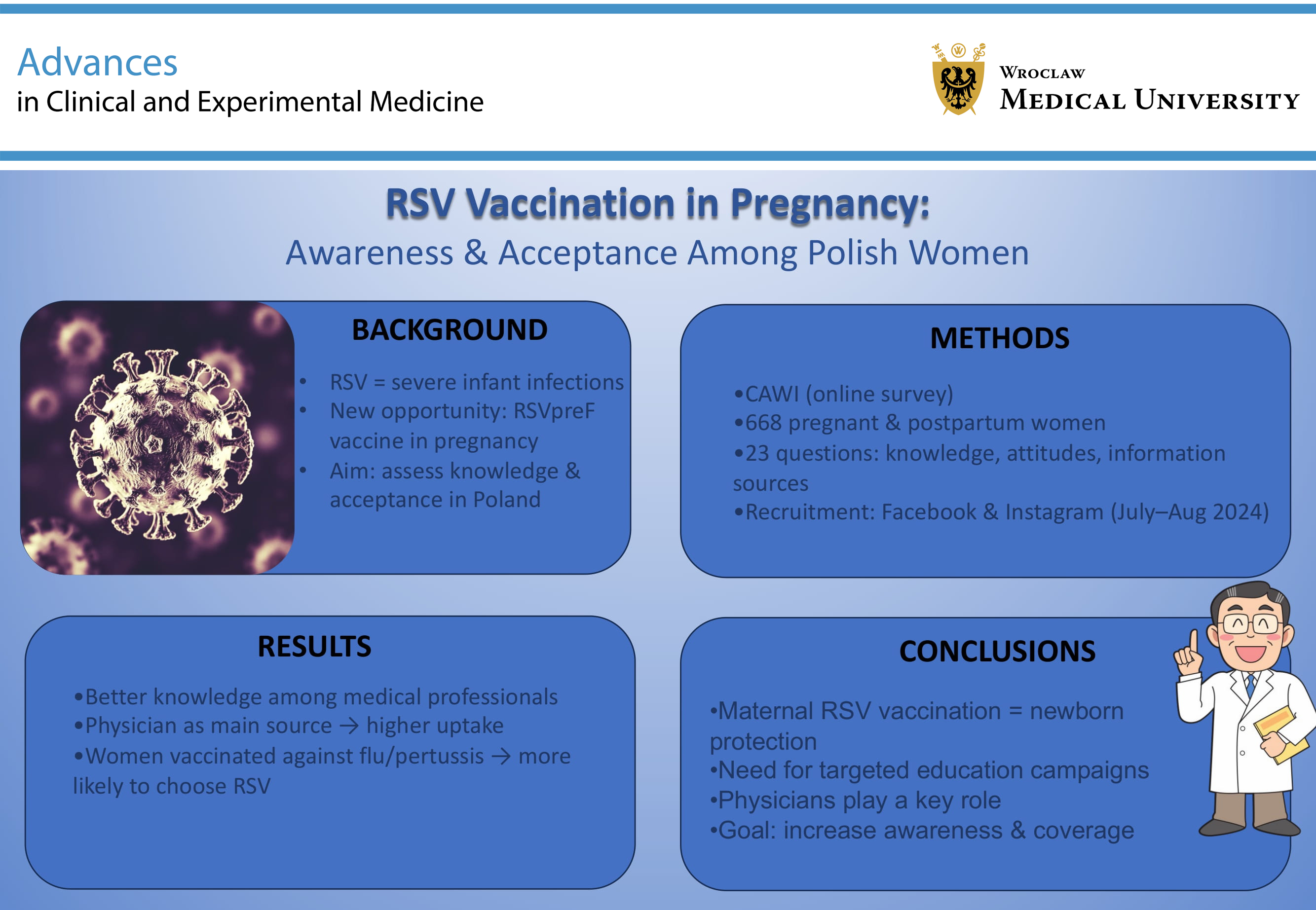
Abstract
Background. Respiratory syncytial virus (RSV) is a major cause of severe lower respiratory tract infections in infants, particularly among vulnerable groups such as preterm newborns and infants with underlying medical conditions. The approval of the RSVpreF vaccine for use during pregnancy offers a new strategy for reducing RSV-related morbidity in newborns.
Objectives. This study aimed to assess RSV vaccination coverage among pregnant women in Poland, identify factors influencing vaccine hesitancy, and evaluate knowledge regarding the benefits of RSV vaccination.
Materials and methods. A Computer-Assisted Web Interview (CAWI) survey was conducted among 668 respondents in Poland. An anonymous questionnaire consisting of 23 questions was distributed via social media platforms between July 25 and August 1, 2024. Participants were recruited through Facebook groups and Instagram and included women who had recently given birth or were currently pregnant.
Results. Respondents with medical backgrounds more frequently provided correct answers to questions regarding RSV than those without medical training. For example, when asked about methods of treating RSV infection, 109 medical professionals (74.15%) answered correctly, compared with 251 non-medical respondents (48.18%; p < 0.001). Individuals with medical backgrounds and those who received information about vaccination from their physician were more likely to receive the RSV vaccine during pregnancy. In addition, women vaccinated against other diseases, such as influenza and pertussis, were more likely to choose RSV vaccination.
Conclusions. Vaccination against RSV during pregnancy is an important strategy for protecting newborns against severe RSV infection and should be promoted as a public health measure. Our findings highlight the need for targeted educational initiatives and public health campaigns to increase awareness and improve vaccination coverage among pregnant women.
Key words: respiratory syncytial virus vaccines, vaccination, pregnant women, vaccine hesitancy, internet-based survey
Background
Respiratory syncytial virus (RSV) is a seasonal pathogen that places a substantial burden on healthcare systems worldwide. In children, RSV infection can manifest with a broad spectrum of clinical presentations, ranging from mild upper respiratory tract infections to severe lower respiratory tract infections, such as pneumonia and bronchiolitis. These severe manifestations may require hospitalization and can lead to serious complications, including respiratory failure.1, 2
Newborns born prematurely and infants with underlying medical conditions are particularly vulnerable to severe RSV infection. High-risk groups include children with chronic lung disease of prematurity (CLDP) or bronchopulmonary dysplasia (BPD), hemodynamically significant congenital heart disease (hsCHD), immunocompromising conditions, and severe neuromuscular disorders.3
For many years, effective methods capable of providing safe and reliable protection for these vulnerable populations were lacking. Despite advances in neonatal and pediatric care, severe RSV infections have continued to pose a significant threat to infant health and survival.
In 2015, the global incidence of RSV-associated acute lower respiratory infection (ALRI) was estimated at 33.1 million cases, resulting in 3.2 million hospitalizations and approx. 59,600 deaths among children younger than 5 years of age. Infants younger than 6 months accounted for a substantial proportion of this disease burden, with an estimated 27,300 deaths worldwide.4
A major advance in RSV prevention occurred in August 2023, when the U.S. Food and Drug Administration (FDA) approved the RSVpreF vaccine for use during pregnancy. This approval was followed in the subsequent month by recommendations from the Advisory Committee on Immunization Practices (ACIP) and the Centers for Disease Control and Prevention (CDC). These organizations recommended administration of a single dose of RSVpreF between 32 and 36 completed weeks of gestation to reduce the risk of RSV-associated lower respiratory tract infections in infants.5, 6
Vaccination during pregnancy continues to generate discussion and concerns among both patients and healthcareprofessionals in Poland. According to the 2024 Protective Vaccination Program, recommended vaccinations during pregnancy include influenza and pertussis vaccines.7
Objectives
The aim of this study was to assess RSV vaccination coverage among pregnant women, identify factors contributing to vaccine hesitancy, and evaluate knowledge regarding the benefits of RSV vaccination.
Materials and methods
This cross-sectional study was based on an original questionnaire developed by the authors. The survey was distributed via social media platforms between July 25 and August 1, 2024. The questionnaire consisted of 23 items and was designed to ensure anonymous and voluntary participation. The target population included women in the 3rd trimester of pregnancy and women up to 6 months postpartum. Participants were recruited through Facebook groups dedicated to pregnant women, where a link to the questionnaire was posted together with an invitation to participate. In addition, the questionnaire was promoted through Instagram Stories. All participants provided informed consent and were informed of their right to withdraw from the study at any time before submitting the questionnaire. Due to the fully anonymous nature of the survey, individual responses could not be identified or withdrawn after submission.
Qualitative variables were expressed as frequencies and percentages (n, %). Prior to conducting the χ2 test, the assumption regarding expected cell frequencies was assessed (i.e., expected counts <5 in no more than 20% of cells). If this assumption was met, Pearson’s χ2 test of independence was applied; otherwise, Fisher’s exact test was used for 2 × 2 contingency tables (Statistica v. 13.3.721.1; StatSoft, Tulsa, USA). The level of statistical significance was set at p < 0.05. When multiple comparisons were performed, a Bonferroni correction was applied by dividing 0.05 by the number of comparisons. During analyses examining associations between responses and specific factors, the response category “maybe” was excluded because it accounted for only 1% of responses. As a measure of effect size in contingency table analyses, Cramér’s V coefficient was calculated, where values close to 0 indicate little or no association and values close to 1 indicate a strong association between the analyzed variables. The study protocol was submitted to the Bioethics Committee of Wroclaw Medical University (Poland), which determined that formal ethical approval was not required (opinion No. Kb_kanc 235/2024). The study was assessed as compliant with ethical standards for scientific research, including the principles outlined in the Declaration of Helsinki, and was not considered to violate the rights of the surveyed participants.
Results
A survey was conducted among 668 women between July 25 and August 1, 2024. The respondents ranged in age from 18 to 42 years. Table 1 presents the demographic characteristics of the study population. The primary objective of the study was to assess women’s knowledge of RSV infection and awareness of its potential consequences. Knowledge was evaluated using a set of author-developed questions, and respondents were categorized as either medical professionals or non-medical respondents. Statistically significant differences between the 2 groups were observed for only 3 questions: “What are the methods of treating RSV infection?”, “Is RSV vaccination recommended during pregnancy?” and “Do you know how RSV vaccines work?”. Detailed results are presented in Table 2. We also assessed respiratory syncytial virus (RSV) vaccination uptake among women working in medical professions and those without medical education (Table 3). Women with medical backgrounds were significantly more likely to receive the RSV vaccine during pregnancy than non-medical respondents. In addition, we examined how frequently physicians informed patients about the availability of RSV vaccination and whether women who received this information from their physician were more likely to choose vaccination than those who did not receive such information (Table 4). Finally, we evaluated the association between uptake of other recommended vaccinations during pregnancy, such as influenza and pertussis vaccines, and RSV vaccination uptake. Detailed results are presented in Table 5.
Discussion
Respiratory syncytial virus (RSV) is the leading cause of acute lower respiratory tract infections and a major contributor to infant mortality, particularly among children younger than 6 months of age in low- and middle-income countries.8, 9 Despite the fact that vaccines have saved thousands, if not millions, of lives, vaccine hesitancy and opposition to vaccination remain significant public health challenges. Anti-vaccination movements have existed since the introduction of vaccines and continue to influence public attitudes toward immunization. In Poland, despite the existence of mandatory vaccination programs, the number of vaccine exemptions nearly doubled over the past 5 years, increasing from 48.6 thousand in 2019 to 87.3 thousand in 2023.10 This trend highlights a growing public health concern that requires attention in the coming years. Similar patterns have also been observed in other countries, including the USA, India, and neighboring Ukraine.11
The introduction of the RSV vaccine has attracted considerable attention, particularly with regard to concerns about its safety and effectiveness. The most commonly reported local and systemic adverse reactions include pain at the injection site, headache, myalgia, and nausea. Nevertheless, attention has also focused on other safety signals observed during clinical trials. Concerns have been raised regarding potential risks such as preterm birth and hypertensive disorders of pregnancy; however, these findings did not reach statistical significance. These observations prompted the U.S. Food and Drug Administration (FDA) to issue a warning regarding the potential risk of preterm birth, particularly among individuals vaccinated before 32 weeks of gestation. In addition, a higher proportion of infants born to vaccinated mothers were reported to have low birth weight (≤2,500 g) and neonatal jaundice compared with infants born to mothers who received placebo. Given these observations, ongoing research and post-marketing surveillance remain essential to ensure that the benefits of RSV vaccination continue to outweigh any potential risks. It is equally important that healthcare professionals remain well informed in order to provide evidence-based recommendations to their respondents.12
Vaccination during pregnancy to confer passive immunity to the newborn has been practiced for more than a century. Historical references to maternal smallpox vaccination date back to the 1870s. Maternal immunoglobulin G (IgG) antibodies generated in response to natural infection or active immunization during pregnancy cross the placenta and enter the fetal circulation, providing newborns with protection during the first months of life.13, 14 Given these well-established benefits, the persistently low uptake of maternal vaccination and the concerns frequently expressed by pregnant women remain a source of concern for healthcare professionals.
In recent years, maternal vaccination has become a standard component of preventive healthcare and has been incorporated into numerous national immunization programs. Recommendations regarding specific vaccines vary among countries due to differences in epidemiological, social, and healthcare-related factors. For example, pertussis vaccination during pregnancy has been implemented in many low- and middle-income countries, whereas influenza vaccination has been incorporated into immunization schedules in most high-income countries and several middle-income countries.15
Maternal vaccination promotes the transplacental transfer of high concentrations of maternal antibodies, providing infants with immediate protection at birth and throughout the first months of life.16, 17, 18 This strategy is currently used to protect infants against tetanus, pertussis, severe acute respiratory syndrome coronavirus 2 (SARS-CoV-2), and influenza.19, 20 Such an approach is particularly important in low- and middle-income countries, where the burden of RSV-associated lower respiratory tract infections is greatest.8
One study evaluating RSV vaccination during pregnancy in Argentina demonstrated that vaccination of 342,110 pregnant women with RSVpreF prevented an estimated 3,915 RSV-related hospitalizations, 6,399 RSV-related emergency department visits, and 67 RSV-related deaths.21
Following recommendations issued by the CDC regarding vaccine safety, numerous vaccinations are recommended during pregnancy, with particular emphasis on vaccines that have been demonstrated to be safe and effective for both mother and child. In Poland, recommendations developed by the National Institute of Public Health – National Research Institute in collaboration with the Polish Vaccinology Society include vaccination against influenza, pertussis, COVID-19, and, more recently, RSV.22, 23
Given that leading medical organizations consider vaccination during pregnancy to be both safe and effective, it is concerning that a substantial proportion of eligible women still choose not to receive recommended vaccines.
According to a study conducted by Wilcox et al. in 2019, the most common reason for declining vaccination was concern about potential adverse effects on the child.24 Consequently, the findings of our study are particularly relevant, as they suggest that insufficient knowledge about vaccination may contribute to fear and uncertainty among patients. Wilcox et al. also demonstrated that healthcare providers often lacked confidence in communicating information about vaccination. In contrast, our study showed that healthcare professionals possessed more accurate and comprehensive knowledge regarding RSV vaccination than respondents without a medical background.24
Additional factors influencing vaccination uptake during pregnancy include ethnicity, access to vaccination through the recommending healthcare provider, and parity. According to a study by McAuslane et al., pertussis vaccination uptake was significantly lower among women who had given birth more than 3 times (48.1%; 95% confidence interval (95% CI): 37.0–59.4) than among those with up to 3 previous births (63.0%; 95% CI: 58.3–67.5).25
Licata et al. reported similarly noteworthy findings, demonstrating that 71.8% of healthcare professionals informed women about influenza vaccination during pregnancy, while 68.8% actively recommended influenza vaccination during pregnancy. Their study population included obstetricians-gynecologists, midwives, and primary care physicians involved in the care of pregnant women. These findings are consistent with the pattern observed in our study regarding RSV vaccination uptake. Although an RSV vaccination rate of 25% among pregnant healthcare professionals may appear relatively low, it was significantly higher than that observed among women without a healthcare background. Furthermore, the findings reported by Licata et al., demonstrating that good knowledge and positive attitudes toward vaccination were the strongest predictors of recommending influenza vaccination during pregnancy, are consistent with our observations regarding RSV vaccination uptake.26
Kherfan and Sallam reported findings similar to ours, demonstrating that among 315 respondents, only 67.6% had heard of RSV before participating in their study. Furthermore, respondents declared that if the RSV vaccine were safe, effective, and available free of charge, 70.2% would be willing to receive it, whereas 15.2% would refuse and 14.6% would remain hesitant. These findings are encouraging and suggest considerable potential for increasing RSV vaccine uptake, particularly when compared with the vaccination rates observed in our study.27
According to available evidence, Poland is not the only country considering the permanent inclusion of RSV vaccination in national immunization recommendations. Papagiannis et al. conducted a study in response to the potential introduction of new RSV vaccination guidelines by the National Vaccines Committee, aiming to assess knowledge, attitudes, and anticipated vaccination practices among healthcare professionals in Central Greece. A particularly encouraging finding was that healthcare professionals demonstrated a high level of knowledge regarding RSV, which was strongly associated with positive attitudes toward RSV vaccination and a greater willingness to recommend it. Similar observations can be drawn from our study, in which medical education was associated with a higher likelihood of RSV vaccination during pregnancy. These findings emphasize the importance of educational interventions targeting both healthcare professionals and patients to improve vaccination uptake.28
As reported by Nowacka et al., one of the most common reasons for declining COVID-19 vaccination was insufficient knowledge about the vaccine. Lessons learned from the introduction of SARS-CoV-2 vaccines may therefore be highly relevant for the implementation of RSV vaccination programs. Women with higher educational attainment (odds ratio (OR) = 2.26, p < 0.001), those who received positive information about vaccination (OR = 2.74, p = 0.017), and those informed about the potential complications of COVID-19 during pregnancy (OR = 2.60, p < 0.001) were more likely to accept vaccination. Accordingly, the authors emphasized the importance of appropriate education, training, and promotion of vaccination. Our findings support this conclusion, as women who received information about RSV vaccination from healthcare professionals were more likely to accept vaccination than those who relied on other sources of information or had not received any information.29
It is important to note that, from April 1, 2025, RSV vaccination has been reimbursed in Poland. This policy change may substantially increase vaccine uptake. At the time our survey was conducted, the cost of RSV vaccination was approx. 800–1,000 PLN. The inclusion of RSV vaccination in the reimbursement program was specified in the Announcement of the Minister of Health of March 19, 2025, concerning the list of reimbursed medicines, foods for special medical purposes, and medical devices, effective from April 1, 2025.30
Limitations of the study
The primary limitation of this study is that data collection relied on social media platforms and online survey distribution. However, experience gained during the COVID-19 pandemic has demonstrated that online surveys can serve as an effective, safe, and accessible tool for this type of research, enabling the collection of data from a large number of participants. We acknowledge that our sample was disproportionately composed of women with higher educational attainment and those working in healthcare professions. We also recognize that these individuals may hold more established views on vaccination, which could have influenced the findings. Consequently, these factors may have affected the representativeness of the sample and, therefore, the results of the analysis.
Conclusions
RSV vaccination during pregnancy represents an important strategy for protecting newborns against RSV infection and its severe consequences. However, awareness of RSV vaccination and vaccine uptake among pregnant women in Poland remain suboptimal. The findings of this study may support public health authorities and other stakeholders in developing future RSV vaccination policies and strategies. Furthermore, these results may help guide the design of targeted educational initiatives aimed at increasing awareness of RSV and RSV vaccination among both healthcare professionals and pregnant women.
Supplementary data
The supplementary materials are available at https://doi.org/10.5281/zenodo.17349531. The package contains the following files:
Supplementary Table 1. General characteristics of the study respondents.
Supplementary Table 2. Comparison of RSV-related knowledge between medical and non-medical respondents.
Supplementary Table 3. Comparison of RSV vaccination rates between medical and non-medical respondents.
Supplementary Table 4. Association between physician-provided information about RSV vaccination and RSV vaccination uptake.
Supplementary Table 5. Association between vaccination against other infectious diseases during pregnancy and RSV vaccination uptake.
Data Availability Statement
The datasets supporting the findings of the current study are openly available in Zenodo at https://doi.org/10.5281/zenodo.17349673.
Consent for publication
Not applicable.
Use of AI and AI-assisted technologies
Not applicable.