Abstract
Background. Clinical learning is important for general surgeons. Besides, postgraduate degree teaching and standardized training of resident physicians are important for general surgeons. Traditional training for resident physicians prescribed by the Chinese authorities is rudimentary.
Objectives. To evaluate the effects of a structured residency training program and standardized training on the overall performance of resident doctors.
Materials and methods. After the 100 resident doctors completed the course and clinical training, their theoretical skills scores (theoretical examination and objective scores), practical skills scores (teaching quality), and satisfaction data were included in the study analyses. Since 2020 (the data from the past 5 years), there have been 30 resident doctors at the structured residency training program (RT cohort) and 70 are rotating in the surgical department (SDR cohort).
Results. Seven (10%) residents from the SDR cohort failed at least one theoretical assessment. None of the resident doctors from the RT cohort failed in any of the theoretical skills. The theory examination paper marks (p < 0.001), the case analysis score (p = 0.003), the medical record writing score (p < 0.001), the physical examinations score (p < 0.001), and the basic theoretical knowledge score (p = 0.016) of resident doctors from the RT cohort were better than those of residents from the SDR cohort. Among the practical skills, interest in promotion (p = 0.023) and knowledge consolidation effect (p = 0.026) were reported as higher among resident doctors of the RT cohort than those of resident doctors of the SDR cohort.
Conclusions. New students admitted to professional master’s degree programs in clinical medicine in China will be required to participate in certified resident training. The structured residency training program has better effects than rotating in the surgical department based on the overall performance of the resident doctor.
Key words: clinical learning, general surgery teaching, medical graduates, resident physicians, standardized training
Background
General surgery is a core surgical specialty.1 The department of general surgery is the mainstay of surgical practice. In addition, it is also one of the main departments requiring rotations during the standard training of resident physicians.2 General surgery is a basic subject for practitioners, especially surgeons.1 Medical graduates are physicians, but they are not fully trained when they graduate from the program. At present, standardized training for resident physicians in most institutions in mainland China is carried out in accordance with the Chinese Ministry of Health guidelines, and the curriculum features variable training durations and high-level, generalized syllabus guidelines, which are managed by individual institutions.3 To improve the quality of practice among medical graduates in China, high-quality training is needed for medical graduates to become doctors.4 The practice patterns of general surgeons are still diverse, reflecting the continuing need for a broad training paradigm that allows for specialization.5
Traditional training programs previously established by regulatory bodies were less standardized compared with modern competency-based curricula.6 Problem-based learning and case-based learning for general surgeons,7 assistant general practitioners,8 and joint surgery,9 as well as a multidisciplinary team-combined flipped classroom teaching model for radiologists,10 have been reported to be effective in improving both theoretical comprehension and practical skill scores. Details of comparative studies on teaching/training for physicians in different specialties and settings are presented in Table 1.6, 7, 8, 9, 10, 11, 12 Little is known about the comparative effectiveness of structured residency training compared with rotational placements in general surgery. Structured residency training and rotational placements in general surgery need to be compared in terms of clinical competence, patient care, and professional development.
Objectives
The objectives of the current study were to compare theoretical scores (theoretical examination scores and objective scores), practical skill scores (teaching quality), and satisfaction among resident physicians who received general surgery teaching during standardized training in a Chinese setting.
Materials and methods
The protocol for this study was prepared by the authors themselves. The study was approved by the Ethics Committee of Minhang Hospital, Fudan University (Shanghai, China; approval No. 2020-010-01K, issued on January 2, 2020). The study was conducted in accordance with Chinese law and the 2008 Declaration of Helsinki. Written informed consent was obtained from participants before the commencement of the study.
A preliminary cross-sectional study was performed from January 15, 2020, to May 15, 2025, at Minhang Hospital.
Resident physicians in clinical general surgery who worked and took part in general surgery teaching or standardized training were included in the analyses. Physicians who did not complete general surgery teaching or standardized training were excluded from the study.
Sample size calculations
The study was based on the assumption that there would be a 10% improvement in theoretical and practical skill scores among physicians admitted to the general surgical residency training base compared with those admitted to other bases who had been rotating in the surgical department. Based on these assumptions, a significance level (α) of 0.05 for a 2-tailed test, and a target statistical power of 1 − β = 0.80, calculated using OpenEpi v. 3.01 (OpenEpi Development Team / Emory University, Atlanta, USA), 30 physicians would be required in each cohort. For robustness, we included 70 physicians from other bases who had been rotating in the surgical department.8
Cohorts
A total of 30 resident physicians were admitted to the general surgical residency training base (RT cohort; structured residency training program), and a total of 70 resident physicians were admitted to other bases and had been rotating in the surgical department (SDR cohort; rotating in the surgical department). In a structured residency training program, resident physicians spent a longer period of 1–2 years studying. Resident physicians rotating in the surgical department spent 1–2 months there during the study. In addition to training at the general surgical residency training base or rotating in the surgical department, resident physicians were free to use WeChat v. 8.0.40 (Tencent Holdings Ltd., Shenzhen, China) to communicate with each other and their mentors. There was 1 mentor for every 5 doctors, who was trained and had at least 3 years of surgical experience at the institute. The training sessions lasted 3–4 h per day and were held 6 days per week, with 1 day off per week.
Outcome measures
The theoretical skills scores
The theory examination paper
At the end of the training, theoretical knowledge was assessed. The theoretical examination paper was standardized, and the closed-book examination was organized by Minhang Hospital.11 One 180-min paper contained 200 multiple-choice questions covering all subjects taught at the graduate level and in the training course. One-third of a mark was deducted for each incorrect answer in the test. The examination was supervised by 3 investigators (H.M., Q.C., and Z.Z.). A score of 49 points or less on the theoretical examination paper constituted failure.
Objective score test
Case analysis and clinical practice (e.g., medical record writing, physical examination, and basic theoretical knowledge) were scored from 0 to 100. A higher score indicated better performance.1 Basic theoretical knowledge included mastery, non-mastery, and general knowledge. A score of 49 points or less in any of the parameters was considered a failure in the objective score test.
Practical skills scores
Teaching quality was assessed by analyzing improvements in the interest of the enrolled resident doctors, knowledge consolidation, literature search and learning, clinical thinking skills, and resident doctor–patient communication ability. Yes/no questions were administered by researchers to the resident doctors. “Yes” was considered an improvement, and “no” was considered no improvement.1
Satisfaction of resident doctors
Resident doctors’ satisfaction was assessed after completion of the course based on the prescribed format of the institute (4-point scale). It was graded as 0 – dissatisfied, 1 – partially satisfied, 2 – satisfied, and 3 – fully satisfied. Not all surveys are available in translated form, and institutions are not willing to disclose them at present.
Clinical benefits of training resident doctors
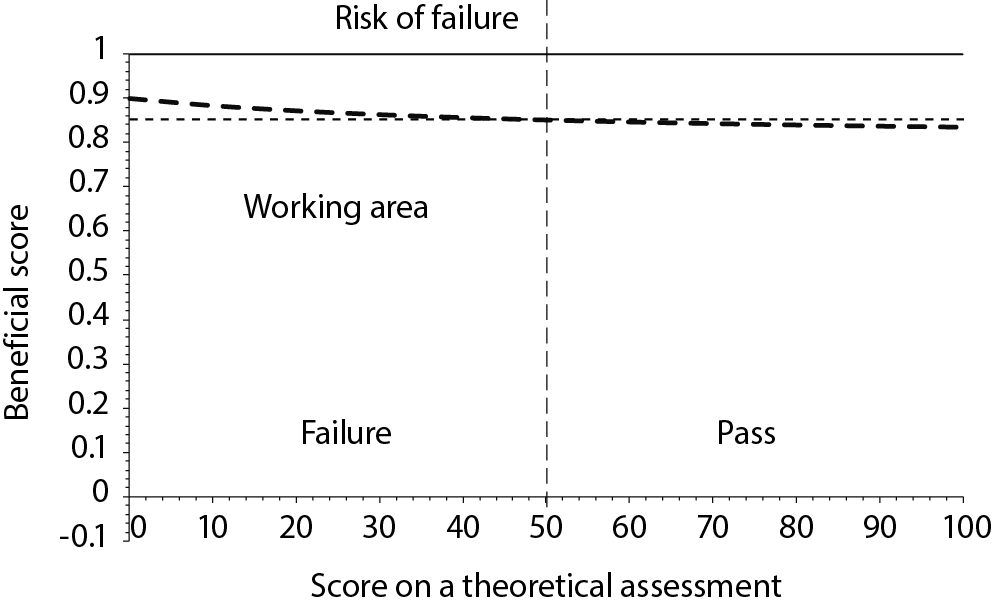
The clinical benefits of training resident doctors were evaluated as a function of the benefit scores. Benefit scores for the training of resident doctors were calculated from the risk of failure among resident doctors in any of the theoretical skill scores, as expressed in Equation 1. The risk related to theoretical skill scores was defined by a calculation involving the theoretical skill scores obtained by resident doctors (Equation 2). The benefit score of resident doctor training is the area above the curve for the adopted training, and the working area is the area under the curve (AUC) for the adopted training. For all adopted training methods, a score of 49 points or less in any theoretical skill score of resident doctors was considered a failure.12, 13
(1)
where
Riskfail – risk of failure of the resident doctor;
Sts – score in any of the theoretical skills.
(2)
where
RDpassed – number of resident physicians who passed all theoretical assessments;
RDtotal – total number of resident doctors in that cohort;
RDfail – number of resident physicians who failed at least one theoretical assessment.
Statistical analyses
InStat v. 3.01 (GraphPad Software, San Diego, USA) was used for statistical analyses. Categorical variables, normally distributed continuous variables, and non-normally distributed continuous variables are presented as frequencies with percentages in parentheses, mean ± standard deviation (SD), and median with Q1–Q3 in parentheses, respectively. CalculatorSoup® (CalculatorSoup, LLC, Ashland, USA) was used to calculate quartile values. The Kolmogorov–Smirnov test was used to check the normality of continuous variables. Bartlett’s test was used to check the homogeneity of SDs of normally distributed continuous variables. An unpaired t-test with or without Welch correction was used for normally distributed continuous variables, and the Mann–Whitney test was used for non-normally distributed continuous variables. The χ2 and Fisher–Freeman–Halton tests were used for categorical variables. All results were considered significant if p < 0.05.
Results
Study population
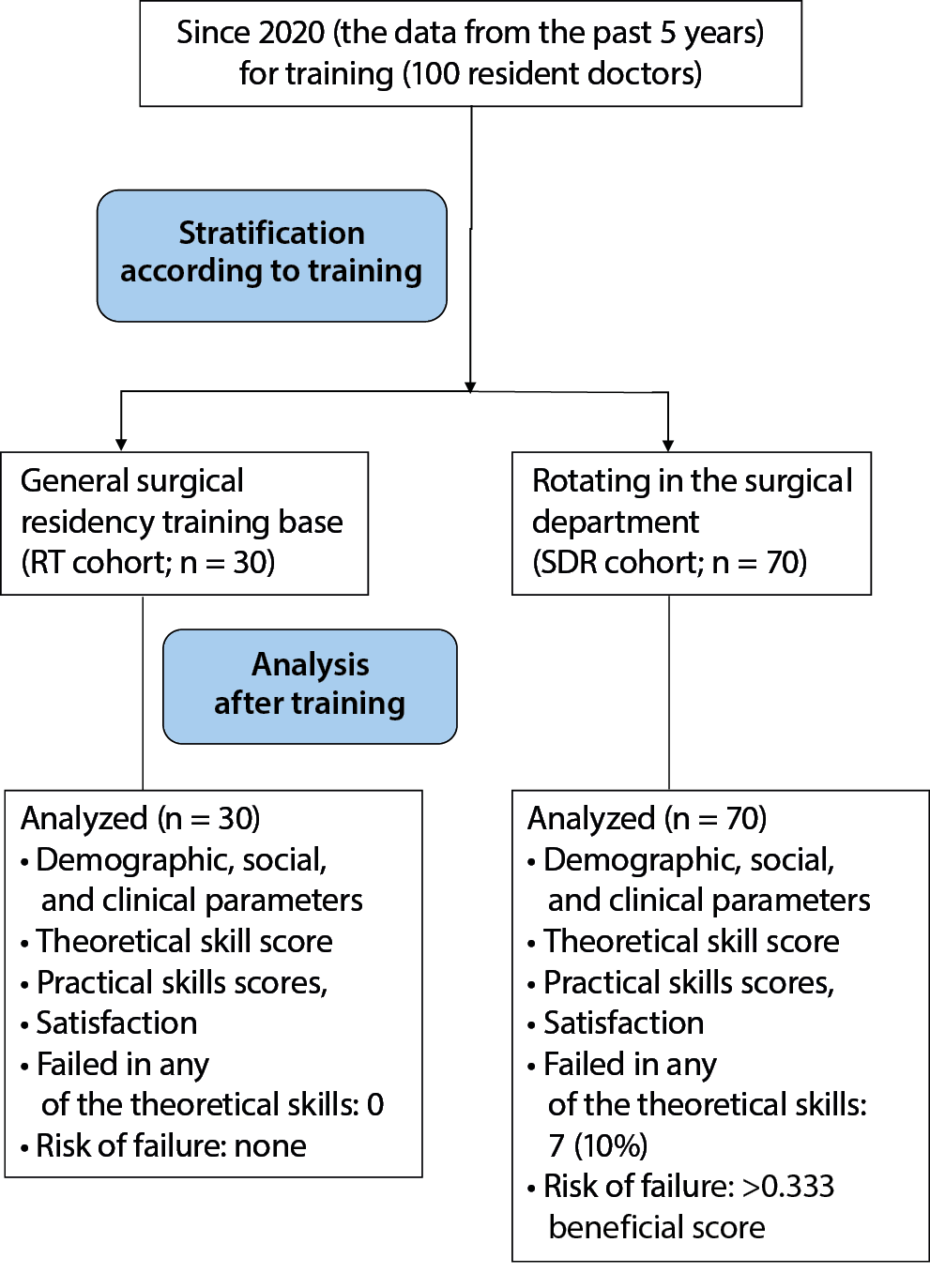
During the study period (from January 15, 2020, to May 15, 2025), a total of 100 resident physicians received training at Minhang Hospital, either at the general surgical residency training base or through rotation in the surgical department. After completion of training, data on theoretical scores (theoretical examination scores and objective scores), practical skill scores (teaching quality), and satisfaction among 100 resident physicians were included in the analyses for the study. The flow diagram of the cross-sectional study is presented in Figure 1.
Demographic, social, and clinical parameters
Resident physicians had a male-to-female ratio of 3 : 2. The age range was 23–25 years. Most were Han Chinese and from urban or suburban areas. Details of the demographic, social, and clinical parameters of resident physicians included in the analyses are presented in Table 2.
Outcome measures
The theoretical skills scores
Six (9%) resident physicians and 1 (1%) resident physician from the SDR cohort failed the theoretical examination paper and the basic theoretical knowledge component, respectively. A total of 7 (10%) resident physicians from the SDR cohort failed at least 1 theoretical skill assessment. None of the resident physicians from the RT cohort failed any theoretical skill assessment. The number of resident physicians who failed any theoretical skill assessment did not differ significantly between the SDR and RT cohorts (p = 0.099, relative risk (RR) = 1.476, 95% confidence interval (95% CI): 1.283–1.699, Fisher’s exact test; the difference in failure rates was not statistically significant).
Scores on the theoretical examination paper, case analysis scores, medical record writing scores, physical examination scores, and basic theoretical knowledge scores of resident physicians from the RT cohort were better than those of resident physicians from the SDR cohort. Details of the theoretical skill scores of resident physicians included in the analyses are presented in Table 3.
Practical skills scores
Among the practical skills, improvement in interest and knowledge consolidation were significantly greater among resident physicians in the RT cohort than among those in the SDR cohort. Furthermore, literature search and learning, clinical thinking skills, and resident physician–patient communication ability were improved among resident physicians in the RT cohort compared with those in the SDR cohort, but the differences were not statistically significant. Details of the practical skills evaluation of resident physicians included in the analyses are presented in Table 4.
Satisfaction of resident doctors
Satisfaction with training was higher among resident physicians in the RT cohort than among resident physicians in the SDR cohort. Details of the comments on the assumption tests used in the study are presented in Table 5.
Clinical benefits for the training of resident doctors
Resident physicians in the SDR cohort had benefit scores ranging from 0.833 to 0.900, and those in the RT cohort had benefit scores ranging from 0 to 1 for practical training after medical graduation. However, below a benefit score of 0.833, resident physicians in the SDR cohort were at risk of failing any theoretical test evaluation. In contrast, resident physicians in the RT cohort had no risk of failure in any theoretical test evaluation. The graphical presentation of the clinical benefits of training resident physicians is presented in Figure 2. Details of the clinical benefits of training resident physicians are presented in Table 6.
Discussion
During the study period, resident physicians either received surgical residency training or rotated in surgical department-based training. In the current context, with the increasing demand for doctors, continuing education is especially important for them.1 Therefore, after graduation, medical graduates should receive clinical training. Since 2015, new doctors in China admitted to professional master’s degree programs in clinical medicine have been required to participate in certified resident training.14
A total of 7 (10%) resident physicians from the SDR cohort failed at least 1 theoretical skill assessment. In addition, benefit scores below 0.833 among resident physicians from the SDR cohort were associated with a risk of failure. Qualified medical graduates should have theoretical knowledge and clinical practice skills.1 The traditional education model has certain limitations.12 This leads to a gap between theoretical skills and practical skills. Resident physicians may become confused when they face serious clinical conditions.15 Since 1949, China has made many changes to develop its medical education system and now has a complex range of medical degrees.16 The current situation of the medical education system in China has been worsened by the mismatch between clinical ability and promotion, as well as inadequate remuneration.14 The surgical residency training base had better effects than rotation in the surgical department based on the overall performance of the resident physicians.
Among practical skills, improvement in clinical thinking skills and resident physician–patient communication ability did not differ significantly between the 2 cohorts (Fisher’s test failed to prove a difference in the number of failures between the 2 cohorts). This is not the same as proving that failure rates are equal. The small sample size is responsible for this. Enhancing the precision and accuracy of practical skills measurements reduces variability in the data, making it easier to detect true effects.
Limitations of the study
The limitations of the study include its cross-sectional design and lack of a trial. The sample size is small. The sample size was calculated based on the final score outcomes, not the number of questions in the administered questionnaires. Outcomes such as “teaching quality” or “interest in promotion” were not measured using multiple methods (e.g., survey instruments or scoring rubrics). Other limitations include the single-institution design, lack of long-term follow-up, and potential observer bias in subjective assessments. Furthermore, not all surveys are available in translated form, and institutions are not willing to disclose them at present, which weakens the emphasis on the scoring system.
Conclusions
New students admitted to professional master’s degree programs in clinical medicine in China are required to participate in certified resident training. The surgical residency training base had better effects than rotation in the surgical department based on the overall performance of the resident physicians. The study contributes to the global discussion on postgraduate medical education and surgical training reform.
Data Availability Statement
Data sharing does not apply to this article, as all data are already included in the manuscript.
Consent for publication of personal information
Not applicable.
Use of AI and AI-assisted technologies
Not applicable.