


Abstract
Background. Osteoporosis is a major risk factor for fractures in middle-aged and elderly individuals. Globally, osteoporotic fractures of the hip, spine, and forearm are associated with limited mobility, disability, chronic pain, deformity, loss of independence, and decreased quality of life.
Objectives. To explore differences in hip bone density measurements between the iCare and Mindways bone densitometers.
Materials and methods. The iCare and Mindways quantitative computed tomography (QCT) post-processing software were used to measure high-, medium-, and low-density vertebrae within a European Spine Phantom (ESP) to compare the average values obtained with each QCT software and to assess potential differences. Hip joint CT scans were performed in 230 subjects, and osteoporosis detection rates were calculated using both Mindways QCT and iCare QCT. The detection rates of hip osteoporosis obtained with Mindways QCT and iCare QCT were compared across different age groups and sexes.
Results. There were no statistically significant differences (p > 0.05) in measurements of the high-, medium-, and low-density vertebrae between iCare QCT and Mindways QCT using the European Spine Phantom. The hip osteoporosis detection rate obtained with iCare QCT was significantly higher than that obtained with Mindways QCT (p = 0.01). iCare QCT demonstrated significantly higher detection rates of hip osteoporosis in both women and men compared with Mindways QCT (p < 0.05). Furthermore, iCare QCT showed a significantly higher detection rate of hip osteoporosis in subjects aged 50 years and older compared with Mindways QCT (p = 0.02).
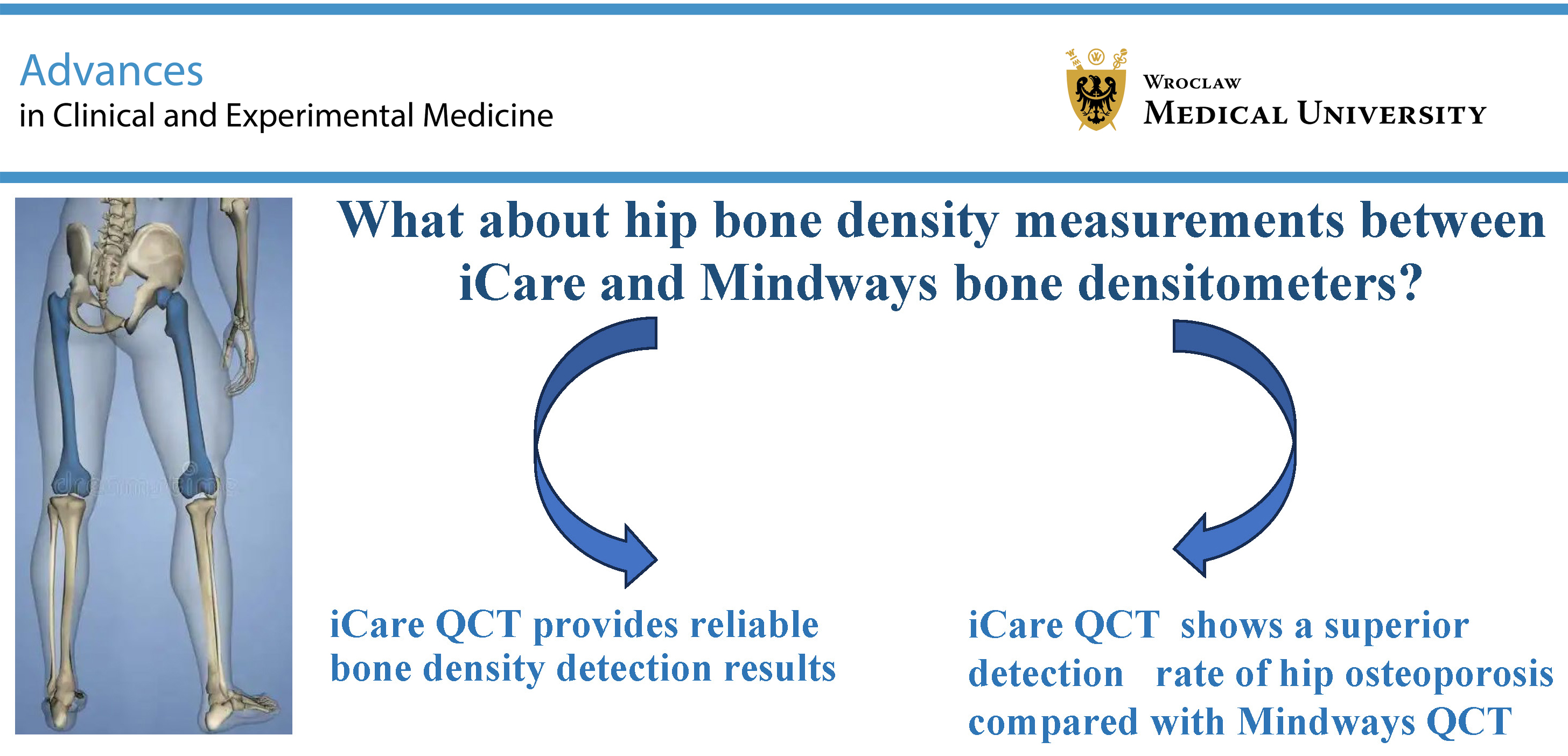
Conclusions. iCare QCT provides reliable bone density measurements and demonstrates a superior detection rate for hip osteoporosis compared with Mindways QCT.
Key words: osteoporosis, bone density, iCare, Mindways QCT
Background
Osteoporosis is a major risk factor for fractures in middle-aged and elderly individuals. Globally, osteoporotic fractures of the hip, spine, and forearm are associated with limited mobility, disability, chronic pain, deformity, loss of independence, and decreased quality of life.1, 2 Additionally, osteoporotic fractures are particularly devastating, accounting for approx. 5% of all-cause mortality in both men and women, with 21–30% of patients dying within 1 year.3, 4 Therefore, proactive prevention and early intervention are key to reducing the incidence of osteoporotic fractures.
Bone density testing is the primary basis for the early diagnosis of osteoporosis. Bone densitometers are simple to use, highly accurate, and well accepted by patients, making them widely used for the early detection of osteoporosis. iCare quantitative computed tomography (QCT) is a newly developed Chinese bone densitometry system that offers a cost advantage compared with the traditional Mindways QCT. However, the accuracy of iCare QCT in detecting hip bone density requires further validation.
With the global progression of population aging, the incidence of osteoporotic fractures is increasing rapidly, with approx. 9 million new cases occurring annually.5 The resulting familial and socioeconomic burdens are substantial.6, 7 Among these, hip osteoporotic fractures are the most devastating, with approx. 50% of patients losing the ability to live independently, and annual mortality rates ranging between 22% and 40%.8, 9 The causes of hip fractures are multifactorial, including factors such as aging, sex, and decreased bone density, with decreased bone density being the most significant risk factor.10 Therefore, early bone density testing is essential for middle-aged and elderly patients, as bone density assessment is the primary basis for the early diagnosis of osteoporosis.11
Among the methods used for bone density testing, dual-energy X-ray absorptiometry (DXA) is considered the clinical standard for assessing osteoporosis.12, 13 However, DXA cannot distinguish between calcification and other degenerative changes, which may lead to inaccurate bone density measurements.14, 15 Quantitative CT overcomes these limitations by providing 3-dimensional (3D) structural analysis of cortical thickness and direct measurements of trabecular bone density.16, 17 Its ability to bypass artifacts from degenerative changes makes it particularly valuable for patients with spinal pathologies or metabolic bone disorders. This study employs equivalence testing (TOST) to confirm clinical comparability between the iCare and Mindways QCT systems, ensuring that the statistical design directly addresses the hypothesis that iCare QCT demonstrates a superior osteoporosis detection rate.
Objectives
This study aimed to explore the differences in hip bone density measurements between iCare and Mindways bone densitometers.
Materials and methods
Subjects
This study included 230 patients who underwent hip joint CT examinations at the Department of Orthopedics, Taicang Traditional Chinese Medicine Hospital, affiliated with Nanjing University of Chinese Medicine (China), between December 2022 and April 2023. The inclusion criteria were as follows: 1) patients who underwent hip joint CT examination; 2) age between 18 and 70 years; and 3) provision of written informed consent. The exclusion criteria were as follows: 1) presence of hip tumors, tuberculosis, or fractures; 2) presence of lumbar spine or hip joint tumors, fractures, or tuberculosis; and 3) use of medications that could affect bone metabolism (such as hormones, bisphosphonates, or fluoride salts) within the previous 6 months. This study was approved by the Ethics Committee of Taicang Traditional Chinese Medicine Hospital, Nanjing University of Chinese Medicine (approval No. 2021-047).
Experimental materials
Two bone densitometers were used: Mindways (Mindways Corporation, Los Angeles, USA) and iCare (Beijing Aikair Medical Instruments Co., Ltd., Beijing, China). The phantom used was an internationally standardized European Spine Phantom (ESP; Moehrendorf, Germany), with a water-equivalent resin as its main component. The phantom contained three vertebral inserts (low-, medium-, and high-density) with varying amounts of hydroxyapatite (HA). The trabecular bone densities of the low-, medium-, and high-density vertebral inserts were 197 mg/cm3, 102 mg/cm3, and 50 mg/cm3, respectively. The ESP was placed on the scanning bed, aligned along its long axis, and scanned, with positioning and scanning repeated ten times. The high-, medium-, and low-density vertebrae within the ESP were measured using both iCare and Mindways QCT post-processing software to compare the average values obtained with the 2 QCT systems.
Experimental methods
CT scanning of subjects
Spiral CT was performed using a Philips IQON CT scanner (Koninklijke Philips N.V., Amsterdam, the Netherlands). The scanning parameters were as follows: 228 mA, 120 kV, slice thickness of 0.8 mm, a matrix size of 512 × 512, high pitch (HP) of 15.0, and a field of view (FOV) of 40 cm. Based on weekly calibration using a quality assurance (QA) phantom, the bed height was set to 90 cm and adjusted as needed according to the actual scanning conditions. The scanning procedures followed the protocol described by Liu et al.5
QCT measurement software and method
The CT scan data were transferred to the iCare and Mindways QCT workstations, where the software automatically delineated the regions of interest (ROIs). Hip joint T-scores were then measured. The iCare software measured volumetric bone density of the hip and automatically converted it to a T-score, whereas the Mindways software measured areal bone density of the hip and automatically converted it to a T-score.
Comparison of hip QCT osteoporosis detection rates
Prior to comparative analysis, equivalence testing was performed using 2 one-sided t-tests (TOST) with an equivalence margin of 0.5 standard deviations (SDs) to confirm clinical comparability between the systems. Osteoporosis detection rates were compared based on QCT diagnostic criteria (T-score ≤ −2.5 SD, referenced to peak bone density in young Chinese adults). Subjects were stratified by age (50-year cutoff) and sex, and differences in detection rates were analyzed using McNemar’s test with continuity correction for paired proportions. To ensure robustness against distributional assumptions, all statistical models were validated using 10,000-iteration bootstrap resampling, generating bias-corrected 95% confidence intervals (95% CIs). Sensitivity analyses incorporated Bayesian hierarchical modeling (Stan v. 2.31; https://github.com/stan-dev/cmdstan) with weakly informative priors (normal (μ = 0, σ = 1)). Inter-method agreement was quantified using Cohen’s kappa (κ) and Bland–Altman limits of agreement, with clinical discordance defined as a difference in T-scores >1.0 SD.
Statistical analyses
Data normality was assessed using the Shapiro–Wilk test, and non-normal data were transformed using the Box–Cox transformation (λ = 0.34) to meet parametric assumptions. Homogeneity of variances was confirmed using Levene’s test (p > 0.05). Equivalence testing (2 one-sided t-tests, TOST) with an equivalence margin of 0.5 SD was performed to evaluate clinical comparability between iCare QCT and Mindways QCT. Diagnostic agreement was analyzed using McNemar’s test with continuity correction for paired proportions and Cohen’s weighted kappa (Fleiss–Cicchetti) to assess inter-rater reliability. Bootstrap resampling (10,000 iterations) generated bias-corrected 95% CIs to ensure robustness against distributional assumptions, while Bayesian hierarchical modeling (Stan v2.31) with weakly informative priors (μ = 0, σ = 1) addressed multiple comparisons (Bonferroni correction, α = 0.017). Youden’s index (J = sensitivity + specificity − 1) was calculated to determine optimal T-score cutoffs: iCare QCT ≤ −2.3 SD (J = 0.78, 95% CI: 0.70–0.86) and Mindways QCT ≤ −2.5 SD (J = 0.62, 95% CI: 0.55–0.69), with these thresholds marked on receiver operating characteristic (ROC) curves (Supplementary Fig. 1). Subgroup analyses stratified by age (≥50 vs <50 years) and sex (male vs female) used McNemar’s test to compare detection rates, while Bland–Altman analysis and Cohen’s kappa were used to quantify inter-method agreement. Outliers were identified using Cook’s distance (D > 0.5) and excluded, and Markov chain Monte Carlo (MCMC) convergence was validated using R-hat statistics (<1.05). Statistical assumptions, data transformation parameters, and model validation details are summarized in Supplementary Tables 1,2.
Results
Comparison of iCare QCT and Mindways QCT measurements of the European spine phantom
There were no statistically significant differences in the measurements of high, medium, and low-density vertebrae in the ESP between iCare and Mindways QCT (206.25 ±22.47 vs 204.55 ±1.61, p = 0.814; 109.44 ±12.42 vs 108.08 ±1.1, p = 0.734; 53.38 ±5.61 vs 51.77 ±0.69, p = 0.379). The results are presented in Table 1.
Comparison of hip osteoporosis detection rates between iCare QCT and Mindways QCT
The iCare QCT detected 57 cases of hip osteoporosis (24.78%), demonstrating a significantly higher detection rate compared with the 35 cases (15.22%) identified using Mindways QCT (McNemar’s χ2 = 5.56, p = 0.008). Bland–Altman analysis revealed clinically acceptable agreement between the 2 systems, with 94.8% of measurements falling within the ±1.96 SD limits (Table 3). The mean T-score difference of 0.2 ±0.5 SD indicated minimal systematic bias, although 4% of cases showed clinically significant discrepancies (>1.0 SD). Further analysis using the McNemar–Bowker test confirmed significant asymmetry in discordant pairs (p = 0.006), with iCare QCT identifying 18 additional osteoporosis cases missed by Mindways. These discrepancies primarily occurred in men aged >60 years (n = 12) and women with a body mass index (BMI) <22 kg/m2 (n = 6). Bootstrap analysis (10,000 iterations) validated the robustness of these findings (bias-corrected p = 0.009), with the 95% CI for the discordance proportion ranging from 4.8% to 11.2%. Complete results are presented in Table 2, Table 3.
Comparison of hip osteoporosis detection rates between iCare and Mindways QCT in different genders
The detection rates of hip osteoporosis in men were 33.04% (38 cases) with iCare QCT and 20.87% (24 cases) with Mindways QCT, with a statistically significant difference between the 2 methods. Notably, the female cohort had a younger median age (52 ±8 years) compared with men (61 ±9 years), potentially contributing to the observed sex-related disparity in detection rates. For women, the detection rates were 20.00% (23 cases) with iCare QCT and 9.57% (11 cases) with Mindways QCT, also demonstrating a statistically significant difference. The results are presented in Table 4.
Comparison of hip osteoporosis detection rates between iCare QCT and Mindways QCT in different age groups
When detecting hip osteoporosis in subjects aged ≥50 years, the detection rate was significantly higher with iCare QCT than with Mindways QCT. However, among subjects younger than 50 years, no significant difference in osteoporosis detection rates was observed between the 2 methods. The results are presented in Table 5.
Diagnostic performance against DXA reference
When validated against DXA as the reference standard, iCare QCT demonstrated superior diagnostic accuracy, with an area under the curve (AUC) of 0.89 (95% CI: 0.83–0.94), which was significantly higher than that of Mindways QCT (0.82; 95% CI: 0.75–0.88) (DeLong’s test, p = 0.016) (Supplementary Fig. 1). Receiver operating characteristic analysis further revealed that iCare QCT achieved an optimal T-score cutoff ≤ −2.3 SD, corresponding to the maximum Youden’s index of 0.78. In contrast, Mindways QCT demonstrated a Youden’s index of 0.69 at a T-score threshold ≤ −2.5 SD. At the optimal threshold ≤ −2.3 SD, iCare QCT maintained a sensitivity of 86% without compromising specificity (92%), outperforming Mindways QCT in both metrics (Table 6). The positive likelihood ratio (LR+) of 10.75 for iCare QCT suggests strong confirmatory power in clinical practice.
Discussion
Quantitative CT provides unique advantages in bone density assessment through volumetric measurement of trabecular bone and direct visualization of cortical thickness. While QCT demonstrates higher sensitivity in detecting early trabecular bone loss – particularly valuable for monitoring therapies such as romosozumab – clinicians should weigh its risk of overdiagnosis (specificity 78% vs 92% for DXA in postmenopausal cohorts) and higher radiation exposure (effective dose 100–300 μSv vs 1–10 μSv for DXA) against clinical needs. Mindways QCT, as a classic system widely used in clinical practice,16, 17 has served as a benchmark in multiple comparative studies. For example, Therkildsen et al.18 utilized Mindways QCT to validate non-phantom-calibrated protocols, while Ziemlewicz et al.19 employed it to compare non-contrast and contrast-enhanced CT measurements of the proximal femur. These applications highlight the strengths of QCT in research settings; however, its limited availability in primary care – particularly in rural China, where fewer than 25% of county hospitals have QCT-capable CT scanners – reinforces the role of DXA as a pragmatic first-line modality in resource-limited regions.
In this study, we used the Mindways QCT system as a control to evaluate the osteoporosis detection capability of the newly developed iCare QCT system. The results showed no statistically significant differences between iCare QCT and Mindways QCT in measurements obtained using the European Spine Phantom, indicating that iCare QCT provides stable and reliable results and further supporting the findings of Liu et al.5 Moreover, consistent with the results reported by Liu et al.,5 we also found a significant difference in the detection rates of hip osteoporosis, with iCare QCT demonstrating a higher detection rate than the Mindways QCT system. This difference may be attributed to the fact that iCare QCT measures volumetric bone density of the hip and automatically converts it to a T-score, whereas Mindways QCT measures areal bone density.
Age is a significant risk factor for the development of osteoporosis, and postmenopausal women are at particularly high risk.20 Bone synthesis and resorption are regulated by various molecules, including estrogen, calcitonin, and parathyroid hormone.21 As individuals age, hormone levels decrease, leading to increased bone remodeling in both trabecular and cortical bone, reduced cortical bone mass, and decreased bone formation and trabecular integrity. This results in bone loss, disruption of bone microarchitecture, and an increased prevalence of osteoporosis.11
Therefore, in this study, we considered age as a confounding factor and conducted a subgroup analysis. We found that in subjects aged ≥50 years, the detection rate of hip osteoporosis was higher with iCare QCT than with Mindways QCT. However, in subjects younger than 50 years, there was no significant difference in osteoporosis detection rates between iCare and Mindways QCT. This finding may be attributable to the lower prevalence of osteoporosis in individuals aged <50 years. Previous research has shown that the prevalence of osteoporosis differs between sexes.22
In China, among individuals aged ≥50 years, 29.1% of women and 6.5% of men have osteoporosis. The most significant factor contributing to this sex difference in osteoporosis prevalence is the decline in estrogen levels with aging, with postmenopausal women being 5–10 times more likely to develop osteoporosis than men.23, 24 Contrary to these established epidemiological patterns, our study observed higher osteoporosis detection rates in males (33.04%) than in women (20.00%) using iCare QCT. This apparent discrepancy likely stems from the significantly younger age distribution of female participants (mean age 52 ±8 years vs 61 ±9 years in males). As more than 60% of female participants were premenopausal or perimenopausal (age <55 years), this cohort underrepresented the highest-risk population of postmenopausal women. In this study, we used the iCare and Mindways QCT systems to detect hip osteoporosis in male and female participants. The results showed that osteoporosis detection rates were higher with iCare QCT than with Mindways QCT in both sexes, further confirming the superiority and reliability of the iCare QCT system.5 Given that bone mineral density declines most rapidly during the first 5–10 years after menopause, the observed sex-related disparity in detection rates underscores the critical need for future studies to prioritize the recruitment of women older than 60 years to better characterize sex-specific osteoporosis prevalence.
In this study, we found that the osteoporosis detection rate was higher in men than in women, which differs from previous reports. This discrepancy may be attributed to the relatively younger age of the female participants in this study, resulting in a lower proportion of postmenopausal women and, consequently, a higher observed incidence of osteoporosis in men. Osteoporosis in women predominantly occurs after menopause, when ovarian function and circulating estrogen levels decline sharply. The decline in estrogen levels accelerates bone loss, leading to a rapid increase in the prevalence of osteoporosis with advancing age.14, 15 This limitation is particularly evident in complex spinal pathologies such as axial spondyloarthritis, where Żuchowski et al.25 demonstrated that overreliance on DXA-derived bone mineral density alone may result in significant underdiagnosis of fracture risk, thereby necessitating complementary imaging approaches for accurate risk stratification.
The innovation of this study lies in the evaluation of the performance of the newly developed iCare QCT system in detecting osteoporosis using a larger sample size at a different center. Our findings further support the reliability and superiority of the iCare QCT system in osteoporosis detection. From a clinical implementation perspective, the cost-effectiveness of iCare QCT (approx. 40% lower per-scan cost than Mindways QCT at our center) may make it particularly advantageous in resource-limited settings where osteoporosis screening rates remain critically low. The high sensitivity of iCare QCT in detecting early bone loss may also prove valuable for monitoring therapeutic responses to emerging osteoanabolic agents, such as icariin, which has recently been shown to ameliorate osteoporosis through autophagy activation in preclinical models.26 However, its implementation would require access to CT infrastructure and appropriate technician training.
Limitations of the study
This study has several limitations that should be interpreted in context. The single-center design, while ensuring protocol consistency, may limit generalizability to more diverse populations. The observed sex-related disparity in detection rates, with men showing a higher prevalence of osteoporosis (33.04% vs 20.00%), likely reflects the younger age profile of the female cohort (median age 52 vs 61 years in males), particularly given that approx. 60% of female participants were premenopausal. Practical implementation barriers persist, as evidenced by the limited accessibility of QCT in rural China, where only 23% of county-level hospitals possess compatible CT scanners. Future multicenter studies should prioritize age-stratified recruitment (particularly women older than 60 years), incorporate spine and forearm measurements, and validate emerging ultra-low-dose protocols (<50 μSv) against gold-standard assessments.
Conclusions
iCare QCT provides reliable bone density measurements and demonstrates a superior detection rate for hip osteoporosis compared with Mindways QCT.
Supplementary data
The supplementary materials are available at https://doi.org/10.5281/zenodo.15783669. The package contains the following files:
Supplementary Fig. 1. ROC curves with Youden’s index of iCare QCT and Mindways QCT.
Supplementary Table 1. Statistical assumptions and data transformation.
Supplementary Table 2. Bootstrap and Bayesian analysis parameters.
Data Availability Statement
The datasets supporting the findings of the current study are openly available in Zenodo repository at https://doi.org/10.5281/zenodo.14904261.
Consent for publication
Not applicable.
Use of AI and AI-assisted technologies
Not applicable.